
Get Complete Analysis Of The Report - Download Updated Free Sample PDF
The Global Commercial Mobile Intensive Care Unit (MICU) Service Market is witnessing strong growth, driven by the rising demand for advanced pre-hospital and inter-facility critical care transport services. Increasing incidence of medical emergencies, trauma cases, and chronic illnesses requiring specialized monitoring during patient transfer is fueling market expansion. Growth in road accidents, cardiac emergencies, and neonatal and geriatric care needs has heightened the requirement for fully equipped mobile ICUs staffed with trained medical professionals.
The Global Commercial Mobile Intensive Care Unit (MICU) Service Market is being shaped by several emerging trends that are enhancing the quality, reach, and efficiency of critical care transport. A prominent trend is the integration of advanced telemedicine and remote monitoring technologies, enabling real-time data transmission between mobile units and hospital command centers, which improves clinical decision-making during transit. There is also a shift toward specialized MICU services tailored for specific patient groups, such as neonatal, pediatric, and cardiac critical care transfers, reflecting growing demand for customized, high-acuity transport solutions. Another key trend is the adoption of digital dispatch and logistics platforms that optimize response times and resource allocation across regions.
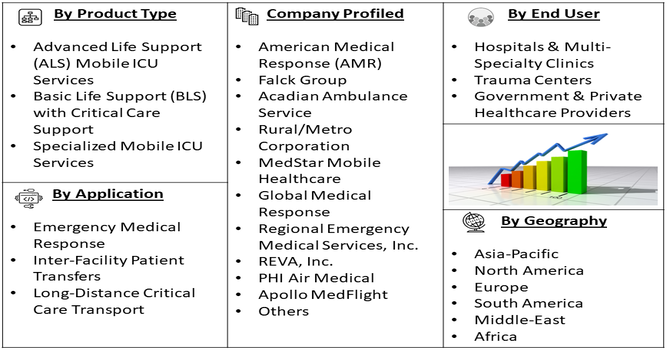
Segmentation: Global Commercial Mobile Intensive Care Unit Service Market is segmented By Service Type (Advanced Life Support (ALS) Mobile ICU Services, Basic Life Support (BLS) with Critical Care Support, Specialized Mobile ICU Services), Mode of Transport (Road Ambulance-Based MICU Services, Air Ambulance-Based MICU Services), Patient Type (Adult Patients, Pediatric Patients, Neonatal Patients), Application (Emergency Medical Response, Inter-Facility Patient Transfers, Long-Distance Critical Care Transport), End User (Hospitals & Multi-Specialty Clinics, Trauma Centers, Government & Private Healthcare Providers), and Geography (North America, Europe, Asia-Pacific, Middle East and Africa, and South America). The report provides the value (in USD million) for the above segments.
For Detailed Market Segmentation - Get a Free Sample PDF
Market Drivers:
A major driver of the Global Commercial Mobile Intensive Care Unit (MICU) Service Market is the increasing incidence of medical emergencies that require immediate and continuous critical care during patient transport.
Growing cases of cardiovascular diseases, trauma injuries, road accidents, and acute respiratory conditions are significantly raising demand for advanced life-support services outside hospital settings. For instance, in March 2025, India’s National Ambulance Services (NAS), under the National Health Mission, operates across 36 States and UTs with BLS, ALS, and innovative ambulance types. Its strategic, population-based allocation improved emergency response and critical care transfers, strengthening the Global Commercial Mobile Intensive Care Unit Service Market with scalable, technology-driven, and accessible mobile ICU solutions worldwide.
Additionally, the rising need for inter-facility transfers of critically ill patients—particularly from smaller healthcare centers to tertiary or super-specialty hospitals—is fueling adoption of commercial MICU services. These mobile units ensure uninterrupted monitoring, ventilation, and life-saving interventions, improving patient outcomes and driving sustained market growth.
The rapid expansion of private healthcare facilities and increasing reliance on outsourced emergency medical services are further driving the commercial MICU service market. For instance, in October 2025, Pristyn Care launched three new super-specialty hospitals in Pune, Indore, and Hyderabad, rapidly expanding its national presence. With this growth, the company surpassed 100 ICU units across India, highlighting its focus on advanced, patient-centric healthcare infrastructure and strengthening critical care capabilities. This expansion boosted the Global Commercial Mobile Intensive Care Unit Service Market by driving private healthcare growth, enhancing emergency care capacity, and encouraging outsourcing of mobile ICU services, improving accessibility, operational efficiency, and quality of critical care delivery across regions.
Commercial providers offer cost-efficient, technologically advanced, and professionally staffed mobile ICUs, making them an attractive option. Rising healthcare expenditure, urbanization, and improved emergency response frameworks—particularly in emerging economies—are accelerating the adoption of commercial MICU services, strengthening overall market growth.
Market Restraints:
The primary restraints in the Global Commercial Mobile Intensive Care Unit (MICU) Service Market is the high cost associated with operating and maintaining advanced mobile ICU units. These services require significant investment in life-support equipment, ventilators, cardiac monitors, infusion pumps, and advanced communication systems, along with continuous maintenance and upgrades. Additionally, staffing MICUs with highly trained critical care physicians, paramedics, and nurses increases labor costs. Fuel expenses, vehicle maintenance, and regulatory compliance further add to operational burdens. These high costs can limit affordability for patients and healthcare providers, especially in price-sensitive regions, thereby restraining broader market adoption.
The Global Commercial Mobile Intensive Care Unit (ICU) Service Market had a significant socioeconomic impact by improving access to advanced critical care, especially during emergencies, disasters, and inter-facility patient transfers. These services reduced pressure on hospital infrastructure while creating specialized employment for medical professionals, paramedics, and technical staff. Mobile ICUs supported timely treatment in remote and underserved areas, helping lower mortality risks and healthcare disparities. However, high service costs often limited access for lower-income populations. Thus, the market contributed to healthcare resilience, emergency preparedness, and innovation in medical transport, while highlighting the need for equitable pricing and broader public–private collaboration worldwide.
Segmental Analysis:
Advanced Life Support (ALS) Mobile ICU Services represent a dominant segment within the Global Commercial Mobile Intensive Care Unit Service Market, owing to their ability to provide high-acuity medical care during patient transport. These units are equipped with advanced life-support equipment such as ventilators, cardiac monitors, defibrillators, and infusion systems, and are staffed by trained critical care professionals. ALS MICU services are widely used for transporting patients with cardiac emergencies, severe trauma, respiratory failure, and other life-threatening conditions. The growing incidence of complex medical emergencies and increasing demand for continuous monitoring during transit are driving the adoption of ALS services. Their critical role in improving patient survival rates makes them a major contributor to overall market value.
Road Ambulance-Based MICU Services account for a substantial share of the market due to their wide availability, cost-effectiveness, and rapid deployment capabilities. These services are essential for urban and semi-urban emergency response and inter-facility transfers, where time-sensitive critical care is required. Road-based MICUs are preferred for short- to medium-distance patient transport and are extensively used by hospitals, trauma centers, and private healthcare providers. Improvements in vehicle design, onboard medical equipment, and real-time communication systems have enhanced service efficiency. As road infrastructure continues to expand and emergency response networks strengthen, road ambulance-based MICU services remain a key segment supporting market growth.
Adult patients constitute the largest patient type segment in the Global Commercial MICU Service Market, driven by the high prevalence of chronic diseases, cardiovascular conditions, trauma cases, and age-related medical emergencies. Adults often require advanced monitoring, respiratory support, and medication administration during transport, increasing reliance on mobile ICU services. The rising aging population globally further contributes to this segment’s growth, as elderly patients frequently need specialized care during inter-hospital transfers. Commercial MICU providers cater extensively to adult patients due to higher service demand and consistent utilization rates. This segment generates significant market value, supported by increasing hospital admissions and emergency medical interventions.
Inter-Facility Patient Transfers represent a critical application segment, driven by the need to move critically ill patients from primary or secondary healthcare centers to tertiary or super-specialty hospitals. Commercial MICU services ensure uninterrupted critical care during these transfers, minimizing risks associated with patient deterioration. Growing specialization in healthcare facilities and uneven distribution of advanced medical infrastructure are increasing the frequency of such transfers. Hospitals increasingly outsource these services to specialized MICU providers to ensure safety and efficiency. The rising number of referrals and patient mobility across healthcare networks makes inter-facility transfers a key revenue-generating application segment.
Hospitals and Multi-Specialty Clinics are the primary end users of commercial MICU services, driven by the need for reliable and efficient critical care transport solutions. These facilities frequently require MICU services for emergency response, patient referrals, and inter-hospital transfers. Outsourcing mobile ICU services allows hospitals to reduce capital expenditure and focus on core clinical operations. Increasing patient inflow, growing complexity of treatments, and the need for advanced care continuity during transport are supporting adoption. As healthcare systems continue to expand and specialize, hospitals and multi-specialty clinics remain key contributors to market demand.
The North America region is expected to witness the highest growth over the forecast period, driven by the presence of advanced healthcare infrastructure, high healthcare expenditure, and strong adoption of emergency medical services. Increasing incidence of chronic diseases, trauma cases, and cardiac emergencies is fueling demand for mobile intensive care units equipped with advanced life-support systems.
In September 2025, Premier, Inc., a leading healthcare technology company, announced its acquisition by an affiliate of Patient Square Capital. The deal, approved unanimously by Premier’s Board, values shares at USD 28.25 each, offering a 23.8% premium over the 60-day average price. The acquisition is expected to strengthen North America’s Commercial Mobile Intensive Care Unit Service Market by enhancing technology integration, improving operational efficiency, and enabling broader adoption of advanced mobile ICU solutions, ultimately supporting more coordinated, data-driven, and scalable critical care delivery across the region.
The region benefits from well-established road and air ambulance networks, telemedicine integration, and trained critical care personnel, enhancing the efficiency and reliability of MICU services. Additionally, growing private healthcare investments, outsourcing of emergency transport services, and rising public awareness of pre-hospital critical care contribute to North America’s leading position in the global market.
| Report Matrics | Details |
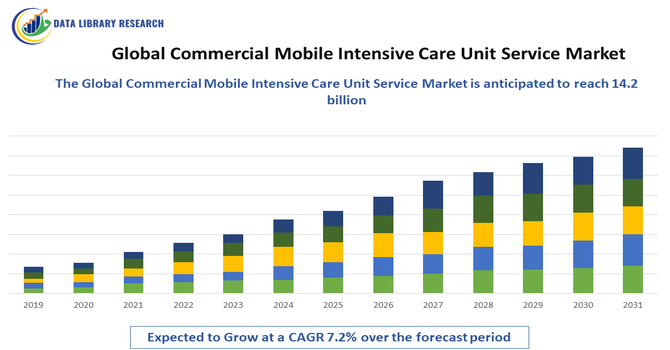
| Market Size Value | USD 14.2 billion |
| Growth Rate | CAGR of 7.2 % |
| Forecast | 2026-2033 |
| Historical data | 2021-2024 |
| Base Year | 2025 |
| Report Coverage | Forecasted revenue, company rating, competitive environment, growth drivers, and trends |
| Segment Coverage | Type, Application, End-User, Geography |
| Regional Scope | North America, Europe, Asia Pacific, Middle East |
| Customized scope | Free customization of reports (With 3 months' Analysis Support ) |
| To Learn More About This Report | Request a Free Sample Copy |
The competitive landscape of the Global Commercial Mobile Intensive Care Unit (MICU) Service Market is highly dynamic, comprising private MICU service providers, emergency medical transport companies, and integrated healthcare service operators. Key players compete by offering advanced life-support equipment, trained critical care staff, rapid response times, and technology-enabled monitoring systems. Strategic collaborations with hospitals, trauma centers, and insurance providers enhance service reach and credibility. Companies are increasingly investing in fleet modernization, telemedicine integration, and regional expansion to capture a larger market share. Market growth is also driven by the differentiation of specialized services for neonatal, pediatric, and adult critical care, as well as by geographic expansion into emerging markets.
The major players for above market are:
Recent Development
Q1. What are the main growth-driving factors for this market?
The market is growing because of the rising need to transport critically ill patients between hospitals for specialized care. As heart disease and trauma cases increase, there is a higher demand for vehicles equipped with ventilators and advanced monitoring. Additionally, government initiatives to improve emergency response times are fueling the expansion of private ambulance fleets.
Q2. What are the main restraining factors for this market?
Growth is limited by the incredibly high cost of equipping and maintaining a vehicle that functions as a rolling hospital room. A global shortage of specialized paramedics and nurses trained in intensive care also makes it difficult to staff these units. Furthermore, strict medical regulations and high insurance premiums for emergency services can discourage new companies from entering.
Q3. Which segment is expected to witness high growth?
The Inter-Hospital Transfer segment is expected to see the highest growth. As healthcare systems become more specialized, patients often need to be moved from small local clinics to large, high-tech surgical centers while remaining on life support. This specialized "facility-to-facility" transport ensures that the most vulnerable patients receive continuous, high-level medical care during the journey.
Q4. Who are the top major players for this market?
The market is led by large-scale private ambulance providers and emergency medical groups. Key players include American Medical Response (AMR), Falck, Acadian Ambulance Service, London Ambulance Service, and Global Medical Response. These organizations dominate by maintaining large fleets of high-tech vehicles and securing long-term contracts with major hospital networks and local governments.
Q5. Which country is the largest player?
The United States is the largest player in the commercial mobile intensive care unit service market. This is due to its highly developed private healthcare sector and the vast distances between specialized medical centers. A strong emphasis on emergency medicine and a high volume of trauma-related patient transfers keep the demand for advanced mobile life-support services consistently high.
Data Library Research are conducted by industry experts who offer insight on industry structure, market segmentations technology assessment and competitive landscape (CL), and penetration, as well as on emerging trends. Their analysis is based on primary interviews (~ 80%) and secondary research (~ 20%) as well as years of professional expertise in their respective industries. Adding to this, by analysing historical trends and current market positions, our analysts predict where the market will be headed for the next five years. Furthermore, the varying trends of segment & categories geographically presented are also studied and the estimated based on the primary & secondary research.
In this particular report from the supply side Data Library Research has conducted primary surveys (interviews) with the key level executives (VP, CEO’s, Marketing Director, Business Development Manager and SOFT) of the companies that active & prominent as well as the midsized organization
FIGURE 1: DLR RESEARH PROCESS
Extensive primary research was conducted to gain a deeper insight of the market and industry performance. The analysis is based on both primary and secondary research as well as years of professional expertise in the respective industries.
In addition to analysing current and historical trends, our analysts predict where the market is headed over the next five years.
It varies by segment for these categories geographically presented in the list of market tables. Speaking about this particular report we have conducted primary surveys (interviews) with the key level executives (VP, CEO’s, Marketing Director, Business Development Manager and many more) of the major players active in the market.
Secondary ResearchSecondary research was mainly used to collect and identify information useful for the extensive, technical, market-oriented, and Friend’s study of the Global Extra Neutral Alcohol. It was also used to obtain key information about major players, market classification and segmentation according to the industry trends, geographical markets, and developments related to the market and technology perspectives. For this study, analysts have gathered information from various credible sources, such as annual reports, sec filings, journals, white papers, SOFT presentations, and company web sites.
Market Size EstimationBoth, top-down and bottom-up approaches were used to estimate and validate the size of the Global market and to estimate the size of various other dependent submarkets in the overall Extra Neutral Alcohol. The key players in the market were identified through secondary research and their market contributions in the respective geographies were determined through primary and secondary research.
Forecast Model