
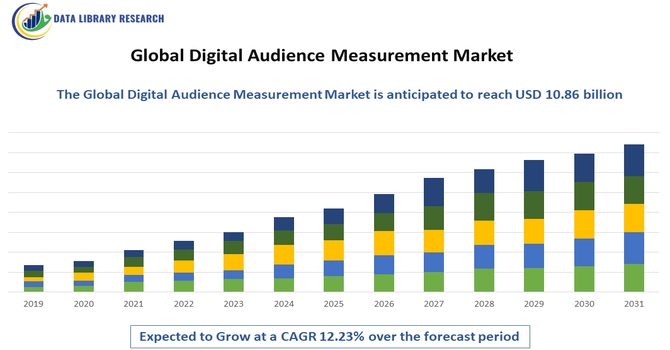
The Global Digital Audience Measurement Market size was estimated at USD 5.97 billion in 2026 and is projected to reach USD 10.86 billion by 2032, growing with a CAGR of 12.23% from 2026-2033.
Get Complete Analysis Of The Report - Download Updated Free Sample PDF
The Global Digital Audience Measurement Market refers to technologies and services that collect, analyze, and report user interaction data across digital platforms to determine audience size, behavior, engagement, and demographics. It supports advertisers, media agencies, publishers, and brands in assessing content performance, optimizing ad spending, and planning strategies across websites, mobile apps, OTT/CTV, and social media. Growing digital content consumption and cross platform media usage have elevated the need for accurate, real time measurement tools that unify fragmented data sources into actionable insights. These solutions help stakeholders understand how audiences interact with digital content, enabling more effective targeting and campaign evaluation.
The global digital audience measurement market is evolving rapidly due to rising demand for cross platform analytics, real time insights, and AI powered attribution models that integrate mobile, web, and streaming data. With smartphone penetration and digital video consumption increasing worldwide, advertisers now prioritize unified audience metrics for holistic campaign evaluation. Measurement tools are being tailored for mobile and OTT environments, responding to shifting user behavior. AI, machine learning, and privacy centric technologies are reshaping how data is collected and analyzed under tightening regulations. Cross device and omnichannel tracking are becoming standard as brands seek granular audience understanding to improve engagement and ROI across campaigns.
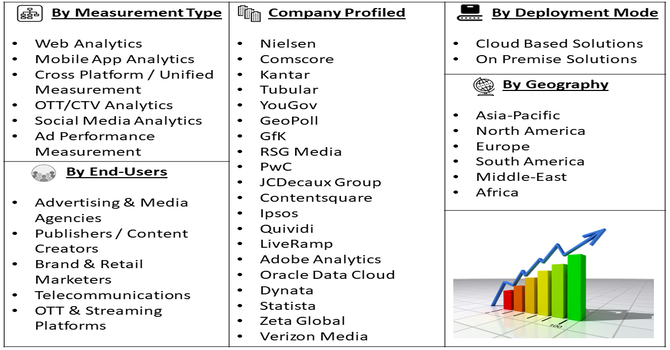
Segmentation: The Global Digital Audience Measurement Market is segmented by Measurement Type (Web Analytics, Mobile App Analytics, Cross Platform / Unified Measurement, OTT/CTV Analytics, Social Media Analytics and Ad Performance Measurement), Data Source (Panel Data, Server Side / Log File Data, Tag Based / Pixel Tracking, SDK/Device Data, Third Party Data Integrations and Cookie Based / Identifier Based Data), Deployment Mode (Cloud Based Solutions and On Premise Solutions), End User Industry (Advertising & Media Agencies, Publishers / Content Creators, Brand & Retail Marketers, Telecommunications, OTT & Streaming Platforms, Market Research Firms and Enterprises (Corporate Analytics)), Organization Size (Large Enterprises and Small & Medium Enterprises (SMEs)), and Geography (North America, Europe, Asia-Pacific, Middle East and Africa, and South America). The report provides the value (in USD million) for the above segments.
For Detailed Market Segmentation - Get a Free Sample PDF
Market Drivers:
Rapid growth in digital media usage—especially mobile, video streaming, and social platforms—has significantly boosted demand for audience measurement tools. Brands and advertisers need precise metrics to understand how users interact with content across devices and channels, helping them optimize content distribution and ad placements. With over half of global media consumption now occurring online, measurement data underpins effective audience targeting and engagement strategies. This trend has fueled investment in cross platform analytics and real time dashboards, moving beyond traditional metrics toward comprehensive user behavior insights. The proliferation of connected devices and multimedia formats continually expands the scope and importance of digital audience measurement solutions.
Programmatic advertising—automated buying and selling of digital ad space—relies heavily on accurate audience data to target users efficiently and optimize spending. Digital audience measurement tools provide the critical metrics needed for real time bidding, segmentation, and personalization. As advertisers shift more budget to programmatic channels, demand for actionable audience insights intensifies, driving market growth. Data driven marketing strategies elevate customer engagement by tailoring content based on behavior analysis. Additionally, advancements in AI and machine learning enhance predictive analytics, enabling marketers to anticipate trends and preferences. This integration of analytics with automated advertising ecosystems positions digital audience measurement as a core enabler of modern marketing.
Market Restraints:
A major restraint on market growth is increasing data privacy concerns and regulatory compliance complexity. Laws like Europe’s GDPR and California’s CCPA limit how audience data can be collected, processed, and used, requiring strict consent mechanisms and data handling practices. These regulations restrict third party tracking and complicate cross device measurement, forcing providers to invest heavily in privacy centric technologies and compliance frameworks. Rising consumer awareness around data rights also reduces willingness to opt into tracking. As firms struggle with consent management and secure data processing, overall measurement accuracy and depth of insights can be impaired, slowing adoption of advanced audience analytics solutions.
Digital audience measurement affects how businesses allocate marketing budgets and engage with consumers, enhancing efficiency and personalization. Accurate audience data enables firms to reduce ad wastage and tailor messaging, ultimately driving revenue growth. This market supports employment in analytics, software development, and media planning sectors. It empowers small and large advertisers alike to compete through data driven strategies. However, growing reliance on tracking raises privacy concerns for consumers and increases compliance burdens for firms, especially under regulations like GDPR and CCPA. Regulatory pressures have encouraged development of privacy focused analytics tools, potentially increasing costs but also building consumer trust in digital services.
Segmental Analysis:
The Social Media Analytics segment is expected to witness the highest growth over the forecast period due to increasing social media usage and the rising demand for real-time insights on audience engagement, brand sentiment, and campaign effectiveness. Businesses, marketers, and advertisers are leveraging platforms such as Facebook, Instagram, Twitter, LinkedIn, and TikTok to monitor user behavior, track brand conversations, and optimize content strategy. Advanced AI-driven analytics, sentiment analysis, and influencer tracking tools enable deeper understanding of target audiences. With digital marketing budgets increasingly shifting to social media, enterprises and agencies are adopting comprehensive analytics solutions, driving significant growth in the social media analytics segment globally.
The Tag-Based / Pixel Tracking segment is projected to witness the highest growth as organizations seek precise, real-time measurement of website and app user interactions. Tags and pixels track clicks, conversions, page views, and user behavior across multiple devices, providing actionable insights for marketing optimization. The growth of programmatic advertising and personalized campaigns relies on accurate tracking technologies to measure ROI and audience engagement. Cloud-based dashboards and integration with analytics platforms enhance the usability of pixel data. Increasing adoption of e-commerce, digital content, and online advertising solutions globally drives demand for tag-based and pixel tracking, making this segment critical in the audience measurement market.
The Cloud-Based Solutions segment is expected to experience the highest growth due to scalability, cost-effectiveness, and real-time accessibility. Cloud deployment enables organizations to process large volumes of cross-platform data without substantial infrastructure investment. Analytics platforms hosted on the cloud facilitate collaboration across geographies, provide faster insights, and support AI-driven predictive analysis. Growing adoption by media agencies, brands, and OTT platforms further drives demand. Subscription and pay-as-you-go pricing models reduce entry barriers for SMEs and startups. Additionally, the integration of cloud-based solutions with mobile and web platforms enhances measurement capabilities, making cloud deployment the preferred model for modern digital audience measurement globally.
The Telecommunications segment is projected to witness the highest growth as telecom companies increasingly rely on digital audience measurement to optimize services, customer engagement, and advertising strategies. Audience analytics helps in understanding user behavior across mobile apps, streaming services, and websites, improving personalization and retention. Telecom operators also leverage data for network planning, content delivery, and cross-promotion of services. The rise of 5G and high-speed connectivity accelerates content consumption, necessitating advanced measurement solutions. Strategic investments in AI-driven analytics, real-time dashboards, and subscriber profiling enable telecom companies to enhance revenue streams and marketing efficiency, driving strong growth in this sector globally.
The SMEs segment is expected to witness the highest growth as smaller organizations increasingly adopt digital audience measurement tools to compete with larger enterprises. Cloud-based, subscription, and pay-per-use models make advanced analytics accessible without heavy capital investment. SMEs leverage insights from website, app, and social media analytics to optimize campaigns, improve customer targeting, and maximize marketing ROI. With growing e-commerce, digital marketing, and content creation among SMEs, data-driven decision-making becomes critical. Flexible, easy-to-use platforms, often integrated with marketing automation tools, enable SMEs to monitor cross-platform engagement and track performance. These trends collectively drive rapid adoption of audience measurement solutions among SMEs worldwide.
The North America region is projected to witness the highest growth over the forecast period due to early adoption of advanced analytics technologies, high digital content consumption, and a robust digital advertising ecosystem.
The presence of major social media platforms, OTT services, and advertising agencies drives demand for accurate audience measurement. For instance, in March 2026, Pod Digital Media’s multi-year partnership with One Venture Group expanded its audience marketplace across 30+ U.S. markets. By enhancing capabilities to track, analyze, and engage high-growth podcast and live event audiences, this collaboration strengthened North America’s digital audience measurement market, enabling more precise targeting and data-driven advertising strategies.
Businesses prioritize real-time, cross-platform insights for campaign optimization, programmatic advertising, and customer personalization. High internet penetration, cloud infrastructure availability, and strong technological innovation facilitate rapid adoption of digital audience measurement solutions. These factors position North America as a key growth driver in the global market, with increasing investments and strategic partnerships supporting expansion.
| Report Matrics | Details |
| Market Size Value | USD 10.86 billion |
| Growth Rate | CAGR of 12.23 % |
| Forecast | 2026-2033 |
| Historical data | 2021-2024 |
| Base Year | 2025 |
| Report Coverage | Forecasted revenue, company rating, competitive environment, growth drivers, and trends |
| Segment Coverage | Type, Application, End-User, Geography |
| Regional Scope | North America, Europe, Asia Pacific, Middle East |
| Customized scope | Free customization of reports (With 3 months Analysis Support ) |
| To Learn More About This Report | Request a Free Sample Copy |
The competitive landscape is moderately fragmented, featuring longstanding measurement firms, global analytics companies, and emerging digital native players. Leaders such as Nielsen and Comscore dominate with comprehensive cross platform solutions, while firms like Kantar, YouGov, and GfK offer broad audience profiling and survey based insights. Specialized players like Tubular and GeoPoll focus on social and mobile measurement niches. Companies compete on data accuracy, technology integration (AI and real time analytics), and cross device tracking capability. Strategic alliances with media agencies and partnerships with ad platforms strengthen service offerings. Innovation in privacy compliant measurement and cloud based real time analytics are key differentiators in an increasingly competitive global market.
The major players are:
Recent Development
Q1. What is the main growth-driving factors for this market?
Market growth is primarily driven by the rising demand for cross-platform measurement as consumers shift between multiple devices and streaming services. The surge in programmatic advertising and the integration of AI-driven real-time analytics are also critical. Furthermore, the global push for transparency in ad spend and the need for cookie less, privacy-compliant identity resolution are accelerating adoption.
Q2. What are the main restraining factors for this market?
Growth is hindered by stringent data privacy regulations (like GDPR and CCPA). Technical complexities in maintaining accurate cross-device identification and the rise of ad-blocking technologies also pose challenges. Additionally, the lack of unified global measurement standards across fragmented media landscapes can complicate large-scale campaigns.
Q3. Which segment is expected to witness high growth ?
The Tag-Based / Pixel Tracking segment was expected to witness the highest growth over the forecast period due to increasing demand for real-time, accurate user behavior data. Tags and pixels enabled precise measurement of clicks, conversions, and engagement across websites and apps, driving adoption among advertisers, marketers, and digital agencies globally.
Q4. Who are the top major players for this market?
The competitive landscape is led by established measurement and data giants, including Nielsen, Kantar, and Comscore. Other major players driving innovation through advanced analytics and specialized data assets include YouGov, GfK (NIQ), Tubular Labs, GeoPoll, and global professional services firms like PwC and RSG Media.
Q5. Which country is the largest player?
The United States is the largest player, accounting for the highest global revenue share due to its advanced ad-tech ecosystem and significant digital ad spend. However, Asia-Pacific is the fastest-growing region, with India and China emerging as dominant hubs driven by massive mobile internet expansion and large-scale digital measurement initiatives.
Data Library Research are conducted by industry experts who offer insight on industry structure, market segmentations technology assessment and competitive landscape (CL), and penetration, as well as on emerging trends. Their analysis is based on primary interviews (~ 80%) and secondary research (~ 20%) as well as years of professional expertise in their respective industries. Adding to this, by analysing historical trends and current market positions, our analysts predict where the market will be headed for the next five years. Furthermore, the varying trends of segment & categories geographically presented are also studied and the estimated based on the primary & secondary research.
In this particular report from the supply side Data Library Research has conducted primary surveys (interviews) with the key level executives (VP, CEO’s, Marketing Director, Business Development Manager and SOFT) of the companies that active & prominent as well as the midsized organization
FIGURE 1: DLR RESEARH PROCESS
Extensive primary research was conducted to gain a deeper insight of the market and industry performance. The analysis is based on both primary and secondary research as well as years of professional expertise in the respective industries.
In addition to analysing current and historical trends, our analysts predict where the market is headed over the next five years.
It varies by segment for these categories geographically presented in the list of market tables. Speaking about this particular report we have conducted primary surveys (interviews) with the key level executives (VP, CEO’s, Marketing Director, Business Development Manager and many more) of the major players active in the market.
Secondary ResearchSecondary research was mainly used to collect and identify information useful for the extensive, technical, market-oriented, and Friend’s study of the Global Extra Neutral Alcohol. It was also used to obtain key information about major players, market classification and segmentation according to the industry trends, geographical markets, and developments related to the market and technology perspectives. For this study, analysts have gathered information from various credible sources, such as annual reports, sec filings, journals, white papers, SOFT presentations, and company web sites.
Market Size EstimationBoth, top-down and bottom-up approaches were used to estimate and validate the size of the Global market and to estimate the size of various other dependent submarkets in the overall Extra Neutral Alcohol. The key players in the market were identified through secondary research and their market contributions in the respective geographies were determined through primary and secondary research.
Forecast Model