
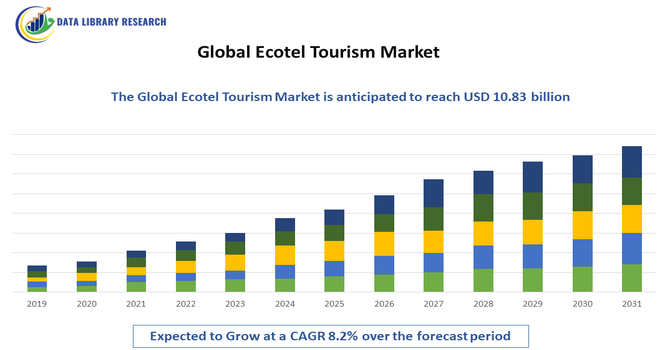
The Global Ecotel Tourism Market size is estimated to grow from USD 0.61 billion in 2026 and is expected to reach to USD 10.83 billion by 2033, growing at a CAGR of 8.2% from 2026-2033.
Get Complete Analysis Of The Report - Download Updated Free Sample PDF
The Global Ecotel Tourism Market is experiencing strong growth driven by increasing consumer preference for sustainable, eco-friendly, and responsible travel experiences. Ecotel tourism focuses on environmentally conscious accommodations such as eco-hotels, eco-lodges, and green resorts that minimize environmental impact while promoting conservation and local community engagement. Rising awareness of climate change, biodiversity protection, and carbon-neutral travel is significantly boosting demand for ecotel-based tourism services across both leisure and business travel segments. Additionally, government initiatives supporting sustainable tourism and the expansion of green hospitality infrastructure are further strengthening market adoption.
The Global Ecotel Tourism Market is witnessing strong evolution driven by rising demand for sustainable, eco-friendly, and low-impact travel experiences. One major trend is the rapid expansion of eco-hotels, green resorts, and eco-lodges that integrate renewable energy systems, waste recycling, and water conservation practices to minimize environmental impact. Another key trend is the growing preference for regenerative tourism, where travelers actively choose destinations that restore ecosystems and support local communities instead of just reducing harm. Digital transformation is also reshaping the market, with increasing use of online booking platforms, AI-based travel planning, and mobile-first ecotel reservations. Additionally, travelers—especially millennials and Gen Z—are showing strong interest in nature-based, off-grid, and wellness-focused stays, while governments and hospitality brands are investing in certified sustainable tourism standards to enhance transparency and credibility in eco-hospitality offerings.
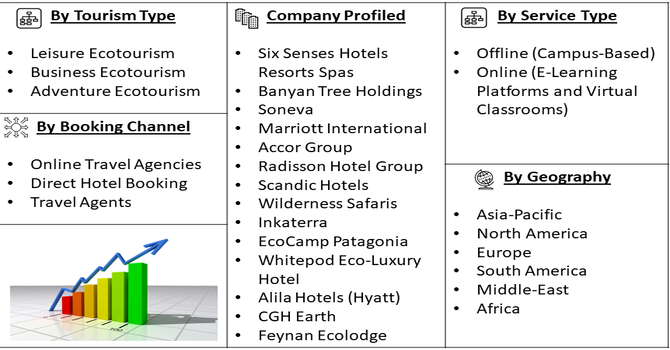
Segmentation: The Global Ecotel Tourism Market is segmented By Type of Accommodation (Eco-Hotels, Eco-Resorts, and Eco-Lodges), Tourism Type (Leisure Ecotourism, Business Ecotourism, and Adventure Ecotourism), By Booking Channel (Online Travel Agencies, Direct Hotel Booking, and Travel Agents), Service Type (Accommodation Services, Transportation Services, and Food & Beverage Services), and Geography (North America, Europe, Asia-Pacific, Middle East and Africa, and South America). The report provides the value (in USD million) for the above segments.
For Detailed Market Segmentation - Get a Free Sample PDF
Market Drivers:
One of the primary drivers of the Global Ecotel Tourism Market is the increasing global demand for sustainable and environmentally responsible travel. Modern travelers, especially millennials and Gen Z, are becoming more conscious of their environmental footprint and prefer accommodation options that prioritize sustainability, energy efficiency, and minimal ecological impact. Ecotel properties, such as eco-hotels and green resorts, use renewable energy sources, water conservation systems, and waste reduction practices, making them highly attractive to eco-conscious tourists. Additionally, growing awareness about climate change and environmental degradation is encouraging travelers to choose destinations that promote conservation and support local ecosystems. This shift in consumer behavior is significantly driving the adoption of ecotel tourism worldwide.
Another key driver is the increasing support from governments and tourism authorities promoting eco-tourism and sustainable hospitality development. Many countries are introducing policies, certifications, and incentives to encourage hotels and resorts to adopt environmentally friendly practices. Investments in eco-tourism infrastructure, such as protected natural parks, eco-resorts, and sustainable transportation networks, are further boosting market growth. Additionally, collaborations between public and private sectors are enhancing awareness and accessibility of ecotel tourism experiences. The expansion of international tourism campaigns focused on green travel destinations is also attracting global travelers. These combined efforts are playing a crucial role in accelerating the growth of the global ecotel tourism market.
Market Restraints:
The major restraints in the Global Ecotel Tourism Market is the high initial investment required to develop and maintain eco-friendly tourism infrastructure. Establishing ecotel facilities involves significant costs related to sustainable construction materials, renewable energy systems, waste management solutions, and eco-certification processes. These expenses can be a major barrier for small and medium-sized hospitality businesses, limiting market entry. Additionally, in many developing and remote regions, the lack of adequate infrastructure such as transportation, utilities, and connectivity restricts the expansion of ecotel tourism. Limited awareness among travelers in some regions regarding eco-tourism benefits further slows adoption. As a result, despite strong demand, high setup costs and infrastructural limitations continue to hinder the rapid growth of the global ecotel tourism market.
The Global Ecotel Tourism Market has a significant socio-economic impact by promoting sustainable development, environmental conservation, and community empowerment. Economically, it generates revenue for local economies through eco-friendly hospitality services, nature-based attractions, and tourism-related employment opportunities. It supports job creation in rural and semi-urban areas, including roles in hospitality, transportation, and eco-tour operations. Socially, ecotel tourism raises awareness about environmental protection and encourages responsible travel behavior among tourists. It also supports local communities by integrating them into tourism activities, preserving cultural heritage, and improving living standards. Additionally, it helps reduce environmental degradation while promoting long-term sustainable tourism development globally.
Segmental Analysis:
The eco-hotels segment holds a significant share in the Global Ecotel Tourism Market due to rising demand for sustainable and environmentally responsible accommodation options. Eco-hotels are designed to minimize environmental impact by using renewable energy sources, energy-efficient systems, water conservation technologies, and sustainable building materials. They appeal strongly to eco-conscious travelers seeking comfortable yet responsible lodging experiences. Increasing awareness of climate change and carbon footprint reduction is further driving demand for eco-hotels across both developed and emerging tourism destinations. Additionally, certifications such as green building standards and eco-labels enhance customer trust and market credibility. The rapid expansion of sustainable hospitality infrastructure continues to strengthen the dominance of eco-hotels in the global market.
The leisure ecotourism segment dominates the Global Ecotel Tourism Market, driven by growing consumer interest in nature-based travel experiences and relaxation in environmentally preserved destinations. Travelers are increasingly seeking vacations that combine comfort with sustainability, such as staying in eco-resorts located in forests, mountains, and coastal areas. This segment benefits from rising awareness of wellness tourism and the desire to escape urban lifestyles. Leisure ecotourism also promotes low-impact travel activities such as hiking, wildlife observation, and cultural immersion. Governments and tourism boards are actively promoting eco-friendly destinations to attract international tourists. The increasing preference for experiential and responsible travel is significantly contributing to the strong growth of this segment globally.
The Online Travel Agencies (OTAs) segment plays a crucial role in the Global Ecotel Tourism Market due to the growing digitalization of the travel industry. OTAs provide travelers with easy access to a wide range of ecotel options, enabling price comparison, reviews, and instant booking convenience. The increasing penetration of smartphones and internet connectivity has significantly boosted online travel bookings. Additionally, OTAs are actively promoting sustainable and eco-friendly accommodations through dedicated filters and eco-certification tags, making it easier for travelers to identify green tourism options. Integration of AI-based recommendation systems and personalized travel planning tools is further enhancing user experience. As digital travel platforms continue to expand, OTAs remain a key driver of ecotel tourism growth worldwide.
The accommodation services segment holds a dominant position in the Global Ecotel Tourism Market, as lodging is the core component of ecotel tourism experiences. This segment includes eco-hotels, eco-resorts, and eco-lodges that prioritize sustainability through energy-efficient operations, waste reduction, and eco-friendly construction practices. The growing preference for environmentally responsible stays among travelers is significantly boosting demand for green accommodation services. Additionally, increasing investments in sustainable hospitality infrastructure and government support for eco-tourism development are further driving segment growth. Hospitality providers are also adopting innovative technologies such as smart energy management systems and water recycling solutions to enhance sustainability. The rising focus on premium eco-luxury experiences is further strengthening the growth of accommodation services in the global market.
North America region is expected to witness the highest growth over the forecast period, driven by increasing demand for sustainable tourism, strong consumer awareness regarding environmental conservation, and rapid expansion of eco-friendly hospitality infrastructure.
The region benefits from well-developed tourism facilities, high disposable income, and a growing preference for experiential and nature-based travel among domestic and international tourists. For instance, in December 2024, Marriott International partnered with Danube Riverside d.o.o. Beograd to introduce the Ritz-Carlton brand in Belgrade, Serbia. Scheduled to open in 2027, the luxury hotel was designed to expand Marriott’s premium hospitality presence in Eastern Europe while offering high-end accommodations, personalized services, and world-class guest experiences in the capital.
Additionally, supportive government initiatives promoting green tourism, carbon-neutral travel, and sustainable hospitality practices are significantly boosting market expansion. The presence of leading hotel chains investing in eco-certified properties and renewable energy adoption further strengthens regional growth. Moreover, rising digitalization in travel booking platforms and increasing promotion of ecotel destinations are accelerating adoption, making North America a key growth hub in the global ecotel tourism market.
| Report Matrics | Details |
| Market Size Value | USD 10.83 billion |
| Growth Rate | CAGR of 8.2 % |
| Forecast | 2026-2033 |
| Historical data | 2021-2024 |
| Base Year | 2025 |
| Report Coverage | Forecasted revenue, company rating, competitive environment, growth drivers, and trends |
| Segment Coverage | Type, Application, End-User, Geography |
| Regional Scope | North America, Europe, Asia Pacific, Middle East |
| Customized scope | Free customization of reports (With 3 months Analysis Support ) |
| To Learn More About This Report | Request a Free Sample Copy |
The Global Ecotel Tourism Market is highly competitive and moderately fragmented, featuring a mix of international hotel chains, luxury eco-resorts, boutique eco-lodges, and specialized sustainable tourism operators. Leading companies are focusing on expanding eco-certified properties, adopting renewable energy solutions, and integrating sustainable hospitality practices such as zero-waste operations and carbon-neutral stays. Strategic partnerships, acquisitions, and destination-based expansions in biodiversity-rich regions are common strategies used to strengthen market presence. Increasing demand from eco-conscious travelers and regulatory pressure for sustainable tourism are further intensifying competition among key players. Additionally, digital platforms and travel aggregators are playing a major role in promoting ecotel offerings globally.
Key Companies:
Recent News
Q1. What are the main growth-driving factors for this market?
The market is primarily driven by rising environmental consciousness among Millennial and Gen Z travelers, with 74% willing to pay more for sustainable stays. Advancements in renewable energy integration within hotels and increasing government support for community-based conservation—such as India’s Amrit Dharohar scheme—are significantly boosting the sector's expansion.
Q2. What are the main restraining factors for this market?
The primary restraints are the high initial capital expenditure required for green building certifications and sustainable technology. Geopolitical instability and global inflationary pressures create financial uncertainty for luxury eco-projects. Additionally, a lack of standardized global "Ecotel" labeling leads to consumer confusion and skepticism regarding genuine sustainability versus "greenwashing."
Q3. Which segment is expected to witness high growth?
The Eco-lodges segment currently captures the majority share due to its focus on immersive, nature-based experiences. However, the Online Booking channel is witnessing the highest growth, fueled by the rise of specialized eco-travel agencies. Geographically, while North America leads, the Asia-Pacific region is emerging as the fastest-growing market.
Q4. Who are the top major players for this market?
The competitive landscape is led by hospitality giants with dedicated sustainability programs, including Accor Group (Planet 21), Marriott International, and Radisson Hotel Group. Other specialized leaders driving innovation include Six Senses Hotels, Scandic Hotels, Banyan Tree, Jetwing Surf, and El Nido Resorts, focusing on zero-waste and carbon-neutral operations.
Q5. Which country is the largest player?
The United States remains the largest country player, with North America commanding approximately 43% of the global market share in 2026. This dominance is supported by a high volume of domestic eco-conscious travelers. Meanwhile, Germany and Switzerland are key European leaders, while China and Costa Rica are significant regional hubs.
Data Library Research are conducted by industry experts who offer insight on industry structure, market segmentations technology assessment and competitive landscape (CL), and penetration, as well as on emerging trends. Their analysis is based on primary interviews (~ 80%) and secondary research (~ 20%) as well as years of professional expertise in their respective industries. Adding to this, by analysing historical trends and current market positions, our analysts predict where the market will be headed for the next five years. Furthermore, the varying trends of segment & categories geographically presented are also studied and the estimated based on the primary & secondary research.
In this particular report from the supply side Data Library Research has conducted primary surveys (interviews) with the key level executives (VP, CEO’s, Marketing Director, Business Development Manager and SOFT) of the companies that active & prominent as well as the midsized organization
FIGURE 1: DLR RESEARH PROCESS
Extensive primary research was conducted to gain a deeper insight of the market and industry performance. The analysis is based on both primary and secondary research as well as years of professional expertise in the respective industries.
In addition to analysing current and historical trends, our analysts predict where the market is headed over the next five years.
It varies by segment for these categories geographically presented in the list of market tables. Speaking about this particular report we have conducted primary surveys (interviews) with the key level executives (VP, CEO’s, Marketing Director, Business Development Manager and many more) of the major players active in the market.
Secondary ResearchSecondary research was mainly used to collect and identify information useful for the extensive, technical, market-oriented, and Friend’s study of the Global Extra Neutral Alcohol. It was also used to obtain key information about major players, market classification and segmentation according to the industry trends, geographical markets, and developments related to the market and technology perspectives. For this study, analysts have gathered information from various credible sources, such as annual reports, sec filings, journals, white papers, SOFT presentations, and company web sites.
Market Size EstimationBoth, top-down and bottom-up approaches were used to estimate and validate the size of the Global market and to estimate the size of various other dependent submarkets in the overall Extra Neutral Alcohol. The key players in the market were identified through secondary research and their market contributions in the respective geographies were determined through primary and secondary research.
Forecast Model