
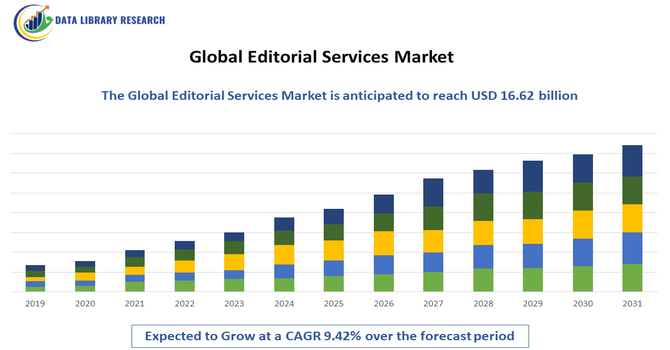
The Global Editorial Services Market is experiencing strong growth, valued at approximately USD 7.57 billion in 2026 and projected to reach USD 16.62 billion by 2033, growing at a 9.42% CAGR from 2026-2033.
 Get Complete Analysis Of The Report - Download Updated Free Sample PDF
The Global Editorial Services Market involves professional services that refine and enhance written content for clarity, accuracy, quality, and publishing readiness. These services include editing (substantive, copyediting, proofreading), formatting, translation, and manuscript support across academic, corporate, and independent authors. They serve authors, publishers, institutions, and businesses aiming to ensure error free, publication ready content. Growth has been driven by digital publishing, rising global research output, and increased demand for high quality English language manuscripts. Online platforms and AI augmented tools have expanded service scalability and accessibility.
The editorial services market has seen rapid technological transformation, primarily through AI powered editing tools that enhance grammar checks, style refinement, plagiarism detection, and turnaround times. Digital, cloud based platforms now dominate delivery, enabling remote collaboration and real time feedback between clients and editors. There’s also increasing demand for specialized services such as scientific editing, translation, and publication support for higher impact academic journals. Geographic growth varies, with North America leading overall spend, while Asia Pacific is the fastest growing regional segment due to rising research output, English language publishing, and higher education expansion. Outsourcing of editorial tasks to professional firms has become common across academia and corporate publishing.
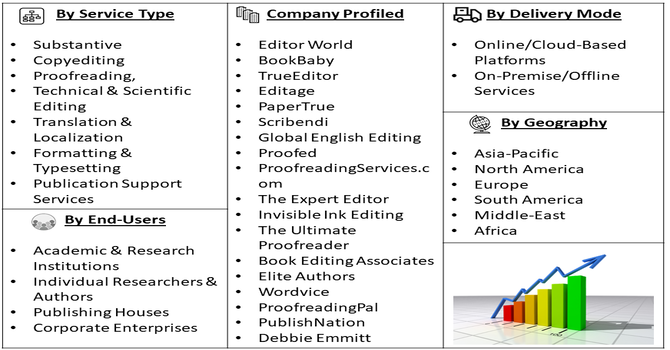
Segmentation: The Global Editorial Services Market is segmented by Service Type (Substantive, Copyediting, Proofreading, Technical & Scientific Editing, Translation & Localization, Formatting & Typesetting and Publication Support Services), End User (Academic & Research Institutions, Individual Researchers & Authors, Publishing Houses, Corporate Enterprises, Media & Communication Companies, and Government & Non-Profit Organization), Delivery Mode (Online/Cloud-Based Platforms and On-Premise/Offline Services), Content Type (Academic Manuscripts & Theses, Books & E-books, Business & Corporate Reports, Marketing & Web Content and Technical Documentation), Language (English-Language Editing and Non-English & Multilingual Editing Services), Enterprise Size (Small & Medium Enterprises (SMEs) and Large Enterprises), and Geography (North America, Europe, Asia-Pacific, Middle East and Africa, and South America). The report provides the value (in USD million) for the above segments.
For Detailed Market Segmentation - Get a Free Sample PDF
Market Drivers:
The rise of digital publishing and online content creation has significantly boosted the editorial services market. As blogs, e-books, corporate reports, and academic content proliferate, professionals increasingly seek editing and refinement services to ensure clarity and credibility. For instance, in February 2026, the release of the e-book by FINN Partners accelerated digital publishing and online content creation in the healthcare sector. It increased demand for specialized editorial services, including AI-integrated writing, data-driven content development, and compliance-focused editing, thereby supporting expansion and innovation within the Global Editorial Services Market.
Cloud-based platforms and online marketplaces offer scalable, remote solutions that connect clients with global editorial talent in real time. Integration of AI and machine learning tools enhances productivity, accuracy, and turnaround speed, making professional services more affordable and accessible. Growth in self-publishing and independent authorship has also broadened the client base, creating new demand beyond traditional academic and corporate segments.
A key driver of the editorial services market is the exponential growth in academic research and publishing activities worldwide.
Universities, research institutes, and scholars face increasing pressure to publish high-quality, peer-reviewed articles in international journals, driving demand for professional editing, proofreading, and manuscript preparation. For instance, in 2025, the launch of the new agent-powered document feature by Grammarly reshaped the Global Editorial Services Market. Its integration of multiple AI agents increased automation in drafting and editing, intensifying competition for traditional editorial providers while simultaneously driving demand for advanced human review, AI-assisted workflows, and quality assurance services.
Non native English speakers particularly lean on editorial services to meet rigorous publication standards. The proliferation of interdisciplinary research and open access publishing further amplifies this trend. As global research output expands across Asia Pacific, Europe, and North America, the need for expert editorial support continues to strengthen, supporting overall market growth and specialized service demand.
Market Restraints:
A significant restraint on market growth is the increasing price competition and rise of AI editing tools that substitute for some traditional editorial services. Free and low cost automated grammar checkers and style tools provide basic editing functions that may deter clients from investing in professional services, particularly for standard content.
Moreover in 2025, regulatory enforcement by the Federal Trade Commission, which required Publishers Clearing House to pay USD 18.5 million in refunds, underscores growing compliance pressures in the Global Editorial Services Market. Heightened scrutiny over misleading promotional practices increases legal risks, operational costs, and marketing restrictions, potentially constraining growth and profitability for industry participants.
The editorial services market plays a vital role in global knowledge dissemination by ensuring quality in academic research, professional reporting, and corporate communications. It supports researchers, authors, and organizations in meeting international standards, contributing to higher publication rates and improved scientific impact. The market also generates employment in editing, proofreading, linguistic translation, and technical writing across global talent pools. Technological adoption and online platforms have expanded opportunities in emerging regions, fostering skill development and economic participation. By enabling clearer communication in science, business, and education, editorial services indirectly boost innovation, uplift academic output, and encourage cross-border knowledge sharing in an increasingly interconnected global economy.
Segmental Analysis:
The Translation & Localization segment was expected to witness the highest growth over the forecast period due to increasing globalization of research, business, and digital content. As organizations expanded across borders, demand for accurate multilingual communication and culturally adapted content rose significantly. Academic researchers sought translation support to publish in international journals, while corporations required localized marketing materials, product documentation, and regulatory content. Growth in e-learning, cross-border publishing, and global digital platforms further strengthened this segment. Advanced language technologies combined with human expertise improved quality and turnaround time. These factors collectively accelerated demand for professional translation and localization services worldwide.
The Publishing Houses segment was expected to witness the highest growth over the forecast period as traditional and digital publishers increasingly outsourced editorial functions. Rising content volumes, faster publishing cycles, and the shift toward digital and open-access formats drove demand for professional editing, proofreading, and formatting services. Publishers sought cost-effective solutions while maintaining high-quality standards, leading to long-term partnerships with editorial service providers. Growth in independent authorship and self-publishing platforms further expanded opportunities for publishing houses. Additionally, increasing demand for multilingual publications and global distribution strengthened reliance on specialized editorial expertise, positioning this segment for sustained expansion.
The Online/Cloud-Based Platforms segment was expected to witness the highest growth over the forecast period due to digital transformation across publishing and content industries. Cloud-based systems enabled real-time collaboration between editors and clients, improved workflow management, and reduced turnaround times. Integration of AI-powered grammar checks and style tools enhanced efficiency while maintaining quality standards. The remote work trend and global freelance networks further accelerated adoption of online platforms. Cost-effectiveness, scalability, and accessibility made cloud-based services attractive to academic institutions, corporations, and independent authors. As digital publishing continued to expand, online platforms remained central to editorial service delivery models.
The Academic Manuscripts & Theses segment was expected to witness the highest growth over the forecast period due to increasing global research output and higher education enrollment. Universities and research institutions emphasized publication in high-impact international journals, driving demand for professional editing and proofreading services. Non-native English-speaking researchers relied heavily on editorial support to meet strict journal standards. Growth in doctoral programs, interdisciplinary research, and open-access publishing further strengthened this segment. Funding agency requirements for high-quality documentation also contributed to demand. As academic competition intensified worldwide, editorial services became essential for improving manuscript acceptance rates and research visibility.
The Small & Medium Enterprises (SMEs) segment was expected to witness the highest growth over the forecast period as SMEs increasingly invested in professional content to strengthen brand credibility and communication. Growing digital marketing activities, website development, and international expansion created demand for editing, proofreading, and localization services. SMEs often lacked in-house editorial teams, making outsourced services cost-effective and scalable. The rise of e-commerce and online business communication further amplified content quality requirements. Additionally, cloud-based editorial platforms provided affordable access to professional services, encouraging SME adoption and significantly contributing to overall market growth.
The North American region was expected to witness the highest growth over the forecast period due to its strong academic research ecosystem, established publishing industry, and advanced digital infrastructure.
The United States and Canada led in research output, corporate communications, and content creation, driving consistent demand for editorial services. High adoption of AI-powered editing tools and cloud platforms further enhanced service efficiency. For instance, in December 2025, Notified announced the launch of Syndicated Articles, a new Content OS workflow capability that expanded the reach of GlobeNewswire press releases across thousands of trusted U.S. news sites and enhanced brand visibility in AI-generated responses. This development strengthened content distribution efficiency and positively influenced growth in the North American Editorial Services Market.
Additionally, the region’s large base of publishing houses, multinational corporations, and independent authors supported sustained market expansion. Continuous innovation in digital publishing and growing emphasis on high-quality communication reinforced North America’s leadership position in the global market.
| Report Matrics | Details |
| Market Size Value | USD 16.62 billion |
| Growth Rate | CAGR of 9.42% |
| Forecast | 2026-2033 |
| Historical data | 2021-2024 |
| Base Year | 2025 |
| Report Coverage | Forecasted revenue, company rating, competitive environment, growth drivers, and trends |
| Segment Coverage | Type, Application, End-User, Geography |
| Regional Scope | North America, Europe, Asia Pacific, Middle East |
| Customized scope | Free customization of reports (With 3 months' analysis support) |
| To Learn More About This Report | Request a Free Sample Copy |
The competitive landscape of the editorial services market is moderately consolidated at the top, with a mix of global leaders and agile niche providers. Established firms such as Editage, Enago, Elsevier Author Services, and American Journal Experts leverage extensive editorial teams, quality assurance frameworks, and global reach. Smaller specialist firms differentiate through niche expertise in academic editing, technical content, or regional language support. Market players compete on service quality, turnaround speed, pricing, and technology integration—especially AI assisted proofreading and workflow platforms. Online delivery platforms have lowered entry barriers, enabling new entrants to scale quickly. Strategic partnerships, mergers, and technology investments are common tactics to capture market share.
The major players for above market are:
Recent Development
Q1. What are the main growth-driving factors for this market?
The primary driver is the explosion of digital content across corporate, academic, and self-publishing sectors. As brands transform into publishers, the need for high-quality, SEO-optimized, and professionally polished material has surged. Additionally, the globalization of business necessitates professional translation and localization editing to ensure cultural relevance across diverse international markets.
Q2. What are the main restraining factors for this market?
The rapid advancement of Generative AI and automated grammar-checking tools poses a significant challenge to traditional editorial roles. Budget constraints in traditional media and the commoditization of freelance labor via low-cost platforms also pressure profit margins. Many organizations are opting for "good enough" automated solutions over premium human-led editorial expertise.
Q3. Which segment is expected to witness high growth?
The Academic Manuscripts & Theses segment was expected to witness the highest growth over the forecast period due to rising global research output and increasing pressure to publish in peer-reviewed journals. Growing enrollment in higher education, especially in emerging economies, and demand for high-quality English-language submissions significantly drove editorial service adoption in this segment.
Q4. Who are the top major players for this market?
The market features a mix of massive publishing conglomerates and specialized service firms. Key players include RELX Group (Elsevier), Thomson Reuters, and Pearson. In the service-specific domain, companies like Enago (Crimson Interactive), Cactus Communications (Editage), and Keywords Studios provide specialized academic and technical editorial services at a global scale.
Q5. Which country is the largest player?
The United States remains the largest player in the editorial services market. This dominance is sustained by its massive media and entertainment industry, a high concentration of leading academic institutions, and a robust corporate sector. The presence of major global publishing houses and a tech-savvy workforce further solidifies its leading position.
Data Library Research are conducted by industry experts who offer insight on industry structure, market segmentations technology assessment and competitive landscape (CL), and penetration, as well as on emerging trends. Their analysis is based on primary interviews (~ 80%) and secondary research (~ 20%) as well as years of professional expertise in their respective industries. Adding to this, by analysing historical trends and current market positions, our analysts predict where the market will be headed for the next five years. Furthermore, the varying trends of segment & categories geographically presented are also studied and the estimated based on the primary & secondary research.
In this particular report from the supply side Data Library Research has conducted primary surveys (interviews) with the key level executives (VP, CEO’s, Marketing Director, Business Development Manager and SOFT) of the companies that active & prominent as well as the midsized organization
FIGURE 1: DLR RESEARH PROCESS
Extensive primary research was conducted to gain a deeper insight of the market and industry performance. The analysis is based on both primary and secondary research as well as years of professional expertise in the respective industries.
In addition to analysing current and historical trends, our analysts predict where the market is headed over the next five years.
It varies by segment for these categories geographically presented in the list of market tables. Speaking about this particular report we have conducted primary surveys (interviews) with the key level executives (VP, CEO’s, Marketing Director, Business Development Manager and many more) of the major players active in the market.
Secondary ResearchSecondary research was mainly used to collect and identify information useful for the extensive, technical, market-oriented, and Friend’s study of the Global Extra Neutral Alcohol. It was also used to obtain key information about major players, market classification and segmentation according to the industry trends, geographical markets, and developments related to the market and technology perspectives. For this study, analysts have gathered information from various credible sources, such as annual reports, sec filings, journals, white papers, SOFT presentations, and company web sites.
Market Size EstimationBoth, top-down and bottom-up approaches were used to estimate and validate the size of the Global market and to estimate the size of various other dependent submarkets in the overall Extra Neutral Alcohol. The key players in the market were identified through secondary research and their market contributions in the respective geographies were determined through primary and secondary research.
Forecast Model