
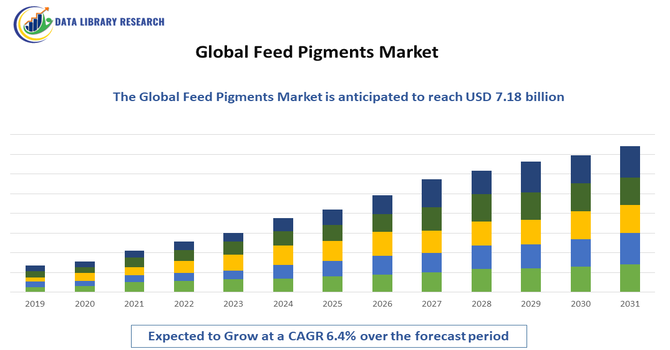
The market was valued at approximately USD 2.35 billion in 2026 and is projected to reach around USD 7.18 billion by 2033, growing at a CAGR of about 6.4% during the forecast period (2026–2033).
 Get Complete Analysis Of The Report - Download Updated Free Sample PDF
Growth is primarily driven by expanding livestock production, increasing consumer preference for naturally pigmented and visually appealing food products, and rising awareness of animal health and nutrition. Additionally, the growing shift toward natural pigments and advancements in feed formulation technologies are supporting market expansion. However, factors such as high production costs of natural pigments and stringent regulatory frameworks may restrain growth. Overall, the market is expected to experience consistent expansion, supported by innovation, rising protein demand, and increasing adoption of functional feed additives globally.
The global feed pigments market is witnessing evolving trends driven by the increasing demand for naturally sourced additives and enhanced animal nutrition. A key trend is the shift from synthetic to natural pigments such as carotenoids, driven by consumer preference for clean-label and chemical-free animal products. The growing aquaculture and poultry industries are also fueling demand for pigments to improve the color and visual appeal of fish, egg yolks, and meat. Additionally, manufacturers are focusing on innovative feed formulations that combine pigmentation with health benefits such as antioxidant properties. Technological advancements in extraction and stabilization of natural pigments are further supporting market growth. Moreover, rising awareness regarding animal welfare and product quality is encouraging the adoption of high-performance feed additives globally.
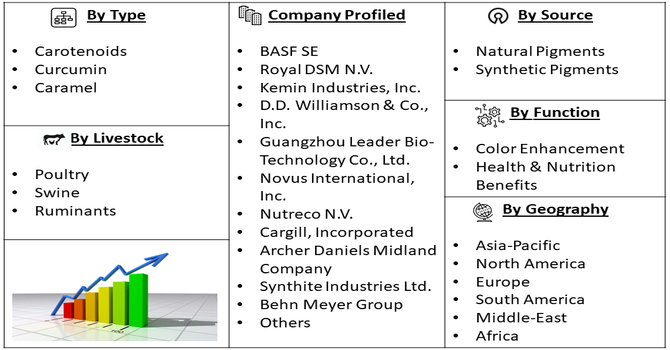
Segmentation: The Global Feed Pigments Market is segmented By Type (Carotenoids, Curcumin, and Caramel), Source (Natural Pigments, and Synthetic Pigments), Livestock (Poultry, Swine, and Ruminants), Function (Color Enhancement and Health & Nutrition Benefits), and Geography (North America, Europe, Asia-Pacific, Middle East and Africa, and South America). The report provides the value (in USD million) for the above segments.
For Detailed Market Segmentation - Get a Free Sample PDF
Market Drivers:
The increasing global consumption of meat, eggs, and aquaculture products is a major driver of the feed pigments market. Consumers are placing greater emphasis on the visual appeal and quality of animal-derived food, particularly the color of egg yolks, poultry skin, and fish flesh. Feed pigments such as carotenoids are widely used to enhance these attributes, making products more attractive and marketable. Additionally, growing awareness about nutrition and food quality is encouraging producers to adopt feed additives that improve both appearance and health benefits. The expansion of the poultry and aquaculture industries, especially in emerging economies, is further fueling demand, thereby driving consistent growth in the feed pigments market globally.
Another key driver is the increasing preference for natural and sustainable feed additives over synthetic alternatives. Consumers are becoming more conscious about food safety and are demanding clean-label animal products, which has led to a surge in the use of natural pigments derived from sources like algae, plants, and spices. These natural pigments not only enhance coloration but also offer additional health benefits such as antioxidant properties, improving animal immunity and overall productivity. Regulatory support for reducing synthetic additives in animal feed is also contributing to this shift. As a result, manufacturers are investing in research and development to produce high-quality natural pigments, boosting market growth.
Market Restraints:
The key restraints in the global feed pigments market are the high cost and limited stability of natural pigments compared to synthetic alternatives. Natural pigments such as carotenoids derived from plants and algae require complex extraction and processing methods, which significantly increase production costs. This makes them less affordable for feed manufacturers, particularly in price-sensitive markets. Additionally, natural pigments are more susceptible to degradation due to heat, light, and oxygen exposure, leading to reduced effectiveness during storage and feed processing. These stability issues can impact product quality and consistency, discouraging widespread adoption. As a result, despite growing demand for natural additives, cost and performance challenges continue to restrain market growth.
The global feed pigments market has a notable socio-economic impact by supporting the livestock and aquaculture industries, which are key sources of income and employment worldwide. The use of feed pigments enhances the quality and market value of animal products, benefiting farmers, producers, and exporters. It also drives growth in related sectors such as feed manufacturing and agricultural supply chains. Additionally, the shift toward natural pigments encourages sustainable farming practices and innovation. However, higher costs of premium pigments can increase production expenses, potentially affecting small-scale farmers, especially in developing regions, thereby influencing overall market accessibility and profitability.
Segmental Analysis:
The carotenoids segment dominates the global feed pigments market due to its wide application in enhancing the color of poultry skin, egg yolks, and aquaculture products. Carotenoids such as astaxanthin and lutein are highly valued for their strong pigmentation properties and additional health benefits, including antioxidant activity. These pigments not only improve visual appeal but also contribute to animal health and productivity. Increasing demand for naturally pigmented animal products is further driving the adoption of carotenoids in feed formulations. The report highlights that this segment accounts for a significant share of the overall market value in USD million, supported by growing usage across poultry and aquaculture industries.
The natural pigments segment is gaining prominence as consumers and regulators increasingly favor clean-label and chemical-free feed additives. Derived from plant, algae, and microbial sources, natural pigments are considered safer and more sustainable compared to synthetic alternatives. They also offer added health benefits such as improved immunity and antioxidant support in livestock. Despite their higher cost, the demand for natural pigments continues to rise due to growing awareness about food safety and environmental sustainability. Manufacturers are investing in advanced extraction and stabilization technologies to improve efficiency. According to the report, natural pigments contribute significantly to the market value measured in USD million.
The poultry segment holds the largest share in the feed pigments market, driven by high global consumption of chicken meat and eggs. Feed pigments are extensively used in poultry to enhance egg yolk color and skin pigmentation, which are key quality parameters for consumers. The growing demand for visually appealing and nutritionally enriched poultry products is encouraging producers to adopt pigment-enriched feed. Additionally, the expansion of commercial poultry farming in emerging economies is further supporting this segment’s growth. The report indicates that the poultry segment accounts for a substantial portion of the overall market value in USD million, making it a key contributor to market expansion.
Color enhancement remains the primary function driving the feed pigments market, as visual appeal plays a crucial role in consumer purchasing decisions. Pigments are widely used to achieve desirable coloration in eggs, meat, and fish, ensuring product consistency and quality. This function is particularly important in competitive retail markets where product appearance directly influences sales. Additionally, consistent coloration helps maintain brand standards and consumer trust. While health benefits are gaining attention, color enhancement continues to dominate due to its immediate and visible impact. The report highlights that this segment contributes a major share to the market value in USD million terms.
Europe region was expected to witness the highest growth over the forecast period due to rising demand for sustainable and natural ingredients across food, feed, pharmaceutical, and nutraceutical industries. Strict environmental regulations and strong support for clean-label products encouraged manufacturers to adopt algae-based and bio-derived carotenoids. Increasing investments in biotechnology, expanding research activities, and growing awareness regarding animal nutrition and food safety further accelerated market expansion.
Moreover, countries such as Germany, France, the Netherlands, and Norway played a major role in innovation and production capacity development. For instance, in January 2025, DSM-Firmenich finalized a USD 45 million expansion of its astaxanthin production facility in Norway. The project introduced advanced bio-encapsulation technologies designed to improve pigment stability and retention, strengthening the company’s production capabilities and supporting increasing global demand for high-performance carotenoid ingredients across feed and nutrition industries.
Additionally, supportive government initiatives promoting sustainable agriculture and reduced dependence on synthetic additives strengthened regional demand, positioning Europe as a rapidly growing market throughout the forecast period.
| Report Matrics | Details |
| Market Size Value | USD 7.18 billion |
| Growth Rate | CAGR of 6.4 % |
| Forecast | 2026-2033 |
| Historical data | 2021-2024 |
| Base Year | 2025 |
| Report Coverage | Forecasted revenue, company rating, competitive environment, growth drivers, and trends |
| Segment Coverage | Type, Application, End-User, Geography |
| Regional Scope | North America, Europe, Asia Pacific, Middle East |
| Customized scope | Free customization of reports (With 3 months Analysis Support ) |
| To Learn More About This Report | Request a Free Sample Copy |
The global feed pigments market is moderately fragmented, with a mix of multinational corporations and regional players competing through innovation, product quality, and strategic expansion. Leading companies focus heavily on research and development to introduce advanced natural and synthetic pigments that enhance both coloration and animal health benefits. Key players are adopting strategies such as mergers, acquisitions, partnerships, and geographic expansion to strengthen their global footprint. The growing demand for natural pigments has intensified competition, pushing companies to invest in sustainable sourcing and improved production technologies. Additionally, strong distribution networks and collaborations with feed manufacturers play a crucial role in maintaining market position. Overall, competition is driven by innovation, regulatory compliance, pricing strategies, and the ability to meet evolving consumer and industry demands.
Key Companies:
Recent News
Q1. What are the main growth-driving factors for this market?
Market growth is primarily driven by the surging demand for high-quality, visually appealing animal products, particularly in poultry and aquaculture. Consumers increasingly associate vibrant yolk and flesh color with freshness and nutrition. Additionally, the shift toward natural pigments that provide antioxidant and immune-system benefits for livestock further accelerates market adoption.
Q2. What are the main restraining factors for this market?
The primary restraints include the high production costs of natural pigments compared to synthetic alternatives, which can limit adoption among price-sensitive manufacturers. Regulatory complexities and approval delays for new feed additives, particularly in Europe, create significant market entry barriers. Additionally, price volatility of raw materials like marigold and algae impacts supply stability.
Q3. Which segment is expected to witness high growth?
The Natural Pigments segment is witnessing the highest growth, driven by the "clean-label" trend and consumer preference for sustainably sourced ingredients. Within livestock, the Aquaculture segment is expanding rapidly, with high demand for astaxanthin to enhance salmon and shrimp coloration. Geographically, the Asia-Pacific region remains the fastest-growing market hub.
Q4. Who are the top major players for this market?
The competitive landscape is led by global nutrition and chemical giants, including BASF SE, Royal DSM, Kemin Industries, and Novus International. Other significant players driving innovation include Phytobiotics, Suntery, Nutrex, and Dohwa, focusing on high-stability carotenoid formulations and plant-derived yellow and red pigments for diverse livestock applications.
Q5. Which country is the largest player?
Germany was expected to witness the highest growth over the forecast period due to strong investments in biotechnology, sustainable feed additives, and natural ingredient development. The country’s advanced manufacturing infrastructure, strict food safety regulations, and rising demand for clean-label and algae-based products supported rapid market expansion across food, feed, and nutraceutical industries.
Data Library Research are conducted by industry experts who offer insight on industry structure, market segmentations technology assessment and competitive landscape (CL), and penetration, as well as on emerging trends. Their analysis is based on primary interviews (~ 80%) and secondary research (~ 20%) as well as years of professional expertise in their respective industries. Adding to this, by analysing historical trends and current market positions, our analysts predict where the market will be headed for the next five years. Furthermore, the varying trends of segment & categories geographically presented are also studied and the estimated based on the primary & secondary research.
In this particular report from the supply side Data Library Research has conducted primary surveys (interviews) with the key level executives (VP, CEO’s, Marketing Director, Business Development Manager and SOFT) of the companies that active & prominent as well as the midsized organization
FIGURE 1: DLR RESEARH PROCESS
Extensive primary research was conducted to gain a deeper insight of the market and industry performance. The analysis is based on both primary and secondary research as well as years of professional expertise in the respective industries.
In addition to analysing current and historical trends, our analysts predict where the market is headed over the next five years.
It varies by segment for these categories geographically presented in the list of market tables. Speaking about this particular report we have conducted primary surveys (interviews) with the key level executives (VP, CEO’s, Marketing Director, Business Development Manager and many more) of the major players active in the market.
Secondary ResearchSecondary research was mainly used to collect and identify information useful for the extensive, technical, market-oriented, and Friend’s study of the Global Extra Neutral Alcohol. It was also used to obtain key information about major players, market classification and segmentation according to the industry trends, geographical markets, and developments related to the market and technology perspectives. For this study, analysts have gathered information from various credible sources, such as annual reports, sec filings, journals, white papers, SOFT presentations, and company web sites.
Market Size EstimationBoth, top-down and bottom-up approaches were used to estimate and validate the size of the Global market and to estimate the size of various other dependent submarkets in the overall Extra Neutral Alcohol. The key players in the market were identified through secondary research and their market contributions in the respective geographies were determined through primary and secondary research.
Forecast Model