
Get Complete Analysis Of The Report - Download Updated Free Sample PDF
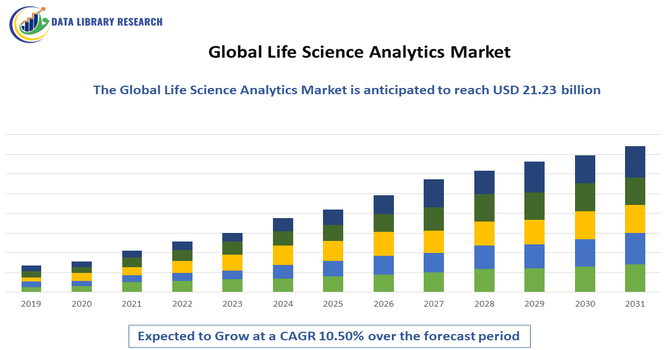
The Global Life Science Analytics Market involves the use of advanced data analytics, artificial intelligence, and computational tools to collect, analyze, and interpret complex biological, clinical, and pharmaceutical data. It enables researchers, healthcare providers, and pharmaceutical companies to make informed decisions in drug discovery, genomics, clinical trials, personalized medicine, and operational efficiency. Growing demand for precision medicine, increasing adoption of digital technologies in life sciences, and the need to optimize R&D productivity are driving market growth. The market also supports regulatory compliance, risk management, and data-driven insights, making analytics critical for innovation, cost reduction, and faster delivery of life science solutions globally.
The Global Life Science Analytics Market is experiencing strong growth driven by increasing adoption of big data analytics, artificial intelligence, and machine learning across healthcare and pharmaceutical sectors. Companies are leveraging real-world evidence, genomics data, and advanced predictive analytics to accelerate drug discovery and improve clinical trial outcomes. Cloud-based analytics platforms, data integration tools, and automation are gaining traction due to scalability and cost efficiency. Additionally, regulatory pressure for data transparency and the growing focus on personalized medicine are shaping market trends.
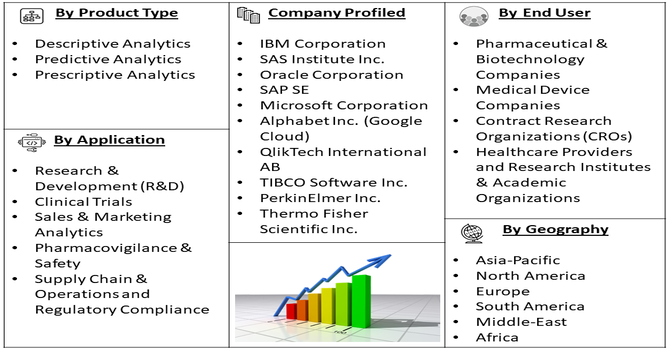
Segmentation: The Global Life Science Analytics Market is segmented by Component (Software and Services), Deployment Mode (On-Premise and Cloud-Based), Application (Research & Development (R&D), Clinical Trials, Sales & Marketing Analytics, Pharmacovigilance & Safety, Supply Chain & Operations and Regulatory Compliance), Data Type (Structured Data, Unstructured Data and Semi-Structured Data), Analytics Type (Descriptive Analytics, Predictive Analytics and Prescriptive Analytics), End User (Pharmaceutical & Biotechnology Companies, Medical Device Companies, Contract Research Organizations (CROs), Healthcare Providers and Research Institutes & Academic Organizations), and Geography (North America, Europe, Asia-Pacific, Middle East and Africa, and South America). The report provides the value (in USD million) for the above segments.
For Detailed Market Segmentation - Get a Free Sample PDF
Market Drivers:
The increasing complexity and cost of drug development have intensified the need for advanced analytics in life sciences. Pharmaceutical and biotechnology companies rely on analytics to optimize drug discovery, accelerate clinical trials, and improve success rates. Life science analytics enables efficient patient recruitment, real-time trial monitoring, biomarker identification, and predictive modeling, reducing development timelines and costs.
In December 2025, Insilico Medicine, successfully listed on the Hong Kong Stock Exchange, becoming the first AI-driven biotech firm to go public on the Main Board under HKEX Chapter 8.05 rules. The IPO raised HKD 2.277 billion, marking the largest biotech fundraising in Hong Kong for the year. As companies seek faster regulatory approvals and improved R&D productivity, demand for sophisticated analytics platforms continues to rise, driving sustained growth in the global life science analytics market.
Rapid advancements in artificial intelligence, machine learning, and big data technologies are significantly driving the life science analytics market. These technologies enable the processing of vast volumes of complex biological, clinical, and patient data with greater accuracy and speed. Cloud-based platforms offer scalability, cost efficiency, and seamless data integration across organizations and geographies. For instance, in January 2025, Microsoft CEO Satya Nadella announced a USD 3 billion investment over two years in cloud and AI infrastructure, including new datacenters. The initiative aimed to boost AI innovation and train 10 million people through ADVANTA(I)GE India, supporting the nation’s long-term competitiveness and digital growth.
AI-driven analytics supports precision medicine, predictive diagnostics, and personalized treatment planning. As healthcare systems increasingly adopt digital transformation strategies, the integration of AI and cloud computing into life science analytics solutions is becoming essential, accelerating market expansion globally.
Market Restraints:
Despite strong growth prospects, data privacy, security concerns, and stringent regulatory requirements remain significant restraints for the life science analytics market. Handling sensitive patient data requires compliance with complex regulations such as HIPAA, GDPR, and other regional data protection laws. Ensuring data security, interoperability, and ethical use of analytics increases operational complexity and costs for organizations. Additionally, variations in regulatory frameworks across countries can delay implementation and adoption of analytics solutions. These challenges may limit widespread deployment, particularly among smaller organizations with limited resources, restraining the overall growth of the global life science analytics market.
Life science analytics plays a critical role in improving healthcare outcomes while reducing overall costs. By enabling faster drug development, optimized clinical trials, and data-driven treatment decisions, analytics helps lower the burden of disease and improve patient quality of life. Early disease detection, precision medicine, and predictive modeling reduce hospitalizations and long-term healthcare expenses. On a broader scale, analytics supports public health planning, workforce productivity, and efficient allocation of healthcare resources. However, disparities in digital infrastructure and data accessibility across regions may limit benefits, highlighting the need for investments in data ecosystems and analytics capabilities worldwide.
Segmental Analysis:
The software segment is expected to witness the highest growth over the forecast period due to increasing reliance on advanced analytics platforms for managing complex life science data. Software solutions enable efficient data integration, visualization, and real-time insights across drug discovery, clinical trials, and commercialization. Growing adoption of AI- and machine learning–enabled analytics tools further supports demand. These platforms help organizations enhance R&D productivity, improve regulatory compliance, and optimize decision-making. Continuous software innovation, scalability, and customization capabilities make analytics software a critical component for life science organizations seeking competitive advantage and operational efficiency.
Cloud-based solutions are projected to experience the highest growth owing to their scalability, flexibility, and cost-effectiveness. Life science organizations increasingly adopt cloud analytics to manage large datasets from genomics, clinical trials, and real-world evidence. Cloud platforms enable seamless collaboration, faster deployment, and secure data sharing across global teams. The shift toward remote research, digital clinical trials, and real-time analytics further accelerates adoption. Additionally, cloud-based solutions support AI-driven analytics and regulatory compliance, making them an attractive option for pharmaceutical and biotechnology companies aiming to enhance innovation while reducing infrastructure and operational costs.
The supply chain and operations segment is expected to witness strong growth as life science companies focus on improving efficiency, resilience, and cost control. Analytics solutions enable real-time tracking, demand forecasting, inventory optimization, and risk management across complex global supply chains. The need to ensure product availability, regulatory compliance, and quality assurance has increased the adoption of data-driven operational analytics. Advanced analytics helps organizations respond quickly to disruptions, reduce waste, and improve decision-making. As pharmaceutical manufacturing and distribution become more complex, analytics-driven supply chain optimization continues to gain strategic importance.
Predictive analytics is anticipated to witness the highest growth due to its ability to forecast outcomes, identify risks, and support proactive decision-making. In life sciences, predictive analytics is widely used for clinical trial optimization, patient stratification, disease progression modeling, and demand forecasting. The integration of AI and machine learning enhances prediction accuracy and actionable insights. Organizations increasingly rely on predictive tools to reduce trial failures, improve patient outcomes, and optimize resource allocation. As data availability and analytical sophistication increase, predictive analytics is becoming a core component of life science analytics strategies.
Pharmaceutical and biotechnology companies are expected to represent the fastest-growing end-user segment as they increasingly adopt analytics to enhance R&D efficiency and commercialization success. Life science analytics supports drug discovery, clinical development, pharmacovigilance, and market access strategies. The need to reduce development costs, accelerate time-to-market, and improve regulatory compliance drives adoption. Additionally, the growing use of real-world evidence and personalized medicine has increased reliance on advanced analytics. As competition intensifies, pharmaceutical and biotech firms continue to invest in analytics platforms to gain deeper insights and maintain a competitive edge.
North America is expected to witness the highest growth over the forecast period due to its advanced healthcare infrastructure, strong presence of pharmaceutical and biotechnology companies, and early adoption of digital technologies. For instance, in October 2024, Oracle launched Oracle Analytics Intelligence for Life Sciences, an AI-powered, cloud-scale data and analytics platform designed to unify disparate datasets into a single intelligent workbench. The solution enabled faster insight generation, supported multidisciplinary research, and integrated seamlessly with Oracle Health and Life Sciences applications, helping organizations identify market needs, evaluate commercial viability, optimize therapeutic launches, and bridge clinical research with clinical care.
Favorable government initiatives, significant R&D investments, and widespread use of AI and cloud-based analytics drive market expansion. For instance, in September 2025, Axtria, an agentic AI–first data analytics and cloud software company serving the global life sciences industry, completed a USD 240 million transaction with Kedaara Capital. The transaction highlighted Kedaara’s commitment to investing in high-quality businesses and underscored Axtria’s strong position at the intersection of AI, innovation, and global life sciences transformation.
Furthermore, the region’s robust regulatory framework supports data-driven innovation while ensuring compliance. Additionally, increasing demand for precision medicine and real-world evidence further fuels analytics adoption, positioning North America as a leading hub for life science analytics development and commercialization.
| Report Matrics | Details |
| Market Size Value | USD 21.23 billion |
| Growth Rate | CAGR of 10.50% |
| Forecast | 2026-2033 |
| Historical data | 2021-2024 |
| Base Year | 2025 |
| Report Coverage | Forecasted revenue, company rating, competitive environment, growth drivers, and trends |
| Segment Coverage | Type, Application, End-User, Geography |
| Regional Scope | North America, Europe, Asia Pacific, Middle East |
| Customized scope | Free customization of reports (With 3 months Analysis Support ) |
| To Learn More About This Report | Request a Free Sample Copy |
The Global Life Science Analytics Market is highly competitive, with major technology firms, healthcare IT providers, and specialized analytics vendors competing for market share. Companies differentiate through advanced AI capabilities, proprietary algorithms, cloud-based platforms, and domain-specific expertise. Strategic partnerships with pharmaceutical companies, research institutions, and healthcare providers are common to expand capabilities and customer reach. Mergers and acquisitions are frequently used to enhance product portfolios and data assets. Emerging startups focusing on genomics, real-world evidence, and AI-driven insights are intensifying competition, pushing established players to continuously innovate and deliver more comprehensive, scalable analytics solutions.
The major players for above market are:
Recent Development
Q1. What are the main growth-driving factors for this market?
The market is growing because pharmaceutical and biotech companies need to process massive amounts of data to speed up drug discovery. Analytics help predict how patients will react to new treatments and improve the efficiency of clinical trials. Additionally, the shift toward "value-based care" is forcing companies to prove their products' effectiveness.
Q2. What are the main restraining factors for this market?
Growth is limited by the high cost of advanced analytics software and a shortage of skilled data scientists who understand life sciences. Concerns about patient data privacy and the risk of cyberattacks also slow down adoption. Furthermore, integrating new digital tools with old, legacy computer systems in hospitals can be very difficult.
Q3. Which segment is expected to witness high growth?
The Predictive Analytics segment is expected to witness the highest growth over the forecast period, driven by increasing demand for data-driven decision-making, enhanced forecasting accuracy, and optimized operational efficiency in life sciences.
Q4. Who are the top major players for this market?
The market is led by global technology leaders and specialized consulting firms. Key players include Oracle, IBM, SAS Institute, Accenture, and IQVIA. These companies dominate by offering powerful cloud-based platforms that help drug makers analyze everything from laboratory research results to the daily performance of their global sales teams.
Q5. Which country is the largest player?
The United States is the largest player in the life science analytics market. This is due to its massive pharmaceutical industry, high healthcare spending, and early adoption of digital technologies. The presence of leading tech hubs and a strong focus on personalized medicine keeps the U.S. at the global forefront.
Data Library Research are conducted by industry experts who offer insight on industry structure, market segmentations technology assessment and competitive landscape (CL), and penetration, as well as on emerging trends. Their analysis is based on primary interviews (~ 80%) and secondary research (~ 20%) as well as years of professional expertise in their respective industries. Adding to this, by analysing historical trends and current market positions, our analysts predict where the market will be headed for the next five years. Furthermore, the varying trends of segment & categories geographically presented are also studied and the estimated based on the primary & secondary research.
In this particular report from the supply side Data Library Research has conducted primary surveys (interviews) with the key level executives (VP, CEO’s, Marketing Director, Business Development Manager and SOFT) of the companies that active & prominent as well as the midsized organization
FIGURE 1: DLR RESEARH PROCESS
Extensive primary research was conducted to gain a deeper insight of the market and industry performance. The analysis is based on both primary and secondary research as well as years of professional expertise in the respective industries.
In addition to analysing current and historical trends, our analysts predict where the market is headed over the next five years.
It varies by segment for these categories geographically presented in the list of market tables. Speaking about this particular report we have conducted primary surveys (interviews) with the key level executives (VP, CEO’s, Marketing Director, Business Development Manager and many more) of the major players active in the market.
Secondary ResearchSecondary research was mainly used to collect and identify information useful for the extensive, technical, market-oriented, and Friend’s study of the Global Extra Neutral Alcohol. It was also used to obtain key information about major players, market classification and segmentation according to the industry trends, geographical markets, and developments related to the market and technology perspectives. For this study, analysts have gathered information from various credible sources, such as annual reports, sec filings, journals, white papers, SOFT presentations, and company web sites.
Market Size EstimationBoth, top-down and bottom-up approaches were used to estimate and validate the size of the Global market and to estimate the size of various other dependent submarkets in the overall Extra Neutral Alcohol. The key players in the market were identified through secondary research and their market contributions in the respective geographies were determined through primary and secondary research.
Forecast Model