
Get Complete Analysis Of The Report - Download Updated Free Sample PDF
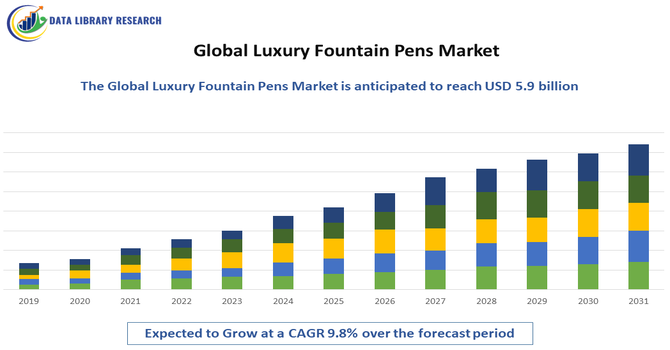
The growth of the Global Luxury Fountain Pens Market is primarily driven by rising disposable incomes, increasing appreciation for craftsmanship, and a resurgence of interest in traditional handwriting and calligraphy. Consumers across emerging economies, particularly in Asia-Pacific, are embracing luxury pens as symbols of status, sophistication, and personal expression. Additionally, the growing trend of gifting premium writing instruments for corporate and personal occasions, along with the popularity of limited-edition and customizable designs, is fueling market expansion. Sustainability trends and innovations in materials—such as refillable systems and eco-friendly components—are also attracting modern consumers seeking both elegance and responsibility. As a result, the market is expected to witness robust growth over the forecast period.
The luxury fountain pen market is being reshaped by several key trends. There’s a strong move toward personalization and customization, with buyers seeking bespoke nibs, engravings, finishes, and limited-edition models. Sustainability is another big one: eco-friendly materials (recycled resins, sustainable woods), refillable ink systems, and greener packaging are increasingly expected. Brands are also incorporating innovative design & materials, such as novel resins, exotic metals, and hybrid functions (stylus tips, etc.) to appeal both as writing tools and status symbols. Moreover, online retail and direct-to-consumer channels are expanding rapidly, giving brands broader reach and consumers more access. Finally, emerging markets—especially in Asia-Pacific—are fueling much of the growth, as rising incomes and luxury consumption drive demand for premium writing instruments.
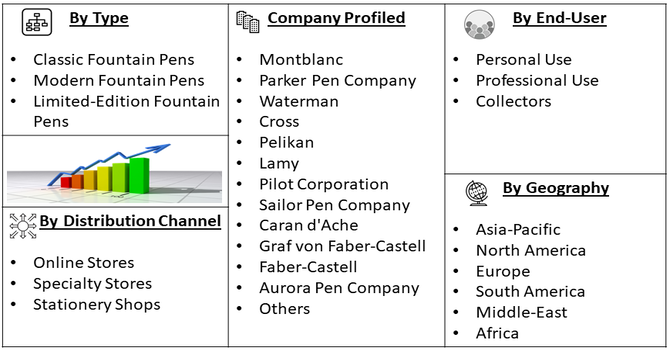
Segmentation: Global Luxury Fountain Pens Market is segmented By Product Type (Classic Fountain Pens, Modern Fountain Pens, Limited-Edition Fountain Pens), Nib Material (Gold, Stainless Steel, Titanium), Distribution Channel (Online Stores, Specialty Stores, Stationery Shops), End-User Segment (Personal Use, Professional Use, Collectors), and Geography (North America, Europe, Asia-Pacific, Middle East and Africa, and South America). The report provides the value (in USD million) for the above segments.
For Detailed Market Segmentation - Get a Free Sample PDF
Market Drivers:
The increasing disposable incomes of consumers, especially in emerging economies such as China, India, and other Asia-Pacific countries, are driving demand for luxury goods, including high-end writing instruments. As more consumers view luxury fountain pens as status symbols and lifestyle accessories, the market continues to expand. Additionally, the growing culture of gifting premium items for corporate and personal occasions further supports this demand surge.
Consumers are showing a strong inclination toward products that reflect individuality, exclusivity, and artistic craftsmanship. Luxury fountain pen manufacturers are capitalizing on this trend by offering limited-edition models, handcrafted designs, and customized nibs or engravings. The emphasis on design aesthetics, material quality, and heritage craftsmanship enhances product appeal and fuels market growth across both collectors and professionals.
Market Restraints:
High price points make these pens less accessible to average consumers, especially in emerging or price-sensitive markets many consider luxury fountain pens discretionary purchases. The shift toward digital communication and handwritten alternatives (typing, tablets, digital signatures) has reduced daily usage of traditional writing instruments. Additionally, maintenance requirements (ink refills, cleaning, proper storage) add friction for casual users who prefer low-maintenance solutions. Counterfeit and imitation products undermine brand integrity and erode consumer trust, especially when purchasing pens online. Finally, rising material and labour costs (for precious metals, exotic woods, skilled craftsmanship) plus supply chain disruptions can hike production costs, which then translate to higher retail prices further tightening the market.
The luxury fountain pen market influences socio-economic dynamics by driving demand for skilled artisans, supporting heritage craftsmanship, and fostering niche employment in design, manufacturing, and retail sectors. It contributes to cultural preservation through traditional techniques while reflecting social stratification, as ownership often signifies status, education, and affluence. Additionally, the market promotes global trade in premium goods, stimulates tourism through exclusive brand boutiques, and supports sustainable luxury initiatives, appealing to consumers valuing artistry and ethical production within the modern economy.
Segmental Analysis:
The limited-edition fountain pens segment is expected to dominate the market during the forecast period, as collectors and enthusiasts increasingly seek exclusive, handcrafted pieces that reflect prestige and individuality. These pens are often made with premium materials like gold, platinum, or rare resins and feature unique designs or collaborations with artists and luxury brands. Their rarity and investment value appeal to high-end consumers, fueling steady demand from both established and emerging markets.
The gold nib segment holds a significant share of the luxury fountain pen market, driven by its superior writing performance, durability, and aesthetic value. Gold nibs offer flexibility and a smoother writing experience compared to other materials, making them highly desirable among professionals and collectors. Additionally, the luxurious appearance and corrosion resistance of gold further enhance its demand in premium and custom-designed pens.
Online stores are emerging as the fastest-growing distribution channel for luxury fountain pens, supported by the expansion of e-commerce platforms and the convenience of digital shopping. Consumers are increasingly purchasing high-end pens online due to broader product availability, ease of comparison, and access to global luxury brands. Furthermore, online exclusive launches and virtual customization options are attracting younger, tech-savvy buyers and expanding brand reach beyond traditional retail networks.
The collectors segment represents a vital share of the luxury fountain pen market, driven by the emotional and investment value associated with limited editions and heritage craftsmanship. Collectors often view fountain pens as timeless art pieces and symbols of legacy, leading to consistent demand for rare models and collaborations. Luxury pen brands cater to this segment by releasing commemorative editions and partnering with artists, resulting in strong brand loyalty and sustained market interest.
The North America region is expected to witness the highest growth over the forecast period in the Global Luxury Fountain Pens Market, driven by a strong culture of luxury consumption, high disposable income levels, and an increasing appreciation for fine craftsmanship and premium writing instruments. The growing trend of gifting luxury pens for corporate and personal occasions, coupled with the resurgence of interest in handwriting, journaling, and calligraphy, is fueling market expansion across the region. Additionally, the presence of established luxury brands, well-developed retail networks, and a rapidly expanding online sales channel are enhancing product accessibility. The U.S. and Canada, in particular, are witnessing growing demand from both professionals and collectors, making North America a key contributor to the global market’s growth trajectory.
| Report Matrics | Details |
| Market Size Value | USD 5.9 billion |
| Growth Rate | CAGR of 9.8% |
| Forecast | 2026-2033 |
| Historical data | 2021-2024 |
| Base Year | 2025 |
| Report Coverage | Forecasted revenue, company rating, competitive environment, growth drivers, and trends |
| Segment Coverage | Type, Application, End-User, Geography |
| Regional Scope | North America, Europe, Asia Pacific, Middle East |
| Customized scope | Free customization of reports (With 3 months Analysis Support ) |
| To Learn More About This Report | Request a Free Sample Copy |
The global luxury fountain pens market is characterized by a blend of heritage brands, innovative newcomers, and specialized artisans, each contributing to the sector's dynamic growth. Established companies like Montblanc, known for its Meisterstück collection, continue to lead with timeless designs and craftsmanship. Brands such as Parker, Waterman, and Cross offer a range of luxury writing instruments that appeal to both traditional and contemporary tastes. Emerging players and boutique manufacturers, including Ranga Pens and Gama Pens, are gaining recognition for their handcrafted, customizable pens that cater to niche markets and collectors. Additionally, companies like Scriveiner and Highlander Pen are introducing modern aesthetics and personalization options, attracting a younger demographic seeking unique and high-quality writing instruments.
Key players:
Recent Development
Q1. What the main growth driving factors for this market?
The main growth driving factors for the luxury fountain pen market are the rising disposable incomes globally, especially in emerging economies, and the pens' status as a symbol of wealth and prestige. There is a notable resurgence of interest in fine writing, calligraphy, and journaling, which appeals to consumers seeking a "digital detox" and a more tactile, expressive form of communication. Furthermore, the market is significantly boosted by the gifting culture, where luxury pens are favored as premium corporate gifts and personal milestones presents. The appreciation for exquisite craftsmanship, heritage, and limited-edition collector items also strongly fuels demand.
Q2. What are the main restraining factors for this market?
The primary restraining factor is the pervasive rise of digital communication and devices, which has significantly reduced the practical necessity for traditional writing instruments like fountain pens for daily tasks. Additionally, the high cost associated with luxury fountain pens limits their market appeal to a niche segment of affluent consumers. Counterfeit products pose a serious threat, as they damage brand reputation and consumer trust, forcing genuine manufacturers to invest heavily in anti-counterfeiting measures. Finally, the high maintenance requirements and limited availability of specialized inks and accessories in certain regions can act as a deterrent for potential buyers.
Q3. Which segment is expected to witness high growth?
The Asia-Pacific region is expected to witness the highest growth in the luxury fountain pen market, driven by its rapidly expanding middle class and increasing consumer spending on luxury goods, particularly in countries like China and India. In terms of product type, the High-End and Ultra-Luxury segments, which include limited-edition and bespoke collector items, are projected for significant expansion. This is due to a growing collector community and the pens' perceived value as an investment or heirloom piece. The e-commerce/online channel is also forecast to experience rapid growth, providing wider access to the global luxury consumer base.
Q4. Who are the top major players for this market?
The global luxury fountain pen market is dominated by several well-established, heritage brands renowned for their craftsmanship and quality. The top major players include Montblanc, which is often cited as a market leader, famous for its Meisterstück collection. Other key competitors are Parker, known for its rich history and popular collections; Cross, recognized for its reliable writing instruments; and Lamy, a prominent German manufacturer celebrated for its modern design and functionality. Furthermore, brands like Waterman and Sheaffer also maintain a strong presence, competing through innovation in design and material.
Q5. Which country is the largest player?
Europe is considered the largest player and the historic hub for the luxury fountain pen market. Countries like Germany, Italy, France, and the United Kingdom have a strong industrial base, deeply-rooted traditions of fine pen manufacturing, and a high concentration of affluent consumers. For instance, reports often highlight that European countries, particularly Germany and Italy, collectively produce a significant majority of high-end models sold worldwide. This strong regional legacy, combined with a persistent culture of appreciation for artisanal luxury goods, firmly establishes Europe's dominant position in the global market.
Data Library Research are conducted by industry experts who offer insight on industry structure, market segmentations technology assessment and competitive landscape (CL), and penetration, as well as on emerging trends. Their analysis is based on primary interviews (~ 80%) and secondary research (~ 20%) as well as years of professional expertise in their respective industries. Adding to this, by analysing historical trends and current market positions, our analysts predict where the market will be headed for the next five years. Furthermore, the varying trends of segment & categories geographically presented are also studied and the estimated based on the primary & secondary research.
In this particular report from the supply side Data Library Research has conducted primary surveys (interviews) with the key level executives (VP, CEO’s, Marketing Director, Business Development Manager and SOFT) of the companies that active & prominent as well as the midsized organization
FIGURE 1: DLR RESEARH PROCESS
Extensive primary research was conducted to gain a deeper insight of the market and industry performance. The analysis is based on both primary and secondary research as well as years of professional expertise in the respective industries.
In addition to analysing current and historical trends, our analysts predict where the market is headed over the next five years.
It varies by segment for these categories geographically presented in the list of market tables. Speaking about this particular report we have conducted primary surveys (interviews) with the key level executives (VP, CEO’s, Marketing Director, Business Development Manager and many more) of the major players active in the market.
Secondary ResearchSecondary research was mainly used to collect and identify information useful for the extensive, technical, market-oriented, and Friend’s study of the Global Extra Neutral Alcohol. It was also used to obtain key information about major players, market classification and segmentation according to the industry trends, geographical markets, and developments related to the market and technology perspectives. For this study, analysts have gathered information from various credible sources, such as annual reports, sec filings, journals, white papers, SOFT presentations, and company web sites.
Market Size EstimationBoth, top-down and bottom-up approaches were used to estimate and validate the size of the Global market and to estimate the size of various other dependent submarkets in the overall Extra Neutral Alcohol. The key players in the market were identified through secondary research and their market contributions in the respective geographies were determined through primary and secondary research.
Forecast Model