
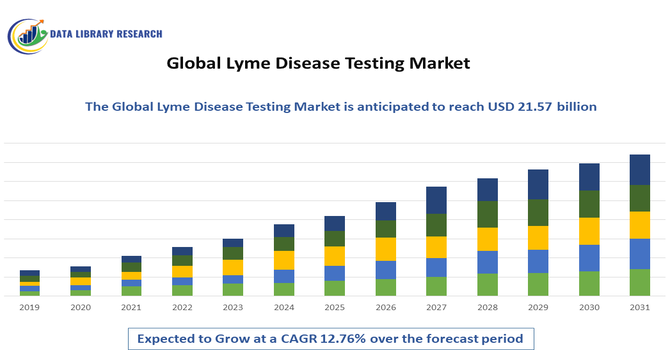
The Global Lyme Disease Testing Market size was estimated at USD 12.25 billion in 2026 and is projected to reach USD 21.57 billion by 2033, growing with a CAGR of 12.76% from 2026-2033.
Get Complete Analysis Of The Report - Download Updated Free Sample PDF
The Global Lyme Disease Testing Market involves diagnostic services and technologies used to detect Lyme disease, a tick-borne bacterial infection primarily caused by Borrelia burgdorferi. This market includes serological tests such as ELISA and Western blot, molecular assays like PCR, and emerging diagnostics that improve early detection and accuracy. Demand is driven by increasing Lyme disease incidence, broader geographic spread of tick vectors, heightened public and clinical awareness, and growing healthcare infrastructure supporting infectious disease testing.
The Lyme Disease Testing Market is evolving through technological advancements and diagnostic innovation. Traditional serological methods such as ELISA and Western blot remain dominant, but emerging platforms like IGRA assays, multiplex pathogen panels, and rapid point-of-care solutions are gaining traction for improved sensitivity and early detection. Integration with digital healthcare systems and AI-assisted interpretation is increasing test accuracy and workflow efficiency. Additionally, expanding at-home test offerings and decentralized testing options are improving accessibility, particularly in rural and underserved regions. Thus, there’s a shift from lab-dependent diagnostics toward more integrated, accessible, and high-precision tools.
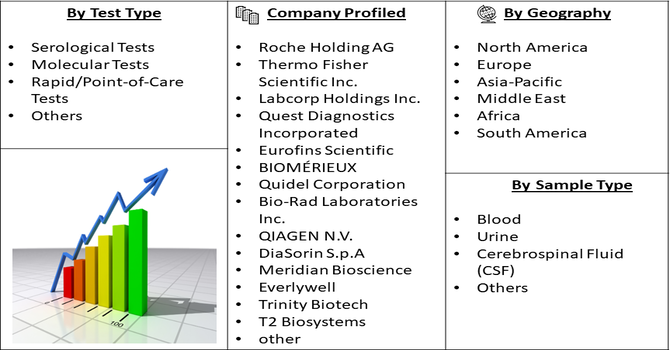
Segmentation: The Lyme Disease Testing Market is segmented by Test Type (Serological Tests (ELISA (Enzyme-Linked Immunosorbent Assay), Western Blots)), Molecular Tests, Rapid/Point-of-Care Tests and Others), Sample Type (Blood, Urine, Cerebrospinal Fluid (CSF) and Others), and Geography (North America, Europe, Asia-Pacific, Middle East and Africa, and South America). The report provides the value (in USD million) for the above segments.
For Detailed Market Segmentation - Get a Free Sample PDF
Market Drivers:
A primary driver for the Global Lyme Disease Testing Market is the increasing incidence and geographic expansion of Lyme disease. For instance, in 2022, WHO reported that Lyme disease has a significant global presence, with estimates around 14.5% (roughly 1 in 7) of the world's population has been infected, though actual reported cases are lower due to underdiagnosis, with highest infection rates in Europe and Asia.
Climate change, warmer winters, and expanding habitats for ticks have led to higher infection rates in both traditional endemic areas and new regions. This growth in cases raises demand for diagnostic testing to confirm infection and guide early treatment. Public health surveillance efforts and awareness campaigns also encourage more people to seek testing after tick exposure or symptom onset. As a result, healthcare providers and laboratories are investing in more diagnostic capacity, driving market growth globally.
Technological advancements in diagnostic tools are significantly boosting the Lyme Disease Testing Market. Newer methods such as improved serological assays, multiplex testing, PCR-based molecular diagnostics, and rapid point-of-care platforms offer better sensitivity, specificity, and faster results. These innovations support early detection, which is crucial to prevent chronic complications. Integration with digital health systems and AI-assisted interpretation further enhances diagnostic accuracy and workflow efficiency.
In November 2025, A new one-step serologic test for Lyme disease, published in the Journal of Clinical Microbiology, promised faster and simpler diagnosis by replacing the CDC’s two-step method. This breakthrough supported earlier detection and broader clinical adoption, boosting demand for advanced serologic diagnostics. As a result, the Global Lyme Disease Testing Market experienced increased momentum toward streamlined, high-efficiency testing solutions. As laboratories and healthcare providers adopt these advanced tests, demand increases, driving market expansion and encouraging ongoing research and development in Lyme disease diagnostics.
Market Restraints
A key restraint for the Global Lyme Disease Testing Market is the risk of false negatives and false positives, especially during early infection stages. Serological tests may not detect antibodies immediately after exposure, while cross-reactivity with other infections can lead to inaccurate results. These diagnostic limitations create uncertainty for clinicians and patients, sometimes resulting in delayed treatment or unnecessary therapies. Additionally, the lack of standardized testing protocols and varying regulatory requirements across regions complicate market adoption. This uncertainty can hinder confidence in testing, limiting widespread use and slowing market growth despite rising disease incidence.
The Global Lyme Disease Testing Market has notable socioeconomic impacts by enhancing public health outcomes and reducing long-term healthcare burdens. Early and accurate diagnosis minimizes disease progression, decreasing costs related to chronic complications such as neurological or joint issues. Improved testing supports more efficient use of healthcare resources and reduces misdiagnosis, fostering better patient care and workforce productivity. However, disparities in testing access and reimbursement limitations can affect underserved populations, underscoring the need for broader healthcare coverage and affordability. Public health surveillance benefits from expanded testing, enabling better disease tracking and prevention strategies in endemic and emerging regions.
Segmental Analysis:
The IFA (Immunofluorescence Assay) segment is expected to witness the highest growth over the forecast period due to its enhanced sensitivity and ability to detect early-stage Lyme disease infections. IFA tests can identify antibodies with higher accuracy compared to traditional methods, making them valuable in confirming suspected cases where symptoms are unclear. As awareness about Lyme disease increases globally, clinicians and laboratories are seeking more reliable diagnostic tools that can provide quicker and more accurate results. Additionally, advancements in fluorescent labeling and automated imaging systems have improved test efficiency and scalability. The growing adoption of advanced diagnostic platforms in hospitals and specialized laboratories is further driving demand for IFA-based testing.
The Cerebrospinal Fluid (CSF) segment is projected to witness the highest growth over the forecast period due to rising cases of neurological Lyme disease and associated complications. CSF testing is crucial for diagnosing neuroborreliosis, especially when patients exhibit symptoms such as meningitis, facial palsy, or severe neurological disturbances. As Lyme disease spreads into new regions, more patients are presenting with advanced stages that require detailed clinical evaluation and confirmation. Hospitals and specialized diagnostic centers are increasingly using CSF-based testing to accurately identify infection in the nervous system, supporting timely and targeted treatment. Improved laboratory capabilities and growing awareness of neurological manifestations are boosting demand for CSF diagnostics.
North America is expected to witness the highest growth over the forecast period, driven by a high prevalence of Lyme disease and strong diagnostic infrastructure. The United States and Canada are among the most affected regions, with expanding tick populations and increased reporting of Lyme cases. This has led to greater demand for diagnostic testing and improved surveillance programs.
In December 2025, The U.S. Department of Health and Human Services (HHS) held a roundtable on Lyme disease diagnostics and clinical needs, led by Secretary Robert F. Kennedy Jr. This event, part of the Make America Healthy Again Commission Strategy Report, aimed to address long-standing gaps in testing and care. Secretary Kennedy emphasized the need for reliable diagnostics and treatment grounded in patient experiences.
Additionally, North America hosts major diagnostic manufacturers and advanced laboratory networks that support the adoption of innovative testing technologies. Public awareness campaigns and government initiatives for early diagnosis further enhance market growth. As healthcare systems prioritize accurate detection and management of Lyme disease, the region remains a leading market for diagnostic solutions.
| Report Matrics | Details |
| Market Size Value | USD 21.57 billion |
| Growth Rate | CAGR of 12.76% |
| Forecast | 2026-2033 |
| Historical data | 2021-2024 |
| Base Year | 2025 |
| Report Coverage | Forecasted revenue, company rating, competitive environment, growth drivers, and trends |
| Segment Coverage | Type, Application, End-User, Geography |
| Regional Scope | North America, Europe, Asia Pacific, Middle East |
| Customized scope | Free customization of reports (With 3 months Analysis Support ) |
| To Learn More About This Report | Request a Free Sample Copy |
The competitive landscape of the Lyme Disease Testing Market includes established diagnostics manufacturers, specialized test kit providers, and laboratory service companies. Key global players focus on expanding their portfolios with high-accuracy assays, automated platforms, and novel diagnostic technologies to differentiate offerings. Strategic partnerships, mergers, and collaborations with research institutions enhance innovation, clinical validation, and market reach. Companies also invest in regulatory approvals and awareness campaigns to strengthen brand recognition and adoption. The market demonstrates moderate concentration with leading firms competing on test accuracy, turnaround times, and geographic penetration, while mid-sized and niche players target specialized assays and regional demand.
The major players for above market are:
Recent Development
Q1. What are the main growth-driving factors for this market?
The market is primarily driven by the rising incidence of tick-borne illnesses globally, linked to expanding tick habitats caused by climate change. Increased public awareness and government initiatives for early diagnosis further propel growth. Additionally, advancements in diagnostic technologies, such as multi-antigen and molecular testing, are enhancing accuracy and market adoption.
Q2. What are the main restraining factors for this market?
High costs associated with advanced diagnostic tests and limited reimbursement policies in several regions act as significant barriers. Furthermore, the inherent complexity of diagnosing Lyme disease—often leading to false negatives during early stages—causes clinical hesitation. These diagnostic limitations, combined with a lack of standardized testing protocols, can restrain overall market expansion
Q3. Which segment is expected to witness high growth?
The Cerebrospinal Fluid (CSF) segment is expected to witness the highest growth over the forecast period due to increasing cases of neurological Lyme disease. CSF testing is essential for diagnosing neuroborreliosis and guiding targeted treatment, driving demand in hospitals and specialized laboratories. Improved diagnostic capabilities and awareness further support segment growth.
Q4. Who are the top major players for this market?
The market is dominated by global diagnostic leaders, including Abbott Laboratories, Bio-Rad Laboratories, and Roche Diagnostics. Other prominent players include Thermo Fisher Scientific, DiaSorin, and Oxford Immunotec. These companies focus on strategic collaborations and the development of automated immunoassay systems to maintain their competitive edge in the infectious disease landscape.
Q5. Which country is the largest player?
The United States is the largest player in the Lyme disease testing market. High prevalence rates, particularly in the Northeast and Upper Midwest regions, necessitate extensive testing infrastructure. Furthermore, the presence of advanced healthcare facilities, significant research funding, and a well-established regulatory framework for diagnostic approval supports the country’s dominance.
Data Library Research are conducted by industry experts who offer insight on industry structure, market segmentations technology assessment and competitive landscape (CL), and penetration, as well as on emerging trends. Their analysis is based on primary interviews (~ 80%) and secondary research (~ 20%) as well as years of professional expertise in their respective industries. Adding to this, by analysing historical trends and current market positions, our analysts predict where the market will be headed for the next five years. Furthermore, the varying trends of segment & categories geographically presented are also studied and the estimated based on the primary & secondary research.
In this particular report from the supply side Data Library Research has conducted primary surveys (interviews) with the key level executives (VP, CEO’s, Marketing Director, Business Development Manager and SOFT) of the companies that active & prominent as well as the midsized organization
FIGURE 1: DLR RESEARH PROCESS
Extensive primary research was conducted to gain a deeper insight of the market and industry performance. The analysis is based on both primary and secondary research as well as years of professional expertise in the respective industries.
In addition to analysing current and historical trends, our analysts predict where the market is headed over the next five years.
It varies by segment for these categories geographically presented in the list of market tables. Speaking about this particular report we have conducted primary surveys (interviews) with the key level executives (VP, CEO’s, Marketing Director, Business Development Manager and many more) of the major players active in the market.
Secondary ResearchSecondary research was mainly used to collect and identify information useful for the extensive, technical, market-oriented, and Friend’s study of the Global Extra Neutral Alcohol. It was also used to obtain key information about major players, market classification and segmentation according to the industry trends, geographical markets, and developments related to the market and technology perspectives. For this study, analysts have gathered information from various credible sources, such as annual reports, sec filings, journals, white papers, SOFT presentations, and company web sites.
Market Size EstimationBoth, top-down and bottom-up approaches were used to estimate and validate the size of the Global market and to estimate the size of various other dependent submarkets in the overall Extra Neutral Alcohol. The key players in the market were identified through secondary research and their market contributions in the respective geographies were determined through primary and secondary research.
Forecast Model