
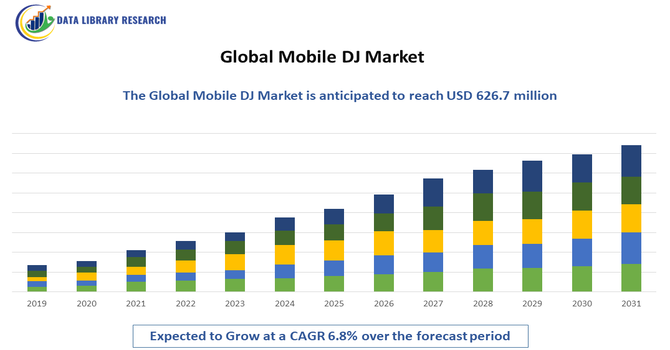
The Global Mobile DJ Market size was USD 416.37 million in 2026 and is projected to reach USD 626.7 million by 2033, expanding at a CAGR of 6.8% during 2026-2033.
Get Complete Analysis Of The Report - Download Updated Free Sample PDF
The Global Mobile DJ Market encompasses services and solutions where DJs bring music, lighting, and entertainment directly to events such as weddings, private parties, corporate gatherings, festivals, and community functions. Mobile DJs offer personalized playlists, live mixing, crowd engagement, and audiovisual experiences without a fixed venue, leveraging advanced sound systems and entertainment software. Growing social events, digital music platforms, and demand for customized experiences fuel market expansion. The industry includes individual DJs, entertainment companies, equipment providers, and tech platforms that support bookings, live streaming, and event management.
The current trends in the Global Mobile DJ Market include rising adoption of digital DJ controllers, cloud-based music libraries, and wireless audio technologies that enhance performance quality and mobility. There is significant growth in mobile DJ booking platforms and apps that streamline event planning and artist discovery. DJs increasingly use lighting automation, synchronized visuals, and advanced mixing software to differentiate their services. Demand for genre-diverse and culturally tailored music sets is expanding, reflecting broader entertainment preferences. Hybrid and virtual events have also propelled live streaming DJ sets. Sustainability trends, such as energy-efficient equipment and eco-conscious event production, are gaining traction among clients and performers.
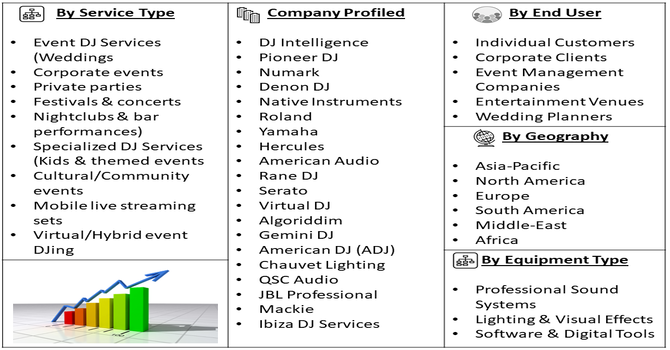
Segmentation: The Global Mobile DJ Market is segmented by Service Type (Event DJ Services (Weddings, Corporate events, Private parties, Festivals & concerts, and Nightclubs & bar performances), and Specialized DJ Services (Kids & themed events, Cultural/Community events, Mobile live streaming sets and Virtual/Hybrid event DJing), Equipment Type (Professional Sound Systems, Lighting & Visual Effects and Software & Digital Tools), End User (Individual Customers, Corporate Clients, Event Management Companies, Entertainment Venues and Wedding Planners), Booking Channel (Direct Bookings, Online Platforms & Mobile Apps and Talent Management Agencies), and Geography (North America, Europe, Asia-Pacific, Middle East and Africa, and South America). The report provides the value (in USD million) for the above segments.
For Detailed Market Segmentation - Get a Free Sample PDF
Market Drivers:
The increasing demand for personalized and experiential entertainment is a significant driver of the Global Mobile DJ Market. Clients seeking unique, tailored music experiences for weddings, corporate events, and social gatherings prefer mobile DJs who can customize playlists, engage audiences, and adapt live performances to specific themes. Social media influence and curated music preferences amplify expectations for bespoke entertainment. As disposable incomes rise and event spending grows, customers invest in professional DJ services to create memorable experiences. Festivals, nightlife, and community events continue to prioritize dynamic sound experiences, further bolstering demand. This shift toward personalization supports sustained market expansion and service innovation.
Technological advancements are a major driver of the Global Mobile DJ Market, as innovations in DJ equipment, software, and connectivity enhance performance capabilities and audience experiences. Digital DJ controllers, wireless microphones, cloud-based music streaming, and AI-powered mixing tools enable DJs to deliver professional-quality sets with greater flexibility and creativity. Mobile apps and platforms facilitate bookings, playlist management, and real-time client interaction. Improved lighting systems, synchronized visuals, and interactive elements help DJs differentiate services, attract diverse event types, and scale operations. Access to affordable, high-performance gear lowers entry barriers for aspiring DJs, expanding the talent pool and market growth globally.
Market Restraints:
A key restraint in the Global Mobile DJ Market is inconsistent income and job security for freelance DJs. Many mobile DJs operate independently, relying on event bookings that fluctuate seasonally and vary by region. Economic downturns, reduced event spending, or restrictive public health conditions can significantly impact revenue streams. High competition, price sensitivity among clients, and pressure to continuously upgrade equipment impose financial strain on smaller operators. Additionally, licensing and copyright challenges related to music performance rights can create administrative hurdles. These factors contribute to market instability for service providers, limiting long-term investment and sustainability for some participants.
The Global Mobile DJ Market has notable socioeconomic impacts by creating employment opportunities for DJs, audio technicians, event planners, and support staff. It stimulates growth in related sectors such as sound equipment manufacturing, event venues, hospitality, and music education. Local economies benefit from event-driven spending on catering, transportation, and accommodations. Mobile DJs often engage with communities, supporting cultural events and social cohesion through music. Emerging markets see increased youth participation in music careers, fostering creative industries. However, income disparities and inconsistent work schedules pose challenges for freelance DJs. Thus, the market contributes to cultural vibrancy, diversified entertainment options, and economic activity across regions.
Segmental Analysis:
The Nightclubs & Bar Performances segment is expected to witness the highest growth over the forecast period due to the revival of nightlife culture and rising demand for immersive entertainment experiences. Urbanization, increasing disposable incomes, and evolving music preferences are driving frequent live DJ bookings across metropolitan areas. Venues are investing in themed nights, celebrity appearances, and genre-specific performances to attract younger audiences. Social media promotion and influencer-driven nightlife trends further amplify footfall and repeat visits. Additionally, tourism growth and international music festivals are strengthening demand for skilled mobile DJs in bars and club environments globally.
The Lighting & Visual Effects segment is projected to register the fastest growth as event organizers increasingly prioritize immersive and visually dynamic experiences. Advanced LED lighting, synchronized laser shows, projection mapping, and stage effects enhance audience engagement and differentiate DJ performances. Clients are demanding customized lighting themes aligned with event concepts, especially for weddings, corporate gatherings, and nightlife venues. Technological advancements have also made high-quality lighting systems more affordable and portable, encouraging wider adoption among mobile DJs. Integration of automated lighting software with DJ controllers further strengthens this segment’s growth trajectory across global markets.
The Event Management Companies segment is anticipated to experience the highest growth as businesses and individuals increasingly outsource event planning to professional organizers. These companies frequently collaborate with mobile DJs to deliver seamless entertainment solutions as part of comprehensive event packages. Corporate events, product launches, destination weddings, and large-scale social gatherings are driving consistent demand. Event planners prefer reliable DJ partners who offer integrated sound, lighting, and technical support services. The growth of experiential marketing campaigns and branded entertainment further accelerates partnerships between DJs and event management firms, strengthening this segment’s expansion globally.
The Online Platforms & Mobile Apps segment is expected to witness rapid growth due to the digitalization of booking and event planning processes. Customers increasingly rely on mobile apps and web-based marketplaces to compare DJs, review ratings, check availability, and secure bookings instantly. These platforms improve transparency, pricing clarity, and convenience for both clients and performers. Integration with digital payments, scheduling tools, and customer feedback systems enhances operational efficiency. Social media integration and targeted advertising further expand reach for DJs. As digital adoption rises globally, online booking channels are becoming the primary growth driver in the market.
The North American region is projected to register the highest growth over the forecast period, supported by a strong entertainment culture, high disposable income, and a mature events industry.
The United States and Canada host numerous corporate events, weddings, music festivals, and nightlife gatherings that consistently demand professional DJ services. For instance, in January 2026, the expanded partnership between Venu Holding Corporation and Aramark Sports + Entertainment is expected to boost the North American Mobile DJ Market by increasing demand for professional DJ services at premium multi-seasonal venues, enhancing live entertainment experiences, and driving higher event engagement and bookings.
Similarly, in 2025, the partnership between Monumental Sports & Entertainment and Cisco is expected to drive growth in the North American Mobile DJ Market by enhancing high-tech arena experiences, increasing demand for live DJ performances, and integrating advanced audio-visual and interactive entertainment solutions.
Advanced technological adoption, including digital mixing tools and premium lighting systems, further strengthens market expansion. Additionally, well-established event management ecosystems and online booking platforms contribute to streamlined service delivery. Continuous innovation and consumer spending on experiential entertainment position North America as a key growth hub globally.
| Report Matrics | Details |
| Market Size Value | USD 626.7 million |
| Growth Rate | CAGR of 6.8% |
| Forecast | 2026-2033 |
| Historical data | 2021-2024 |
| Base Year | 2025 |
| Report Coverage | Forecasted revenue, company rating, competitive environment, growth drivers, and trends |
| Segment Coverage | Type, Application, End-User, Geography |
| Regional Scope | North America, Europe, Asia Pacific, Middle East |
| Customized scope | Free customization of reports (With 3 months' analysis support) |
| To Learn More About This Report | Request a Free Sample Copy |
The competitive landscape of the Global Mobile DJ Market is fragmented and dynamic, featuring independent DJs, regional entertainment companies, and technology-enabled booking platforms. Key differentiation factors include service customization, music library variety, brand reputation, and pricing flexibility. Digital tools such as DJ software, mobile apps, and social media are essential for marketing and audience engagement. Competitive pressure encourages innovation in live performance technologies, audiovisual integration, and client experience services. Collaborations with event planners, venues, and corporate clients provide strategic advantages. Smaller operators focus on niche segments like weddings and cultural festivals, while larger service providers emphasize scalability and multi-city reach, driving competition across service quality and technological adoption.
The major players for above market are:
Recent Development
Q1. What are the main growth-driving factors for this market?
The surge in post-pandemic social gatherings, particularly weddings and corporate events, is the primary driver. Advancements in portable technology, such as lightweight PA systems and cloud-based mixing software, have lowered the barrier to entry. Additionally, the rising trend of personalized, "boutique" event experiences has increased demand for versatile, mobile professionals.
Q2. What are the main restraining factors for this market?
High competition from low-cost hobbyists often drives down market pricing, making it difficult for professionals to maintain margins. Economic inflation impacting consumer discretionary spending can lead to smaller event budgets. Furthermore, noise ordinances in urban areas and strict licensing requirements for public performances pose significant logistical and legal challenges for operators.
Q3. Which segment is expected to witness high growth?
The Nightclubs & Bar Performances segment is expected to witness the highest growth over the forecast period, driven by the resurgence of nightlife, rising urban youth populations, and increasing demand for live music experiences. Venues are investing in professional DJs and immersive setups to enhance customer engagement, boost footfall, and strengthen brand positioning.
Q4. Who are the top major players for this market?
The market is dominated by equipment manufacturers that empower mobile DJs, including Pioneer DJ (AlphaTheta), Denon DJ (inMusic), and Numark. In terms of service platforms, companies like WeddingWire and The Knot act as major market aggregators. Native Instruments and Serato also remain vital players by providing the essential software infrastructure.
Q5. Which country is the largest player?
The United States is the largest player in the mobile DJ market, characterized by a massive wedding industry and a culture of high-production private celebrations. The presence of major industry associations and specialized trade shows further strengthens this position. Following closely is the United Kingdom, which maintains a very high-density professional market.
Data Library Research are conducted by industry experts who offer insight on industry structure, market segmentations technology assessment and competitive landscape (CL), and penetration, as well as on emerging trends. Their analysis is based on primary interviews (~ 80%) and secondary research (~ 20%) as well as years of professional expertise in their respective industries. Adding to this, by analysing historical trends and current market positions, our analysts predict where the market will be headed for the next five years. Furthermore, the varying trends of segment & categories geographically presented are also studied and the estimated based on the primary & secondary research.
In this particular report from the supply side Data Library Research has conducted primary surveys (interviews) with the key level executives (VP, CEO’s, Marketing Director, Business Development Manager and SOFT) of the companies that active & prominent as well as the midsized organization
FIGURE 1: DLR RESEARH PROCESS
Extensive primary research was conducted to gain a deeper insight of the market and industry performance. The analysis is based on both primary and secondary research as well as years of professional expertise in the respective industries.
In addition to analysing current and historical trends, our analysts predict where the market is headed over the next five years.
It varies by segment for these categories geographically presented in the list of market tables. Speaking about this particular report we have conducted primary surveys (interviews) with the key level executives (VP, CEO’s, Marketing Director, Business Development Manager and many more) of the major players active in the market.
Secondary ResearchSecondary research was mainly used to collect and identify information useful for the extensive, technical, market-oriented, and Friend’s study of the Global Extra Neutral Alcohol. It was also used to obtain key information about major players, market classification and segmentation according to the industry trends, geographical markets, and developments related to the market and technology perspectives. For this study, analysts have gathered information from various credible sources, such as annual reports, sec filings, journals, white papers, SOFT presentations, and company web sites.
Market Size EstimationBoth, top-down and bottom-up approaches were used to estimate and validate the size of the Global market and to estimate the size of various other dependent submarkets in the overall Extra Neutral Alcohol. The key players in the market were identified through secondary research and their market contributions in the respective geographies were determined through primary and secondary research.
Forecast Model