
Get Complete Analysis Of The Report - Download Updated Free Sample PDF
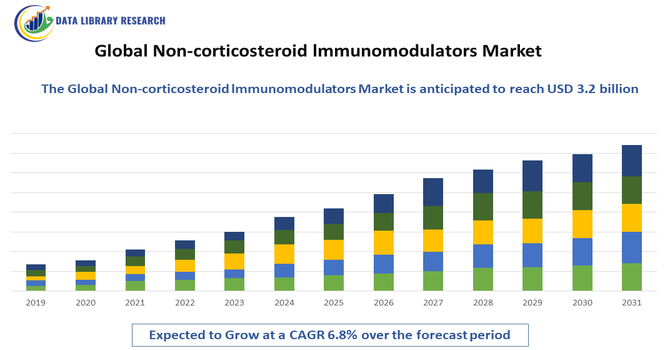
The global non-corticosteroid immunomodulators market focuses on drugs that regulate or modulate the immune system without using corticosteroids. These therapies target autoimmune diseases, inflammatory disorders, and organ transplant rejection, offering effective treatment with fewer steroid-related side effects, driving adoption across hospitals, clinics, and specialized healthcare settings worldwide.
The global non-corticosteroid immunomodulators market grew due to rising prevalence of autoimmune and chronic inflammatory diseases, increasing organ transplant procedures, and the demand for steroid-sparing therapies that reduce long-term side effects. Advances in biologics, targeted therapies, and personalized medicine, alongside growing healthcare infrastructure and awareness, further fueled adoption globally.
The global non-corticosteroid immunomodulators market witnessed rapid growth driven by increasing prevalence of autoimmune diseases, inflammatory disorders, and organ transplant procedures. Key trends included the development of targeted biologics, monoclonal antibodies, and small-molecule therapies that modulate immune responses without corticosteroid-associated side effects. Personalized medicine approaches, precision dosing, and combination therapies gained prominence, improving patient outcomes. Additionally, regulatory approvals for novel immunomodulators and rising investment in R&D fostered product innovation.
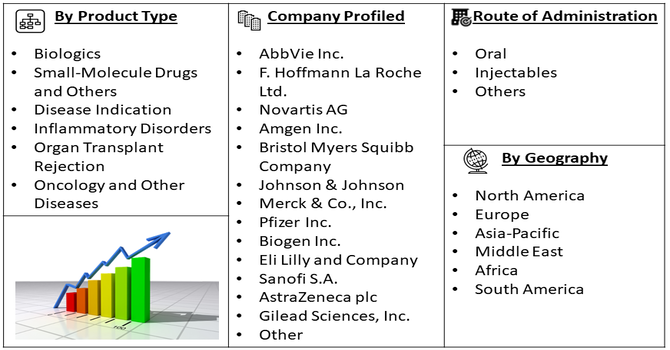
Segmentation: The Global Non-Corticosteroid Immunomodulators Market is segmented by Product Type (Biologics (monoclonal antibodies, fusion proteins), Small-Molecule Drugs and Others), Disease Indication (Autoimmune Diseases (rheumatoid arthritis, multiple sclerosis, psoriasis), Inflammatory Disorders (IBD, Crohn’s disease, ulcerative colitis), Organ Transplant Rejection, Oncology and Other Diseases), Route of Administration (Oral, Injectables and Others), and Geography (North America, Europe, Asia-Pacific, Middle East and Africa, and South America). The report provides the value (in USD million) for the above segments.
For Detailed Market Segmentation - Get a Free Sample PDF
Market Drivers:
The global non-corticosteroid immunomodulators market was strongly driven by the increasing prevalence of autoimmune and inflammatory diseases such as rheumatoid arthritis, multiple sclerosis, lupus, psoriasis, and inflammatory bowel disease.
In 2024, National Health Council, reported that, 1988 and 2012, the prevalence of antinuclear antibodies (ANA), a key autoimmunity biomarker, nearly doubled, with a 300% increase among adolescents aged 12 to 19. Over the past 40 years, type 1 diabetes prevalence almost doubled in adults, while celiac disease in the U.S. increased five-fold in 30 years. Multiple sclerosis cases rose 30% globally from 2013 to 2022, and inflammatory bowel disease (IBD) prevalence grew 46% between 2006 and 2021. These rising autoimmune and inflammatory disease rates significantly boosted demand for non-corticosteroid immunomodulators, driving market growth, encouraging safer targeted therapies, and accelerating global innovation. As healthcare providers sought safer, more targeted treatment options, demand for non-corticosteroid immunomodulators grew across hospitals, specialty clinics, and home-care settings.
Technological innovation and R&D in biologics, small-molecule drugs, and targeted immunotherapies significantly propelled market growth. Non-corticosteroid immunomodulators offered precise modulation of immune responses, minimizing side effects associated with corticosteroids.
Regulatory approvals for advanced immunomodulators, along with integration of digital health monitoring and telemedicine, supported adoption in both clinical and home-care settings. For instance, in October 2025, the FDA expanded AbbVie’s RINVOQ approval, permitting its use as a first-line treatment before TNF blockers for certain inflammatory bowel disease patients. This advancement in targeted therapy enhanced personalized treatment options, strengthening the global non-corticosteroid immunomodulators market by increasing adoption of precision medicines and accelerating innovation in safer, more effective immune-modulating therapies worldwide.
Market Restraints:
The global non-corticosteroid immunomodulators market faced restraints due to high therapy costs and limited accessibility, particularly in developing countries. Biologics and advanced small-molecule drugs often carried premium pricing, making them unaffordable for low-income patients and smaller healthcare providers. Limited distribution networks, inadequate healthcare infrastructure, and regulatory barriers restricted access in rural and underserved regions. High costs of research, development, and regulatory compliance were also passed to end-users, slowing adoption.
The rise of non-corticosteroid immunomodulators significantly influenced healthcare systems and society. By reducing corticosteroid-related complications, these therapies improved quality of life for patients with autoimmune and inflammatory diseases. Reduced hospitalizations and side effects lowered overall healthcare costs while enabling outpatient management and home-based care. Increased access to advanced immunotherapies in emerging economies fostered equitable treatment options. Pharmaceutical investments in immunomodulators generated employment, research opportunities, and economic growth. Furthermore, effective disease management decreased work absenteeism, improved productivity, and lessened caregiver burden.
Segmental Analysis:
The small-molecule drugs segment was projected to witness the highest growth due to their advantages in oral bioavailability, targeted immune modulation, and cost-effectiveness compared to biologics. These drugs offered easier manufacturing, distribution, and administration, enabling wider patient access across hospitals, specialty clinics, and home-care settings. Increased prevalence of autoimmune and inflammatory disorders drove demand for convenient, long-term therapies. Additionally, pharmaceutical companies invested heavily in R&D for novel small-molecule immunomodulators with improved efficacy, safety, and fewer side effects, further accelerating adoption. Favorable regulatory approvals and growing awareness of non-corticosteroid options reinforced market expansion globally over the forecast period.
The autoimmune disease segment was forecast to experience the highest growth, driven by increasing incidence of conditions such as rheumatoid arthritis, multiple sclerosis, lupus, and psoriasis worldwide. Chronic nature of autoimmune disorders required long-term management with steroid-sparing immunomodulators, boosting demand for non-corticosteroid therapies.
Advances in personalized medicine, targeted treatments, and biologics improved patient outcomes, further stimulating adoption. Rising awareness, early diagnosis, and increased healthcare infrastructure supported market penetration in hospitals, specialty clinics, and home-care settings. The combination of unmet medical needs, favorable reimbursement policies, and growing patient populations positioned autoimmune diseases as the leading segment driving growth in the global immunomodulator market.
The oral segment was expected to witness the highest growth due to patient preference for convenient, non-invasive administration and ease of adherence in long-term therapies. Oral non-corticosteroid immunomodulators, particularly small-molecule drugs, allowed home-based treatment without the need for injections, reducing hospital visits and overall treatment costs.
Advances in formulation technology improved absorption, efficacy, and tolerability, expanding applicability across autoimmune and inflammatory diseases. Strong adoption in outpatient settings, combined with increasing availability of prescription oral immunomodulators, drove market growth. Thus, the oral route became the most attractive administration form, enhancing patient compliance and supporting the expansion of the global non-corticosteroid immunomodulator market.
North America was projected to witness the highest growth in the non-corticosteroid immunomodulators market due to a mature healthcare system, high prevalence of autoimmune and inflammatory diseases, and strong adoption of advanced therapies. For instance, the 2025, Pfizer report stated that in the U.S., around 1.5 million adults lived with rheumatoid arthritis (RA), a chronic inflammatory condition, with an annual incidence of 70 per 100,000. Women were two to three times more affected than men, and onset typically occurred between ages 30 and 60. This high prevalence drove demand for non-corticosteroid immunomodulators, expanding the U.S. market.
Favorable reimbursement policies, regulatory support, and well-established distribution networks ensured widespread access to innovative biologics and small-molecule immunomodulators. Investments in R&D, clinical trials, and personalized medicine further strengthened the market. For instance, in October 2025, the FDA approved Boehringer Ingelheim’s JASCAYD, the first new treatment for idiopathic pulmonary fibrosis (IPF) in over ten years. Nerandomilast, an oral PDE4B inhibitor with antifibrotic and immunomodulatory properties, helped slow lung function decline. This approval boosted the US non-corticosteroid immunomodulators market by expanding treatment options and driving demand for advanced respiratory therapies.
Furthermore, the high patient awareness and demand for steroid-sparing treatments contributed to accelerated adoption across hospitals, specialty clinics, and home-care settings. North America’s leadership in healthcare innovation positioned it as the dominant growth region globally.
| Report Matrics | Details |
| Market Size Value | USD 1.92 billion |
| Growth Rate | CAGR of 5.1% |
| Forecast | 2026-2033 |
| Historical data | 2021-2024 |
| Base Year | 2025 |
| Report Coverage | Forecasted revenue, company rating, competitive environment, growth drivers, and trends |
| Segment Coverage | Type, Application, End-User, Geography |
| Regional Scope | North America, Europe, Asia Pacific, Middle East |
| Customized scope | Free customization of reports (With 3 months Analysis Support ) |
| To Learn More About This Report | Request a Free Sample Copy |
The competitive landscape for non-corticosteroid immunomodulators was moderately consolidated, led by major pharmaceutical and biotech companies specializing in biologics and small-molecule therapies. Market leaders competed through innovation, expanding product pipelines, and strategic collaborations for R&D, clinical trials, and licensing agreements. Key strategies included developing targeted therapies, personalized medicine solutions, and combination regimens to improve efficacy and safety. Companies invested heavily in regulatory approvals, patent protection, and global distribution networks to capture hospital, clinic, and outpatient segments.
The major players for above market are:
Recent Development
Q1. What are the main growth-driving factors for this market?
The growth is primarily driven by the increasing global prevalence of autoimmune disorders and chronic inflammatory diseases like Crohn's disease. Furthermore, the rising need for organ transplants, where these drugs prevent rejection, and a shift towards therapies with fewer side effects than traditional steroids, are key drivers.
Q2. What are the main restraining factors for this market?
The biggest restraints are the very high cost of non-corticosteroid immunomodulatory therapies, particularly biologics, which limits patient access globally. Safety concerns regarding potential severe side effects, like increased risk of infection or malignancy from prolonged use, also require continuous patient monitoring and restrict growth.
Q3. Which segment is expected to witness high growth?
The segment using targeted Biologics and Biosimilars for Oncology (Cancer) applications is anticipated to see the highest growth. These non-corticosteroid therapies leverage the body's immune system more specifically, offering superior treatment efficacy and reduced toxicity compared to older, less targeted immunosuppressants.
Q4. Who are the top major players for this market?
Leading companies are global pharmaceutical giants heavily invested in advanced biologics and targeted therapies. Major players include Novartis AG, Bristol-Myers Squibb Company, Pfizer Inc., Amgen Inc., and F. Hoffmann-La Roche Ltd. They focus on research and development for autoimmune diseases and cancer.
Q5. Which country is the largest player?
The United States holds the largest market share within North America. This dominance is attributed to high healthcare spending, a significant patient population with chronic immune disorders, a well-established regulatory framework for drug approvals, and substantial ongoing investment in biotechnology research and development.
Data Library Research are conducted by industry experts who offer insight on industry structure, market segmentations technology assessment and competitive landscape (CL), and penetration, as well as on emerging trends. Their analysis is based on primary interviews (~ 80%) and secondary research (~ 20%) as well as years of professional expertise in their respective industries. Adding to this, by analysing historical trends and current market positions, our analysts predict where the market will be headed for the next five years. Furthermore, the varying trends of segment & categories geographically presented are also studied and the estimated based on the primary & secondary research.
In this particular report from the supply side Data Library Research has conducted primary surveys (interviews) with the key level executives (VP, CEO’s, Marketing Director, Business Development Manager and SOFT) of the companies that active & prominent as well as the midsized organization
FIGURE 1: DLR RESEARH PROCESS
Extensive primary research was conducted to gain a deeper insight of the market and industry performance. The analysis is based on both primary and secondary research as well as years of professional expertise in the respective industries.
In addition to analysing current and historical trends, our analysts predict where the market is headed over the next five years.
It varies by segment for these categories geographically presented in the list of market tables. Speaking about this particular report we have conducted primary surveys (interviews) with the key level executives (VP, CEO’s, Marketing Director, Business Development Manager and many more) of the major players active in the market.
Secondary ResearchSecondary research was mainly used to collect and identify information useful for the extensive, technical, market-oriented, and Friend’s study of the Global Extra Neutral Alcohol. It was also used to obtain key information about major players, market classification and segmentation according to the industry trends, geographical markets, and developments related to the market and technology perspectives. For this study, analysts have gathered information from various credible sources, such as annual reports, sec filings, journals, white papers, SOFT presentations, and company web sites.
Market Size EstimationBoth, top-down and bottom-up approaches were used to estimate and validate the size of the Global market and to estimate the size of various other dependent submarkets in the overall Extra Neutral Alcohol. The key players in the market were identified through secondary research and their market contributions in the respective geographies were determined through primary and secondary research.
Forecast Model