
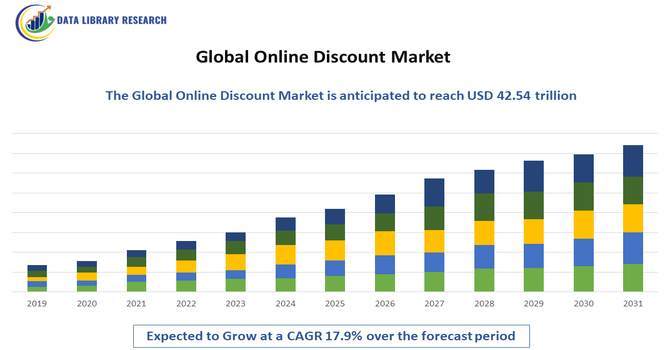
The Global Online Discount Market is expected to reach USD 87.26 trillion by 2033, growing at a CAGR of 17.9% from 2026 to 2033, from USD 42.54 trillion in 2026.
 Get Complete Analysis Of The Report - Download Updated Free Sample PDF
The Global Online Discount Market encompasses digital platforms and e-commerce websites offering products and services at reduced prices through coupons, flash sales, promotional codes, cashback, and special deals. It serves a broad range of categories, including fashion, electronics, groceries, travel, and entertainment. The market is driven by increasing internet penetration, mobile shopping growth, and consumer demand for cost savings and value. Retailers and brands use online discounts to attract price-sensitive shoppers, clear inventory, and boost customer loyalty. The sector integrates advanced analytics, personalized marketing, and real-time pricing strategies, facilitating dynamic, large-scale discounting across global and regional markets.
The online discount market is evolving with growing adoption of AI-powered personalized discounts tailored to consumer preferences. Mobile commerce drives significant traffic, encouraging app-exclusive deals and location-based offers. Social commerce integrates discounts with influencer marketing and live streaming sales events, enhancing engagement. Subscription-based loyalty programs and cashback wallets are increasing in popularity, incentivizing repeat purchases. Sustainability-focused discounts promote eco-friendly products. Omnichannel strategies blend online and offline discounts, offering seamless consumer experiences. Additionally, real-time dynamic pricing enables retailers to adjust discounts based on demand, competition, and inventory levels, optimizing sales and margins in an increasingly competitive digital environment.
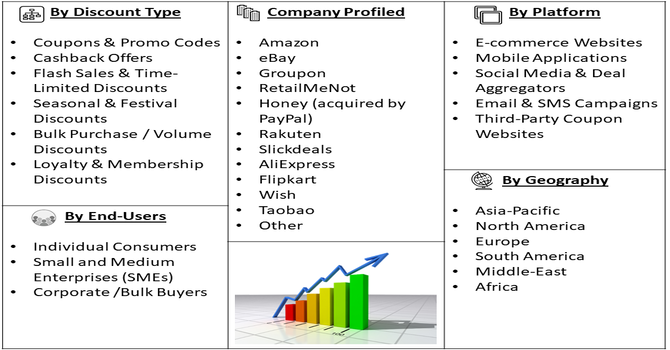
Segmentation: The Global Online Discount Market is segmented by Discount Type (Coupons & Promo Codes, Cashback Offers, Flash Sales & Time-Limited Discounts, Seasonal & Festival Discounts, Bulk Purchase / Volume Discounts, and Loyalty & Membership Discounts), Product Category (Fashion & Apparel, Electronics & Gadgets, Groceries & FMCG, Travel & Hospitality, Health & Beauty, Home & Furniture and Entertainment & Subscriptions), Platform (E-commerce Websites, Mobile Applications, Social Media & Deal Aggregators, Email & SMS Campaigns and Third-Party Coupon Websites), End User (Individual Consumers, Small and Medium Enterprises (SMEs) and Corporate /Bulk Buyers), and Geography (North America, Europe, Asia-Pacific, Middle East and Africa, and South America). The report provides the value (in USD million) for the above segments.
 For Detailed Market Segmentation - Get a Free Sample PDF
Market Drivers:
Increasing global internet and smartphone penetration has fueled the growth of the online discount market by expanding access to digital shopping platforms. Affordable smartphones and data plans enable more consumers to browse, compare, and purchase discounted products anytime, anywhere. For instance, in May 2025, JetBlue and United’s Blue-Sky collaboration expanded options for travelers and enabled cross-airline loyalty benefits, strengthening the Global Online Discount Market and the Loyalty & Membership Discounts segment. The partnership increased consumer engagement, enhanced value through points redemption, and promoted adoption of digital discount and rewards programs across both airlines’ customer bases.
This connectivity shift drives mobile-first strategies, app-based deals, and push notifications, enhancing consumer engagement. Additionally, growing digital literacy and comfort with e-commerce facilitate adoption of discount platforms among diverse demographics. Retailers capitalize on this trend by offering exclusive mobile discounts and flash sales, accelerating transaction volumes and broadening market reach, especially in emerging economies with rapidly expanding internet user bases.
Consumers increasingly prioritize value shopping, driven by economic uncertainty, budget constraints, and heightened price awareness. The desire for savings and maximized purchasing power motivates shoppers to actively seek online discounts, coupons, and cashback offers. Digital platforms simplify deal discovery, comparison, and redemption, catering to this value-conscious behaviour. Additionally, the rise of social media and deal-sharing communities amplifies awareness and trust in discounted purchases. Retailers respond with personalized promotions and loyalty rewards to attract and retain these price-sensitive customers. This shift towards savvy, deal-driven shopping is a critical driver for market expansion across various product categories globally.
Market Restraints:
Concerns about the quality and authenticity of discounted products pose a restraint on the online discount market. Consumers may perceive heavily discounted items as inferior or counterfeit, leading to reduced trust and reluctance to purchase. Incidents of fraudulent deals, misleading promotions, and inconsistent pricing further undermine confidence. These issues are exacerbated by the proliferation of third-party sellers and unverified platforms, complicating quality assurance. Retailers and platforms face challenges in maintaining transparency and ensuring genuine discounts while protecting brand reputation. Overcoming these concerns requires stringent verification, clear communication, and enhanced customer service, but lingering skepticism can slow market adoption and growth.
The online discount market positively impacts economies by increasing consumer purchasing power, particularly benefiting low- and middle-income groups. It promotes digital inclusion as more consumers gain access to affordable goods and services online. The market supports small and medium enterprises (SMEs) by enabling wider reach and competitive pricing. Employment opportunities grow in digital marketing, logistics, and tech sectors. However, heavy discounting can pressure profit margins and supply chains, potentially affecting product quality and fair labor practices. Consumer behavior shifts towards bargain hunting may reduce brand loyalty. Thus, the sector stimulates economic activity and democratizes access to diverse products globally.
Segmental Analysis:
The Cashback Offers segment is expected to witness the highest growth over the forecast period as consumers increasingly prefer instant monetary benefits on purchases. Cashback incentives drive repeat purchases, improve customer loyalty, and encourage higher spending on e-commerce platforms. Mobile wallets, payment apps, and integrated fintech solutions facilitate seamless cashback transactions, enhancing adoption. Retailers and brands leverage these offers to boost engagement, promote new products, and compete effectively in a crowded digital marketplace. Additionally, personalized cashback programs based on purchase behavior and preferences provide tailored value, increasing consumer satisfaction. The convenience, transparency, and perceived savings associated with cashback offers position this segment for rapid global growth.
The Groceries & FMCG segment is projected to witness the highest growth in the online discount market over the forecast period due to increasing consumer preference for convenient, cost-effective online shopping. Daily essentials, packaged foods, and household products attract frequent purchases, making discounts, promo codes, and cashback highly appealing. Rising urbanization, busier lifestyles, and the COVID-19 pandemic have accelerated adoption of digital grocery platforms. Retailers are leveraging app-based flash sales, subscription models, and bundled offers to attract and retain customers. Additionally, loyalty programs and personalized discounts for FMCG products encourage repeat purchases. These factors collectively position the groceries and FMCG segment as a key growth driver globally.
The social media & Deal Aggregators segment is expected to witness the highest growth over the forecast period as consumers increasingly discover and compare discounts through digital channels. Platforms like Instagram, Facebook, TikTok, and specialized deal aggregators provide real-time offers, user reviews, and price comparisons, influencing purchasing decisions. Influencer collaborations, targeted advertising, and viral deal-sharing amplify consumer engagement. These platforms also facilitate seamless coupon redemption, mobile app integration, and personalized recommendations. Retailers leverage social commerce and aggregator networks to increase visibility and drive sales. As digital adoption expands, particularly among millennials and Gen Z, social media and deal aggregator platforms are becoming central to the global online discount ecosystem.
The Small and Medium Enterprises (SMEs) segment is expected to witness the highest growth over the forecast period due to increased access to online discount platforms that help smaller businesses compete with larger retailers. SMEs leverage coupons, flash sales, and app-based deals to attract new customers, boost visibility, and increase sales without large marketing budgets. Digital marketplaces and aggregator platforms provide low-cost entry into e-commerce, enabling SMEs to expand reach nationally and internationally. The flexibility of online discount campaigns allows SMEs to quickly adjust pricing and promotional strategies based on market trends. Consequently, this segment benefits from technology-driven growth and rising consumer demand for value-focused products.
The Asia-Pacific region is expected to witness the highest growth in the online discount market over the forecast period due to rising internet penetration, widespread smartphone adoption, and expanding e-commerce infrastructure. Countries such as China, India, and Southeast Asian nations are experiencing rapid digital transformation, creating a large, tech-savvy consumer base. Government initiatives supporting digital payments and fintech solutions further facilitate adoption of online discounts. High population density, growing middle-class income, and increasing preference for convenience and value-driven shopping boost platform engagement. Additionally, the proliferation of social media, mobile apps, and deal aggregators accelerates access to promotions. These factors position Asia-Pacific as a key growth hub globally.
| Report Matrics | Details |
| Market Size Value | USD 42.54 trillion |
| Growth Rate | CAGR of 16.23 % |
| Forecast | 2026-2033 |
| Historical data | 2021-2024 |
| Base Year | 2025 |
| Report Coverage | Forecasted revenue, company rating, competitive environment, growth drivers, and trends |
| Segment Coverage | Type, Application, End-User, Geography |
| Regional Scope | North America, Europe, Asia Pacific, Middle East |
| Customized scope | Free customization of reports (With 3 months' analysis support) |
| To Learn More About This Report | Request a Free Sample Copy |
The Global Online Discount Market is highly competitive, featuring major e-commerce giants, niche deal platforms, and coupon aggregators. Companies differentiate through exclusive partnerships, user experience, app functionalities, and personalized discount algorithms. Strategic mergers and acquisitions consolidate market share and expand geographic reach. Emerging players leverage social media and influencer collaborations to boost visibility. Loyalty programs and omni-channel integration strengthen consumer retention. Advanced data analytics enable dynamic pricing and targeted campaigns, increasing competitive intensity. Market leaders invest heavily in technology infrastructure and customer service to maintain dominance, while smaller players focus on niche segments or regional specialization to carve out market positions.
The major players for the above market are:
Recent Development
Q1. What are the main growth-driving factors for this market?
The surge in high-speed internet penetration and smartphone adoption globally is the primary driver. Consumers are increasingly seeking value-for-money, fueled by inflationary pressures. Additionally, the rise of "social commerce" and AI-driven personalized deal recommendations has made finding discounts easier, while rapid urbanization and improved logistics infrastructure support seamless delivery.
Q2. What are the main restraining factors for this market?
Logistical complexities and rising shipping costs significantly squeeze profit margins for discount retailers. Security concerns regarding online payment fraud and data privacy also deter some consumers. Furthermore, intense competition leads to "discount fatigue," where constant price-dropping erodes brand loyalty and makes it difficult for smaller platforms to remain sustainable.
Q3. Which segment is expected to witness high growth?
The Social Media & Deal Aggregators segment is expected to witness the highest growth over the forecast period as consumers increasingly rely on platforms like Instagram, Facebook, and specialized aggregator apps to discover real-time discounts. Influencer promotions, personalized deals, and social sharing drive engagement, boosting online discount adoption globally.
Q4. Who are the top major players for this market?
The market is dominated by global e-commerce giants and specialized discount platforms. Key players include Amazon (through its "Deals" section), Groupon, and Rakuten. Emerging powerhouses like Pinduoduo (Temu) and Shein have also disrupted the market with aggressive pricing strategies, alongside established coupon-focused sites like RetailMeNot and Honey (PayPal).
Q5. Which country is the largest player?
China is currently the largest player in the online discount market. This dominance is supported by its massive digital-savvy population and a highly integrated ecosystem of mobile payments like Alipay and WeChat Pay. The country’s sophisticated manufacturing base allows for ultra-low-cost production, fueling domestic discount giants that are now expanding globally.
Data Library Research are conducted by industry experts who offer insight on industry structure, market segmentations technology assessment and competitive landscape (CL), and penetration, as well as on emerging trends. Their analysis is based on primary interviews (~ 80%) and secondary research (~ 20%) as well as years of professional expertise in their respective industries. Adding to this, by analysing historical trends and current market positions, our analysts predict where the market will be headed for the next five years. Furthermore, the varying trends of segment & categories geographically presented are also studied and the estimated based on the primary & secondary research.
In this particular report from the supply side Data Library Research has conducted primary surveys (interviews) with the key level executives (VP, CEO’s, Marketing Director, Business Development Manager and SOFT) of the companies that active & prominent as well as the midsized organization
FIGURE 1: DLR RESEARH PROCESS
Extensive primary research was conducted to gain a deeper insight of the market and industry performance. The analysis is based on both primary and secondary research as well as years of professional expertise in the respective industries.
In addition to analysing current and historical trends, our analysts predict where the market is headed over the next five years.
It varies by segment for these categories geographically presented in the list of market tables. Speaking about this particular report we have conducted primary surveys (interviews) with the key level executives (VP, CEO’s, Marketing Director, Business Development Manager and many more) of the major players active in the market.
Secondary ResearchSecondary research was mainly used to collect and identify information useful for the extensive, technical, market-oriented, and Friend’s study of the Global Extra Neutral Alcohol. It was also used to obtain key information about major players, market classification and segmentation according to the industry trends, geographical markets, and developments related to the market and technology perspectives. For this study, analysts have gathered information from various credible sources, such as annual reports, sec filings, journals, white papers, SOFT presentations, and company web sites.
Market Size EstimationBoth, top-down and bottom-up approaches were used to estimate and validate the size of the Global market and to estimate the size of various other dependent submarkets in the overall Extra Neutral Alcohol. The key players in the market were identified through secondary research and their market contributions in the respective geographies were determined through primary and secondary research.
Forecast Model