
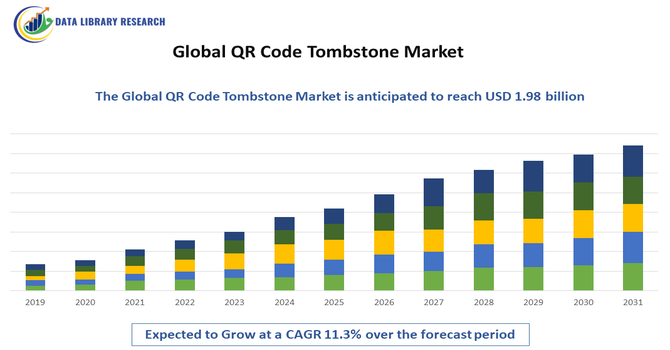
The Global QR Code Tombstone Market size was valued at USD 835.47 million in 2026 and the revenue is expected to grow at a CAGR of 11.3% from 2026 to 2033, reaching USD 1.98 billion in 2033.
 Get Complete Analysis Of The Report - Download Updated Free Sample PDF
The Global QR Code Tombstone Market involves the production and adoption of tombstones embedded with Quick Response (QR) codes, enabling digital memorialization. These tombstones link to online platforms containing personal tributes, photos, videos, and genealogical information. This market integrates technology with traditional memorial practices, offering interactive, accessible remembrance solutions. It caters to cemeteries, funeral homes, and families seeking modern ways to honor loved ones. The growing digitalization of memorial services and rising smartphone usage worldwide drive the market, enhancing visitor engagement and providing a lasting, shareable digital legacy alongside physical tombstones.
The QR Code Tombstone Market is witnessing rapid growth due to increasing digitalization and consumer preference for interactive memorial experiences. Integration of augmented reality (AR) and multimedia content with QR codes is enhancing user engagement. Eco-friendly and smart tombstones embedded with QR codes are gaining popularity. Additionally, partnerships between tech firms and funeral service providers are expanding product offerings. The COVID-19 pandemic accelerated demand for remote memorialization solutions. Rising smartphone penetration and social media integration allow easy sharing of memorial content. These trends collectively drive innovation and consumer adoption in the global market.
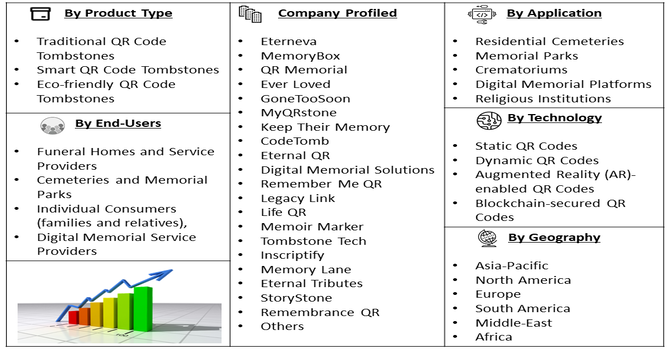
Segmentation: The Global QR Code Tombstone Market is segmented by Product Type (Traditional QR Code Tombstones, Smart QR Code Tombstones and Eco-friendly QR Code Tombstones), Application (Residential Cemeteries, Memorial Parks, Crematoriums, Digital Memorial Platforms and Religious Institutions), Technology (Static QR Codes, Dynamic QR Codes, Augmented Reality (AR)-enabled QR Codes and Blockchain-secured QR Codes), End User (Funeral Homes and Service Providers, Cemeteries and Memorial Parks, Individual Consumers (families and relatives), and Digital Memorial Service Providers), and Geography (North America, Europe, Asia-Pacific, Middle East and Africa, and South America). The report provides the value (in USD million) for the above segments.
 For Detailed Market Segmentation - Get a Free Sample PDF
Market Drivers:
The rising digitalization of memorial services is a primary driver for the QR Code Tombstone Market. Families increasingly seek innovative ways to remember loved ones beyond traditional tombstones, preferring interactive, multimedia memorials accessible via smartphones. The integration of QR codes with digital content allows seamless sharing of memories, stories, and genealogical data, enhancing emotional connection and visitor engagement. This trend is fueled by widespread internet access, growing smartphone penetration, and social media use, making digital memorialization more mainstream. The demand for personalized, meaningful, and long-lasting tributes in a tech-savvy society propels the market’s growth worldwide.
Expanding smartphone penetration globally significantly drives the QR Code Tombstone Market. As more people own smartphones capable of scanning QR codes, accessibility to digital memorial content becomes easier and widespread. Younger generations, comfortable with technology, demand modern memorial solutions that blend tradition with innovation. Additionally, increased tech adoption in funeral services, including online tributes and virtual ceremonies, complements QR code tombstones. This technological shift enables enhanced user experiences with multimedia integration, augmented reality, and social sharing features, encouraging families and service providers to invest in these advanced memorial options, thereby accelerating market growth and innovation.
Market Restraints:
The QR Code Tombstone Market faces challenges from privacy concerns and digital divides. Users worry about data security, unauthorized access, and misuse of personal memorial content shared via QR codes. This hesitance limits adoption among privacy-conscious consumers. Additionally, digital divides—stemming from lack of internet access, smartphone ownership, or tech literacy in certain regions or older demographics—restrict market penetration. Resistance to change in traditional funeral practices also slows acceptance. Overcoming these barriers requires robust data protection measures, user education, and inclusive solutions to ensure equitable access and trust, balancing innovation with sensitivity to privacy and cultural values.
The QR Code Tombstone Market positively impacts society by modernizing memorial practices, fostering emotional connection through digital tributes. It promotes cultural preservation by enabling accessible family histories and stories. Economically, it creates new revenue streams for funeral homes and tech firms, supporting job creation in digital memorial services. The technology also democratizes access to memorialization, benefiting diverse socioeconomic groups. However, digital divides in some regions may limit reach. Thus, the market encourages sustainable and meaningful remembrance while blending technology with tradition, reflecting evolving social values around death, memory, and legacy in a connected world.
Segmental Analysis:
The Traditional QR Code Tombstones segment is anticipated to experience the highest growth due to its widespread acceptance and affordability. These tombstones offer a straightforward integration of QR codes, allowing users to access digital memorial content easily without complex technology. Many cemeteries and families prefer traditional designs combined with QR functionality as a balanced approach between conventional memorialization and modern innovation. Additionally, this segment benefits from rising awareness of digital memorials and increased smartphone penetration globally. The simplicity, cost-effectiveness, and compatibility with existing cemetery infrastructure make traditional QR code tombstones a preferred choice, fueling significant growth throughout the forecast period.
The Residential Cemeteries segment is expected to witness the highest growth driven by increasing demand for personalized and interactive memorial solutions in family-owned burial grounds. As families seek meaningful ways to preserve legacies, QR code tombstones offer a practical way to link physical memorials with rich digital content. Residential cemeteries often allow more customization, making them ideal for integrating QR codes with personal stories, photos, and videos. Growing consumer interest in combining tradition with technology, along with expanding smartphone use, supports market expansion in this segment. Moreover, smaller cemetery operations are adopting QR codes to enhance visitor engagement and differentiation.
The Augmented Reality (AR)-enabled QR Codes segment is poised for the fastest growth as it provides an immersive and engaging memorial experience. By combining QR codes with AR technology, users can access 3D visuals, virtual tours, and interactive tributes that go beyond static information. This advanced solution appeals especially to younger, tech-savvy generations seeking innovative ways to commemorate loved ones. Increasing investments in AR by memorial service providers and rising consumer demand for experiential technology are key growth drivers. The ability to create dynamic, customizable content enhances emotional connection and sets AR-enabled QR codes apart, driving rapid adoption and market expansion.
The Funeral Homes and Service Providers segment is expected to lead growth due to their pivotal role in adopting and promoting QR code tombstone solutions. These providers seek innovative services to meet evolving consumer demands for personalized, tech-enabled memorials. By integrating QR codes into their offerings, funeral homes can differentiate themselves and enhance customer experience with digital storytelling, video tributes, and genealogical content. The growing collaboration between tech firms and funeral service providers accelerates market penetration. Additionally, funeral homes have direct access to end users, enabling effective promotion and customization, which is expected to drive substantial growth in this segment.
The Asia-Pacific region is forecasted to witness the highest growth in the QR Code Tombstone Market, fuelled by increasing digital adoption, smartphone penetration, and rising disposable incomes. Growing awareness of digital memorial practices and a shift toward innovative, personalized tribute methods are particularly notable in countries like China, Japan, South Korea, and India. Rapid urbanization and expanding middle-class populations further boost demand. Additionally, cultural shifts toward combining tradition with technology support QR code tombstone adoption. Increasing investments by local startups and collaborations with international players enhance market development, making Asia-Pacific the fastest-growing region throughout the forecast period.
| Report Matrics | Details |
| Market Size Value | USD 1.98 billion |
| Growth Rate | CAGR of 11.3 % |
| Forecast | 2026-2033 |
| Historical data | 2021-2024 |
| Base Year | 2025 |
| Report Coverage | Forecasted revenue, company rating, competitive environment, growth drivers, and trends |
| Segment Coverage | Type, Application, End-User, Geography |
| Regional Scope | North America, Europe, Asia Pacific, Middle East |
| Customized scope | Free customization of reports (With 3 months Analysis Support ) |
| To Learn More About This Report | Request a Free Sample Copy |
The competitive landscape of the Global QR Code Tombstone Market is characterized by innovation, strategic collaborations, and regional expansions. Key players focus on integrating advanced technologies like AR, blockchain, and AI with QR code tombstones to differentiate their offerings. Companies invest heavily in R&D and form partnerships with cemeteries, funeral service providers, and digital memorial platforms. Market fragmentation exists, with numerous startups introducing niche solutions alongside established firms expanding product lines. Competitive pricing, quality, and customization options drive consumer choice. Geographic expansion into emerging markets further intensifies competition, with players emphasizing digital marketing and customer education to capture market share.
The major players are:
Recent Development
Q1. What are the main growth-driving factors for this market?
The primary driver is the digitalization of grief, as families seek interactive ways to preserve legacies through photos, videos, and biographies. Rising smartphone penetration makes these memorials easily accessible. Additionally, younger generations’ comfort with technology and the desire for "living memorials" that transcend traditional limited engravings are pushing global market adoption.
Q2. What are the main restraining factors for this market?
Significant restraints include cultural and religious traditionalism, as many find digital additions to gravesites unconventional or disrespectful. Privacy and security concerns regarding the data hosted on linked websites also deter some users. Furthermore, the long-term durability of QR codes against environmental weathering and the risk of link rot pose significant challenges.
Q3. Which segment is expected to witness high growth?
The Augmented Reality (AR)-enabled QR Codes segment is expected to witness the highest growth, driven by its immersive, interactive memorial experiences. Combining AR with QR codes enhances emotional connection through 3D visuals and virtual tributes, appealing to tech-savvy consumers seeking innovative, personalized ways to honor loved ones.
Q4. Who are the top major players for this market?
Top players include specialist firms like Quiring Monuments (LivingTree), Kuremoto, and MemoryMedallion. Traditional memorial companies are also partnering with tech providers like QR Memorials and LegacyTouch. These companies focus on durable materials, such as laser-etched granite or weather-resistant metal plates, paired with secure, long-term cloud storage for the digital data.
Q5. Which country is the largest player?
Japan is the largest player in this market, driven by its high technological adoption and limited physical space in cemeteries. The Japanese culture's emphasis on ancestral honor combined with a shrinking workforce has led to innovative, tech-heavy memorial solutions, making it a global leader in integrating QR technology into traditional funerary practices.
Data Library Research are conducted by industry experts who offer insight on industry structure, market segmentations technology assessment and competitive landscape (CL), and penetration, as well as on emerging trends. Their analysis is based on primary interviews (~ 80%) and secondary research (~ 20%) as well as years of professional expertise in their respective industries. Adding to this, by analysing historical trends and current market positions, our analysts predict where the market will be headed for the next five years. Furthermore, the varying trends of segment & categories geographically presented are also studied and the estimated based on the primary & secondary research.
In this particular report from the supply side Data Library Research has conducted primary surveys (interviews) with the key level executives (VP, CEO’s, Marketing Director, Business Development Manager and SOFT) of the companies that active & prominent as well as the midsized organization
FIGURE 1: DLR RESEARH PROCESS
Extensive primary research was conducted to gain a deeper insight of the market and industry performance. The analysis is based on both primary and secondary research as well as years of professional expertise in the respective industries.
In addition to analysing current and historical trends, our analysts predict where the market is headed over the next five years.
It varies by segment for these categories geographically presented in the list of market tables. Speaking about this particular report we have conducted primary surveys (interviews) with the key level executives (VP, CEO’s, Marketing Director, Business Development Manager and many more) of the major players active in the market.
Secondary ResearchSecondary research was mainly used to collect and identify information useful for the extensive, technical, market-oriented, and Friend’s study of the Global Extra Neutral Alcohol. It was also used to obtain key information about major players, market classification and segmentation according to the industry trends, geographical markets, and developments related to the market and technology perspectives. For this study, analysts have gathered information from various credible sources, such as annual reports, sec filings, journals, white papers, SOFT presentations, and company web sites.
Market Size EstimationBoth, top-down and bottom-up approaches were used to estimate and validate the size of the Global market and to estimate the size of various other dependent submarkets in the overall Extra Neutral Alcohol. The key players in the market were identified through secondary research and their market contributions in the respective geographies were determined through primary and secondary research.
Forecast Model