
Get Complete Analysis Of The Report - Download Updated Free Sample PDF
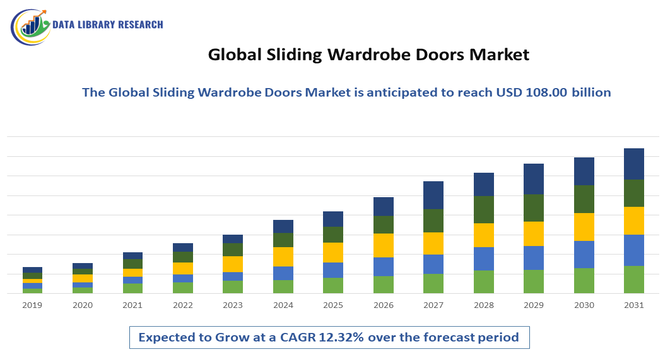
The Global Sliding Wardrobe Doors Market is experiencing robust growth driven by rising urbanization, increasing residential construction, and growing demand for space-efficient interior solutions. Modern housing designs, particularly in urban apartments with limited floor space, are accelerating the adoption of sliding wardrobe doors due to their functional and aesthetic advantages over traditional hinged doors. Growing consumer preference for customized and modular furniture, along with increasing focus on interior aesthetics, is further fueling market expansion. Technological advancements in materials, soft-close mechanisms, and lightweight yet durable door systems are enhancing product appeal.
The Global Sliding Wardrobe Doors Market is being shaped by several evolving trends that reflect consumer preferences for style, functionality, and smart living. A major trend is the increasing demand for customized and modular wardrobe solutions that integrate seamlessly with modern interior designs, allowing homeowners to personalize finishes, panel materials, and storage configurations. The use of high-quality, lightweight materials such as aluminum frames, tempered glass, and engineered wood is growing, offering durability along with contemporary aesthetics. Smart sliding mechanisms—including soft-close tracks, silent rollers, and motorized automation—are becoming more popular, especially in premium residential projects.
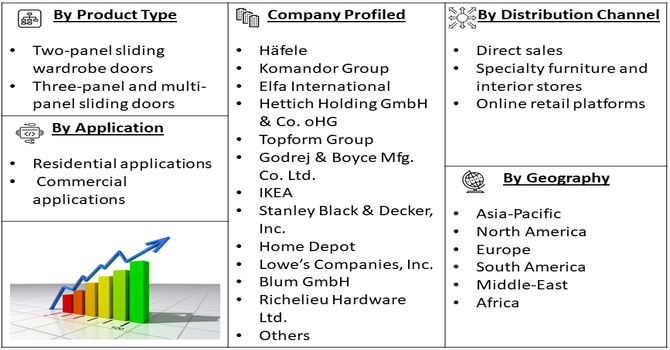
Segmentation: Global Sliding Wardrobe Doors Market is segmented By Material Type (Glass sliding wardrobe doors, Wood and engineered wood sliding doors, Metal and aluminum frame sliding doors), Door Type (Two-panel sliding wardrobe doors, Three-panel and multi-panel sliding doors), Mechanism Type (Top-hung sliding systems, Bottom-rolling sliding systems, Soft-close and automated sliding systems), Application (Residential applications, Commercial applications), Distribution Channel (Direct sales, Specialty furniture and interior stores, Online retail platforms), and Geography (North America, Europe, Asia-Pacific, Middle East and Africa, and South America). The report provides the value (in USD million) for the above segments.
For Detailed Market Segmentation - Get a Free Sample PDF
Market Drivers:
Rapid urbanization and increasing population density, particularly in metropolitan areas, are major drivers of the Global Sliding Wardrobe Doors Market. As living spaces become more compact, especially in apartments and high-rise residential buildings, consumers are seeking space-saving furniture solutions that enhance functionality without compromising aesthetics. Sliding wardrobe doors eliminate the need for door swing space, making them ideal for small bedrooms and modern layouts. Their ability to integrate seamlessly into wall-to-wall storage designs further increases usability. Growing residential construction in emerging economies, coupled with rising demand for smart and efficient interior designs, continues to drive strong adoption of sliding wardrobe doors across urban housing markets globally.
Increasing consumer focus on home aesthetics and personalized interior design is significantly driving the sliding wardrobe doors market. Homeowners are increasingly investing in customized furniture solutions that reflect individual style preferences and complement modern interior themes. Sliding wardrobe doors offer a wide range of design options, including glass, mirrored, wood, and mixed-material panels, along with customizable finishes and colors.
Technological advancements such as soft-close mechanisms, silent tracks, and premium hardware enhance user experience and product appeal. For instance, in 2020, Monumental Windows and Doors launched its 5000 Sublinear slim line sliding glass door system, featuring patent-pending reverse rolling technology. Designed for luxury residential and commercial projects, the system integrates the track into the bottom panel, enhancing performance, ease of use, and maintenance. The innovation supports multi-panel barefoot sill designs, delivering unobstructed views and superior functionality for architects, builders, and homeowners.
Market Restraints:
The major restraints in the Global Sliding Wardrobe Doors Market are the relatively high cost associated with installation and customization. Sliding wardrobe systems often require precision-engineered tracks, high-quality hardware, and professional installation to ensure smooth operation and durability. Customized designs, premium materials such as tempered glass or aluminum frames, and advanced features like soft-close or automated mechanisms further increase overall costs. These higher expenses can deter price-sensitive consumers, particularly in developing regions or budget housing segments. As a result, some consumers may opt for traditional hinged wardrobes or ready-made furniture solutions, limiting wider market penetration despite the functional benefits of sliding wardrobe doors.
Segmental Analysis:
Glass sliding wardrobe doors represent a prominent segment in the global market due to their modern appearance and ability to enhance visual space. These doors are widely preferred in contemporary residential interiors as they reflect light and create an illusion of larger rooms, making them ideal for compact urban homes. Options such as frosted, tinted, mirrored, and lacquered glass allow high levels of customization to match interior themes. Advances in tempered and safety glass technologies have improved durability and user safety, supporting wider adoption. Additionally, easy maintenance and resistance to moisture make glass sliding doors suitable for diverse climatic conditions. Growing consumer preference for sleek, minimalist interior designs continues to drive demand for this segment.
Two-panel sliding wardrobe doors hold a significant share in the market, particularly in small to medium-sized residential spaces. These doors offer a practical balance between accessibility and space utilization, allowing smooth operation without occupying additional floor area. Two-panel configurations are easy to install and maintain, making them popular in both new constructions and renovation projects. Their compatibility with various materials such as glass, wood, and metal frames enhances design flexibility. Cost-effectiveness compared to multi-panel systems further supports adoption among budget-conscious consumers. As urban apartments continue to dominate housing development, the demand for efficient and functional two-panel sliding wardrobe doors is expected to remain strong globally.
Soft-close and automated sliding systems are emerging as a high-growth segment, driven by increasing demand for convenience, safety, and premium living experiences. These mechanisms prevent abrupt door movement, reduce noise, and enhance durability by minimizing wear and tear. Automated systems integrated with smart home technologies are gaining traction in luxury residential and high-end commercial applications. Consumers are increasingly valuing smooth, effortless operation combined with modern aesthetics. Technological advancements and declining costs of automation components are making these systems more accessible. As smart homes and premium interior solutions gain popularity, the adoption of soft-close and automated sliding wardrobe mechanisms is expected to rise steadily.
Residential applications dominate the Global Sliding Wardrobe Doors Market, supported by rapid urbanization and increasing housing development. Homeowners are increasingly opting for sliding wardrobe doors to maximize space efficiency and enhance interior aesthetics. These doors are particularly suited for bedrooms and walk-in closets in apartments where space constraints are common. Rising disposable incomes and growing interest in home personalization are driving demand for customized sliding door solutions. Additionally, the growing trend of modular furniture and ready-to-install wardrobes is supporting market growth in the residential segment. Continuous investment in residential construction and renovation activities is expected to sustain strong demand over the forecast period.
Specialty furniture and interior stores play a vital role in the distribution of sliding wardrobe doors, offering consumers access to customized and premium solutions. These stores provide professional design consultation, material selection, and installation services, enhancing customer experience. Consumers often prefer physical stores to assess material quality, finishes, and sliding mechanisms before purchase. Strong relationships with interior designers and real estate developers further strengthen this channel. As demand for personalized and high-quality interior solutions increases, specialty stores continue to attract customers seeking tailored wardrobe systems. This channel remains particularly influential in urban markets where design-driven purchasing decisions are prominent.
Europe is expected to witness the highest growth in the Global Sliding Wardrobe Doors Market over the forecast period, driven by urbanization, rising apartment living, and strong demand for space-efficient furniture solutions. Increasing renovation activities across Western and Northern Europe, combined with consumer preference for modern, minimalist interiors, supported market expansion.
In November 2025, Glide and Slide Ltd, a leading UK fitted furniture specialist, expanded its bespoke sliding door wardrobe design, manufacturing, and installation services to homeowners in Solihull and neighboring regions. The move strengthens the company’s market presence, offering customized, high-quality storage solutions and enhancing accessibility to its tailored wardrobe expertise for residential clients in this growing service area. Glide and Slide’s expansion boosted Europe’s Sliding Wardrobe Doors Market by increasing regional demand for bespoke, high-quality, and customizable wardrobe solutions.
Growth in modular furniture adoption, sustainability-focused materials, and customized home storage solutions further accelerated demand. Technological advancements in soft-close mechanisms and smart fittings enhanced product appeal. Additionally, a strong presence of premium furniture manufacturers, robust e-commerce penetration, and favorable housing policies contributed to increased consumer spending on interior upgrades, positioning Europe as a key growth hub for sliding wardrobe door solutions.
| Report Matrics | Details |
| Market Size Value | USD 108.00 billion |
| Growth Rate | CAGR of 12.32% |
| Forecast | 2026-2033 |
| Historical data | 2021-2024 |
| Base Year | 2025 |
| Report Coverage | Forecasted revenue, company rating, competitive environment, growth drivers, and trends |
| Segment Coverage | Type, Application, End-User, Geography |
| Regional Scope | North America, Europe, Asia Pacific, Middle East |
| Customized scope | Free customization of reports (With 3 months Analysis Support ) |
| To Learn More About This Report | Request a Free Sample Copy |
The competitive landscape of the Global Sliding Wardrobe Doors Market is characterized by the presence of established furniture manufacturers, specialized interior solution providers, and emerging regional players focused on delivering customizable and innovative storage solutions. Companies are competing on product design, material quality, advanced sliding mechanisms, and value-added services such as installation and after-sales support. Strategic initiatives, including geographic expansion, partnerships with real estate developers, and adoption of digital customization tools are enhancing market reach. Product differentiation through the use of premium materials like tempered glass, engineered wood, and aluminum frames, along with soft-close and automated systems, is intensifying competition. Sustainability trends are also prompting players to incorporate eco-friendly materials and manufacturing practices. As consumer demand evolves toward aesthetically appealing and space-efficient wardrobes, manufacturers that offer flexible design options and superior customer experience are positioned to gain significant market share.
The major players for this market are:
Recent Development
Q1. What are the main growth-driving factors for this market?
The market is growing because urban living spaces are becoming smaller, making space-saving furniture essential. Sliding doors do not require extra room to open, making them perfect for compact apartments. Additionally, the rising popularity of home renovation projects and the demand for modern, "minimalist" interior designs are fueling global sales.
Q2. What are the main restraining factors for this market?
Growth is limited by the high cost of premium materials like tempered glass and custom aluminum frames. Installation can also be difficult, requiring perfectly level floors and professional help, which adds to the total expense. Furthermore, high-quality sliding mechanisms can wear out over time, leading to maintenance concerns for homeowners.
Q3. Which segment is expected to witness high growth?
The Customized and Mirror-Finished segment is expected to see the highest growth. Homeowners love mirrored doors because they make small rooms feel much larger and brighter by reflecting light. These custom designs allow people to choose specific colors and textures that match their unique home decor, driving high-end luxury sales.
Q4. Who are the top major players for this market?
The market is led by global furniture retailers and specialized door manufacturers. Key players include IKEA, Stanley, Spacepro, Sogal, and Komandor. These companies dominate by offering a wide range of affordable DIY kits for average consumers, as well as high-end, professionally installed systems for luxury homes and commercial hotel projects.
Q5. Which country is the largest player?
The United Kingdom is currently a leading player in the sliding wardrobe doors market. This is due to a long history of built-in furniture traditions and a high number of older homes with limited space. Strong consumer interest in interior design and a large network of specialized manufacturers keep the U.K. dominant.
Data Library Research are conducted by industry experts who offer insight on industry structure, market segmentations technology assessment and competitive landscape (CL), and penetration, as well as on emerging trends. Their analysis is based on primary interviews (~ 80%) and secondary research (~ 20%) as well as years of professional expertise in their respective industries. Adding to this, by analysing historical trends and current market positions, our analysts predict where the market will be headed for the next five years. Furthermore, the varying trends of segment & categories geographically presented are also studied and the estimated based on the primary & secondary research.
In this particular report from the supply side Data Library Research has conducted primary surveys (interviews) with the key level executives (VP, CEO’s, Marketing Director, Business Development Manager and SOFT) of the companies that active & prominent as well as the midsized organization
FIGURE 1: DLR RESEARH PROCESS
Extensive primary research was conducted to gain a deeper insight of the market and industry performance. The analysis is based on both primary and secondary research as well as years of professional expertise in the respective industries.
In addition to analysing current and historical trends, our analysts predict where the market is headed over the next five years.
It varies by segment for these categories geographically presented in the list of market tables. Speaking about this particular report we have conducted primary surveys (interviews) with the key level executives (VP, CEO’s, Marketing Director, Business Development Manager and many more) of the major players active in the market.
Secondary ResearchSecondary research was mainly used to collect and identify information useful for the extensive, technical, market-oriented, and Friend’s study of the Global Extra Neutral Alcohol. It was also used to obtain key information about major players, market classification and segmentation according to the industry trends, geographical markets, and developments related to the market and technology perspectives. For this study, analysts have gathered information from various credible sources, such as annual reports, sec filings, journals, white papers, SOFT presentations, and company web sites.
Market Size EstimationBoth, top-down and bottom-up approaches were used to estimate and validate the size of the Global market and to estimate the size of various other dependent submarkets in the overall Extra Neutral Alcohol. The key players in the market were identified through secondary research and their market contributions in the respective geographies were determined through primary and secondary research.
Forecast Model