
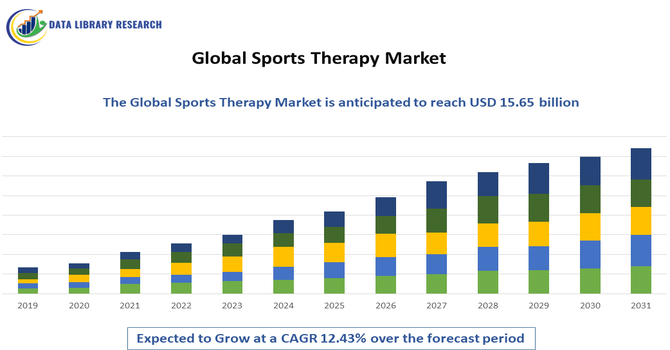
The Global Sports Therapy Market, valued around USD 7.18 billion in 2026 and projected to reach USD 15.65 billion by 2033, growing with a CAGR of 12.43% from 2026-2033.
Get Complete Analysis Of The Report - Download Updated Free Sample PDF
The Global Sports Therapy Market includes services and products designed to prevent, diagnose, and treat sports-related injuries and improve athletic performance. It encompasses physiotherapy, massage therapy, chiropractic care, rehabilitation equipment, and digital therapy tools used by athletes, fitness enthusiasts, and patients recovering from injuries. Demand is driven by rising participation in sports, increasing awareness of injury prevention, and growing emphasis on fitness and rehabilitation. Sports therapy services are commonly offered in clinics, hospitals, gyms, and sports academies.
The global sports therapy market is evolving with increasing demand for personalized and technology-driven treatment approaches. Integration of digital platforms, wearable sensors, and tele-rehabilitation tools is enhancing patient monitoring and remote care delivery. There is a growing focus on preventive treatment, performance optimization, and injury risk reduction among athletes and fitness enthusiasts. Advanced modalities such as shockwave therapy, laser therapy, and cryotherapy are becoming mainstream. Additionally, the rise of professional and amateur sports participation, aging populations seeking active lifestyles, and heightened awareness of physical wellbeing are driving service uptake.
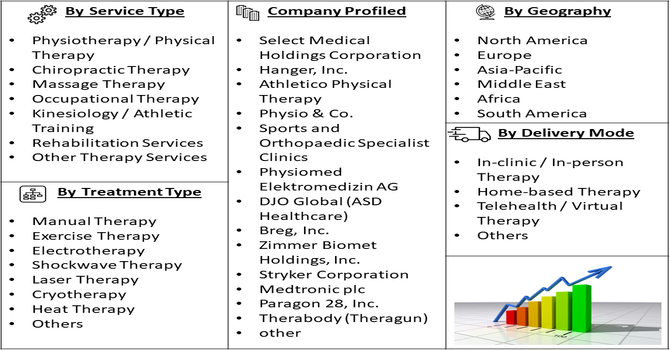
Segmentation: The Global Sports Therapy Market is segmented by Service Type (Physiotherapy / Physical Therapy, Chiropractic Therapy, Massage Therapy, Occupational Therapy, Kinesiology / Athletic Training, Rehabilitation Services and Other Therapy Services), Treatment Type (Manual Therapy, Exercise Therapy, Electrotherapy (TENS, EMS), Shockwave Therapy, Laser Therapy, Cryotherapy, Heat Therapy and Others), Delivery Mode (In-clinic / In-person Therapy, Home-based Therapy, Telehealth / Virtual Therapy and Others), and Geography (North America, Europe, Asia-Pacific, Middle East and Africa, and South America). The report provides the value (in USD million) for the above segments.
For Detailed Market Segmentation - Get a Free Sample PDF
Market Drivers:
Rising sports participation and fitness culture globally have significantly boosted demand for sports therapy. As more people engage in recreational sports, competitive athletics, and gym-based training, the incidence of musculoskeletal injuries, strains, and overuse conditions has increased. Athletes and fitness enthusiasts now seek professional therapy to prevent injuries, improve performance, and speed recovery. Additionally, major sporting events and professional leagues drive investment in sports medicine and rehabilitation services, encouraging adoption of advanced therapies. This growing emphasis on active lifestyles and injury prevention has expanded the need for specialized sports therapy services worldwide.
Technological advancements in rehabilitation and recovery tools have accelerated growth in the sports therapy market. Innovations such as wearable sensors, motion analysis systems, shockwave therapy, laser therapy, and cryotherapy enable more precise diagnosis, personalized treatment plans, and faster recovery outcomes. Digital platforms and tele-rehabilitation also allow remote monitoring, virtual sessions, and progress tracking, making therapy more accessible and convenient. As healthcare providers and athletes increasingly rely on data-driven approaches, these technologies have strengthened service quality and expanded market reach. This tech-driven transformation has also encouraged partnerships between therapy clinics, sports teams, and fitness brands, supporting market expansion.
Market Restraints:
High treatment costs and limited insurance coverage remain major restraints for the sports therapy market. Many advanced therapies and rehabilitation programs involve expensive equipment and require skilled professionals, making services unaffordable for a large portion of the population. In many regions, sports therapy is not fully covered by health insurance, leading to high out-of-pocket expenses. This limits adoption, especially among low-income groups and in developing economies. Additionally, lack of standardized regulations and varying quality of care can reduce patient trust, further constraining market growth.
The sports therapy market contributes significantly to public health and economic activity by reducing injury-related downtime and improving physical performance. Access to effective therapy helps individuals return to work or sport sooner, boosting productivity and quality of life. It also lowers long-term healthcare costs by preventing chronic musculoskeletal issues and reducing surgical interventions. The industry supports employment for therapists, trainers, and support staff, while spurring growth in related sectors like fitness technology, equipment manufacturing, and sports medicine education. Moreover, sports therapy enhances community fitness culture and encourages participation across age groups, fostering healthier, more active lifestyles with positive socioeconomic outcomes.
Segmental Analysis:
Physiotherapy has emerged as the most sought-after sports therapy service due to its broad application in injury recovery, performance enhancement, and chronic condition management. It offers a wide range of evidence-based techniques, including exercise prescription, manual therapy, and functional rehabilitation, making it suitable for athletes, fitness enthusiasts, and patients recovering from surgery or injuries. Increasing awareness of preventive care and rehabilitation benefits has encouraged more individuals to seek physiotherapy early, reducing long-term complications. Moreover, integration with sports clubs, hospitals, and fitness centers has expanded access, positioning physiotherapy as the fastest-growing segment in the sports therapy market.
Cryotherapy is gaining rapid popularity as a high-impact recovery and pain management treatment in sports therapy. Athletes increasingly use whole-body and localized cryotherapy to reduce inflammation, alleviate muscle soreness, and accelerate recovery after intense training or competitions. The rise in demand is driven by its non-invasive nature, quick treatment times, and perceived performance benefits. Fitness centers, rehabilitation clinics, and sports facilities are adding cryotherapy chambers to attract clients and provide premium recovery services. As scientific evidence and athlete endorsements grow, cryotherapy is expected to witness strong adoption, making it one of the fastest-growing treatment segments in the market.
Despite digital health growth, in-clinic therapy remains the dominant and fastest-growing delivery mode in sports therapy due to hands-on treatment needs. Manual techniques, physical assessments, and specialized equipment require direct therapist interaction, making in-person sessions essential for accurate diagnosis and effective rehabilitation. Athletes and patients prefer clinic visits for personalized care, real-time adjustments, and supervised exercises. Additionally, clinics offer access to advanced modalities such as shockwave therapy, laser therapy, and electrotherapy that cannot be fully replicated remotely. The continued expansion of specialized sports therapy clinics and rehabilitation centers supports strong growth in the in-person segment over the forecast period.
North America is poised for the highest growth in sports therapy, driven by strong sports participation, high healthcare spending, and advanced rehabilitation infrastructure. The region benefits from widespread adoption of sports science, preventive care, and performance optimization among professional teams, colleges, and fitness enthusiasts.
In May 2025, the acquisition of California-based Spine & Sport Physical Therapy expanded PRN’s footprint by adding 51 clinics across Southern and Northern California, strengthening its position as a top outpatient therapy provider in the state. Known for patient-centered care and strong clinical outcomes, Spine & Sport brought research-based expertise and broad service offerings. The retained leadership and integration into PRN’s existing California network boosted market consolidation and service capacity in North America’s sports therapy sector.
Additionally, the presence of leading therapy providers, advanced medical technologies, and supportive insurance systems promotes access to specialized rehabilitation services. Growing awareness of injury prevention, rising geriatric fitness trends, and increasing demand for personalized care also contribute to market expansion. Strong R&D activity and integration of digital health solutions further reinforce North America’s leadership in sports therapy growth.
| Report Matrics | Details |
| Market Size Value | USD 15.65 billion |
| Growth Rate | CAGR of 12.43% |
| Forecast | 2026-2033 |
| Historical data | 2021-2024 |
| Base Year | 2025 |
| Report Coverage | Forecasted revenue, company rating, competitive environment, growth drivers, and trends |
| Segment Coverage | Type, Application, End-User, Geography |
| Regional Scope | North America, Europe, Asia Pacific, Middle East |
| Customized scope | Free customization of reports (With 3 months Analysis Support ) |
| To Learn More About This Report | Request a Free Sample Copy |
The competitive landscape of the global sports therapy market is diverse, including independent clinics, hospital-based rehabilitation centers, specialized sports therapy chains, and digital health startups. Providers compete on service quality, technological capabilities, range of therapies, and professional expertise. Adoption of innovative treatment technologies and integration with sports science research differentiates leaders from smaller practices. Strategic partnerships with sports teams, fitness centers, and healthcare networks expand market reach and brand visibility. Telehealth and app-based services are fostering new competition from tech-driven entrants. Geographic expansion into emerging markets and investment in therapist training also shape competitive dynamics. Regulatory compliance and accreditation play key roles in establishing trust and credibility.
The major players for above market are:
Recent Development
Q1. What are the main growth-driving factors for this market?
The market is driven by increasing participation in professional and recreational sports, leading to higher injury rates. Growing awareness of physical fitness, the rise of sports medicine technology, and an aging population staying active contribute significantly. Additionally, government initiatives promoting athletic activities and improved insurance coverage for rehabilitation services further accelerate growth.
Q2. What are the main restraining factors for this market?
High costs associated with specialized sports therapy equipment and long-term treatment sessions can limit market accessibility for middle-income patients. Furthermore, a shortage of highly skilled sports therapists in developing regions hinders market expansion. The availability of low-cost alternative treatments and home-based recovery tools also presents a challenge to professional clinics.
Q3. Which segment is expected to witness high growth?
Cryotherapy is expected to grow fastest as athletes and fitness enthusiasts increasingly seek rapid recovery and inflammation relief. Its non-invasive, time-efficient treatments are popular in sports clinics and wellness centers. Rising endorsements, expanding clinic availability, and growing awareness of performance benefits are driving strong adoption across markets.
Q4. Who are the top major players for this market?
Prominent players in the sports therapy market include DJO Global, Inc., BTL Industries, Zimmer MedizinSysteme GmbH, and Performance Health. Other influential companies include Mueller Sports Medicine, Inc. and Cramer Products. These leaders focus on product innovation, strategic partnerships with sports organizations, and expanding their portfolios in physical therapy and bracing.
Q5. Which country is the largest player?
The United States is the largest player in the sports therapy market. This dominance stems from a massive sports culture, high healthcare spending, and advanced medical infrastructure. The presence of major professional leagues (NFL, NBA, MLB) and a robust network of specialized clinics ensure a consistently high demand for therapy.
Data Library Research are conducted by industry experts who offer insight on industry structure, market segmentations technology assessment and competitive landscape (CL), and penetration, as well as on emerging trends. Their analysis is based on primary interviews (~ 80%) and secondary research (~ 20%) as well as years of professional expertise in their respective industries. Adding to this, by analysing historical trends and current market positions, our analysts predict where the market will be headed for the next five years. Furthermore, the varying trends of segment & categories geographically presented are also studied and the estimated based on the primary & secondary research.
In this particular report from the supply side Data Library Research has conducted primary surveys (interviews) with the key level executives (VP, CEO’s, Marketing Director, Business Development Manager and SOFT) of the companies that active & prominent as well as the midsized organization
FIGURE 1: DLR RESEARH PROCESS
Extensive primary research was conducted to gain a deeper insight of the market and industry performance. The analysis is based on both primary and secondary research as well as years of professional expertise in the respective industries.
In addition to analysing current and historical trends, our analysts predict where the market is headed over the next five years.
It varies by segment for these categories geographically presented in the list of market tables. Speaking about this particular report we have conducted primary surveys (interviews) with the key level executives (VP, CEO’s, Marketing Director, Business Development Manager and many more) of the major players active in the market.
Secondary ResearchSecondary research was mainly used to collect and identify information useful for the extensive, technical, market-oriented, and Friend’s study of the Global Extra Neutral Alcohol. It was also used to obtain key information about major players, market classification and segmentation according to the industry trends, geographical markets, and developments related to the market and technology perspectives. For this study, analysts have gathered information from various credible sources, such as annual reports, sec filings, journals, white papers, SOFT presentations, and company web sites.
Market Size EstimationBoth, top-down and bottom-up approaches were used to estimate and validate the size of the Global market and to estimate the size of various other dependent submarkets in the overall Extra Neutral Alcohol. The key players in the market were identified through secondary research and their market contributions in the respective geographies were determined through primary and secondary research.
Forecast Model