
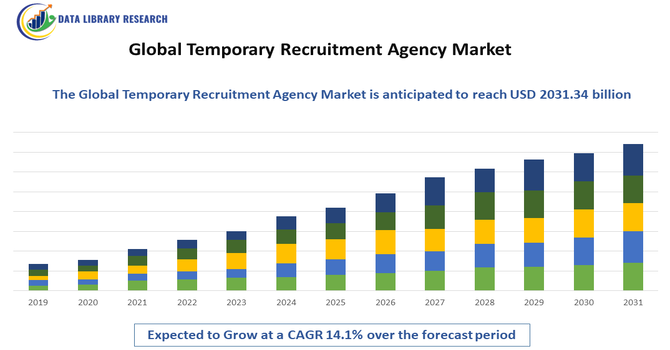
The Global Temporary Recruitment Agency Market is likely to hit USD 2031.34 billion by 2033, growing at a CAGR of 14.1%, from USD 835.7 billion in 2025.
Get Complete Analysis Of The Report - Download Updated Free Sample PDF
The Global Temporary Recruitment Agency Market refers to the worldwide industry of firms that specialize in sourcing, screening, and placing workers in short-term, contract, project-based, and interim roles for client organizations. These agencies serve diverse sectors such as IT, healthcare, manufacturing, retail, and corporate services, providing flexible workforce solutions that help companies scale labour to match demand while minimizing long-term employment commitments. The market includes services like temporary staffing, temp-to-permanent hiring, payroll support, and on-demand talent matching. Growing demand for workforce agility, remote work, and digital hiring technologies continues to shape this dynamic market landscape.
The global temporary recruitment market is evolving with significant trends such as digital transformation and AI adoption, which streamline candidate sourcing, screening, and placement using predictive analytics and automated platforms. Remote and hybrid work models are driving demand for flexible staffing arrangements, particularly in IT and support services. Temporary hiring has also grown as companies embrace agile workforce strategies to adjust to economic shifts and project-based needs. Use of mobile staffing apps and cloud-based applicant tracking systems is rising, improving workforce management and candidate engagement. Sustainability and diversity hiring are emerging priorities, influencing service offerings and recruitment strategies.
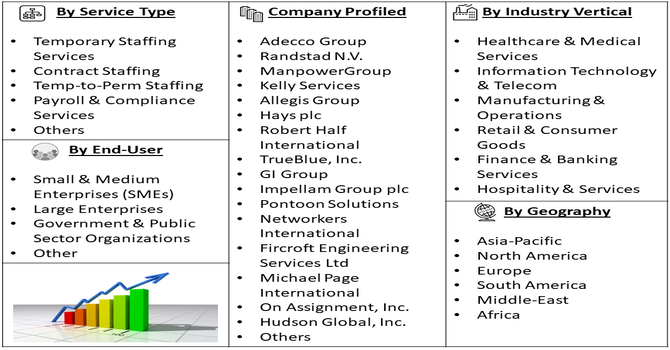
Segmentation: The Global Temporary Recruitment Agency Market is segmented by Service Type (Temporary Staffing Services, Contract Staffing, Temp-to-Perm Staffing, Payroll & Compliance Services and Others), Industry Vertical (Healthcare & Medical Services, Information Technology & Telecom, Manufacturing & Operations, Retail & Consumer Goods, Finance & Banking Services, Hospitality & Services and Other Sectors (Logistics, Education, Public Sector)), End-User (Small & Medium Enterprises (SMEs), Large Enterprises, Government & Public Sector Organizations and Other End Users (Non-profits, Startups)), and Geography (North America, Europe, Asia-Pacific, Middle East and Africa, and South America). The report provides the value (in USD million) for the above segments.
 For Detailed Market Segmentation - Get a Free Sample PDF
Market Drivers:
A key driver of market growth is increasing corporate demand for flexible workforce solutions to adapt to fluctuating project needs and economic cycles. Temporary recruitment agencies enable businesses to scale labour up or down without long-term contracts, reducing fixed salary expenses and benefit obligations. This flexibility is especially crucial in industries facing seasonal peaks, uncertain demand, or rapid technological change. By providing access to specialized, short-term talent pools, agencies help organizations maintain operational continuity and responsiveness. Workforce flexibility also allows employers to trial candidates before permanent hiring decisions, increasing staffing efficiency.
Another major driver is the integration of technology and digital platforms in recruitment processes. AI-powered applicant tracking systems, predictive analytics, and automated candidate sourcing tools significantly enhance the speed and accuracy of temporary placements.
Digital matching platforms and mobile apps simplify job discovery and improve the user experience for both workers and employers. For instance, in November 2025, BrainLab Inc., a ZIGExN Group company, announced that its staffing and placement management system, MatchinGood, received recognition in two categories at the ITreview Grid Award 2025 Fall. The recognition highlighted the platform’s role in advancing digital integration, streamlining recruitment workflows, improving system efficiency, and strengthening technology-driven hiring processes. These technologies reduce administrative burdens, optimize talent pipelines, and improve placement outcomes. As agencies adopt technology to drive efficiency and data-driven decision making, they can expand services, enter new markets, and differentiate offerings—further propelling market expansion.
Market Restraints:
One significant restraint in the global temporary recruitment market is regulatory and compliance complexity across jurisdictions. Varying labour laws, worker classification rules, and employment regulations create administrative burdens for agencies operating internationally. Ensuring compliance with standards for wages, benefits, tax reporting, and worker rights increases operational costs and legal risk. Regulatory uncertainty related to gig work classification and contract labour restrictions can deter agency expansion or slow cross-border placements. Smaller agencies may struggle to adapt to complex compliance frameworks, limiting their competitiveness. Compliance challenges also require investment in HR technology and legal expertise, which can constrain profitability and scalability.
The temporary recruitment market plays a vital socioeconomic role by reducing unemployment and supporting economic flexibility. By connecting businesses with short-term talent, it helps firms adjust to fluctuating demand while offering workers diverse job opportunities and skill development. Temporary staffing contributes significantly to employment figures globally, including large workforces in the U.S., Europe, and Asia. It supports industries during peak seasons, project peaks, and labour shortages, helping sustain productivity and competitiveness. For workers, temporary roles can offer income stability, pathways to permanent employment, and entry points into new industries. By augmenting formal job markets, temporary hiring fosters labour market dynamism and resilience.
Segmental Analysis:
The Contract Staffing segment is projected to register the most robust growth within the Global Temporary Recruitment Agency Market over the forecast period. Companies increasingly prefer contract hires to meet project-based or short-term workforce demands without long-term employment obligations. This trend is being reinforced by uncertain economic conditions, sector-specific skills shortages, and organizational priorities to reduce fixed costs while accessing specialized talent quickly. Contract staffing offers flexibility, allowing firms to scale operations in response to fluctuating demand and technology-driven project cycles. Rapid adoption of digital recruitment platforms further accelerates placements, enhancing efficiency and responsiveness. As businesses continue to value agility and cost-efficiency, demand for contract staffing services is expected to outpace other segments.
The Healthcare & Medical Services segment is anticipated to experience the highest growth over the forecast period within the Global Temporary Recruitment Agency Market. Aging populations, rising chronic disease prevalence, and periodic surges in patient demand have intensified the need for flexible clinical staffing across hospitals, clinics, long-term care, and allied health settings. Shortages of nurses, allied professionals, and specialized clinicians are persistent, prompting healthcare providers to rely on temporary workforce solutions to maintain service quality and operational continuity. Technological tools that enhance credentialing, scheduling, and placement accuracy further enable agencies to match talent to demand efficiently. Market analysis also shows that North America’s healthcare temporary staffing demand remains especially strong, underlining the sector’s significant growth impact.
The Small & Medium Enterprises (SMEs) segment is projected to witness the highest growth among end-user categories in the Global Temporary Recruitment Agency Market. SMEs often operate with limited HR resources and constrained budgets for permanent hires, making temporary staffing a cost-effective solution for scaling workforce capacity during peak periods or specific projects. As digital platforms simplify access to pre-screened talent pools, SMEs can adopt flexible staffing models more readily, reducing recruitment lead times and administrative burdens. Furthermore, increasing economic pressure to optimize costs and stay competitive encourages SMEs to leverage temporary recruitment services for specialized skills and short-term labor, supporting agile business strategies and resource allocation.
The North American region is expected to achieve the highest growth rate in the Global Temporary Recruitment Agency Market over the forecast period.
North America continues to lead due to its mature labor markets, high reliance on flexible workforce strategies, and widespread adoption of digital recruitment technologies. Strong demand spans key sectors including healthcare, IT, finance, and services where temporary and contract staffing are critical for meeting fluctuating demand and specialized project needs. For instance, in June 2025, the Association of Canadian Search, Employment and Staffing Services reported a fourth consecutive month of growth, with the Canadian Staffing Index rising 11.8% year over year and 3.7% month over month. This sustained expansion signalled strengthening demand and positive momentum across North America’s temporary recruitment agency market.
The region’s robust economic infrastructure, extensive presence of global staffing firms, and supportive employment regulations help sustain growth momentum. Additionally, digitization and AI-enabled hiring platforms are accelerating recruitment efficiency, reinforcing North America’s dominant growth trajectory in the global market. For instance, in 2024, Randstad USA’s recognition as one of America’s Best Recruiting and Temporary Staffing Firms for 2024 enhanced its market credibility and reinforced its leadership position within the industry. The distinction strengthened client confidence, elevated competitive benchmarks, and underscored service excellence, thereby contributing to heightened competition and sustained growth across North America’s temporary recruitment agency market.
Thus, all such factors are together fuelling the growth of North America’s temporary recruitment agency market.
| Report Matrics | Details |
| Market Size Value | USD 2031.34 billion |
| Growth Rate | CAGR of 14.1 % |
| Forecast | 2026-2033 |
| Historical data | 2021-2024 |
| Base Year | 2025 |
| Report Coverage | Forecasted revenue, company rating, competitive environment, growth drivers, and trends |
| Segment Coverage | Type, Application, End-User, Geography |
| Regional Scope | North America, Europe, Asia Pacific, Middle East |
| Customized scope | Free customization of reports (With 3 months Analysis Support ) |
| To Learn More About This Report | Request a Free Sample Copy |
The Global Temporary Recruitment Agency Market is fragmented yet dominated by several multinational staffing leaders and specialized firms with extensive networks and technology capabilities. Major global players leverage digital platforms, geographic reach, and broad service portfolios to capture market share across regions. Competitive factors include speed of placement, quality of candidate screening, technological innovation (like AI and workforce analytics), and industry specialization. Emerging and regional agencies also compete by focusing on niche sectors, local knowledge, or tailored solutions for SMEs. Partnerships, acquisitions, and service diversification are common strategies as firms aim to enhance client solutions and differentiate in a competitive talent services environment.
The main players for this market are:
Recent Development
Q1. What are the main growth-driving factors for this market?
The rise of the "gig economy" and the increasing need for workforce flexibility drive market growth. Companies utilize temporary staffing to manage seasonal demand and reduce long-term overhead costs. Additionally, the growing complexity of labor laws and the need for specialized skills encourage businesses to outsource hiring to expert agencies.
Q2. What are the main restraining factors for this market?
Strict labor regulations and changing legal definitions regarding "co-employment" pose significant challenges for agencies. Fluctuating economic conditions often lead companies to freeze all hiring, including temporary roles. Furthermore, high competition among agencies leads to price wars and thinning profit margins, while talent shortages make it difficult to fill specialized positions.
Q3. Which segment is expected to witness high growth?
The IT and Healthcare segments are expected to witness the highest growth. The rapid pace of digital transformation requires specialized technical talent on a project basis, while the global nursing shortage forces healthcare facilities to rely heavily on travel nurses and temporary clinical staff to maintain essential patient care standards.
Q4. Who are the top major players for this market?
The market is dominated by global leaders such as Randstad N.V., The Adecco Group, and ManpowerGroup. These firms leverage vast international networks and proprietary digital platforms. Other significant players include Allegis Group, Kelly Services, and Robert Half, which focus on specialized professional staffing and high-volume recruitment solutions across diverse industries.
Q5. Which country is the largest player?
The United States is the largest player in the temporary recruitment market. Its leadership is sustained by a highly flexible labor market and a corporate culture that prioritizes "just-in-time" staffing models. The presence of major global corporations and a diverse economy ensures consistent demand across the industrial, office, and professional sectors.
Data Library Research are conducted by industry experts who offer insight on industry structure, market segmentations technology assessment and competitive landscape (CL), and penetration, as well as on emerging trends. Their analysis is based on primary interviews (~ 80%) and secondary research (~ 20%) as well as years of professional expertise in their respective industries. Adding to this, by analysing historical trends and current market positions, our analysts predict where the market will be headed for the next five years. Furthermore, the varying trends of segment & categories geographically presented are also studied and the estimated based on the primary & secondary research.
In this particular report from the supply side Data Library Research has conducted primary surveys (interviews) with the key level executives (VP, CEO’s, Marketing Director, Business Development Manager and SOFT) of the companies that active & prominent as well as the midsized organization
FIGURE 1: DLR RESEARH PROCESS
Extensive primary research was conducted to gain a deeper insight of the market and industry performance. The analysis is based on both primary and secondary research as well as years of professional expertise in the respective industries.
In addition to analysing current and historical trends, our analysts predict where the market is headed over the next five years.
It varies by segment for these categories geographically presented in the list of market tables. Speaking about this particular report we have conducted primary surveys (interviews) with the key level executives (VP, CEO’s, Marketing Director, Business Development Manager and many more) of the major players active in the market.
Secondary ResearchSecondary research was mainly used to collect and identify information useful for the extensive, technical, market-oriented, and Friend’s study of the Global Extra Neutral Alcohol. It was also used to obtain key information about major players, market classification and segmentation according to the industry trends, geographical markets, and developments related to the market and technology perspectives. For this study, analysts have gathered information from various credible sources, such as annual reports, sec filings, journals, white papers, SOFT presentations, and company web sites.
Market Size EstimationBoth, top-down and bottom-up approaches were used to estimate and validate the size of the Global market and to estimate the size of various other dependent submarkets in the overall Extra Neutral Alcohol. The key players in the market were identified through secondary research and their market contributions in the respective geographies were determined through primary and secondary research.
Forecast Model