
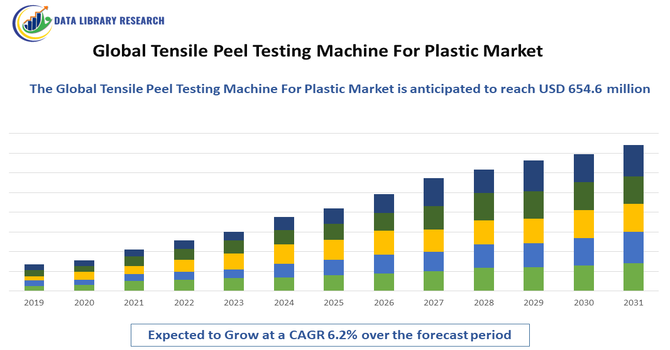
Get Complete Analysis Of The Report - Download Updated Free Sample PDF
The growth of the Global Tensile Peel Testing Machine for Plastic Market is primarily driven by the increasing demand for high-precision, reliable testing equipment to evaluate adhesion strength, bonding quality, and material durability across plastic packaging, automotive components, consumer goods, and industrial materials. As manufacturers adopt advanced polymers, multilayer films, and engineered plastic composites, the need for accurate peel, tensile, and adhesion testing has intensified to ensure compliance with stringent international quality and safety standards.
The latest trends in the Global Tensile Peel Testing Machine for Plastic Market highlight a strong shift toward advanced automation, digitalization, and high-precision measurement technologies. Manufacturers are increasingly integrating AI-enabled analytics, real-time data logging, and IoT-connected systems to enhance accuracy, repeatability, and process control in peel and adhesion testing. There is growing adoption of multifunctional universal testing systems capable of handling tensile, peel, shear, and puncture tests within a single platform, improving laboratory efficiency. Demand is also rising for non-destructive and micro-force testing capabilities to support lightweight plastics, flexible packaging films, and high-performance polymer composites.
Segmentation: Global Tensile Peel Testing Machine For Plastic Market is segmented (Tensile Test Machines, Peel Test Machines, Adhesion/Bond Strength Test Machines), Load Capacity (Low-capacity machines, Medium-capacity machines, High-capacity machines), Automation Level (Manual Testing Machines, Semi-automatic Testing Machines, Fully Automatic/Computerized Testing Machines), End Use Industry (Packaging, Automotive & Transportation, Consumer Goods & Electronics), Application (Adhesion strength measurement, Bonding quality analysis, Seal integrity testing, Tensile performance evaluation), and Geography (North America, Europe, Asia-Pacific, Middle East and Africa, and South America). The report provides the value (in USD million) for the above segments.
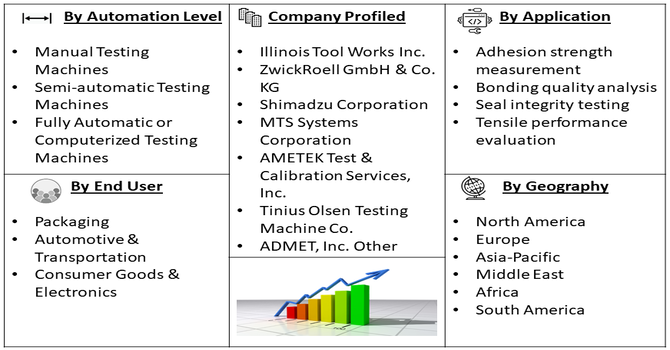
For Detailed Market Segmentation - Get a Free Sample PDF
Market Drivers:
One of the primary drivers of the Global Tensile Peel Testing Machine for Plastic Market is the increasing need for rigorous quality assurance as industries adopt advanced plastic materials, multilayer films, and engineered polymer composites.
Modern applications—such as food packaging, medical devices, high-strength automotive components, and electronics—require materials with precise bonding, adhesion, and tensile properties. This demand is further amplified by the rise of flexible packaging and lightweight materials, which require reliable peel, tensile, and seal integrity testing to prevent product failures, contamination, or structural weakness during use.
Rapid advancements in automated testing technologies significantly propel market growth, as industries across packaging, automotive, and consumer goods shift toward more efficient, data-driven quality control systems.
Modern tensile peel testing machines now incorporate computerized control systems, high-resolution sensors, digital force measurement, and real-time data capture, enabling precise and repeatable tests. Automation not only reduces human error but also increases testing throughput—crucial for large-scale plastic manufacturing environments. Additionally, integration with IoT, cloud platforms, and laboratory information management systems (LIMS) allows seamless monitoring, reporting, and analysis of test results.
Market Restraints:
The high initial investment costs for advanced, fully automated testing machines—especially those equipped with digital controls, high-precision sensors, and multifunction capabilities—remain a significant barrier. Many companies continue to rely on manual or semi-automated systems due to budget constraints. Additionally, the lack of standardization in testing procedures across different regions and industries creates inconsistencies in performance evaluation, making it challenging for manufacturers to select suitable equipment that complies with varied regulatory requirements. Technical complexity is another restraint, as operating sophisticated testing machines often requires skilled personnel, advanced calibration knowledge, and regular maintenance, which can increase operational costs.
The Global Tensile Peel Testing Machine for Plastic Market had significant socioeconomic impacts by enhancing quality control, product reliability, and manufacturing efficiency across the plastics and packaging industries. Its adoption had enabled manufacturers to meet regulatory standards, reduce material waste, and improve consumer safety, contributing to economic productivity. The market’s growth had created skilled job opportunities in testing, engineering, and quality assurance, while driving investment in laboratory infrastructure and technological upgrades. Additionally, increased demand for precise testing had fostered innovation in testing methodologies and equipment, strengthening competitiveness among manufacturers globally and supporting sustainable practices in plastic production and packaging sectors.
Segmental Analysis:
Peel test machines represent a key segment in the market due to the increasing use of multilayer plastic films, laminates, and adhesive-based products in packaging and industrial applications. These machines measure the peel strength and adhesion quality between layers, which is critical for ensuring product integrity, seal reliability, and performance under stress. Peel testing is widely used in food and pharmaceutical packaging, where leak prevention and durability are paramount. The growing adoption of flexible and lightweight packaging materials has further driven demand for precise, high-resolution peel testing systems.
Medium-capacity machines, capable of handling loads between 1–10 kN, are widely used across packaging, consumer goods, and automotive sectors. They provide an optimal balance between measurement range and precision, making them suitable for most industrial applications involving plastics and laminates. Their versatility and affordability compared to high-capacity systems make them popular among quality-control laboratories, R&D centers, and mid-scale manufacturing units. This segment is expected to grow steadily as manufacturers increasingly adopt standardized testing for everyday production processes.
Fully automatic and computerized testing machines are gaining traction as industries move toward digitalized quality-control environments. These systems offer high precision, repeatability, and the ability to integrate with software for real-time data acquisition, analysis, and reporting. Automation reduces human error, enhances throughput, and allows for complex multi-step tests such as adhesion, tensile, and seal integrity evaluations in a single setup. The trend toward Industry 4.0 and smart manufacturing further drives demand for these advanced automated systems.
The packaging industry is the largest end-user segment for tensile peel testing machines due to the critical need for testing the adhesion, sealing strength, and durability of plastic films, pouches, and laminates. The rise of flexible packaging, multilayer films, and sustainable biodegradable plastics has increased the complexity of materials used, necessitating reliable testing equipment to ensure product performance, shelf-life, and regulatory compliance. Packaging manufacturers rely heavily on peel and tensile testing to maintain quality across high-volume production lines.
Seal integrity testing is a vital application segment as it ensures the safety, durability, and functionality of sealed plastic products, particularly in food, pharmaceutical, and medical packaging. Tensile peel testing machines help identify weak seals, bonding defects, and adhesion failures, preventing product leakage, contamination, and recalls. The increasing regulatory focus on product safety and quality, coupled with consumer demand for reliable packaging, continues to drive adoption of seal integrity testing in industrial processes.
North America is a leading regional market due to the presence of advanced manufacturing infrastructure, stringent quality and regulatory standards, and high adoption of automated testing systems. The region benefits from strong investments in R&D, widespread use of high-performance plastics, and an emphasis on quality assurance in packaging, automotive, and medical industries.
The growing focus on Industry 4.0 practices and smart laboratories further fuels demand for computerized and automated tensile peel testing machines, maintaining North America’s dominance over the forecast period. For instance, in November 2025, Sauce Labs’ introduction of Sauce AI for Insights had showcased the transformative role of AI-powered analytics in quality assessment and process optimization. By enabling faster, more accurate evaluation of test data, it had emphasized the critical importance of reliable testing solutions. This focus had indirectly increased awareness and demand for precise equipment, such as tensile peel testing machines, supporting efficiency, accuracy, and growth in the Global Tensile Peel Testing Machine for Plastic Market.
Thus, such factors are driving the growth of above market in this region.
| Report Matrics | Details |
| Market Size Value | USD 654.6 million |
| Growth Rate | CAGR of 6.2% |
| Forecast | 2026-2033 |
| Historical data | 2021-2024 |
| Base Year | 2025 |
| Report Coverage | Forecasted revenue, company rating, competitive environment, growth drivers, and trends |
| Segment Coverage | Type, Application, End-User, Geography |
| Regional Scope | North America, Europe, Asia Pacific, Middle East |
| Customized scope | Free customization of reports (With 3 months Analysis Support ) |
| To Learn More About This Report | Request a Free Sample Copy |
The competitive landscape of the global tensile peel testing machine for plastic market is marked by a diverse mix of long established universal and materials testing equipment manufacturers, specialized adhesion/peel testers, and a growing number of global and regional suppliers — all vying to offer more precise, versatile, and automated quality control solutions. Leading players differentiate themselves through technical capabilities (e.g., high force ranges, multi test flexibility, digital data acquisition, compliance with international standards), breadth of product offerings, and global service and distribution networks. Ongoing consolidation, partnerships, and product innovation (e.g. combining tensile, peel, seal, and adhesion tests in universal machines) continue to intensify competition and push the market toward higher-performance, smarter testing instruments.
Key Players:
Recent Development
Q1. What are the main growth-driving factors for this market?
The market is primarily driven by the increasing need for strict quality control and assurance across manufacturing sectors, especially automotive and packaging. The growing global focus on developing high-performance, lightweight materials like composites and specialized plastics requires precise testing for safety, durability, and compliance with stringent industry standards, thus boosting machine demand.
Q2. What are the main restraining factors for this market?
A key restraining factor is the high initial investment required for purchasing advanced tensile testing machines, which often feature complex electromechanical or universal testing capabilities. Furthermore, the market faces a constraint from the high operational costs, including maintenance and the necessity of hiring or training skilled technicians to operate and interpret results accurately.
Q3. Which segment is expected to witness high growth?
The electromechanical testing machines segment is projected to show significant growth. This is due to their high precision, efficiency, and suitability for testing materials like plastics and composites that require exact and consistent force application. The increasing push towards automation and specialized niche applications in high-tech industries also favors this segment.
Q4. Who are the top major players for this market?
The market is dominated by established global companies known for precision testing equipment. Key major players include Instron (Ametek), ZwickRoell, Shimadzu Corporation, and Tinius Olsen. These companies maintain market leadership by constantly innovating in software, automation capabilities, and offering comprehensive testing solutions tailored to specific industry standards.
Q5. Which country is the largest player?
The United States in the North American region currently holds the largest market share for tensile testing machines. This is attributed to the presence of a robust manufacturing base, continuous high R&D spending, and the mandatory regulatory frameworks that require strict material quality testing, particularly in the defense, aerospace, and medical device industries.
Data Library Research are conducted by industry experts who offer insight on industry structure, market segmentations technology assessment and competitive landscape (CL), and penetration, as well as on emerging trends. Their analysis is based on primary interviews (~ 80%) and secondary research (~ 20%) as well as years of professional expertise in their respective industries. Adding to this, by analysing historical trends and current market positions, our analysts predict where the market will be headed for the next five years. Furthermore, the varying trends of segment & categories geographically presented are also studied and the estimated based on the primary & secondary research.
In this particular report from the supply side Data Library Research has conducted primary surveys (interviews) with the key level executives (VP, CEO’s, Marketing Director, Business Development Manager and SOFT) of the companies that active & prominent as well as the midsized organization
FIGURE 1: DLR RESEARH PROCESS
Extensive primary research was conducted to gain a deeper insight of the market and industry performance. The analysis is based on both primary and secondary research as well as years of professional expertise in the respective industries.
In addition to analysing current and historical trends, our analysts predict where the market is headed over the next five years.
It varies by segment for these categories geographically presented in the list of market tables. Speaking about this particular report we have conducted primary surveys (interviews) with the key level executives (VP, CEO’s, Marketing Director, Business Development Manager and many more) of the major players active in the market.
Secondary ResearchSecondary research was mainly used to collect and identify information useful for the extensive, technical, market-oriented, and Friend’s study of the Global Extra Neutral Alcohol. It was also used to obtain key information about major players, market classification and segmentation according to the industry trends, geographical markets, and developments related to the market and technology perspectives. For this study, analysts have gathered information from various credible sources, such as annual reports, sec filings, journals, white papers, SOFT presentations, and company web sites.
Market Size EstimationBoth, top-down and bottom-up approaches were used to estimate and validate the size of the Global market and to estimate the size of various other dependent submarkets in the overall Extra Neutral Alcohol. The key players in the market were identified through secondary research and their market contributions in the respective geographies were determined through primary and secondary research.
Forecast Model