
Get Complete Analysis Of The Report - Download Updated Free Sample PDF
Rapid adoption of ultra-slim power banks is being driven by a convergence of consumer and technological trends: ubiquitous smartphone and wearable ownership (and increasingly power-hungry features like 5G, high-refresh displays, and mobile gaming) has pushed demand for portable, discreet charging; advances in high-energy-density lithium-polymer cells and compact PCB/thermal designs allow manufacturers to pack meaningful capacity into thinner enclosures; rising consumer preference for lightweight, pocketable accessories.
The Global Ultra-Slim Power Bank Market is evolving rapidly with several clear latest trends shaping product development, consumer preferences, and competitive dynamics. Manufacturers are increasingly integrating advanced fast-charging technologies such as USB-C Power Delivery and Quick Charge to meet user demand for rapid power delivery in sleek form factors, while wireless charging (including emerging Qi2 standards) is gaining traction as consumers seek cable-free convenience with slim designs. Sustainability and eco-friendly product narratives are becoming more prominent, with brands emphasizing recyclable materials, energy-efficient manufacturing, and even solar-assisted charging solutions to appeal to environmentally conscious buyers.
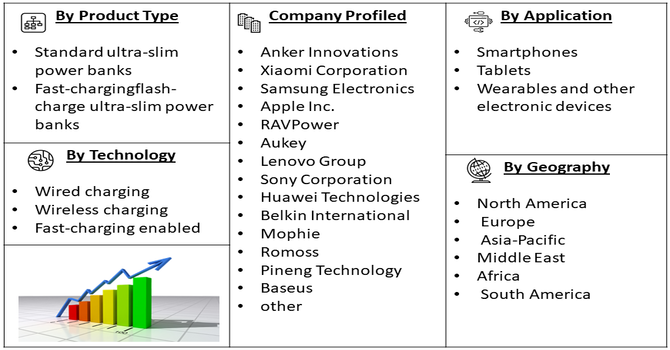
Segmentation: Global Ultra-Slim Power Bank Market is segmented By Product Type (Standard ultra-slim power banks, Fast-charging, flash-charge ultra-slim power banks), Battery Capacity (Below 2,000 mAh, 2,000–5,000 mAh, 5,000–10,000 mAh), Charging Technology (Wired charging, Wireless charging, Fast-charging enabled), Number of Output Ports (Single output port, Dual output ports, Multiple output ports), Application (Smartphones, Tablets, Wearables and other electronic devices), and Geography (North America, Europe, Asia-Pacific, Middle East and Africa, and South America). The report provides the value (in USD million) for the above segments.
For Detailed Market Segmentation - Get a Free Sample PDF
Market Drivers:
The rapid increase in global smartphone penetration, along with the growing use of tablets, wearables, wireless earbuds, and other portable electronics, is a major driver of the ultra-slim power bank market. Modern devices support high-performance features such as 5G connectivity, high-resolution displays, mobile gaming, video streaming, and AI-enabled applications, all of which significantly increase battery consumption. At the same time, users expect uninterrupted connectivity during travel, work, and daily commuting. Ultra-slim power banks address this need by offering convenient, on-the-go charging without adding bulk, making them particularly attractive to urban consumers, professionals, students, and frequent travelers. The shift toward mobile-centric lifestyles continues to fuel consistent demand for compact and lightweight charging solutions.
Continuous advancements in lithium-polymer battery technology, energy-dense cells, and miniaturized electronic components are significantly driving market growth. These innovations allow manufacturers to deliver higher charging capacity, faster power delivery, and improved safety features within ultra-thin and lightweight form factors. Improvements in thermal management, fast-charging protocols such as USB-C Power Delivery, and efficient power management circuits enhance performance while maintaining sleek designs. Additionally, growing consumer preference for aesthetically appealing and premium-looking accessories has encouraged brands to focus on ultra-slim, minimalist designs. As technology enables better performance without compromising portability, ultra-slim power banks are increasingly replacing bulky traditional models, accelerating market expansion globally.
Market Restraints:
The major restraints in the global ultra-slim power bank market is the inherent limitations on battery capacity due to compact and thin designs. While ultra-slim power banks offer superior portability and aesthetics, their reduced thickness restricts the amount of energy that can be stored compared to conventional bulky power banks. This often results in fewer full charging cycles, making them less suitable for power-intensive devices such as tablets, laptops, and 5G smartphones used for gaming or streaming. As consumer expectations for longer battery life continue to rise, some users perceive ultra-slim power banks as insufficient for extended usage, which can limit adoption, particularly among heavy users and travelers requiring high-capacity backup power.
The socioeconomic impact of the Global Ultra Slim Power Bank Market is significant in everyday life and the broader economy. As portable devices become essential for communication, work, and entertainment, ultra slim power banks have enabled constant connectivity by providing reliable backup power solutions, especially in regions with inconsistent access to electricity. This has improved productivity and supported remote work and digital inclusion. The market has created jobs in manufacturing, design, logistics, and retail, and boosted e commerce growth by expanding product availability. However, environmental concerns around battery disposal have drawn attention to sustainable practices, influencing both consumer behavior and regulatory policies. Overall, the market has enhanced convenience, gadget use, and economic activity worldwide.
Segmental Analysis:
Fast-charging ultra-slim power banks are gaining significant traction due to their ability to deliver higher output in shorter periods, addressing consumer demand for quick top-ups on-the-go. These products incorporate advanced technologies like USB-C Power Delivery and Quick Charge, allowing devices to reach substantial battery levels in under an hour. Their combination of portability and high-speed performance appeals to urban professionals, students, and travelers, making them a preferred choice over standard ultra-slim models, particularly in regions with heavy mobile device usage.
The 5,000–10,000 mAh segment dominates demand as it provides an optimal balance between portability and usability. These power banks are slim enough to fit into pockets and bags while offering enough energy to charge smartphones multiple times or tablets once fully. This mid-range capacity attracts mainstream consumers seeking convenience without compromising on the number of charges or device compatibility, driving widespread adoption across personal and professional user segments.
Wireless ultra-slim power banks are increasingly popular due to the growing adoption of Qi-enabled devices and the convenience of cable-free charging. Consumers value the ability to charge smartphones, wearables, and earbuds without needing to connect a cable, enhancing user experience. Despite slightly lower efficiency compared to wired fast-charging, the sleek design, minimal clutter, and compatibility with multiple devices support growing adoption, particularly in premium and lifestyle-focused markets.
Power banks with dual output ports offer the flexibility to charge two devices simultaneously, making them ideal for users with multiple gadgets or shared usage scenarios. Ultra-slim models with dual ports combine portability with practicality, allowing efficient energy distribution without adding bulk. This feature is increasingly preferred by travelers, professionals, and tech-savvy users who rely on multiple devices daily.
Smartphones remain the primary application segment for ultra-slim power banks. The constant growth in smartphone usage, coupled with increasing battery demands from high-performance apps, cameras, and 5G connectivity, drives strong adoption. Ultra-slim designs provide convenience for everyday carry while ensuring users remain powered throughout work, travel, or leisure, making this segment the largest contributor to overall market demand.
The Asia-Pacific region is expected to witness the highest growth over the forecast period in the ultra-slim power bank market due to rapid urbanization, rising smartphone penetration, and increasing adoption of portable electronic devices.
A large young population, growing digital lifestyles, and the popularity of travel and remote work are driving demand for lightweight, compact charging solutions. For instance, in April 2025, The launch of PicoGo’s ultra-slim power banks strengthens Asia-Pacific’s position in the global ultra-slim power bank market by showcasing advanced miniaturization and Qi2 wireless charging innovation. Wallet-thin designs, ultra-portable formats, and fast-charging capabilities align with the region’s mobile-centric lifestyle, boosting consumer adoption, encouraging product differentiation, and accelerating technological competitiveness across Asia-Pacific markets.
Expanding e-commerce platforms and strong presence of consumer electronics manufacturers further support market growth. Additionally, improving disposable incomes and rising awareness of fast-charging and high-capacity power banks are encouraging frequent upgrades. Government initiatives supporting digital connectivity and technological innovation also contribute to market expansion, positioning Asia-Pacific as a key growth hub for ultra-slim power banks.
| Report Matrics | Details |
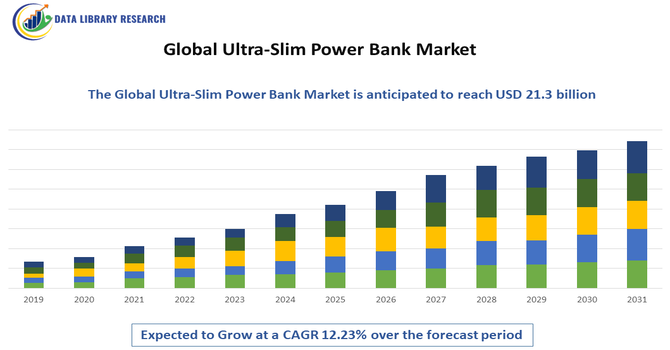
| Market Size Value | USD 21.3 billion |
| Growth Rate | CAGR of 12.23 % |
| Forecast | 2026-2033 |
| Historical data | 2021-2024 |
| Base Year | 2025 |
| Report Coverage | Forecasted revenue, company rating, competitive environment, growth drivers, and trends |
| Segment Coverage | Type, Application, End-User, Geography |
| Regional Scope | North America, Europe, Asia Pacific, Middle East |
| Customized scope | Free customization of reports (With 3 months Analysis Support ) |
| To Learn More About This Report | Request a Free Sample Copy |
The Global Ultra-Slim Power Bank Market is characterized by intense competition among established and emerging players striving to capture market share through innovation, advanced technology, and strong brand presence. Companies focus on developing high-capacity, fast-charging, and aesthetically appealing ultra-slim power banks to meet the growing demand from tech-savvy consumers and professionals. Key strategies include product differentiation, strategic partnerships, expansion of distribution networks, and investments in research and development. The market is witnessing continuous innovation in battery technology, wireless charging, and compact designs, which is driving competition and shaping the landscape across global regions.
Key Players:
Recent Developments
Q1. What are the main growth-driving factors for this market?
The primary driver is the "nomadic" lifestyle of modern consumers who require constant connectivity but prefer lightweight, pocket-sized accessories. As smartphones become thinner and more powerful, users demand portable chargers that match this sleek aesthetic. The rise of travel, outdoor activities, and remote work has made high-capacity, ultra-thin power banks a daily necessity for maintaining device uptime.
Q2. What are the main restraining factors for this market?
Growth is challenged by the physical limits of battery technology; making a power bank "ultra-slim" often means sacrificing total capacity or heat dissipation. Furthermore, the rapid adoption of fast-charging wall outlets and the integration of larger batteries into new smartphones can reduce the immediate need for external packs. Intense price competition from generic, low-quality brands also erodes profit margins for premium players.
Q3. Which segment is expected to witness high growth?
The Lithium-Polymer (Li-Po) segment is expected to witness the highest growth. Unlike traditional cylindrical cells, Li-Po batteries can be manufactured in flat, flexible shapes, which is the "secret sauce" behind ultra-slim designs. Their ability to deliver high energy density in a thin profile makes them the standard for premium, credit-card-sized, and "wallet" power banks.
Q4. Who are the top major players for this market?
The market is led by consumer electronics giants and specialized charging brands. Key players include Anker Innovations, Xiaomi, Samsung Electronics, and RAVPower. These companies dominate through advanced safety certifications, sleek industrial designs, and the integration of "Power Delivery" (PD) technology that allows their slim devices to charge even laptops and tablets quickly.
Q5. Which country is the largest player?
China is the largest player in this market. It serves as both the world's leading manufacturer and one of the biggest consumer bases. With a massive ecosystem of electronics suppliers in Shenzhen and a population that is highly reliant on mobile payments and social media, the demand and production capacity for affordable, high-tech power banks are unmatched.
Data Library Research are conducted by industry experts who offer insight on industry structure, market segmentations technology assessment and competitive landscape (CL), and penetration, as well as on emerging trends. Their analysis is based on primary interviews (~ 80%) and secondary research (~ 20%) as well as years of professional expertise in their respective industries. Adding to this, by analysing historical trends and current market positions, our analysts predict where the market will be headed for the next five years. Furthermore, the varying trends of segment & categories geographically presented are also studied and the estimated based on the primary & secondary research.
In this particular report from the supply side Data Library Research has conducted primary surveys (interviews) with the key level executives (VP, CEO’s, Marketing Director, Business Development Manager and SOFT) of the companies that active & prominent as well as the midsized organization
FIGURE 1: DLR RESEARH PROCESS
Extensive primary research was conducted to gain a deeper insight of the market and industry performance. The analysis is based on both primary and secondary research as well as years of professional expertise in the respective industries.
In addition to analysing current and historical trends, our analysts predict where the market is headed over the next five years.
It varies by segment for these categories geographically presented in the list of market tables. Speaking about this particular report we have conducted primary surveys (interviews) with the key level executives (VP, CEO’s, Marketing Director, Business Development Manager and many more) of the major players active in the market.
Secondary ResearchSecondary research was mainly used to collect and identify information useful for the extensive, technical, market-oriented, and Friend’s study of the Global Extra Neutral Alcohol. It was also used to obtain key information about major players, market classification and segmentation according to the industry trends, geographical markets, and developments related to the market and technology perspectives. For this study, analysts have gathered information from various credible sources, such as annual reports, sec filings, journals, white papers, SOFT presentations, and company web sites.
Market Size EstimationBoth, top-down and bottom-up approaches were used to estimate and validate the size of the Global market and to estimate the size of various other dependent submarkets in the overall Extra Neutral Alcohol. The key players in the market were identified through secondary research and their market contributions in the respective geographies were determined through primary and secondary research.
Forecast Model