
Digital Assistants in Healthcare Market Overview and Analysis

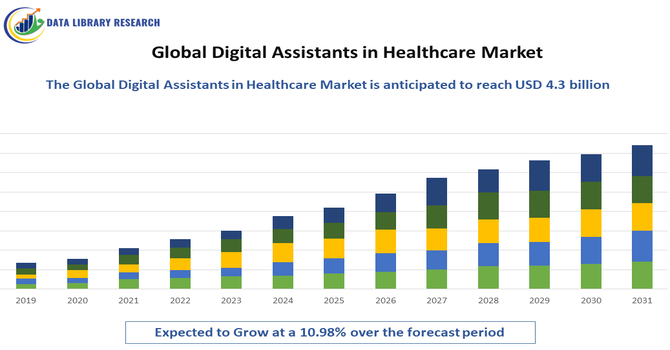
The Global Digital Assistants in Healthcare Market is projected to grow from USD 598.95 million in 2025 to USD 4.3 billion by 2032, registering a CAGR of 10.98% from 2025-2032.

The Global Digital Assistants in Healthcare Market encompasses AI-driven virtual assistants and chatbots that support healthcare professionals and patients by streamlining administrative tasks, improving patient engagement, enabling personalized care, and enhancing operational efficiency across healthcare systems worldwide.

The Global Digital Assistants in Healthcare Market is experiencing robust growth driven by the rapid adoption of AI-powered virtual health tools, rising demand for remote patient monitoring, and increasing focus on improving patient engagement and hospital workflow efficiency. Healthcare providers are leveraging digital assistants such as chatbots, voice-based AI, and smart medical assistants to streamline administrative tasks, enhance triage support, provide medication reminders, and deliver personalized care guidance, reducing operational burden and improving clinical outcomes.

Digital Assistants in Healthcare Market Latest Trends

The Global Digital Assistants in Healthcare Market is witnessing rapid evolution as AI-powered tools transition from basic chatbots to advanced clinical co-pilots capable of supporting diagnostic triage, clinical documentation, and workflow automation. A major trend is the integration of generative AI and large-language-model–based assistants that enable natural, context-aware communication and streamline tasks like medical transcription, appointment scheduling, patient follow-ups, and EHR interaction. Voice-enabled healthcare assistants and multimodal interfaces are gaining adoption to improve clinician efficiency and enhance patient accessibility, particularly for elderly and visually impaired users.

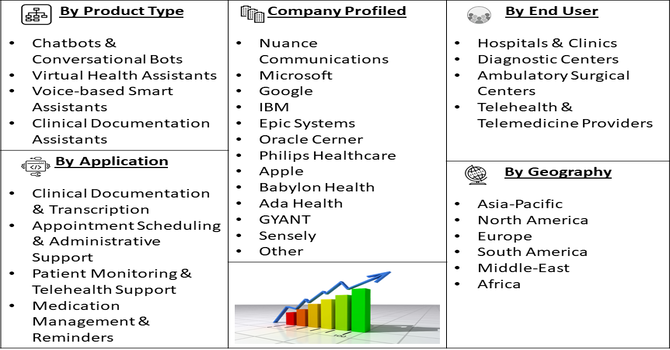
Segmentation: Global Digital Assistants in Healthcare Market is segmented By Technology (Artificial Intelligence, Machine Learning, Natural Language Processing), Product Type (Chatbots & Conversational Bots, Virtual Health Assistants, Voice-based Smart Assistants, Clinical Documentation Assistants), Application (Clinical Documentation & Transcription, Appointment Scheduling & Administrative Support, Patient Monitoring & Telehealth Support, Medication Management & Reminders), End User (Hospitals & Clinics, Diagnostic Centers, Ambulatory Surgical Centers, Telehealth & Telemedicine Providers), and Geography (North America, Europe, Asia-Pacific, Middle East and Africa, and South America). The report provides the value (in USD million) for the above segments.
Market Drivers:

  • Rising demand for remote patient care and virtual health support

The increasing adoption of telemedicine, remote patient monitoring, and home-based care is a major driver for digital assistants in healthcare. As healthcare systems shift toward virtual and hybrid care models, AI assistants help manage patient interactions, offer symptom guidance, provide medication reminders, and support chronic disease management, improving accessibility and reducing clinical workload.

  • Surge in healthcare digitalization and focus on operational efficiency

Healthcare providers are investing heavily in digital transformation to streamline workflows, reduce administrative burdens, and enhance patient experience. Digital assistants equipped with AI, NLP, and voice-recognition technologies automate tasks such as appointment scheduling, medical documentation, and billing queries, enabling healthcare organizations to cut costs, boost staff productivity, and deliver more efficient, coordinated, and patient-centric care.

In April 2025, Shezlong’s launch of the region’s first AI-powered therapy assistant reflects the broader surge in healthcare digitalization and growing emphasis on operational efficiency. By integrating advanced AI tools into mental health services, Shezlong streamlined therapeutic workflows, enhanced real-time patient engagement, and optimized therapists’ productivity. This innovation aligns with the global trend of leveraging digital technologies to deliver scalable, efficient, and personalized care, reinforcing how AI-driven digital assistants are becoming essential in improving healthcare outcomes and resource management across the industry.

Market Restraints

  • Stringent Regulatory Requirements and Data Privacy Concerns

The Global Digital Assistants in Healthcare Market faces key restraints including stringent regulatory requirements and data privacy concerns, as healthcare organizations handle highly sensitive patient information. Ensuring compliance with standards such as HIPAA, GDPR, and other regional healthcare regulations creates complexity and slows adoption. Additionally, integration challenges with legacy hospital information systems and electronic health records (EHRs) hinder seamless deployment, often requiring significant time, cost, and IT expertise. Limited AI training data quality and concerns over accuracy and reliability in clinical decision-support scenarios also restrict full-scale implementation. Furthermore, resistance from clinicians due to fear of technology replacement, lack of digital literacy among aging populations, and high initial investment costs in AI infrastructure and interoperability solutions pose notable barriers, particularly for small and mid-sized healthcare providers.

Socio Economic Impact on Digital Assistants in Healthcare Market

The rise of digital assistants is poised to significantly impact global healthcare's socioeconomic landscape by addressing key challenges like rising costs and limited access. Economically, they streamline administrative tasks, such as scheduling and billing, and support remote monitoring, potentially leading to billions in annual savings for health systems by reducing labor costs and unnecessary hospital visits. Societally, these assistants improve health equity by offering 24/7, multi-lingual support and care navigation, breaking down geographical barriers and reaching underserved populations. However, this shift raises concerns about a 'digital divide,' where individuals with lower digital literacy or income may be excluded, and potential job displacement in administrative roles, requiring proactive policies to ensure inclusive adoption and workforce retraining.

Segmental Analysis

  • Artificial Intelligence (AI) segment is expected to witness highest growth over the forecast period

The Artificial Intelligence segment leads the market as AI-enabled healthcare assistants deliver advanced automation, real-time patient interaction, and context-aware clinical support. AI technologies enhance decision-making, streamline documentation, enable predictive assistance, and improve patient triaging and monitoring. The growing shift toward AI-driven virtual care, voice-enabled support, and self-learning healthcare bots continues to accelerate adoption across hospitals and telehealth platforms.

  • Virtual Health Assistants segment is expected to witness highest growth over the forecast period

Virtual Health Assistants (VHAs) are experiencing strong growth due to their ability to interact naturally with patients, manage health queries, provide medication reminders, and support symptom assessment and chronic-disease management. These assistants improve patient engagement and reduce burden on healthcare professionals, especially in remote-care environments. Their integration with telehealth systems, mobile apps, and EHR platforms is boosting usage across outpatient and home-care settings.

  • Clinical Documentation & Transcription segment is expected to witness highest growth over the forecast period

The Clinical Documentation & Transcription segment is gaining momentum as AI-driven voice assistants and ambient clinical intelligence systems are increasingly used to automate real-time note-taking and medical transcription. This reduces physician workload, prevents burnout, enhances accuracy, and saves significant time in electronic health record (EHR) updates. The demand for automated documentation solutions is growing rapidly in hospitals, specialty clinics, and telemedicine consultations.

  • Hospitals & Clinics segment is expected to witness highest growth over the forecast period

Hospitals & Clinics form the largest end-user segment, adopting digital assistants to streamline patient communication, automate administrative tasks, improve care coordination, and support clinical workflows. These systems help manage scheduling, triage, documentation, and AI-enabled virtual nursing support. Rising focus on digital transformation, operational efficiency, and improved patient outcomes is pushing adoption across large hospitals and multispecialty networks.

  • North America is expected to witness highest growth over the forecast period

North America dominates the market due to widespread digital-health adoption, advanced healthcare IT infrastructure, high investment in AI-based health innovations, and supportive regulatory frameworks. The region also has strong telehealth penetration, growing clinical automation strategies, and major tech companies driving AI integration in healthcare.

The United States leads with significant deployments across hospitals, payers, and home-care systems. For instance, in January 2025, Accenture and Meiji Yasuda Life Insurance Company entered a multi-year partnership, running through March 2030, to drive a comprehensive corporate transformation using artificial intelligence (AI). The collaboration focuses on enhancing workforce efficiency and innovation by integrating AI-powered digital assistants and other digital technologies into daily operations. This initiative positively influenced the Global Digital Assistants in Healthcare Market, highlighting the growing cross-industry adoption of AI-driven assistants that boost productivity, streamline workflows, and inspire similar advancements in healthcare ecosystems worldwide.

Similarly, February 2025, Drive Health, a Phoenix-based digital health startup, announced the launch of its groundbreaking AI nurse in collaboration with Google Public Sector, marking a major milestone in expanding healthcare accessibility and addressing the U.S. healthcare workforce shortage. The AI nurse aims to enhance patient outcomes and streamline clinical support nationwide. This innovation significantly boosted the Global Digital Assistants in Healthcare Market, showcasing the U.S. leadership in AI-driven care delivery, operational efficiency, and scalable digital solutions for modern healthcare systems. Thus, all such factors are driving the growth of above market in this region.

Digital Assistants in Healthcare Market Competitive Landscape

The competitive landscape for the Global Digital Assistants in Healthcare Market is dynamic and crowded, featuring large tech incumbents, established healthcare IT vendors, and agile startups competing on AI capabilities, EHR interoperability, voice and ambient-listening features, regulatory compliance, and vertical specialization (telehealth, clinical documentation, patient engagement). Market leaders leverage scale, existing customer relationships, and deep pockets to integrate assistants into broad healthcare platforms, while smaller specialists differentiate through niche clinical workflows, superior NLP models, or quicker deployment and customization. Strategic partnerships, M&A, and regulatory-compliant productization are common tactics as players race to embed digital assistants across hospitals, telemedicine providers, and home-care ecosystems.

Key Players

  • Nuance Communications
  • Microsoft
  • Google
  • Amazon Web Services (AWS)
  • IBM
  • Epic Systems
  • Oracle Cerner
  • Philips Healthcare
  • Apple
  • Babylon Health
  • Ada Health
  • Buoy Health
  • GYANT
  • Sensely
  • Suki (Suki.ai)
  • Infermedica
  • Orbita
  • Conversa Health
  • K Health
  • LivePerson

Recent Development

  • In July 2025, Minneapolis-based Allina Health launched “Alli,” an AI-powered virtual assistant built on SoundHound’s Amelia conversational AI platform, to streamline patient interactions and appointment management. Integrated with the electronic health record (EHR), Alli authenticates patients and reduces call center workload by handling scheduling tasks, with plans to expand to medication refills, provider searches, and nonclinical inquiries. This advancement strengthened the Global Digital Assistants in Healthcare Market, showcasing how AI-driven solutions enhance patient access, operational efficiency, and automation across healthcare systems worldwide.


  • In March 2025, Microsoft Corp. unveiled Microsoft Dragon Copilot, the first AI assistant for clinical workflows that combined Dragon Medical One’s dictation and Dragon Ambient eXperience’s listening capabilities with generative AI and healthcare safeguards. Integrated into Microsoft Cloud for Healthcare, it enhanced efficiency, provider experience, and patient outcomes. As clinician burnout in the U.S. dropped from 53% in 2023 to 48% in 2024, this innovation accelerated global adoption of digital assistants, advancing automation, accuracy, and productivity in healthcare systems worldwide.


Frequently Asked Questions (FAQ) :

Q1. What the main growth driving factors for this market?

The main drivers are the rising demand for efficient healthcare, especially for chronic disease management and home-based monitoring. Rapid advancements in Artificial Intelligence (AI) and the growing use of smartphones and digital health tools also play a key role. These assistants help automate tasks like appointment scheduling and symptom checking, easing the burden on healthcare staff and providing faster patient support. The shift towards value-based care also encourages their adoption for better patient outcomes.

Q2. What are the main restraining factors for this market?

The primary concern is the security and privacy of sensitive patient data, requiring strict adherence to regulations like HIPAA, which can be complex. Other major obstacles include the high initial costs of implementation, challenges integrating new digital assistant systems with older, existing hospital technologies, and the need for standardized regulatory clarity around AI-driven clinical decisions. These factors slow down the wider adoption among providers.

Q3. Which segment is expected to witness high growth?

The Automatic Speech Recognition (ASR) and AI-powered chatbot segments are projected to see the highest growth. ASR is driven by the demand for hands-free documentation and efficient communication in clinical settings. Chatbots are expanding rapidly as they offer immediate, 24/7 patient responses for basic inquiries, appointment booking, and triage, greatly enhancing patient engagement and streamlining hospital workflows using sophisticated AI.

Q4. Who are the top major players for this market?

The market is led by major technology companies leveraging their core AI and cloud capabilities. Key players include Microsoft (which acquired Nuance Communications), known for clinical documentation solutions, Amazon (with Alexa Health), focused on patient engagement and home monitoring, and Google LLC. Other significant companies specializing in the sector are Sensely Inc., eGain Corporation, and Babylon Healthcare Services Limited.

Q5. Which country is the largest player?

The North American region, particularly the United States, is the largest market player by revenue share. This dominance is due to the rapid and high adoption rate of advanced AI and digital health technologies, a strong IT infrastructure, and the high demand for virtual care and efficient patient management systems. However, the Asia Pacific region is expected to grow the fastest, driven by increasing investments in digital healthcare.

Digital Assistants in Healthcare MARKET STUDY GLOBAL MARKET ANALYSIS, INSIGHTS AND FORECAST, 2022-2029

    1. Introduction

    • 1.1. Research Scope
    • 1.2. Market Segmentation
    • 1.3. Research Methodology
    • 1.4. Definitions and Assumptions

    2. Executive Summary

      3. Market Dynamics

      • 3.1. Market Drivers
      • 3.2. Market Restraints
      • 3.3. Market Opportunities

      4. Key Insights

      • 4.1. Key Emerging Trends – For Major Countries
      • 4.2. Latest Technological Advancement
      • 4.3. Regulatory Landscape
      • 4.4. Industry SWOT Analysis
      • 4.5. Porters Five Forces Analysis

      5. Global Digital Assistants in Healthcare Market Analysis (USD Billion), Insights and Forecast, 2018-2029

      • 5.1. Key Findings / Summary
      • 5.2. Market Analysis, Insights and Forecast – By Segment 1
        • 5.2.1. Sub-Segment 1
        • 5.2.2. Sub-Segment 2
      • 5.3. Market Analysis, Insights and Forecast – By Segment 2
        • 5.3.1. Sub-Segment 1
        • 5.3.2. Sub-Segment 2
        • 5.3.3. Sub-Segment 3
        • 5.3.4. Others
      • 5.4. Market Analysis, Insights and Forecast – By Segment 3
        • 5.4.1. Sub-Segment 1
        • 5.4.2. Sub-Segment 2
        • 5.4.3. Sub-Segment 3
        • 5.4.4. Others
      • 5.5. Market Analysis, Insights and Forecast – By Region
        • 5.5.1. North America
        • 5.5.2. Latin America
        • 5.5.3. Europe
        • 5.5.4. Asia Pacific
        • 5.5.5. Middle East and Africa

      6. North America Digital Assistants in Healthcare Market Analysis (USD Billion), Insights and Forecast, 2018-2029

      • 6.1. Key Findings / Summary
      • 6.2. Market Analysis, Insights and Forecast – By Segment 1
        • 6.2.1. Sub-Segment 1
        • 6.2.2. Sub-Segment 2
      • 6.3. Market Analysis, Insights and Forecast – By Segment 2
        • 6.3.1. Sub-Segment 1
        • 6.3.2. Sub-Segment 2
        • 6.3.3. Sub-Segment 3
        • 6.3.4. Others
      • 6.4. Market Analysis, Insights and Forecast – By Segment 3
        • 6.4.1. Sub-Segment 1
        • 6.4.2. Sub-Segment 2
        • 6.4.3. Sub-Segment 3
        • 6.4.4. Others
      • 6.5. Market Analysis, Insights and Forecast – By Country
        • 6.5.1. U.S.
        • 6.5.2. Canada

      7. Latin America Digital Assistants in Healthcare Market Analysis (USD Billion), Insights and Forecast, 2018-2029

      • 7.1. Key Findings / Summary
      • 7.2. Market Analysis, Insights and Forecast – By Segment 1
        • 7.2.1. Sub-Segment 1
        • 7.2.2. Sub-Segment 2
      • 7.3. Market Analysis, Insights and Forecast – By Segment 2
        • 7.3.1. Sub-Segment 1
        • 7.3.2. Sub-Segment 2
        • 7.3.3. Sub-Segment 3
        • 7.3.4. Others
      • 7.4. Market Analysis, Insights and Forecast – By Segment 3
        • 7.4.1. Sub-Segment 1
        • 7.4.2. Sub-Segment 2
        • 7.4.3. Sub-Segment 3
        • 7.4.4. Others
      • 7.5. Insights and Forecast – By Country
        • 7.5.1. Brazil
        • 7.5.2. Mexico
        • 7.5.3. Rest of Latin America

      8. Europe Digital Assistants in Healthcare Market Analysis (USD Billion), Insights and Forecast, 2018-2029

      • 8.1. Key Findings / Summary
      • 8.2. Market Analysis, Insights and Forecast – By Segment 1
        • 8.2.1. Sub-Segment 1
        • 8.2.2. Sub-Segment 2
      • 8.3. Market Analysis, Insights and Forecast – By Segment 2
        • 8.3.1. Sub-Segment 1
        • 8.3.2. Sub-Segment 2
        • 8.3.3. Sub-Segment 3
        • 8.3.4. Others
      • 8.4. Market Analysis, Insights and Forecast – By Segment 3
        • 8.4.1. Sub-Segment 1
        • 8.4.2. Sub-Segment 2
        • 8.4.3. Sub-Segment 3
        • 8.4.4. Others
      • 8.5. Market Analysis, Insights and Forecast – By Country
        • 8.5.1. UK
        • 8.5.2. Germany
        • 8.5.3. France
        • 8.5.4. Italy
        • 8.5.5. Spain
        • 8.5.6. Russia
        • 8.5.7. Rest of Europe

      9. Asia Pacific Digital Assistants in Healthcare Market Analysis (USD Billion), Insights and Forecast, 2018-2029

      • 9.1. Key Findings / Summary
      • 9.2. Market Analysis, Insights and Forecast – By Segment 1
        • 9.2.1. Sub-Segment 1
        • 9.2.2. Sub-Segment 2
      • 9.3. Market Analysis, Insights and Forecast – By Segment 2
        • 9.3.1. Sub-Segment 1
        • 9.3.2. Sub-Segment 2
        • 9.3.3. Sub-Segment 3
        • 9.3.4. Others
      • 9.4. Market Analysis, Insights and Forecast – By Segment 3
        • 9.4.1. Sub-Segment 1
        • 9.4.2. Sub-Segment 2
        • 9.4.3. Sub-Segment 3
        • 9.4.4. Others
      • 9.5. Market Analysis, Insights and Forecast – By Country
        • 9.5.1. China
        • 9.5.2. India
        • 9.5.3. Japan
        • 9.5.4. Australia
        • 9.5.5. South East Asia
        • 9.5.6. Rest of Asia Pacific

      10. Middle East & Africa Digital Assistants in Healthcare Market Analysis (USD Billion), Insights and Forecast, 2018-2029

      • 10.1. Key Findings / Summary
      • 10.2. Market Analysis, Insights and Forecast – By Segment 1
        • 10.2.1. Sub-Segment 1
        • 10.2.2. Sub-Segment 2
      • 10.3. Market Analysis, Insights and Forecast – By Segment 2
        • 10.3.1. Sub-Segment 1
        • 10.3.2. Sub-Segment 2
        • 10.3.3. Sub-Segment 3
        • 10.3.4. Others
      • 10.4. Market Analysis, Insights and Forecast – By Segment 3
        • 10.4.1. Sub-Segment 1
        • 10.4.2. Sub-Segment 2
        • 10.4.3. Sub-Segment 3
        • 10.4.4. Others
      • 10.5. Market Analysis, Insights and Forecast – By Country
        • 10.5.1. GCC
        • 10.5.2. South Africa
        • 10.5.3. Rest of Middle East & Africa

      11. Competitive Analysis

      • 11.1. Company Market Share Analysis, 2018
      • 11.2. Key Industry Developments
      • 11.3. Company Profile
        • 11.3.1. Company 1
          • 11.3.1.1. Business Overview
          • 11.3.1.2. Segment 1 & Service Offering
          • 11.3.1.3. Overall Revenue
          • 11.3.1.4. Geographic Presence
          • 11.3.1.5. Recent Development
        *Similar details will be provided for the following companies
        • 11.3.2. Company 2
        • 11.3.3. Company 3
        • 11.3.4. Company 4
        • 11.3.5. Company 5
        • 11.3.6. Company 6
        • 11.3.7. Company 7
        • 11.3.8. Company 8
        • 11.3.9. Company 9
        • 11.3.10. Company 10
        • 11.3.11. Company 11
        • 11.3.12. Company 12
      List of Figures

      Figure 1: Global Digital Assistants in Healthcare Market Revenue Breakdown (USD Billion, %) by Region, 2022 & 2029
      Figure 2: Global Digital Assistants in Healthcare Market Value Share (%), By Segment 1, 2022 & 2029
      Figure 3: Global Digital Assistants in Healthcare Market Forecast (USD Billion), by Sub-Segment 1, 2018-2029
      Figure 4: Global Digital Assistants in Healthcare Market Forecast (USD Billion), by Sub-Segment 2, 2018-2029
      Figure 5: Global Digital Assistants in Healthcare Market Value Share (%), By Segment 2, 2022 & 2029
      Figure 6: Global Digital Assistants in Healthcare Market Forecast (USD Billion), by Sub-Segment 1, 2018-2029
      Figure 7: Global Digital Assistants in Healthcare Market Forecast (USD Billion), by Sub-Segment 2, 2018-2029
      Figure 8: Global Digital Assistants in Healthcare Market Forecast (USD Billion), by Sub-Segment 3, 2018-2029
      Figure 9: Global Digital Assistants in Healthcare Market Forecast (USD Billion), by Others, 2018-2029
      Figure 10: Global Digital Assistants in Healthcare Market Value Share (%), By Segment 3, 2022 & 2029
      Figure 11: Global Digital Assistants in Healthcare Market Forecast (USD Billion), by Sub-Segment 1, 2018-2029
      Figure 12: Global Digital Assistants in Healthcare Market Forecast (USD Billion), by Sub-Segment 2, 2018-2029
      Figure 13: Global Digital Assistants in Healthcare Market Forecast (USD Billion), by Sub-Segment 3, 2018-2029
      Figure 14: Global Digital Assistants in Healthcare Market Forecast (USD Billion), by Others, 2018-2029
      Figure 15: Global Digital Assistants in Healthcare Market Value (USD Billion), by Region, 2022 & 2029
      Figure 16: North America Digital Assistants in Healthcare Market Value Share (%), By Segment 1, 2022 & 2029
      Figure 17: North America Digital Assistants in Healthcare Market Forecast (USD Billion), by Sub-Segment 1, 2018-2029
      Figure 18: North America Digital Assistants in Healthcare Market Forecast (USD Billion), by Sub-Segment 2, 2018-2029
      Figure 19: North America Digital Assistants in Healthcare Market Value Share (%), By Segment 2, 2022 & 2029
      Figure 20: North America Digital Assistants in Healthcare Market Forecast (USD Billion), by Sub-Segment 1, 2018-2029
      Figure 21: North America Digital Assistants in Healthcare Market Forecast (USD Billion), by Sub-Segment 2, 2018-2029
      Figure 22: North America Digital Assistants in Healthcare Market Forecast (USD Billion), by Sub-Segment 3, 2018-2029
      Figure 23: North America Digital Assistants in Healthcare Market Forecast (USD Billion), by Others, 2018-2029
      Figure 24: North America Digital Assistants in Healthcare Market Value Share (%), By Segment 3, 2022 & 2029
      Figure 25: North America Digital Assistants in Healthcare Market Forecast (USD Billion), by Sub-Segment 1, 2018-2029
      Figure 26: North America Digital Assistants in Healthcare Market Forecast (USD Billion), by Sub-Segment 2, 2018-2029
      Figure 27: North America Digital Assistants in Healthcare Market Forecast (USD Billion), by Sub-Segment 3, 2018-2029
      Figure 28: North America Digital Assistants in Healthcare Market Forecast (USD Billion), by Others, 2018-2029
      Figure 29: North America Digital Assistants in Healthcare Market Forecast (USD Billion), by U.S., 2018-2029
      Figure 30: North America Digital Assistants in Healthcare Market Forecast (USD Billion), by Canada, 2018-2029
      Figure 31: Latin America Digital Assistants in Healthcare Market Value Share (%), By Segment 1, 2022 & 2029
      Figure 32: Latin America Digital Assistants in Healthcare Market Forecast (USD Billion), by Sub-Segment 1, 2018-2029
      Figure 33: Latin America Digital Assistants in Healthcare Market Forecast (USD Billion), by Sub-Segment 2, 2018-2029
      Figure 34: Latin America Digital Assistants in Healthcare Market Value Share (%), By Segment 2, 2022 & 2029
      Figure 35: Latin America Digital Assistants in Healthcare Market Forecast (USD Billion), by Sub-Segment 1, 2018-2029
      Figure 36: Latin America Digital Assistants in Healthcare Market Forecast (USD Billion), by Sub-Segment 2, 2018-2029
      Figure 37: Latin America Digital Assistants in Healthcare Market Forecast (USD Billion), by Sub-Segment 3, 2018-2029
      Figure 38: Latin America Digital Assistants in Healthcare Market Forecast (USD Billion), by Others, 2018-2029
      Figure 39: Latin America Digital Assistants in Healthcare Market Value Share (%), By Segment 3, 2022 & 2029
      Figure 40: Latin America Digital Assistants in Healthcare Market Forecast (USD Billion), by Sub-Segment 1, 2018-2029
      Figure 41: Latin America Digital Assistants in Healthcare Market Forecast (USD Billion), by Sub-Segment 2, 2018-2029
      Figure 42: Latin America Digital Assistants in Healthcare Market Forecast (USD Billion), by Sub-Segment 3, 2018-2029
      Figure 43: Latin America Digital Assistants in Healthcare Market Forecast (USD Billion), by Others, 2018-2029
      Figure 44: Latin America Digital Assistants in Healthcare Market Forecast (USD Billion), by Brazil, 2018-2029
      Figure 45: Latin America Digital Assistants in Healthcare Market Forecast (USD Billion), by Mexico, 2018-2029
      Figure 46: Latin America Digital Assistants in Healthcare Market Forecast (USD Billion), by Rest of Latin America, 2018-2029
      Figure 47: Europe Digital Assistants in Healthcare Market Value Share (%), By Segment 1, 2022 & 2029
      Figure 48: Europe Digital Assistants in Healthcare Market Forecast (USD Billion), by Sub-Segment 1, 2018-2029
      Figure 49: Europe Digital Assistants in Healthcare Market Forecast (USD Billion), by Sub-Segment 2, 2018-2029
      Figure 50: Europe Digital Assistants in Healthcare Market Value Share (%), By Segment 2, 2022 & 2029
      Figure 51: Europe Digital Assistants in Healthcare Market Forecast (USD Billion), by Sub-Segment 1, 2018-2029
      Figure 52: Europe Digital Assistants in Healthcare Market Forecast (USD Billion), by Sub-Segment 2, 2018-2029
      Figure 53: Europe Digital Assistants in Healthcare Market Forecast (USD Billion), by Sub-Segment 3, 2018-2029
      Figure 54: Europe Digital Assistants in Healthcare Market Forecast (USD Billion), by Others, 2018-2029
      Figure 55: Europe Digital Assistants in Healthcare Market Value Share (%), By Segment 3, 2022 & 2029
      Figure 56: Europe Digital Assistants in Healthcare Market Forecast (USD Billion), by Sub-Segment 1, 2018-2029
      Figure 57: Europe Digital Assistants in Healthcare Market Forecast (USD Billion), by Sub-Segment 2, 2018-2029
      Figure 58: Europe Digital Assistants in Healthcare Market Forecast (USD Billion), by Sub-Segment 3, 2018-2029
      Figure 59: Europe Digital Assistants in Healthcare Market Forecast (USD Billion), by Others, 2018-2029
      Figure 60: Europe Digital Assistants in Healthcare Market Forecast (USD Billion), by U.K., 2018-2029
      Figure 61: Europe Digital Assistants in Healthcare Market Forecast (USD Billion), by Germany, 2018-2029
      Figure 62: Europe Digital Assistants in Healthcare Market Forecast (USD Billion), by France, 2018-2029
      Figure 63: Europe Digital Assistants in Healthcare Market Forecast (USD Billion), by Italy, 2018-2029
      Figure 64: Europe Digital Assistants in Healthcare Market Forecast (USD Billion), by Spain, 2018-2029
      Figure 65: Europe Digital Assistants in Healthcare Market Forecast (USD Billion), by Russia, 2018-2029
      Figure 66: Europe Digital Assistants in Healthcare Market Forecast (USD Billion), by Rest of Europe, 2018-2029
      Figure 67: Asia Pacific Digital Assistants in Healthcare Market Value Share (%), By Segment 1, 2022 & 2029
      Figure 68: Asia Pacific Digital Assistants in Healthcare Market Forecast (USD Billion), by Sub-Segment 1, 2018-2029
      Figure 69: Asia Pacific Digital Assistants in Healthcare Market Forecast (USD Billion), by Sub-Segment 2, 2018-2029
      Figure 70: Asia Pacific Digital Assistants in Healthcare Market Value Share (%), By Segment 2, 2022 & 2029
      Figure 71: Asia Pacific Digital Assistants in Healthcare Market Forecast (USD Billion), by Sub-Segment 1, 2018-2029
      Figure 72: Asia Pacific Digital Assistants in Healthcare Market Forecast (USD Billion), by Sub-Segment 2, 2018-2029
      Figure 73: Asia Pacific Digital Assistants in Healthcare Market Forecast (USD Billion), by Sub-Segment 3, 2018-2029
      Figure 74: Asia Pacific Digital Assistants in Healthcare Market Forecast (USD Billion), by Others, 2018-2029
      Figure 75: Asia Pacific Digital Assistants in Healthcare Market Value Share (%), By Segment 3, 2022 & 2029
      Figure 76: Asia Pacific Digital Assistants in Healthcare Market Forecast (USD Billion), by Sub-Segment 1, 2018-2029
      Figure 77: Asia Pacific Digital Assistants in Healthcare Market Forecast (USD Billion), by Sub-Segment 2, 2018-2029
      Figure 78: Asia Pacific Digital Assistants in Healthcare Market Forecast (USD Billion), by Sub-Segment 3, 2018-2029
      Figure 79: Asia Pacific Digital Assistants in Healthcare Market Forecast (USD Billion), by Others, 2018-2029
      Figure 80: Asia Pacific Digital Assistants in Healthcare Market Forecast (USD Billion), by China, 2018-2029
      Figure 81: Asia Pacific Digital Assistants in Healthcare Market Forecast (USD Billion), by India, 2018-2029
      Figure 82: Asia Pacific Digital Assistants in Healthcare Market Forecast (USD Billion), by Japan, 2018-2029
      Figure 83: Asia Pacific Digital Assistants in Healthcare Market Forecast (USD Billion), by Australia, 2018-2029
      Figure 84: Asia Pacific Digital Assistants in Healthcare Market Forecast (USD Billion), by Southeast Asia, 2018-2029
      Figure 85: Asia Pacific Digital Assistants in Healthcare Market Forecast (USD Billion), by Rest of Asia Pacific, 2018-2029
      Figure 86: Middle East & Africa Digital Assistants in Healthcare Market Value Share (%), By Segment 1, 2022 & 2029
      Figure 87: Middle East & Africa Digital Assistants in Healthcare Market Forecast (USD Billion), by Sub-Segment 1, 2018-2029
      Figure 88: Middle East & Africa Digital Assistants in Healthcare Market Forecast (USD Billion), by Sub-Segment 2, 2018-2029
      Figure 89: Middle East & Africa Digital Assistants in Healthcare Market Value Share (%), By Segment 2, 2022 & 2029
      Figure 90: Middle East & Africa Digital Assistants in Healthcare Market Forecast (USD Billion), by Sub-Segment 1, 2018-2029
      Figure 91: Middle East & Africa Digital Assistants in Healthcare Market Forecast (USD Billion), by Sub-Segment 2, 2018-2029
      Figure 92: Middle East & Africa Digital Assistants in Healthcare Market Forecast (USD Billion), by Sub-Segment 3, 2018-2029
      Figure 93: Middle East & Africa Digital Assistants in Healthcare Market Forecast (USD Billion), by Others, 2018-2029
      Figure 94: Middle East & Africa Digital Assistants in Healthcare Market Value Share (%), By Segment 3, 2022 & 2029
      Figure 95: Middle East & Africa Digital Assistants in Healthcare Market Forecast (USD Billion), by Sub-Segment 1, 2018-2029
      Figure 96: Middle East & Africa Digital Assistants in Healthcare Market Forecast (USD Billion), by Sub-Segment 2, 2018-2029
      Figure 97: Middle East & Africa Digital Assistants in Healthcare Market Forecast (USD Billion), by Sub-Segment 3, 2018-2029
      Figure 98: Middle East & Africa Digital Assistants in Healthcare Market Forecast (USD Billion), by Others, 2018-2029
      Figure 99: Middle East & Africa Digital Assistants in Healthcare Market Forecast (USD Billion), by GCC, 2018-2029
      Figure 100: Middle East & Africa Digital Assistants in Healthcare Market Forecast (USD Billion), by South Africa, 2018-2029
      Figure 101: Middle East & Africa Digital Assistants in Healthcare Market Forecast (USD Billion), by Rest of Middle East & Africa, 2018-2029 
      List of Tables
      Table 1: Global Digital Assistants in Healthcare Market Revenue (USD Billion) Forecast, by Segment 1, 2018-2029
      Table 2: Global Digital Assistants in Healthcare Market Revenue (USD Billion) Forecast, by Segment 2, 2018-2029
      Table 3: Global Digital Assistants in Healthcare Market Revenue (USD Billion) Forecast, by Segment 3, 2018-2029
      Table 4: Global Digital Assistants in Healthcare Market Revenue (USD Billion) Forecast, by Region, 2018-2029
      Table 5: North America Digital Assistants in Healthcare Market Revenue (USD Billion) Forecast, by Segment 1, 2018-2029
      Table 6: North America Digital Assistants in Healthcare Market Revenue (USD Billion) Forecast, by Segment 2, 2018-2029
      Table 7: North America Digital Assistants in Healthcare Market Revenue (USD Billion) Forecast, by Segment 3, 2018-2029
      Table 8: North America Digital Assistants in Healthcare Market Revenue (USD Billion) Forecast, by Country, 2018-2029
      Table 9: Europe Digital Assistants in Healthcare Market Revenue (USD Billion) Forecast, by Segment 1, 2018-2029
      Table 10: Europe Digital Assistants in Healthcare Market Revenue (USD Billion) Forecast, by Segment 2, 2018-2029
      Table 11: Europe Digital Assistants in Healthcare Market Revenue (USD Billion) Forecast, by Segment 3, 2018-2029
      Table 12: Europe Digital Assistants in Healthcare Market Revenue (USD Billion) Forecast, by Country, 2018-2029
      Table 13: Latin America Digital Assistants in Healthcare Market Revenue (USD Billion) Forecast, by Segment 1, 2018-2029
      Table 14: Latin America Digital Assistants in Healthcare Market Revenue (USD Billion) Forecast, by Segment 2, 2018-2029
      Table 15: Latin America Digital Assistants in Healthcare Market Revenue (USD Billion) Forecast, by Segment 3, 2018-2029
      Table 16: Latin America Digital Assistants in Healthcare Market Revenue (USD Billion) Forecast, by Country, 2018-2029
      Table 17: Asia Pacific Digital Assistants in Healthcare Market Revenue (USD Billion) Forecast, by Segment 1, 2018-2029
      Table 18: Asia Pacific Digital Assistants in Healthcare Market Revenue (USD Billion) Forecast, by Segment 2, 2018-2029
      Table 19: Asia Pacific Digital Assistants in Healthcare Market Revenue (USD Billion) Forecast, by Segment 3, 2018-2029
      Table 20: Asia Pacific Digital Assistants in Healthcare Market Revenue (USD Billion) Forecast, by Country, 2018-2029
      Table 21: Middle East & Africa Digital Assistants in Healthcare Market Revenue (USD Billion) Forecast, by Segment 1, 2018-2029
      Table 22: Middle East & Africa Digital Assistants in Healthcare Market Revenue (USD Billion) Forecast, by Segment 2, 2018-2029
      Table 23: Middle East & Africa Digital Assistants in Healthcare Market Revenue (USD Billion) Forecast, by Segment 3, 2018-2029
      Table 24: Middle East & Africa Digital Assistants in Healthcare Market Revenue (USD Billion) Forecast, by Country, 2018-2029
      Research Process

      Data Library Research are conducted by industry experts who offer insight on industry structure, market segmentations technology assessment and competitive landscape (CL), and penetration, as well as on emerging trends. Their analysis is based on primary interviews (~ 80%) and secondary research (~ 20%) as well as years of professional expertise in their respective industries. Adding to this, by analysing historical trends and current market positions, our analysts predict where the market will be headed for the next five years. Furthermore, the varying trends of segment & categories geographically presented are also studied and the estimated based on the primary & secondary research.

      In this particular report from the supply side Data Library Research has conducted primary surveys (interviews) with the key level executives (VP, CEO’s, Marketing Director, Business Development Manager and SOFT) of the companies that active & prominent as well as the midsized organization

      FIGURE 1: DLR RESEARH PROCESS

      research-methodology1

      Primary Research

      Extensive primary research was conducted to gain a deeper insight of the market and industry performance. The analysis is based on both primary and secondary research as well as years of professional expertise in the respective industries.

      In addition to analysing current and historical trends, our analysts predict where the market is headed over the next five years.

      It varies by segment for these categories geographically presented in the list of market tables. Speaking about this particular report we have conducted primary surveys (interviews) with the key level executives (VP, CEO’s, Marketing Director, Business Development Manager and many more) of the major players active in the market.

      Secondary Research

      Secondary research was mainly used to collect and identify information useful for the extensive, technical, market-oriented, and Friend’s study of the Global Extra Neutral Alcohol. It was also used to obtain key information about major players, market classification and segmentation according to the industry trends, geographical markets, and developments related to the market and technology perspectives. For this study, analysts have gathered information from various credible sources, such as annual reports, sec filings, journals, white papers, SOFT presentations, and company web sites.

      Market Size Estimation

      Both, top-down and bottom-up approaches were used to estimate and validate the size of the Global market and to estimate the size of various other dependent submarkets in the overall Extra Neutral Alcohol. The key players in the market were identified through secondary research and their market contributions in the respective geographies were determined through primary and secondary research.

      Forecast Model

      research-methodology2

      Happy to Assist You

      If you have a question?

      info@datalibraryresearch.com

      IND : +91 955 279 0357

      Browse Related Reports