
Get Complete Analysis Of The Report - Download Updated Free Sample PDF
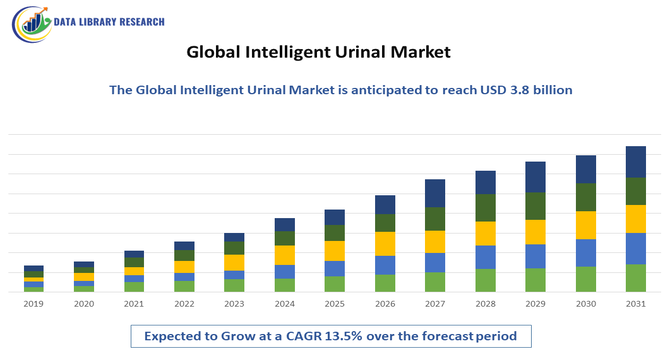
The Global Intelligent Urinal Market refers to the industry focused on smart urinal systems equipped with sensors, automated flushing, water-saving features, and hygiene-monitoring technologies. These urinals are increasingly adopted in commercial, public, and institutional facilities, driven by demand for water efficiency, sanitation improvements, and integration with smart building and IoT solutions.
The growth of the global intelligent urinal market is driven by increasing awareness of water conservation, rising demand for hygiene and sanitation in public and commercial spaces, and the adoption of smart building technologies. Technological advancements, such as sensor-based flushing, IoT integration, and maintenance monitoring, further propel market expansion by enhancing efficiency, convenience, and sustainability.
The global intelligent urinal market has experienced significant growth due to rising demand for water-efficient, hygiene-focused sanitation solutions in commercial, institutional, and public facilities. Key trends include sensor-based flushing systems, IoT connectivity, and real-time usage analytics, allowing for remote monitoring, predictive maintenance, and optimized water consumption. Touchless operation, antimicrobial materials, and seamless integration into smart building and smart-city infrastructure are increasingly prioritized.
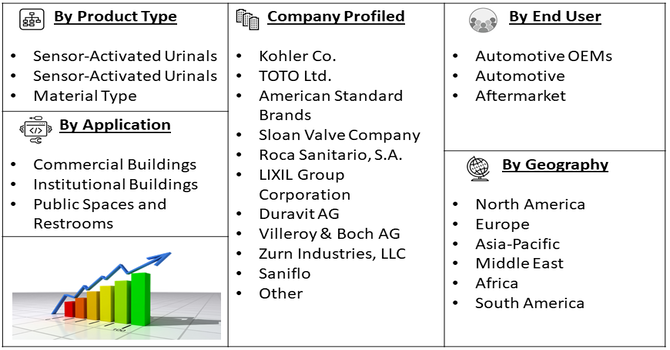
Segmentation: The Global Intelligent Urinal Market is segmented by Product Type (Sensor-Activated Urinals, Sensor-Activated Urinals, and Material Type), Application (Commercial Buildings, Institutional Buildings and Public Spaces and Restrooms), and Geography (North America, Europe, Asia-Pacific, Middle East and Africa, and South America). The report provides the value (in USD million) for the above segments.
For Detailed Market Segmentation - Get a Free Sample PDF
Market Drivers:
The global intelligent urinal market is significantly driven by increasing emphasis on water conservation. Intelligent urinals feature sensor-based, automated flushing systems that optimize water usage by reducing unnecessary flushing, helping commercial, public, and institutional facilities save substantial amounts of water. Governments and environmental agencies worldwide are promoting sustainable water management practices, encouraging the adoption of water-efficient fixtures. Rising awareness of environmental sustainability among consumers and facility managers has further accelerated deployment. As urban populations grow and water scarcity becomes a critical concern, intelligent urinals are seen as essential for efficient, eco-friendly sanitation solutions.
The market is also propelled by the increasing demand for enhanced hygiene standards and integration with smart building infrastructure. Intelligent urinals offer touchless operation, antimicrobial materials, and real-time monitoring, reducing the spread of germs in high-traffic areas. Their compatibility with IoT and building management systems enables remote monitoring, predictive maintenance, and data-driven facility management.
In November 2025, AceLife strengthened the global intelligent urinal market and smart building integration by achieving U.S. UPC certification for its TREVI Smart Toilet, the first Korean product to do so. Meeting stringent water-saving and plumbing standards, the certification underscored the product’s hygiene and efficiency credentials, boosting confidence in smart, sustainable restroom solutions and encouraging broader adoption worldwide. This combination of convenience, safety, and operational efficiency is driving the global intelligent urinal market’s rapid growth, particularly in urbanized and technologically advanced regions.
Market Restraints:
Despite the advantages, the global intelligent urinal market faces restraints due to high initial costs and installation complexity. Advanced features like sensors, IoT connectivity, and automated flushing significantly increase purchase and maintenance expenses compared to conventional urinals. Installation often requires specialized plumbing and integration with building management systems, posing challenges for small businesses or budget-conscious facilities. Additionally, the cost of replacement parts and periodic maintenance can deter adoption in developing regions.
The Intelligent urinals have a notable socioeconomic impact by improving public health, conserving water resources, and reducing operational costs in high-traffic facilities. Their adoption enhances hygiene standards in airports, hospitals, offices, and commercial buildings, which directly benefits occupants and visitors. Reduced water usage lowers utility expenses and supports environmental sustainability, particularly in regions facing water scarcity. The deployment of these smart sanitation systems also promotes modernization in urban infrastructure, contributing to safer, cleaner, and more efficient public and commercial environments. Thus, the technology supports sustainable development goals while improving both economic efficiency and quality of life.
Segmental Analysis:
The sensor-activated urinals segment is expected to witness the highest growth over the forecast period due to rising demand for hygiene, water efficiency, and convenience in public and commercial restrooms. These urinals automatically flush only when used, significantly reducing water consumption compared to traditional systems while minimizing the spread of germs through touchless operation. Increasing awareness of sustainability and sanitation, coupled with the integration of smart technologies in modern facilities, has accelerated their adoption globally. High-traffic areas such as airports, hospitals, shopping malls, and office complexes benefit particularly from these systems, as they reduce maintenance requirements, improve user experience, and support facility managers in achieving environmental and operational efficiency goals.
The commercial buildings segment, including offices, hospitals, hotels, airports, and shopping malls, is expected to experience the highest growth due to the need for efficient, hygienic, and sustainable sanitation solutions. Intelligent urinals offer automated flushing, water conservation, and reduced maintenance, making them ideal for high-footfall areas. Companies and institutions increasingly implement smart sanitary fixtures to meet sustainability standards and green-building certification requirements. The growing emphasis on user comfort, operational efficiency, and environmental responsibility in commercial infrastructure has made intelligent urinals a preferred choice. As new construction and modernization projects expand, the adoption of these systems in commercial buildings is expected to remain a key driver of market growth worldwide.
The Asia-Pacific region is projected to witness the fastest growth in the intelligent urinal market due to rapid urbanization, increasing infrastructure development, and growing awareness of hygiene and water conservation. For instance, in November 2025, Professor Park Seung-min advanced the Asia-Pacific intelligent urinal market by developing the region’s first smart toilet capable of diagnosing colorectal cancer through stool DNA analysis. This innovative health-focused technology highlighted the potential for intelligent restroom systems to provide diagnostic and wellness benefits, attracting research funding and accelerating adoption of advanced smart urinal and toilet solutions across the Asia-Pacific region.
Governments and developers are increasingly incorporating smart restroom solutions in commercial and public facilities, aligning with smart-city initiatives and sustainability goals. Rising disposable incomes and modernization in high-traffic areas such as airports, malls, hospitals, and offices are driving demand for advanced, touchless sanitation systems.
Additionally, increasing environmental regulations and the push for water-efficient solutions further accelerate adoption. For instance, in July 2025, Toto Ltd. influenced the Asia-Pacific intelligent urinal market by launching Japan’s first home-use toilet capable of analyzing stool quantity, consistency, and other health indicators. Coupled with a smartphone app for tracking daily metrics, this innovation catered to health-conscious consumers, demonstrating the potential of intelligent restroom technologies to integrate wellness monitoring and driving adoption of advanced smart urinals across the region. As a result, intelligent urinal technologies are gaining strong traction across both urban and emerging markets within the Asia-Pacific region.
| Report Matrics | Details |
| Market Size Value | USD 3.8 billion |
| Growth Rate | CAGR of 9.6% |
| Forecast | 2026-2033 |
| Historical data | 2021-2024 |
| Base Year | 2025 |
| Report Coverage | Forecasted revenue, company rating, competitive environment, growth drivers, and trends |
| Segment Coverage | Type, Application, End-User, Geography |
| Regional Scope | North America, Europe, Asia Pacific, Middle East |
| Customized scope | Free customization of reports (With 3 months Analysis Support ) |
| To Learn More About This Report | Request a Free Sample Copy |
The competitive landscape of the intelligent urinal market features established sanitaryware manufacturers and emerging technology providers focusing on sensors, IoT integration, and water-management innovations. Companies compete based on advanced features such as automated flushing, analytics, self-cleaning, and connectivity, as well as adherence to water-efficiency and green-building standards. The market is increasingly driven by large-scale installations in airports, shopping malls, office complexes, and public facilities, prompting continuous innovation in design and technology. Strategic collaborations, product differentiation, and investments in research and development are key competitive strategies, as manufacturers seek to expand market share and meet growing demand for sustainable, intelligent restroom solutions globally.
The major players for above market are:
Recent Development
Q1. What are the main growth-driving factors for this market?
The primary driver is the global focus on water conservation and sustainability, compelling commercial and institutional users to adopt waterless or highly efficient sensor-activated solutions. Additionally, rising public awareness regarding hygiene and sanitation promotes the use of touchless, intelligent fixtures to minimize germ spread in public and commercial restrooms.
Q2. What are the main restraining factors for this market?
The main hurdles include the higher initial cost of smart or waterless urinals compared to conventional models, which can deter adoption in price-sensitive markets. There are also perceived issues related to maintenance complexity and user hygiene skepticism, as some users doubt the effectiveness or cleanliness of water-free systems.
Q3. Which segment is expected to witness high growth?
The Sensor-Activated flush mechanism segment is projected for high growth. This is driven by the increasing integration of touchless technology in smart buildings and the strong demand from commercial sectors (like offices and malls) seeking improved public hygiene, operational efficiency, and enhanced user experience.
Q4. Who are the top major players for this market?
This market involves several key players, primarily companies specializing in sanitaryware and plumbing fixtures, often focusing on water-saving and sensor technologies. While specific brand dominance varies by region, top players include established global brands that manufacture and innovate across the sanitary and bathroom equipment sector.
Q5. Which country is the largest player?
The Asia Pacific (APAC) region, particularly due to rapid urbanization and extensive infrastructure development in countries like China and India, holds the largest and fastest-growing share of the overall urinals market. North America and Europe also maintain significant market shares due to high adoption rates of water-efficient technology.
Data Library Research are conducted by industry experts who offer insight on industry structure, market segmentations technology assessment and competitive landscape (CL), and penetration, as well as on emerging trends. Their analysis is based on primary interviews (~ 80%) and secondary research (~ 20%) as well as years of professional expertise in their respective industries. Adding to this, by analysing historical trends and current market positions, our analysts predict where the market will be headed for the next five years. Furthermore, the varying trends of segment & categories geographically presented are also studied and the estimated based on the primary & secondary research.
In this particular report from the supply side Data Library Research has conducted primary surveys (interviews) with the key level executives (VP, CEO’s, Marketing Director, Business Development Manager and SOFT) of the companies that active & prominent as well as the midsized organization
FIGURE 1: DLR RESEARH PROCESS
Extensive primary research was conducted to gain a deeper insight of the market and industry performance. The analysis is based on both primary and secondary research as well as years of professional expertise in the respective industries.
In addition to analysing current and historical trends, our analysts predict where the market is headed over the next five years.
It varies by segment for these categories geographically presented in the list of market tables. Speaking about this particular report we have conducted primary surveys (interviews) with the key level executives (VP, CEO’s, Marketing Director, Business Development Manager and many more) of the major players active in the market.
Secondary ResearchSecondary research was mainly used to collect and identify information useful for the extensive, technical, market-oriented, and Friend’s study of the Global Extra Neutral Alcohol. It was also used to obtain key information about major players, market classification and segmentation according to the industry trends, geographical markets, and developments related to the market and technology perspectives. For this study, analysts have gathered information from various credible sources, such as annual reports, sec filings, journals, white papers, SOFT presentations, and company web sites.
Market Size EstimationBoth, top-down and bottom-up approaches were used to estimate and validate the size of the Global market and to estimate the size of various other dependent submarkets in the overall Extra Neutral Alcohol. The key players in the market were identified through secondary research and their market contributions in the respective geographies were determined through primary and secondary research.
Forecast Model