Misting Cooling Systems Market Overview and Analysis
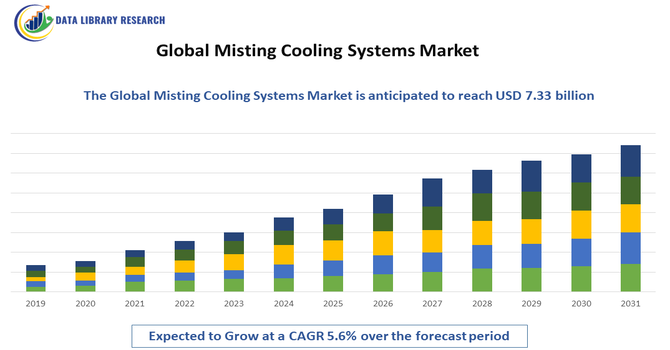
- The Global Misting Systems Market is estimated to be valued at USD 2.21 billion in 2025 and is expected to reach USD 7.33 billion by 2032, growing with a CAGR of 5.6% from 2025-2032.
Get Complete Analysis Of The Report - Download Updated Free Sample PDF
The Global Misting Cooling Systems Market is experiencing strong growth driven primarily by the increasing demand for energy-efficient and sustainable cooling solutions as global temperatures rise due to climate change, prompting residential, commercial, and industrial sectors to seek effective alternatives to traditional air conditioning. Misting cooling systems offer significant energy savings, lower operational costs, and efficient temperature reduction in outdoor and semi-enclosed spaces, making them attractive for applications such as hospitality, outdoor leisure, agriculture, and industrial environments.
Misting Cooling Systems Market Latest Trends
The global misting cooling systems market is increasingly shaped by technological advancements and smart system integration, with manufacturers embedding IoT enabled controls and smart sensors to enable real time monitoring, remote operation, and automatic adjustments of mist output based on temperature and humidity levels, enhancing efficiency and user convenience. There is also a strong shift toward eco friendly and water conserving solutions, including systems with precision nozzles, automated water recycling features, and energy efficient pumps that reduce resource consumption while maintaining cooling performance.
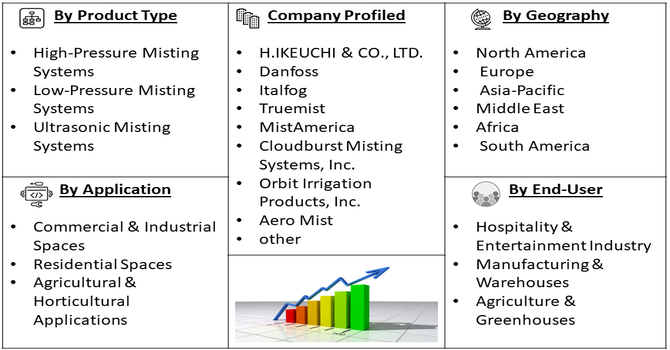
Segmentation: Global Misting Cooling Systems Market is segmented By Product Type (High-Pressure Misting Systems, Low-Pressure Misting Systems, Ultrasonic Misting Systems), Application (Commercial & Industrial Spaces, Residential Spaces, Agricultural & Horticultural Applications), End-User (Hospitality & Entertainment Industry, Manufacturing & Warehouses, Agriculture & Greenhouses), Distribution Channel (Direct Sales, Retail / Dealers, Online Sales), and Geography (North America, Europe, Asia-Pacific, Middle East and Africa, and South America). The report provides the value (in USD million) for the above segments.
For Detailed Market Segmentation - Get a Free Sample PDF
Market Drivers:
- Rising Demand for Energy-Efficient Cooling Solutions
The primary drivers of the misting cooling systems market is the growing demand for energy-efficient and cost-effective alternatives to conventional air conditioning systems. As global temperatures continue to rise and energy costs increase, industries, commercial spaces, and residential consumers are seeking sustainable cooling solutions that reduce electricity consumption. Misting cooling systems operate using less power than traditional HVAC units, providing rapid temperature reduction in outdoor and semi-enclosed environments while significantly lowering energy bills. This energy efficiency, combined with environmental concerns over greenhouse gas emissions, strongly propels market growth.
- Expansion in Commercial, Industrial, and Outdoor Applications
Another key driver is the increasing adoption of misting cooling systems across diverse sectors, including hospitality, manufacturing, warehousing, agriculture, and outdoor leisure spaces. Restaurants, hotels, stadiums, factories, and greenhouses are leveraging misting systems to improve comfort, optimize productivity, and enhance crop yield in controlled environments. The systems’ ability to provide localized, efficient cooling for large outdoor areas without the need for extensive infrastructure or ducting makes them attractive for commercial and industrial users. This growing versatility and applicability across multiple sectors accelerate overall market growth.
Market Restraints:
- High Initial Installation Costs
A major restraint for the misting cooling systems market is the relatively high upfront cost of installation, especially for high-pressure and advanced smart misting systems. These systems require specialized pumps, precision nozzles, piping networks, and sometimes integration with IoT-based control systems, which can make the initial investment significantly higher than conventional fans or basic air coolers. For small businesses or residential users, this cost can be a barrier, slowing widespread adoption despite the potential long-term energy savings. The need for professional installation and maintenance further adds to the total cost of ownership.
Socioeconomic Impact on Misting Cooling Systems Market
The Global Misting Cooling Systems Market has generated a meaningful socioeconomic impact by improving thermal comfort, workplace productivity, and public health in hot and arid environments. These systems support outdoor commercial spaces, agriculture, manufacturing, and hospitality by reducing heat stress, lowering energy consumption compared to traditional air conditioning, and enabling cost-efficient climate control. Market expansion has created employment across system manufacturing, installation, and maintenance while encouraging innovation in water-efficient and smart cooling technologies. Additionally, misting systems enhance consumer experiences in retail and recreational settings, supporting revenue growth for businesses. However, water availability and infrastructure disparities may limit adoption in some regions, highlighting the need for sustainable designs to ensure inclusive economic and social benefits.
Segmental Analysis:
- High-Pressure Misting Systems segment is expected to witness the highest growth over the forecast period
High-pressure misting systems are designed to deliver fine water droplets at high pressure, enabling rapid cooling over large outdoor or semi-enclosed spaces. They are widely used in commercial, industrial, and outdoor leisure applications due to their efficient cooling performance and ability to reduce ambient temperatures by several degrees. These systems are favored for their long-range spray, durability, and suitability in hot climates, driving strong adoption in markets where effective outdoor cooling is critical.
- Commercial & Industrial Spaces segment is expected to witness the highest growth over the forecast period
Misting cooling systems are increasingly adopted in commercial buildings, manufacturing plants, warehouses, and other industrial environments. They help maintain comfortable working conditions, improve employee productivity, and protect temperature-sensitive goods or equipment. Their ability to provide localized and energy-efficient cooling makes them an attractive alternative to conventional HVAC systems, especially in open or large spaces where traditional air conditioning is impractical.
- Hospitality & Entertainment Industry segment is expected to witness the highest growth over the forecast period
The hospitality and entertainment sector, including hotels, restaurants, resorts, stadiums, and theme parks, is a major end-user of misting cooling systems. These systems enhance guest comfort in outdoor dining areas, patios, pools, and event spaces, making them an integral part of the customer experience. Seasonal peak demand, combined with the need to maintain customer satisfaction, drives consistent adoption in this segment.
- Online Sales segment is expected to witness the highest growth over the forecast period
Online sales of misting cooling systems are gaining traction, fueled by e-commerce platforms and direct-to-consumer models. Customers benefit from convenient product selection, comparison, doorstep delivery, and easy access to user reviews. Online channels are especially important for small businesses and residential buyers seeking portable or modular systems, supporting broader market penetration and facilitating rapid adoption globally.
- North America segment is expected to witness the highest growth over the forecast period
North America is expected to witness significant growth due to high demand for energy-efficient cooling solutions, rising adoption in commercial and industrial sectors, and increasing consumer preference for eco-friendly outdoor cooling options.
Supportive government initiatives for energy conservation, coupled with technological innovations such as IoT-enabled systems, further drive market expansion across the United States and Canada. For instance, in 2025, Johnson Controls acquired Xcell Misting Ltd, strengthening its expertise in advanced water mist technologies and fire protection systems. This acquisition enhanced access to innovative mist-based solutions across multiple sectors in North America. By integrating Xcell’s specialized capabilities, Johnson Controls expanded application potential for misting technologies, supporting market growth, technological advancement, and broader adoption within North America’s misting cooling and safety systems market.
Moreover, the increasing awareness of heat management, expanding outdoor spaces, and regulatory emphasis on eco-friendly technologies are accelerating the adoption of misting cooling systems. Together, these factors position the region as a key contributor to continued innovation, investment, and market expansion.
| Report Matrics |
Details |
| Market Size Value |
USD 3.8 billion |
| Growth Rate |
CAGR of 11.20 % |
| Forecast |
2026-2033 |
| Historical data |
2021-2024 |
| Base Year |
2025 |
| Report Coverage |
Forecasted revenue, company rating, competitive environment, growth drivers, and trends |
| Segment Coverage |
Type, Application, End-User, Geography |
| Regional Scope |
North America, Europe, Asia Pacific, Middle East |
| Customized scope |
Free customization of reports (With 3 months Analysis Support ) |
| To Learn More About This Report |
Request a Free Sample Copy |
Misting Cooling Systems Market Competitive Landscape
The competitive landscape of the Global Misting Cooling Systems Market is characterized by a mix of well established international manufacturers and specialized regional players working to differentiate their offerings through product innovation, energy efficiency, smart controls, and global distribution expansion. Companies are focusing on technologies such as high pressure nozzles, IoT enabled systems, and automated cooling solutions to meet the rising demand for sustainable and efficient cooling across commercial, industrial, agricultural, and residential sectors. Continuous R&D, strategic partnerships, and broader geographic presence are key strategies adopted by leading players to strengthen their market positions in a competitive and evolving environment.
Key Companies in the Market:
- H.IKEUCHI & CO., LTD.
- Danfoss
- Italfog
- Truemist
- MistAmerica
- Cloudburst Misting Systems, Inc.
- Orbit Irrigation Products, Inc.
- Aero Mist
- Maverick Misting Systems
- Koolfog
- Cool Mist LLC
- Premier Misting Systems
- Hurricane Misting Systems
- Aqua Cooling
- Cooloff
- Synergy Cooling
- Aegean Mist
- Evaporative Cooling Systems
- Misting Systems Inc.
- Universal Fog Systems, Inc.
Recent Development
- In August 2025, Smart Mist USA’s commercial-grade wall and floor misting fans expanded access to high-pressure cooling solutions for commercial properties across California, Arizona, Florida, and Texas. By delivering superior outdoor cooling performance compared with traditional systems, this offering strengthened adoption of advanced misting technologies, supported energy-efficient climate control, and contributed to growth in the Global Misting Cooling Systems Market.
- In June 2024, aerMist launched its 300A high-pressure misting system to address rising temperature challenges in large commercial spaces and residential patios. This innovation met growing demand for efficient outdoor cooling solutions, enhanced thermal comfort, and reinforced the shift toward advanced high-pressure technologies, thereby contributing to increased adoption and growth in the Global Misting Cooling Systems Market.
Frequently Asked Questions (FAQ) :
Q1. What are the main growth-driving factors for this market?
The primary driver is the increase in global temperatures and more frequent heatwaves, making outdoor spaces uncomfortable. There is also a rising trend in "outdoor living," where homeowners and restaurants invest in cooling for patios and decks. Additionally, industries like agriculture and construction use these systems to protect workers and livestock from heat-related illnesses.
Q2. What are the main restraining factors for this market?
Growth is limited by high water consumption, which is a concern in drought-prone regions where water use is restricted. High-pressure systems can also be expensive to install and require regular maintenance to prevent nozzle clogging from mineral buildup. In humid climates, misting is less effective because the air cannot absorb more moisture.
Q3. Which segment is expected to witness high growth?
The High-Pressure Misting Systems segment is expected to see the highest growth. These systems create a much finer "dry" mist that evaporates instantly without getting people or furniture wet. Because they provide the most significant temperature drop, they are increasingly being installed in luxury resorts, theme parks, and high-end commercial outdoor dining areas.
Q4. Who are the top major players for this market?
The market is led by companies specializing in environmental cooling and fluid atomization. Key players include MistCooling Inc., Koolfog, Inc., Cloud-line, Fogco, and Orbit Irrigation Products. These companies dominate by offering everything from simple DIY kits for home gardens to massive, custom-engineered cooling solutions for industrial plants and large stadiums.
Q5. Which country is the largest player?
The United States is the largest player in the misting cooling systems market. This is driven by the extreme summer heat in southern and western states like Arizona, Texas, and California. The U.S. has a strong market for both residential backyard cooling and large-scale industrial applications, supported by high disposable income and innovation.
List of Figures
Figure 1: Global Misting Cooling Systems Market Revenue Breakdown (USD Billion, %) by Region, 2022 & 2029
Figure 2: Global Misting Cooling Systems Market Value Share (%), By Segment 1, 2022 & 2029
Figure 3: Global Misting Cooling Systems Market Forecast (USD Billion), by Sub-Segment 1, 2018-2029
Figure 4: Global Misting Cooling Systems Market Forecast (USD Billion), by Sub-Segment 2, 2018-2029
Figure 5: Global Misting Cooling Systems Market Value Share (%), By Segment 2, 2022 & 2029
Figure 6: Global Misting Cooling Systems Market Forecast (USD Billion), by Sub-Segment 1, 2018-2029
Figure 7: Global Misting Cooling Systems Market Forecast (USD Billion), by Sub-Segment 2, 2018-2029
Figure 8: Global Misting Cooling Systems Market Forecast (USD Billion), by Sub-Segment 3, 2018-2029
Figure 9: Global Misting Cooling Systems Market Forecast (USD Billion), by Others, 2018-2029
Figure 10: Global Misting Cooling Systems Market Value Share (%), By Segment 3, 2022 & 2029
Figure 11: Global Misting Cooling Systems Market Forecast (USD Billion), by Sub-Segment 1, 2018-2029
Figure 12: Global Misting Cooling Systems Market Forecast (USD Billion), by Sub-Segment 2, 2018-2029
Figure 13: Global Misting Cooling Systems Market Forecast (USD Billion), by Sub-Segment 3, 2018-2029
Figure 14: Global Misting Cooling Systems Market Forecast (USD Billion), by Others, 2018-2029
Figure 15: Global Misting Cooling Systems Market Value (USD Billion), by Region, 2022 & 2029
Figure 16: North America Misting Cooling Systems Market Value Share (%), By Segment 1, 2022 & 2029
Figure 17: North America Misting Cooling Systems Market Forecast (USD Billion), by Sub-Segment 1, 2018-2029
Figure 18: North America Misting Cooling Systems Market Forecast (USD Billion), by Sub-Segment 2, 2018-2029
Figure 19: North America Misting Cooling Systems Market Value Share (%), By Segment 2, 2022 & 2029
Figure 20: North America Misting Cooling Systems Market Forecast (USD Billion), by Sub-Segment 1, 2018-2029
Figure 21: North America Misting Cooling Systems Market Forecast (USD Billion), by Sub-Segment 2, 2018-2029
Figure 22: North America Misting Cooling Systems Market Forecast (USD Billion), by Sub-Segment 3, 2018-2029
Figure 23: North America Misting Cooling Systems Market Forecast (USD Billion), by Others, 2018-2029
Figure 24: North America Misting Cooling Systems Market Value Share (%), By Segment 3, 2022 & 2029
Figure 25: North America Misting Cooling Systems Market Forecast (USD Billion), by Sub-Segment 1, 2018-2029
Figure 26: North America Misting Cooling Systems Market Forecast (USD Billion), by Sub-Segment 2, 2018-2029
Figure 27: North America Misting Cooling Systems Market Forecast (USD Billion), by Sub-Segment 3, 2018-2029
Figure 28: North America Misting Cooling Systems Market Forecast (USD Billion), by Others, 2018-2029
Figure 29: North America Misting Cooling Systems Market Forecast (USD Billion), by U.S., 2018-2029
Figure 30: North America Misting Cooling Systems Market Forecast (USD Billion), by Canada, 2018-2029
Figure 31: Latin America Misting Cooling Systems Market Value Share (%), By Segment 1, 2022 & 2029
Figure 32: Latin America Misting Cooling Systems Market Forecast (USD Billion), by Sub-Segment 1, 2018-2029
Figure 33: Latin America Misting Cooling Systems Market Forecast (USD Billion), by Sub-Segment 2, 2018-2029
Figure 34: Latin America Misting Cooling Systems Market Value Share (%), By Segment 2, 2022 & 2029
Figure 35: Latin America Misting Cooling Systems Market Forecast (USD Billion), by Sub-Segment 1, 2018-2029
Figure 36: Latin America Misting Cooling Systems Market Forecast (USD Billion), by Sub-Segment 2, 2018-2029
Figure 37: Latin America Misting Cooling Systems Market Forecast (USD Billion), by Sub-Segment 3, 2018-2029
Figure 38: Latin America Misting Cooling Systems Market Forecast (USD Billion), by Others, 2018-2029
Figure 39: Latin America Misting Cooling Systems Market Value Share (%), By Segment 3, 2022 & 2029
Figure 40: Latin America Misting Cooling Systems Market Forecast (USD Billion), by Sub-Segment 1, 2018-2029
Figure 41: Latin America Misting Cooling Systems Market Forecast (USD Billion), by Sub-Segment 2, 2018-2029
Figure 42: Latin America Misting Cooling Systems Market Forecast (USD Billion), by Sub-Segment 3, 2018-2029
Figure 43: Latin America Misting Cooling Systems Market Forecast (USD Billion), by Others, 2018-2029
Figure 44: Latin America Misting Cooling Systems Market Forecast (USD Billion), by Brazil, 2018-2029
Figure 45: Latin America Misting Cooling Systems Market Forecast (USD Billion), by Mexico, 2018-2029
Figure 46: Latin America Misting Cooling Systems Market Forecast (USD Billion), by Rest of Latin America, 2018-2029
Figure 47: Europe Misting Cooling Systems Market Value Share (%), By Segment 1, 2022 & 2029
Figure 48: Europe Misting Cooling Systems Market Forecast (USD Billion), by Sub-Segment 1, 2018-2029
Figure 49: Europe Misting Cooling Systems Market Forecast (USD Billion), by Sub-Segment 2, 2018-2029
Figure 50: Europe Misting Cooling Systems Market Value Share (%), By Segment 2, 2022 & 2029
Figure 51: Europe Misting Cooling Systems Market Forecast (USD Billion), by Sub-Segment 1, 2018-2029
Figure 52: Europe Misting Cooling Systems Market Forecast (USD Billion), by Sub-Segment 2, 2018-2029
Figure 53: Europe Misting Cooling Systems Market Forecast (USD Billion), by Sub-Segment 3, 2018-2029
Figure 54: Europe Misting Cooling Systems Market Forecast (USD Billion), by Others, 2018-2029
Figure 55: Europe Misting Cooling Systems Market Value Share (%), By Segment 3, 2022 & 2029
Figure 56: Europe Misting Cooling Systems Market Forecast (USD Billion), by Sub-Segment 1, 2018-2029
Figure 57: Europe Misting Cooling Systems Market Forecast (USD Billion), by Sub-Segment 2, 2018-2029
Figure 58: Europe Misting Cooling Systems Market Forecast (USD Billion), by Sub-Segment 3, 2018-2029
Figure 59: Europe Misting Cooling Systems Market Forecast (USD Billion), by Others, 2018-2029
Figure 60: Europe Misting Cooling Systems Market Forecast (USD Billion), by U.K., 2018-2029
Figure 61: Europe Misting Cooling Systems Market Forecast (USD Billion), by Germany, 2018-2029
Figure 62: Europe Misting Cooling Systems Market Forecast (USD Billion), by France, 2018-2029
Figure 63: Europe Misting Cooling Systems Market Forecast (USD Billion), by Italy, 2018-2029
Figure 64: Europe Misting Cooling Systems Market Forecast (USD Billion), by Spain, 2018-2029
Figure 65: Europe Misting Cooling Systems Market Forecast (USD Billion), by Russia, 2018-2029
Figure 66: Europe Misting Cooling Systems Market Forecast (USD Billion), by Rest of Europe, 2018-2029
Figure 67: Asia Pacific Misting Cooling Systems Market Value Share (%), By Segment 1, 2022 & 2029
Figure 68: Asia Pacific Misting Cooling Systems Market Forecast (USD Billion), by Sub-Segment 1, 2018-2029
Figure 69: Asia Pacific Misting Cooling Systems Market Forecast (USD Billion), by Sub-Segment 2, 2018-2029
Figure 70: Asia Pacific Misting Cooling Systems Market Value Share (%), By Segment 2, 2022 & 2029
Figure 71: Asia Pacific Misting Cooling Systems Market Forecast (USD Billion), by Sub-Segment 1, 2018-2029
Figure 72: Asia Pacific Misting Cooling Systems Market Forecast (USD Billion), by Sub-Segment 2, 2018-2029
Figure 73: Asia Pacific Misting Cooling Systems Market Forecast (USD Billion), by Sub-Segment 3, 2018-2029
Figure 74: Asia Pacific Misting Cooling Systems Market Forecast (USD Billion), by Others, 2018-2029
Figure 75: Asia Pacific Misting Cooling Systems Market Value Share (%), By Segment 3, 2022 & 2029
Figure 76: Asia Pacific Misting Cooling Systems Market Forecast (USD Billion), by Sub-Segment 1, 2018-2029
Figure 77: Asia Pacific Misting Cooling Systems Market Forecast (USD Billion), by Sub-Segment 2, 2018-2029
Figure 78: Asia Pacific Misting Cooling Systems Market Forecast (USD Billion), by Sub-Segment 3, 2018-2029
Figure 79: Asia Pacific Misting Cooling Systems Market Forecast (USD Billion), by Others, 2018-2029
Figure 80: Asia Pacific Misting Cooling Systems Market Forecast (USD Billion), by China, 2018-2029
Figure 81: Asia Pacific Misting Cooling Systems Market Forecast (USD Billion), by India, 2018-2029
Figure 82: Asia Pacific Misting Cooling Systems Market Forecast (USD Billion), by Japan, 2018-2029
Figure 83: Asia Pacific Misting Cooling Systems Market Forecast (USD Billion), by Australia, 2018-2029
Figure 84: Asia Pacific Misting Cooling Systems Market Forecast (USD Billion), by Southeast Asia, 2018-2029
Figure 85: Asia Pacific Misting Cooling Systems Market Forecast (USD Billion), by Rest of Asia Pacific, 2018-2029
Figure 86: Middle East & Africa Misting Cooling Systems Market Value Share (%), By Segment 1, 2022 & 2029
Figure 87: Middle East & Africa Misting Cooling Systems Market Forecast (USD Billion), by Sub-Segment 1, 2018-2029
Figure 88: Middle East & Africa Misting Cooling Systems Market Forecast (USD Billion), by Sub-Segment 2, 2018-2029
Figure 89: Middle East & Africa Misting Cooling Systems Market Value Share (%), By Segment 2, 2022 & 2029
Figure 90: Middle East & Africa Misting Cooling Systems Market Forecast (USD Billion), by Sub-Segment 1, 2018-2029
Figure 91: Middle East & Africa Misting Cooling Systems Market Forecast (USD Billion), by Sub-Segment 2, 2018-2029
Figure 92: Middle East & Africa Misting Cooling Systems Market Forecast (USD Billion), by Sub-Segment 3, 2018-2029
Figure 93: Middle East & Africa Misting Cooling Systems Market Forecast (USD Billion), by Others, 2018-2029
Figure 94: Middle East & Africa Misting Cooling Systems Market Value Share (%), By Segment 3, 2022 & 2029
Figure 95: Middle East & Africa Misting Cooling Systems Market Forecast (USD Billion), by Sub-Segment 1, 2018-2029
Figure 96: Middle East & Africa Misting Cooling Systems Market Forecast (USD Billion), by Sub-Segment 2, 2018-2029
Figure 97: Middle East & Africa Misting Cooling Systems Market Forecast (USD Billion), by Sub-Segment 3, 2018-2029
Figure 98: Middle East & Africa Misting Cooling Systems Market Forecast (USD Billion), by Others, 2018-2029
Figure 99: Middle East & Africa Misting Cooling Systems Market Forecast (USD Billion), by GCC, 2018-2029
Figure 100: Middle East & Africa Misting Cooling Systems Market Forecast (USD Billion), by South Africa, 2018-2029
Figure 101: Middle East & Africa Misting Cooling Systems Market Forecast (USD Billion), by Rest of Middle East & Africa, 2018-2029
List of Tables
Table 1: Global Misting Cooling Systems Market Revenue (USD Billion) Forecast, by Segment 1, 2018-2029
Table 2: Global Misting Cooling Systems Market Revenue (USD Billion) Forecast, by Segment 2, 2018-2029
Table 3: Global Misting Cooling Systems Market Revenue (USD Billion) Forecast, by Segment 3, 2018-2029
Table 4: Global Misting Cooling Systems Market Revenue (USD Billion) Forecast, by Region, 2018-2029
Table 5: North America Misting Cooling Systems Market Revenue (USD Billion) Forecast, by Segment 1, 2018-2029
Table 6: North America Misting Cooling Systems Market Revenue (USD Billion) Forecast, by Segment 2, 2018-2029
Table 7: North America Misting Cooling Systems Market Revenue (USD Billion) Forecast, by Segment 3, 2018-2029
Table 8: North America Misting Cooling Systems Market Revenue (USD Billion) Forecast, by Country, 2018-2029
Table 9: Europe Misting Cooling Systems Market Revenue (USD Billion) Forecast, by Segment 1, 2018-2029
Table 10: Europe Misting Cooling Systems Market Revenue (USD Billion) Forecast, by Segment 2, 2018-2029
Table 11: Europe Misting Cooling Systems Market Revenue (USD Billion) Forecast, by Segment 3, 2018-2029
Table 12: Europe Misting Cooling Systems Market Revenue (USD Billion) Forecast, by Country, 2018-2029
Table 13: Latin America Misting Cooling Systems Market Revenue (USD Billion) Forecast, by Segment 1, 2018-2029
Table 14: Latin America Misting Cooling Systems Market Revenue (USD Billion) Forecast, by Segment 2, 2018-2029
Table 15: Latin America Misting Cooling Systems Market Revenue (USD Billion) Forecast, by Segment 3, 2018-2029
Table 16: Latin America Misting Cooling Systems Market Revenue (USD Billion) Forecast, by Country, 2018-2029
Table 17: Asia Pacific Misting Cooling Systems Market Revenue (USD Billion) Forecast, by Segment 1, 2018-2029
Table 18: Asia Pacific Misting Cooling Systems Market Revenue (USD Billion) Forecast, by Segment 2, 2018-2029
Table 19: Asia Pacific Misting Cooling Systems Market Revenue (USD Billion) Forecast, by Segment 3, 2018-2029
Table 20: Asia Pacific Misting Cooling Systems Market Revenue (USD Billion) Forecast, by Country, 2018-2029
Table 21: Middle East & Africa Misting Cooling Systems Market Revenue (USD Billion) Forecast, by Segment 1, 2018-2029
Table 22: Middle East & Africa Misting Cooling Systems Market Revenue (USD Billion) Forecast, by Segment 2, 2018-2029
Table 23: Middle East & Africa Misting Cooling Systems Market Revenue (USD Billion) Forecast, by Segment 3, 2018-2029
Table 24: Middle East & Africa Misting Cooling Systems Market Revenue (USD Billion) Forecast, by Country, 2018-2029
Research Process
Data Library Research are conducted by industry experts who offer insight on
industry structure, market segmentations technology assessment and competitive landscape (CL), and penetration, as well as on emerging trends. Their analysis is based on primary interviews (~ 80%) and secondary research (~ 20%) as well as years of professional expertise in their respective industries. Adding to this, by analysing historical trends and current market positions, our analysts predict where the market will be headed for the next five years. Furthermore, the varying trends of segment & categories geographically presented are also studied and the estimated based on the primary & secondary research.
In this particular report from the supply side Data Library Research has conducted primary surveys (interviews) with the key level executives (VP, CEO’s, Marketing Director, Business Development Manager
and SOFT) of the companies that active & prominent as well as the midsized organization
FIGURE 1: DLR RESEARH PROCESS
![research-methodology1]()
Primary Research
Extensive primary research was conducted to gain a deeper insight of the market and industry performance. The analysis is based on both primary and secondary research as well as years of professional expertise in the respective industries.
In addition to analysing current and historical trends, our analysts predict where the market is headed over the next five years.
It varies by segment for these categories geographically presented in the list of market tables. Speaking about this particular report we have conducted primary surveys (interviews) with the key level executives (VP, CEO’s, Marketing Director, Business Development Manager and many more) of the major players active in the market.
Secondary Research
Secondary research was mainly used to collect and identify information useful for the extensive, technical, market-oriented, and Friend’s study of the Global Extra Neutral Alcohol. It was also used to obtain key information about major players, market classification and segmentation according to the industry trends, geographical markets, and developments related to the market and technology perspectives. For this study, analysts have gathered information from various credible sources, such as annual reports, sec filings, journals, white papers, SOFT presentations, and company web sites.
Market Size Estimation
Both, top-down and bottom-up approaches were used to estimate and validate the size of the Global market and to estimate the size of various other dependent submarkets in the overall Extra Neutral Alcohol. The key players in the market were identified through secondary research and their market contributions in the respective geographies were determined through primary and secondary research.
Forecast Model
![research-methodology2]()