
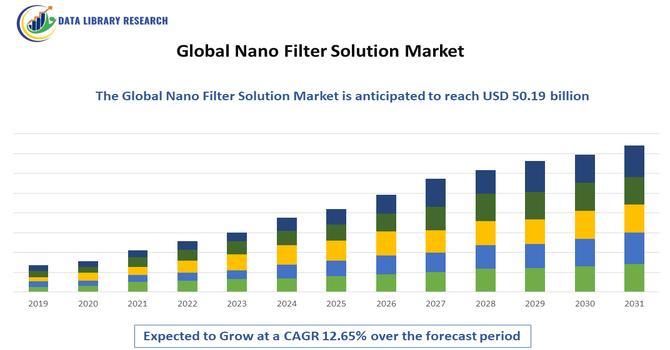
The Global Nano Filter Solution Market size is valued at USD 22.98 billion in 2026 and is expected to cross around USD 50.19 billion by 2033, growing with a CAGR of 12.65% from 2026-2033.
Get Complete Analysis Of The Report - Download Updated Free Sample PDF
The Global Nano Filter Solution Market refers to the global industry that develops, manufactures, and supplies nano scale filtration technologies and systems used to separate contaminants, particles, and dissolved substances at molecular levels. These solutions include nanofiltration membranes, cartridges, modules, and integrated systems applicable to water and wastewater treatment, industrial process filtration, pharmaceuticals, food & beverage production, and other sectors. Nanofiltration typically targets particles in the 0.001–0.01-micron range, offering high efficiency with lower energy consumption than some traditional methods, addressing needs for clean water, environmental compliance, and industrial purification processes.
The nano filter solution market is trending toward sustainable and eco efficient technologies. Manufacturers are innovating membranes with higher flux, fouling resistance, and longer service life, reducing overall system costs and environmental impacts. Hybrid filtration systems combining nano filtration with ultrafiltration or reverse osmosis are gaining traction for enhanced performance in complex applications. IoT enabled smart systems enable real time monitoring and predictive maintenance, improving reliability. Customized solutions for specific industrial uses and modular, scalable designs for expanding infrastructure needs are increasingly common. Government incentives and sustainability targets are encouraging adoption globally.
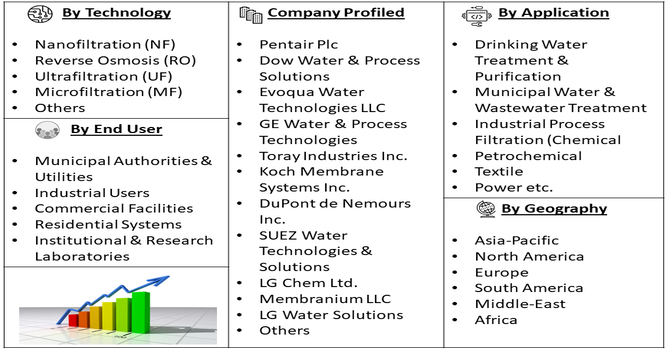
Segmentation: The Global Nano Filter Solution Market is segmented by Technology (Nanofiltration (NF), Reverse Osmosis (RO), Ultrafiltration (UF), Microfiltration (MF) and Others), Component (Nano Membranes, Pressure Vessels & Housings, Pumps & Motors, Valves & Fittings and Monitoring & Control Systems), Material (Polymeric Membranes, Inorganic / Ceramic Membranes, Hybrid Materials, and Other Specialty Materials), Application (Drinking Water Treatment & Purification, Municipal Water & Wastewater Treatment, Industrial Process Filtration (Chemical, Petrochemical, Textile, Power, etc.), Food & Beverage Processing, Pharmaceuticals & Biotechnology, Electronics & Semiconductor Manufacturing and Others), Membrane Configuration (Spiral Wound, Hollow Fiber, Tubular, Plate & Frame and Others), End User (Municipal Authorities & Utilities, Industrial Users, Commercial Facilities, Residential Systems and Institutional & Research Laboratories), and Geography (North America, Europe, Asia-Pacific, Middle East and Africa, and South America). The report provides the value (in USD million) for the above segments.
For Detailed Market Segmentation - Get a Free Sample PDF
Market Drivers:
Global water scarcity and the rising need for safe potable water are strong drivers. Rapid population growth, urbanization, and industrial expansion increase demand for advanced water treatment technologies that can effectively remove contaminants, organic compounds, and ions while preserving essential minerals. Stringent environmental and health regulations worldwide push municipalities and industries to adopt nanofiltration solutions that meet regulatory standards and public health goals. Technological improvements lowering operational costs and increasing efficiency further accelerate market adoption. Industrial Application Expansion@@@@ Nano filter solutions are increasingly adopted in industrial sectors such as pharmaceutical manufacturing, chemical processing, food & beverage production, and wastewater management.
In January 2025, MIT engineers developed a nanofiltration process that captured and recycled aluminium from manufacturing waste, enhancing production efficiency and reducing hazardous byproducts. This innovation accelerated industrial application expansion, driving demand in the global nano filter solution market by demonstrating cost savings, sustainability benefits, and the technology’s effectiveness in heavy industrial processes.
These industries require high precision purification and separation processes that nanofiltration technologies uniquely provide. Integration with automation and IoT for performance tracking enhances appeal in industrial environments. Government infrastructure investments in emerging economies, aiming to upgrade treatment facilities and meet sustainability commitments, also stimulate market growth across diverse sectors.
Market Restraints:
A primary restraint is the capital and operational cost associated with nano filter systems. The initial investment for high performance membranes, modules, and supporting components can be significantly higher than conventional filtration alternatives, making adoption slower in price sensitive markets and small scale applications. Additionally, membrane fouling and degradation over time require pre treatment investments and maintenance, raising total lifecycle costs. Lack of awareness in some regions and competition from established conventional technologies also limit market penetration, especially where infrastructure funding is constrained.
Nano filtration solutions have meaningful socioeconomic impacts by improving access to clean, safe water — a basic determinant of public health. Advanced nanofiltration helps reduce waterborne diseases and lowers healthcare burdens in communities lacking reliable water infrastructure. In industrial regions, these technologies improve wastewater treatment and recycling, reducing environmental pollution and contributing to sustainable economic growth. Job creation in advanced manufacturing, R&D, installation, and maintenance services supports skilled employment. Adoption in emerging markets also drives infrastructure investment and technology transfer, strengthening industrial competitiveness and regional development.
Segmental Analysis:
The Nanofiltration (NF) segment is poised for the highest growth during the forecast period due to its ability to efficiently remove divalent ions, organic compounds, and micropollutants with lower energy requirements compared to reverse osmosis. NF membranes offer a balanced performance between ultrafiltration and RO, making them ideal for municipal water treatment, industrial wastewater reuse, and desalination pretreatment. Increasing global concerns about water scarcity, tightening discharge standards, and demand for cost effective purification technologies are driving adoption. Additionally, ongoing technological improvements in NF membranes—such as enhanced fouling resistance and longer service life—boost operational reliability and reduce lifecycle costs, further strengthening demand across end use industries.
The Polymeric Membranes segment is expected to achieve the highest growth in the forecast period, primarily because these membranes balance performance, cost effectiveness, and ease of manufacturing. Polymer based membranes, particularly polyamide thin film composites, deliver high selectivity and permeability for key applications such as potable water production, industrial effluent treatment, and food & beverage processing. Their flexibility allows for customization to target specific contaminants and operating conditions. Polymer membranes also benefit from widespread industry familiarity, scalable production, and ongoing R&D that enhances fouling resistance and durability. With expanding adoption in emerging markets and continual integration into modular purification systems, polymeric membranes are increasingly preferred over more expensive inorganic alternatives.
The Nano Membranes segment is projected to exhibit the highest growth over the forecast period as industries and municipalities seek sophisticated filtration capable of removing particles at molecular and nano scale dimensions. Nano membranes deliver exceptional separation efficiency, enabling high purity water production, brackish water treatment, and advanced wastewater reuse. Adoption is driven by increasing regulatory pressure to meet stringent discharge and potable water quality standards, along with rising environmental awareness. Continuous advancements in nanomaterial science—such as graphene enhanced and other engineered nano composite membranes—improve flux, lifespan, and fouling control. These innovations make nano membranes more cost competitive and reliable, supporting broader market penetration across industrial and residential water applications.
The Drinking Water Treatment & Purification segment is forecast to grow fastest due to escalating demand for safe and clean drinking water worldwide. Rapid urbanization, population growth, and deteriorating freshwater sources have amplified the need for advanced purification solutions capable of removing pathogens, organic contaminants, and emerging micropollutants. Nano filter solutions, with their ability to deliver high quality potable water with lower energy consumption than traditional approaches, are increasingly adopted by municipal authorities, private utilities, and decentralized systems. Heightened public health awareness, combined with government investments in infrastructure upgrades and stringent quality mandates, further propels the segment’s adoption, especially in developing regions striving to meet Sustainable Development Goals for universal clean water access.
The Petrochemical segment is anticipated to witness the highest growth over the forecast period as the industry increasingly integrates advanced filtration to meet stringent process and environmental standards. Nano filter solutions are ideal for separating fine contaminants, recovering valuable chemicals, and treating complex effluents in petrochemical operations. Enhanced membrane technologies offer resilience to harsh chemical environments and deliver energy efficient performance, which is vital in high volume production settings. Additionally, tightening environmental regulations on wastewater discharge and recycling within petrochemical facilities drive demand for reliable, high precision nano filtration. The ability to reduce operational costs through improved recovery and reuse of water and solvents reinforces long term adoption in petrochemical supply chains.
The Spiral Wound configuration segment is expected to lead growth due to its compact design, high packing density, and ease of integration into existing systems. Spiral wound modules offer superior surface area to volume ratios, enhancing throughput without significantly increasing footprint — a critical factor for both industrial and municipal applications with space constraints. Their modular nature enables flexible scaling and swift maintenance, lowering total cost of ownership. Coupled with ongoing innovations in membrane materials and anti fouling features, spiral wound systems deliver consistent performance in water and wastewater treatment, desalination pretreatment, and industrial purification. These advantages have made spiral wound configurations a preferred choice for new installations and retrofits alike.
The Municipal Authorities & Utilities segment is expected to grow fastest as governments and public utilities prioritize upgrading aging infrastructure and meeting stricter water quality and sustainability targets. With rising urban populations and limited freshwater resources, nanofiltration solutions are increasingly deployed for potable water production, wastewater reuse, and stringent contaminant removal. Municipal investments in smart, energy efficient treatment technologies are supported by regulatory frameworks and financing programs aimed at securing long term water security. The reliability, scalability, and relatively low operational costs of nano filter systems further enhance their appeal. This driving force reflects global trends toward resilient, future ready public water systems capable of serving expanding metropolitan demands.
North America is forecast to experience the highest growth during the forecast period, driven by robust infrastructure investments, strong regulatory frameworks, and high awareness of water quality issues.
The United States and Canada are accelerating upgrades to municipal water and industrial treatment facilities to address aging systems and emerging contaminants such as PFAS. For instance, in 2024, Dow Chemical and Veolia North America partnered to enhance water treatment at wastewater plants, increasing the deployment of reverse osmosis and ultrafiltration systems. This collaboration boosted North America’s nano filter solution market by accelerating adoption, improving infrastructure efficiency, and driving demand for advanced filtration technologies.
Also, substantial R&D activity and commercial deployment of advanced nanofiltration technologies further support uptake. Additionally, stringent environmental standards and sustainability goals at federal and state levels encourage utilities and industries to adopt energy efficient filtration solutions. The presence of major technology providers and rising demand for decentralized and smart water purification solutions augment the region’s leadership in the global nano filter solution market.
| Report Matrics | Details |
| Market Size Value | USD 50.19 billion |
| Growth Rate | CAGR of 12.65 % |
| Forecast | 2026-2033 |
| Historical data | 2021-2024 |
| Base Year | 2025 |
| Report Coverage | Forecasted revenue, company rating, competitive environment, growth drivers, and trends |
| Segment Coverage | Type, Application, End-User, Geography |
| Regional Scope | North America, Europe, Asia Pacific, Middle East |
| Customized scope | Free customization of reports (With 3 months' analysis support) |
| To Learn More About This Report | Request a Free Sample Copy |
The competitive landscape is comprised of established multinational corporations and regional specialists competing on technology innovation, system efficiency, and service support. Key companies invest heavily in R&D to develop advanced membranes with better selectivity, durability, and energy efficiency. Strategic partnerships, mergers, and acquisitions are common, helping firms expand portfolios and geographic presence. Competitive differentiation also emphasizes after sales services, customization, and cost efficiency. Price competition and intellectual property in membrane technology influence positioning. Overall, the market shows moderate fragmentation with ongoing consolidation expected as players seek growth in emerging regions and specialized applications.
The major players are:
Recent Development
Q1. What is the main growth-driving factors for this market?
The growth is fuelled by the escalating global water scarcity and the resulting demand for advanced wastewater recycling and desalination. Stringent environmental regulations (such as the EPA’s focus on PFAS "forever chemicals") push industries toward nanofiltration’s ability to selectively remove micropollutants. Its lower energy consumption compared to reverse osmosis also makes it highly attractive for cost-conscious utilities
Q2. What are the main restraining factors for this market?
The market is primarily hindered by membrane fouling, where organic matter and minerals clog the pores, leading to higher cleaning costs and shorter equipment lifespans. High initial capital investment for specialized pumps and pressure vessels remains a barrier for smaller municipalities. Additionally, the sensitivity to free chlorine in feed water necessitates expensive pretreatment to prevent membrane damage.
Q3. Which segment is expected to witness high growth?
The Nano Membranes segment is projected to experience the highest growth over the forecast period due to their exceptional ability to remove contaminants at molecular and nano levels. Rising demand for high-purity water, stringent environmental regulations, and advancements in nanomaterials are driving widespread adoption across industrial, municipal, and residential applications.
Q4. Who are the top major players for this market?
The market is led by global innovation giants including DuPont (FilmTec), Toray Industries, and Danaher Corporation (Pall). Other dominant players include Veolia Water Technologies, Alfa Laval, Hydranautics (Nitto), and Suez Water Technologies. Emerging specialists like NX Filtration (focusing on hollow-fiber technology) and Vontron Technology are also gaining significant global market share.
Q5. Which country is the largest player??
The United States is currently the largest individual market player, backed by extensive R&D and a mature industrial base. However, on a regional level, Asia-Pacific (led by China) holds the largest overall market share. China’s dominance is fueled by its status as a global manufacturing hub and aggressive government-led investments in "smart" water infrastructure.
Data Library Research are conducted by industry experts who offer insight on industry structure, market segmentations technology assessment and competitive landscape (CL), and penetration, as well as on emerging trends. Their analysis is based on primary interviews (~ 80%) and secondary research (~ 20%) as well as years of professional expertise in their respective industries. Adding to this, by analysing historical trends and current market positions, our analysts predict where the market will be headed for the next five years. Furthermore, the varying trends of segment & categories geographically presented are also studied and the estimated based on the primary & secondary research.
In this particular report from the supply side Data Library Research has conducted primary surveys (interviews) with the key level executives (VP, CEO’s, Marketing Director, Business Development Manager and SOFT) of the companies that active & prominent as well as the midsized organization
FIGURE 1: DLR RESEARH PROCESS
Extensive primary research was conducted to gain a deeper insight of the market and industry performance. The analysis is based on both primary and secondary research as well as years of professional expertise in the respective industries.
In addition to analysing current and historical trends, our analysts predict where the market is headed over the next five years.
It varies by segment for these categories geographically presented in the list of market tables. Speaking about this particular report we have conducted primary surveys (interviews) with the key level executives (VP, CEO’s, Marketing Director, Business Development Manager and many more) of the major players active in the market.
Secondary ResearchSecondary research was mainly used to collect and identify information useful for the extensive, technical, market-oriented, and Friend’s study of the Global Extra Neutral Alcohol. It was also used to obtain key information about major players, market classification and segmentation according to the industry trends, geographical markets, and developments related to the market and technology perspectives. For this study, analysts have gathered information from various credible sources, such as annual reports, sec filings, journals, white papers, SOFT presentations, and company web sites.
Market Size EstimationBoth, top-down and bottom-up approaches were used to estimate and validate the size of the Global market and to estimate the size of various other dependent submarkets in the overall Extra Neutral Alcohol. The key players in the market were identified through secondary research and their market contributions in the respective geographies were determined through primary and secondary research.
Forecast Model