Overseas Mental Health Platform Market Overview and Analysis
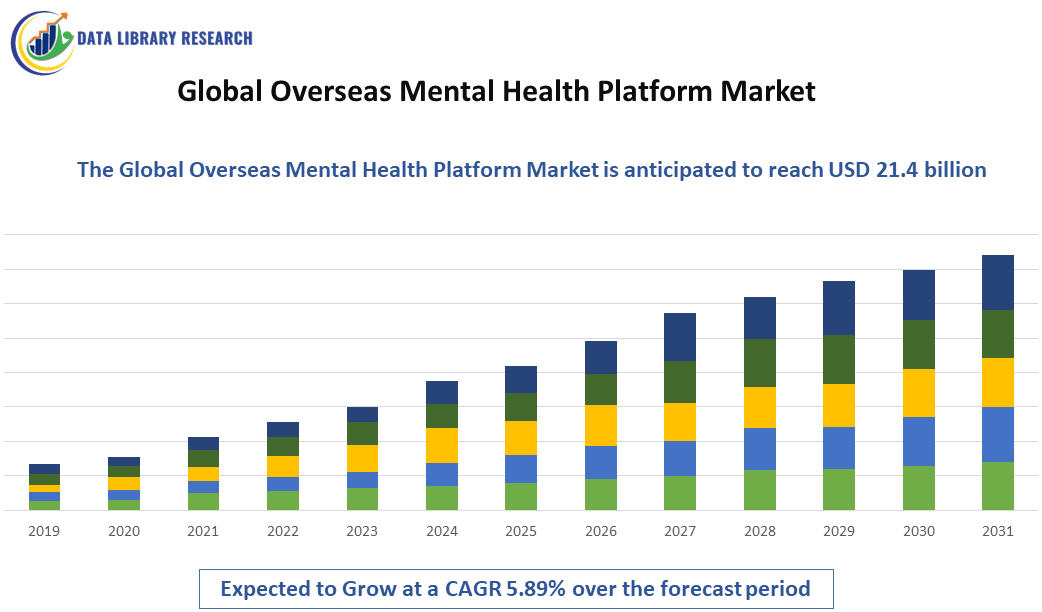
The Global Overseas Mental Health Platform Market is estimated to be USD 7.8 billion in 2026, and it is expected to reach USD 21.4 billion by 2033, growing with a CAGR of 5.89% from 2026-2033.
Get Complete Analysis Of The Report - Download Updated Free Sample PDF
The Global Overseas Mental Health Platform Market includes digital services and platforms that provide mental health support to individuals living or working outside their home countries. These platforms offer therapy, counseling, coaching, and self-help tools via video calls, chat, or app-based programs, often tailored to expatriates, international students, and migrant workers. They address unique challenges such as cultural adjustment, language barriers, isolation, and stress related to relocation. The market is driven by growing awareness of mental wellbeing, rising cross-border mobility, and increasing acceptance of online therapy.
Overseas Mental Health Platform Market Latest Trends
The global overseas mental health platform market is being shaped by rising cross-border mobility and growing awareness of mental wellbeing. Increasing numbers of expatriates, international students, and migrant workers are seeking accessible and culturally sensitive support online. Platforms are integrating AI-based chatbots, multilingual therapy options, and personalized care plans to improve reach and engagement. Hybrid models combining digital and in-person counseling are gaining traction, while employers and educational institutions increasingly offer mental health benefits to support international populations.
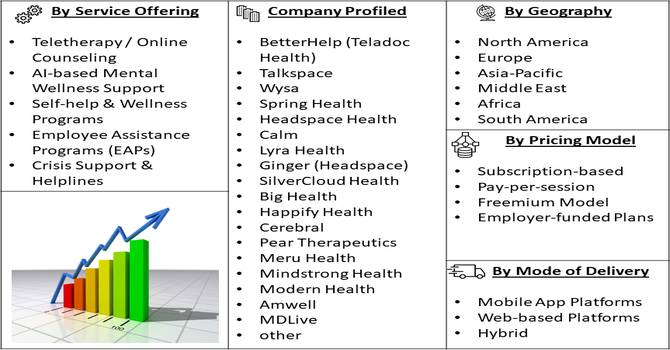
Segmentation: The Global Overseas Mental Health Platform Market is segmented by Service Type (Teletherapy / Online Counseling, AI-based Mental Wellness Support, Self-help & Wellness Programs, Employee Assistance Programs (EAPs) and Crisis Support & Helplines), Pricing Model (Subscription-based, Pay-per-session, Freemium Model, Employer-funded Plans), Mode of Delivery (Mobile App Platforms, Web-based Platforms and Hybrid (App + In-person)), and Geography (North America, Europe, Asia-Pacific, Middle East and Africa, and South America). The report provides the value (in USD million) for the above segments.
For Detailed Market Segmentation - Get a Free Sample PDF
Market Drivers:
- Growing International Mobility and Cultural Stress
Rising global mobility—through expatriate assignments, international education, and migration—has increased demand for mental health support that is accessible across borders. People living abroad often face cultural adjustment challenges, loneliness, language barriers, and work-related stress, creating a strong need for convenient mental wellness services. Overseas mental health platforms provide timely access to counseling and support, regardless of location, helping users cope with adaptation difficulties. As more individuals pursue global opportunities, the demand for culturally sensitive, remote mental health solutions continues to grow, driving market expansion worldwide.
- Increased Awareness and Acceptance of Online Mental Health Care
Mental health awareness has improved globally, and stigma around seeking therapy has decreased significantly. This shift has led more people to explore digital platforms as a comfortable and confidential option for support. Remote therapy is especially appealing to those who lack local access to specialized care or who prefer privacy and flexibility.
Advancements in telehealth technology, secure communication tools, and app-based programs have further enhanced user experience and trust. For instance, in 2024, Ewolv’s launch strengthened the global overseas mental health platform market by expanding tailored support for women professionals, particularly those working internationally. The platform’s focus on holistic wellbeing highlighted the growing need for workplace mental health solutions and reinforced the role of employers in addressing stress and burnout. This development helped diversify offerings and increased demand for culturally sensitive, gender-specific digital mental health care globally.
Market Restraints
- Regulatory and Data Privacy Challenges
Overseas mental health platforms face significant regulatory hurdles due to differing healthcare laws, licensing requirements, and telehealth standards across countries. Providers must navigate complex legal frameworks to ensure therapists are licensed to practice in users’ regions and comply with local medical regulations. Additionally, handling sensitive mental health data across borders raises privacy concerns and requires strong cybersecurity measures. Data protection laws vary widely, and noncompliance can lead to penalties and loss of user trust. These regulatory and privacy challenges can slow expansion, limit service offerings, and increase operational costs for platform providers.
Socioeconomic Impact on Overseas Mental Health Platform Market
Overseas mental health platforms play a crucial role in improving wellbeing among international communities, supporting emotional stability, productivity, and social integration. By offering affordable and convenient care, these services help reduce barriers to treatment for people facing language, cultural, or geographic constraints. Improved mental health can enhance academic performance, work efficiency, and overall quality of life, benefiting families and communities. Economically, platforms contribute to job creation for therapists, counselors, and tech professionals, while reducing long-term healthcare costs linked to untreated mental health issues. They also support employers and institutions by lowering absenteeism and improving retention among international employees and students.
Segmental Analysis:
- Teletherapy / Online Counselling segment is expected to witness highest growth over the forecast period
The teletherapy and online counseling segment is expected to experience the highest growth over the forecast period as remote mental health support becomes more widely accepted and trusted. This format offers real-time access to licensed professionals, making it especially valuable for overseas users who face time-zone differences and limited local therapy options. The convenience of scheduling sessions from any location, combined with improved video communication and privacy protections, strengthens its appeal. Employers and educational institutions increasingly integrate teletherapy into wellness programs, further driving adoption. Overall, the segment benefits from a strong shift toward digital-first care and greater demand for professional support.
- Pay-per-session segment is expected to witness highest growth over the forecast period
The pay-per-session model is expected to witness the highest growth over the forecast period because it offers flexibility and affordability for users who may not want long-term commitments. Overseas individuals often require short-term support for specific challenges such as relocation stress, cultural adjustment, or crisis situations, making one-time sessions more suitable. This model also allows users to choose therapists based on immediate needs without being locked into subscriptions. As platforms expand globally, pay-per-session services attract new users who prefer “as-needed” support. The transparency and simplicity of this pricing approach make it an increasingly popular choice in international markets.
- Mobile App Platforms segment is expected to witness highest growth over the forecast period
Mobile app platforms are expected to record the highest growth over the forecast period due to the widespread use of smartphones and growing demand for on-the-go mental wellness support. Mobile apps provide instant access to therapy sessions, self-help tools, mood tracking, and guided exercises, making mental health care more convenient and user-friendly. For overseas users, apps reduce barriers like time-zone differences and limited local resources, while also offering multilingual options and culturally adapted content. As digital adoption increases globally, mobile apps are becoming the preferred channel for mental health support, especially among younger populations and tech-savvy users.
- North American Region is expected to witness highest growth over the forecast period
The North American region is expected to witness the highest growth over the forecast period driven by strong digital health adoption and widespread acceptance of online mental health services. The region has a large expatriate and international student population, creating demand for accessible and culturally sensitive support. For instance, in 2024, Magellan Health’s launch of a Teen Mental Wellbeing app strengthened North America’s overseas mental health platform market by expanding digital support for young international users. The app’s evidence-based tools and resilience-building features enhanced access to age-appropriate mental health resources, particularly for teens and young adults facing cross-border stress. This innovation reinforced the region’s focus on scalable, tech-driven care for global youth populations.
Employers in North America increasingly offer mental health benefits as part of employee wellness programs, boosting platform usage. Additionally, strong investments in telehealth technology and established healthcare infrastructure support rapid market expansion. With ongoing focus on mental wellbeing and high smartphone penetration, North America remains a key growth driver for overseas mental health platforms.
| Report Matrics |
Details |
| Market Size Value |
USD 21.4 billion |
| Growth Rate |
CAGR of 5.89% |
| Forecast |
2026-2033 |
| Historical data |
2021-2024 |
| Base Year |
2025 |
| Report Coverage |
Forecasted revenue, company rating, competitive environment, growth drivers, and trends |
| Segment Coverage |
Type, Application, End-User, Geography |
| Regional Scope |
North America, Europe, Asia Pacific, Middle East |
| Customized scope |
Free customization of reports (With 3 months Analysis Support ) |
| To Learn More About This Report |
Request a Free Sample Copy |
Overseas Mental Health Platform Market Competitive Landscape
The competitive landscape of overseas mental health platforms is diverse, featuring global teletherapy providers, region-specific startups, and established healthcare companies expanding digitally. Major players compete on the basis of service quality, language options, cultural expertise, and technology integration. Differentiation often comes through specialized offerings for expatriates, multilingual therapists, and partnerships with universities or employers. Many platforms focus on data privacy, clinical accreditation, and user experience to build trust. Competition is also driven by pricing models, subscription plans, and the ability to provide immediate access to care. As the market grows, mergers, strategic alliances, and regional expansions are expected to intensify.
The major players for above market are:
- BetterHelp (Teladoc Health)
- Talkspace
- Wysa
- Spring Health
- Headspace Health
- Calm
- Lyra Health
- Ginger (Headspace)
- SilverCloud Health
- Big Health
- Happify Health
- Cerebral
- Pear Therapeutics
- Meru Health
- Mindstrong Health
- Modern Health
- Amwell
- MDLive
- 7 Cups
- Myndlift
Recent Development
- In January 2026, Mantra Health’s launch of Beacon strengthened the global overseas mental health platform market by enhancing early intervention and student support capabilities. The intelligence-driven system improved mental health monitoring and personalized care for international students, supporting retention and wellbeing. With strategic guidance from the Jed Foundation, the initiative reinforced trust and expanded demand for digital mental health solutions in higher education globally.
- In October 2025, Lyra Health’s launched, clinical-grade AI mental health experience strengthened the global overseas mental health platform market by making high-quality support more accessible across borders. The AI-driven service expanded round-the-clock care, enhanced clinical reliability, and improved scalability for international users. With strong provider oversight and safety protocols, it boosted trust in AI-assisted mental healthcare and accelerated digital adoption worldwide.
Frequently Asked Questions (FAQ) :
Q1. What are the main growth-driving factors for this market?
The primary drivers include the global de-stigmatization of mental health issues and a surge in workplace wellness initiatives. Technological advancements in AI-driven therapy and the convenience of remote accessibility are crucial. Additionally, increasing rates of anxiety and depression worldwide have boosted demand for scalable, borderless digital counseling solutions and platforms.
Q2. What are the main restraining factors for this market?
Growth is significantly hindered by data privacy concerns and the lack of standardized international regulations for cross-border digital therapy. Language barriers and cultural nuances in treatment can also limit effectiveness. Furthermore, inconsistent reimbursement policies from insurance providers and the high cost of acquiring specialized medical talent remain major market challenges.
Q3. Which segment is expected to witness high growth?
The "Tele-therapy" or "Online Counseling" segment is expected to witness the highest growth. This is driven by its ability to provide immediate, on-demand access to licensed professionals regardless of geographic location. The segment's scalability, combined with rising adoption among younger demographics who prefer digital interaction, makes it the dominant growth engine
Q4. Who are the top major players for this market?
The market is led by prominent platforms such as BetterHelp (Teladoc Health), Talkspace, and Headspace Health. Other key players include Ginger, Lyra Health, and Modern Health. These organizations maintain their competitive edge through extensive therapist networks, sophisticated mobile application interfaces, and strategic partnerships with large multinational corporations for employee benefits.
Q5. Which country is the largest player?
The United States is the largest player in the global mental health platform market. Its leadership is fueled by a robust venture capital ecosystem for health-tech startups, high digital literacy, and significant healthcare spending. The country also hosts the headquarters of the industry’s most influential platforms, driving global innovation and standards.
List of Figures
Figure 1: Global Overseas Mental Health Platform Market Revenue Breakdown (USD Billion, %) by Region, 2022 & 2029
Figure 2: Global Overseas Mental Health Platform Market Value Share (%), By Segment 1, 2022 & 2029
Figure 3: Global Overseas Mental Health Platform Market Forecast (USD Billion), by Sub-Segment 1, 2018-2029
Figure 4: Global Overseas Mental Health Platform Market Forecast (USD Billion), by Sub-Segment 2, 2018-2029
Figure 5: Global Overseas Mental Health Platform Market Value Share (%), By Segment 2, 2022 & 2029
Figure 6: Global Overseas Mental Health Platform Market Forecast (USD Billion), by Sub-Segment 1, 2018-2029
Figure 7: Global Overseas Mental Health Platform Market Forecast (USD Billion), by Sub-Segment 2, 2018-2029
Figure 8: Global Overseas Mental Health Platform Market Forecast (USD Billion), by Sub-Segment 3, 2018-2029
Figure 9: Global Overseas Mental Health Platform Market Forecast (USD Billion), by Others, 2018-2029
Figure 10: Global Overseas Mental Health Platform Market Value Share (%), By Segment 3, 2022 & 2029
Figure 11: Global Overseas Mental Health Platform Market Forecast (USD Billion), by Sub-Segment 1, 2018-2029
Figure 12: Global Overseas Mental Health Platform Market Forecast (USD Billion), by Sub-Segment 2, 2018-2029
Figure 13: Global Overseas Mental Health Platform Market Forecast (USD Billion), by Sub-Segment 3, 2018-2029
Figure 14: Global Overseas Mental Health Platform Market Forecast (USD Billion), by Others, 2018-2029
Figure 15: Global Overseas Mental Health Platform Market Value (USD Billion), by Region, 2022 & 2029
Figure 16: North America Overseas Mental Health Platform Market Value Share (%), By Segment 1, 2022 & 2029
Figure 17: North America Overseas Mental Health Platform Market Forecast (USD Billion), by Sub-Segment 1, 2018-2029
Figure 18: North America Overseas Mental Health Platform Market Forecast (USD Billion), by Sub-Segment 2, 2018-2029
Figure 19: North America Overseas Mental Health Platform Market Value Share (%), By Segment 2, 2022 & 2029
Figure 20: North America Overseas Mental Health Platform Market Forecast (USD Billion), by Sub-Segment 1, 2018-2029
Figure 21: North America Overseas Mental Health Platform Market Forecast (USD Billion), by Sub-Segment 2, 2018-2029
Figure 22: North America Overseas Mental Health Platform Market Forecast (USD Billion), by Sub-Segment 3, 2018-2029
Figure 23: North America Overseas Mental Health Platform Market Forecast (USD Billion), by Others, 2018-2029
Figure 24: North America Overseas Mental Health Platform Market Value Share (%), By Segment 3, 2022 & 2029
Figure 25: North America Overseas Mental Health Platform Market Forecast (USD Billion), by Sub-Segment 1, 2018-2029
Figure 26: North America Overseas Mental Health Platform Market Forecast (USD Billion), by Sub-Segment 2, 2018-2029
Figure 27: North America Overseas Mental Health Platform Market Forecast (USD Billion), by Sub-Segment 3, 2018-2029
Figure 28: North America Overseas Mental Health Platform Market Forecast (USD Billion), by Others, 2018-2029
Figure 29: North America Overseas Mental Health Platform Market Forecast (USD Billion), by U.S., 2018-2029
Figure 30: North America Overseas Mental Health Platform Market Forecast (USD Billion), by Canada, 2018-2029
Figure 31: Latin America Overseas Mental Health Platform Market Value Share (%), By Segment 1, 2022 & 2029
Figure 32: Latin America Overseas Mental Health Platform Market Forecast (USD Billion), by Sub-Segment 1, 2018-2029
Figure 33: Latin America Overseas Mental Health Platform Market Forecast (USD Billion), by Sub-Segment 2, 2018-2029
Figure 34: Latin America Overseas Mental Health Platform Market Value Share (%), By Segment 2, 2022 & 2029
Figure 35: Latin America Overseas Mental Health Platform Market Forecast (USD Billion), by Sub-Segment 1, 2018-2029
Figure 36: Latin America Overseas Mental Health Platform Market Forecast (USD Billion), by Sub-Segment 2, 2018-2029
Figure 37: Latin America Overseas Mental Health Platform Market Forecast (USD Billion), by Sub-Segment 3, 2018-2029
Figure 38: Latin America Overseas Mental Health Platform Market Forecast (USD Billion), by Others, 2018-2029
Figure 39: Latin America Overseas Mental Health Platform Market Value Share (%), By Segment 3, 2022 & 2029
Figure 40: Latin America Overseas Mental Health Platform Market Forecast (USD Billion), by Sub-Segment 1, 2018-2029
Figure 41: Latin America Overseas Mental Health Platform Market Forecast (USD Billion), by Sub-Segment 2, 2018-2029
Figure 42: Latin America Overseas Mental Health Platform Market Forecast (USD Billion), by Sub-Segment 3, 2018-2029
Figure 43: Latin America Overseas Mental Health Platform Market Forecast (USD Billion), by Others, 2018-2029
Figure 44: Latin America Overseas Mental Health Platform Market Forecast (USD Billion), by Brazil, 2018-2029
Figure 45: Latin America Overseas Mental Health Platform Market Forecast (USD Billion), by Mexico, 2018-2029
Figure 46: Latin America Overseas Mental Health Platform Market Forecast (USD Billion), by Rest of Latin America, 2018-2029
Figure 47: Europe Overseas Mental Health Platform Market Value Share (%), By Segment 1, 2022 & 2029
Figure 48: Europe Overseas Mental Health Platform Market Forecast (USD Billion), by Sub-Segment 1, 2018-2029
Figure 49: Europe Overseas Mental Health Platform Market Forecast (USD Billion), by Sub-Segment 2, 2018-2029
Figure 50: Europe Overseas Mental Health Platform Market Value Share (%), By Segment 2, 2022 & 2029
Figure 51: Europe Overseas Mental Health Platform Market Forecast (USD Billion), by Sub-Segment 1, 2018-2029
Figure 52: Europe Overseas Mental Health Platform Market Forecast (USD Billion), by Sub-Segment 2, 2018-2029
Figure 53: Europe Overseas Mental Health Platform Market Forecast (USD Billion), by Sub-Segment 3, 2018-2029
Figure 54: Europe Overseas Mental Health Platform Market Forecast (USD Billion), by Others, 2018-2029
Figure 55: Europe Overseas Mental Health Platform Market Value Share (%), By Segment 3, 2022 & 2029
Figure 56: Europe Overseas Mental Health Platform Market Forecast (USD Billion), by Sub-Segment 1, 2018-2029
Figure 57: Europe Overseas Mental Health Platform Market Forecast (USD Billion), by Sub-Segment 2, 2018-2029
Figure 58: Europe Overseas Mental Health Platform Market Forecast (USD Billion), by Sub-Segment 3, 2018-2029
Figure 59: Europe Overseas Mental Health Platform Market Forecast (USD Billion), by Others, 2018-2029
Figure 60: Europe Overseas Mental Health Platform Market Forecast (USD Billion), by U.K., 2018-2029
Figure 61: Europe Overseas Mental Health Platform Market Forecast (USD Billion), by Germany, 2018-2029
Figure 62: Europe Overseas Mental Health Platform Market Forecast (USD Billion), by France, 2018-2029
Figure 63: Europe Overseas Mental Health Platform Market Forecast (USD Billion), by Italy, 2018-2029
Figure 64: Europe Overseas Mental Health Platform Market Forecast (USD Billion), by Spain, 2018-2029
Figure 65: Europe Overseas Mental Health Platform Market Forecast (USD Billion), by Russia, 2018-2029
Figure 66: Europe Overseas Mental Health Platform Market Forecast (USD Billion), by Rest of Europe, 2018-2029
Figure 67: Asia Pacific Overseas Mental Health Platform Market Value Share (%), By Segment 1, 2022 & 2029
Figure 68: Asia Pacific Overseas Mental Health Platform Market Forecast (USD Billion), by Sub-Segment 1, 2018-2029
Figure 69: Asia Pacific Overseas Mental Health Platform Market Forecast (USD Billion), by Sub-Segment 2, 2018-2029
Figure 70: Asia Pacific Overseas Mental Health Platform Market Value Share (%), By Segment 2, 2022 & 2029
Figure 71: Asia Pacific Overseas Mental Health Platform Market Forecast (USD Billion), by Sub-Segment 1, 2018-2029
Figure 72: Asia Pacific Overseas Mental Health Platform Market Forecast (USD Billion), by Sub-Segment 2, 2018-2029
Figure 73: Asia Pacific Overseas Mental Health Platform Market Forecast (USD Billion), by Sub-Segment 3, 2018-2029
Figure 74: Asia Pacific Overseas Mental Health Platform Market Forecast (USD Billion), by Others, 2018-2029
Figure 75: Asia Pacific Overseas Mental Health Platform Market Value Share (%), By Segment 3, 2022 & 2029
Figure 76: Asia Pacific Overseas Mental Health Platform Market Forecast (USD Billion), by Sub-Segment 1, 2018-2029
Figure 77: Asia Pacific Overseas Mental Health Platform Market Forecast (USD Billion), by Sub-Segment 2, 2018-2029
Figure 78: Asia Pacific Overseas Mental Health Platform Market Forecast (USD Billion), by Sub-Segment 3, 2018-2029
Figure 79: Asia Pacific Overseas Mental Health Platform Market Forecast (USD Billion), by Others, 2018-2029
Figure 80: Asia Pacific Overseas Mental Health Platform Market Forecast (USD Billion), by China, 2018-2029
Figure 81: Asia Pacific Overseas Mental Health Platform Market Forecast (USD Billion), by India, 2018-2029
Figure 82: Asia Pacific Overseas Mental Health Platform Market Forecast (USD Billion), by Japan, 2018-2029
Figure 83: Asia Pacific Overseas Mental Health Platform Market Forecast (USD Billion), by Australia, 2018-2029
Figure 84: Asia Pacific Overseas Mental Health Platform Market Forecast (USD Billion), by Southeast Asia, 2018-2029
Figure 85: Asia Pacific Overseas Mental Health Platform Market Forecast (USD Billion), by Rest of Asia Pacific, 2018-2029
Figure 86: Middle East & Africa Overseas Mental Health Platform Market Value Share (%), By Segment 1, 2022 & 2029
Figure 87: Middle East & Africa Overseas Mental Health Platform Market Forecast (USD Billion), by Sub-Segment 1, 2018-2029
Figure 88: Middle East & Africa Overseas Mental Health Platform Market Forecast (USD Billion), by Sub-Segment 2, 2018-2029
Figure 89: Middle East & Africa Overseas Mental Health Platform Market Value Share (%), By Segment 2, 2022 & 2029
Figure 90: Middle East & Africa Overseas Mental Health Platform Market Forecast (USD Billion), by Sub-Segment 1, 2018-2029
Figure 91: Middle East & Africa Overseas Mental Health Platform Market Forecast (USD Billion), by Sub-Segment 2, 2018-2029
Figure 92: Middle East & Africa Overseas Mental Health Platform Market Forecast (USD Billion), by Sub-Segment 3, 2018-2029
Figure 93: Middle East & Africa Overseas Mental Health Platform Market Forecast (USD Billion), by Others, 2018-2029
Figure 94: Middle East & Africa Overseas Mental Health Platform Market Value Share (%), By Segment 3, 2022 & 2029
Figure 95: Middle East & Africa Overseas Mental Health Platform Market Forecast (USD Billion), by Sub-Segment 1, 2018-2029
Figure 96: Middle East & Africa Overseas Mental Health Platform Market Forecast (USD Billion), by Sub-Segment 2, 2018-2029
Figure 97: Middle East & Africa Overseas Mental Health Platform Market Forecast (USD Billion), by Sub-Segment 3, 2018-2029
Figure 98: Middle East & Africa Overseas Mental Health Platform Market Forecast (USD Billion), by Others, 2018-2029
Figure 99: Middle East & Africa Overseas Mental Health Platform Market Forecast (USD Billion), by GCC, 2018-2029
Figure 100: Middle East & Africa Overseas Mental Health Platform Market Forecast (USD Billion), by South Africa, 2018-2029
Figure 101: Middle East & Africa Overseas Mental Health Platform Market Forecast (USD Billion), by Rest of Middle East & Africa, 2018-2029
List of Tables
Table 1: Global Overseas Mental Health Platform Market Revenue (USD Billion) Forecast, by Segment 1, 2018-2029
Table 2: Global Overseas Mental Health Platform Market Revenue (USD Billion) Forecast, by Segment 2, 2018-2029
Table 3: Global Overseas Mental Health Platform Market Revenue (USD Billion) Forecast, by Segment 3, 2018-2029
Table 4: Global Overseas Mental Health Platform Market Revenue (USD Billion) Forecast, by Region, 2018-2029
Table 5: North America Overseas Mental Health Platform Market Revenue (USD Billion) Forecast, by Segment 1, 2018-2029
Table 6: North America Overseas Mental Health Platform Market Revenue (USD Billion) Forecast, by Segment 2, 2018-2029
Table 7: North America Overseas Mental Health Platform Market Revenue (USD Billion) Forecast, by Segment 3, 2018-2029
Table 8: North America Overseas Mental Health Platform Market Revenue (USD Billion) Forecast, by Country, 2018-2029
Table 9: Europe Overseas Mental Health Platform Market Revenue (USD Billion) Forecast, by Segment 1, 2018-2029
Table 10: Europe Overseas Mental Health Platform Market Revenue (USD Billion) Forecast, by Segment 2, 2018-2029
Table 11: Europe Overseas Mental Health Platform Market Revenue (USD Billion) Forecast, by Segment 3, 2018-2029
Table 12: Europe Overseas Mental Health Platform Market Revenue (USD Billion) Forecast, by Country, 2018-2029
Table 13: Latin America Overseas Mental Health Platform Market Revenue (USD Billion) Forecast, by Segment 1, 2018-2029
Table 14: Latin America Overseas Mental Health Platform Market Revenue (USD Billion) Forecast, by Segment 2, 2018-2029
Table 15: Latin America Overseas Mental Health Platform Market Revenue (USD Billion) Forecast, by Segment 3, 2018-2029
Table 16: Latin America Overseas Mental Health Platform Market Revenue (USD Billion) Forecast, by Country, 2018-2029
Table 17: Asia Pacific Overseas Mental Health Platform Market Revenue (USD Billion) Forecast, by Segment 1, 2018-2029
Table 18: Asia Pacific Overseas Mental Health Platform Market Revenue (USD Billion) Forecast, by Segment 2, 2018-2029
Table 19: Asia Pacific Overseas Mental Health Platform Market Revenue (USD Billion) Forecast, by Segment 3, 2018-2029
Table 20: Asia Pacific Overseas Mental Health Platform Market Revenue (USD Billion) Forecast, by Country, 2018-2029
Table 21: Middle East & Africa Overseas Mental Health Platform Market Revenue (USD Billion) Forecast, by Segment 1, 2018-2029
Table 22: Middle East & Africa Overseas Mental Health Platform Market Revenue (USD Billion) Forecast, by Segment 2, 2018-2029
Table 23: Middle East & Africa Overseas Mental Health Platform Market Revenue (USD Billion) Forecast, by Segment 3, 2018-2029
Table 24: Middle East & Africa Overseas Mental Health Platform Market Revenue (USD Billion) Forecast, by Country, 2018-2029
Research Process
Data Library Research are conducted by industry experts who offer insight on
industry structure, market segmentations technology assessment and competitive landscape (CL), and penetration, as well as on emerging trends. Their analysis is based on primary interviews (~ 80%) and secondary research (~ 20%) as well as years of professional expertise in their respective industries. Adding to this, by analysing historical trends and current market positions, our analysts predict where the market will be headed for the next five years. Furthermore, the varying trends of segment & categories geographically presented are also studied and the estimated based on the primary & secondary research.
In this particular report from the supply side Data Library Research has conducted primary surveys (interviews) with the key level executives (VP, CEO’s, Marketing Director, Business Development Manager
and SOFT) of the companies that active & prominent as well as the midsized organization
FIGURE 1: DLR RESEARH PROCESS
![research-methodology1]()
Primary Research
Extensive primary research was conducted to gain a deeper insight of the market and industry performance. The analysis is based on both primary and secondary research as well as years of professional expertise in the respective industries.
In addition to analysing current and historical trends, our analysts predict where the market is headed over the next five years.
It varies by segment for these categories geographically presented in the list of market tables. Speaking about this particular report we have conducted primary surveys (interviews) with the key level executives (VP, CEO’s, Marketing Director, Business Development Manager and many more) of the major players active in the market.
Secondary Research
Secondary research was mainly used to collect and identify information useful for the extensive, technical, market-oriented, and Friend’s study of the Global Extra Neutral Alcohol. It was also used to obtain key information about major players, market classification and segmentation according to the industry trends, geographical markets, and developments related to the market and technology perspectives. For this study, analysts have gathered information from various credible sources, such as annual reports, sec filings, journals, white papers, SOFT presentations, and company web sites.
Market Size Estimation
Both, top-down and bottom-up approaches were used to estimate and validate the size of the Global market and to estimate the size of various other dependent submarkets in the overall Extra Neutral Alcohol. The key players in the market were identified through secondary research and their market contributions in the respective geographies were determined through primary and secondary research.
Forecast Model
![research-methodology2]()