
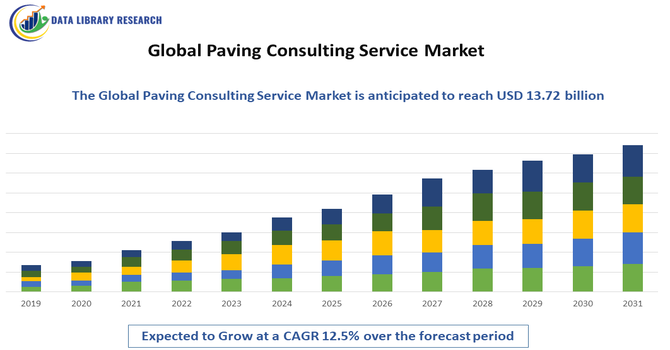
The global asphalt pavers market was valued at USD 2.06 billion in 2026 and is projected to reach USD 13.72 billion by 2033, growing at a CAGR of 6.3% during the forecast period from 2026-2033.
Get Complete Analysis Of The Report - Download Updated Free Sample PDF
The Global Paving Consulting Service Market comprises professional advisory, engineering, and technical support services provided for pavement design, construction, maintenance, and lifecycle optimization. These services include project planning, material selection, pavement evaluation, quality control, troubleshooting, and sustainability consulting for roads, highways, airports, and commercial surfaces. Consultants assist public agencies and private developers in improving cost efficiency, durability, and compliance with standards. The market spans services linked to asphalt, concrete, and specialty paving solutions, supporting infrastructure development worldwide. Growth is driven by rising infrastructure investments, increasing project complexity, and the need for expert guidance to ensure performance and minimize long-term maintenance costs.
The market is witnessing strong trends toward sustainability, digitalization, and performance-based pavement solutions. Increasing adoption of recycled asphalt, warm-mix technologies, and eco-friendly materials is reshaping consulting requirements, as clients seek compliance with environmental regulations. Digital tools such as real-time monitoring, automated grading systems, and predictive maintenance analytics are enhancing project accuracy and lifecycle planning. There is also a growing focus on long-life pavements and performance-based contracts that prioritize durability and lifecycle cost efficiency. Additionally, urbanization and smart city initiatives are increasing demand for integrated consulting services that combine engineering expertise with data-driven decision-making and infrastructure resilience planning.
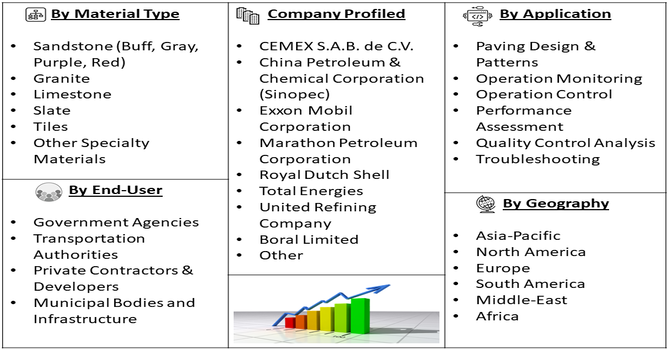
Segmentation: The Global Paving Consulting Service Market is segmented by Service Type (Pavement Evaluation & Condition Assessment, Maintenance Planning & Lifecycle Management, Asset Management Consulting, Data Collection & Analysis, Quality Control & Testing, Troubleshooting & Technical Advisory, Troubleshooting & Technical Advisory, Operation Monitoring & Control and Decision-Making & Strategic Consulting), Material Type (Sandstone (Buff, Gray, Purple, Red), Granite, Limestone, Slate, and Tiles and Other Specialty Materials), Application (Paving Design & Patterns, Operation Monitoring, Operation Control, Performance Assessment, Quality Control Analysis, and Troubleshooting), End-User (Government Agencies, Transportation Authorities, Private Contractors & Developers, Municipal Bodies and Infrastructure), Project Type (Highways & Roads, Airports & Runways, Parking Lots, Urban & Municipal Infrastructure and Industrial & Commercial Facilities), and Geography (North America, Europe, Asia-Pacific, Middle East and Africa, and South America). The report provides the value (in USD million) for the above segments.
For Detailed Market Segmentation - Get a Free Sample PDF
Market Drivers:
A major driver of the Global Paving Consulting Service Market is the rapid expansion of infrastructure development worldwide. Governments are investing heavily in road construction, airport expansion, and urban mobility projects to support economic growth and urbanization. For instance, in 2025, the European Union approved the Horizon Europe initiative, which promoted sustainable road construction and innovation. This program increased investment in eco-friendly technologies and drove demand for consulting services focused on sustainability, regulatory compliance, and advanced materials, thereby strengthening growth in the Global Paving Consulting Service Market.
These large-scale projects require specialized consulting services to ensure optimal design, material selection, and cost efficiency. Aging infrastructure in developed regions further increases demand for rehabilitation and maintenance consulting. As billions are spent annually on paving projects, stakeholders rely on consultants to minimize risks, avoid costly errors, and enhance project outcomes, thereby driving consistent demand for professional advisory services across both public and private sectors
Innovations such as polymer-modified asphalt, recycled materials, and smart monitoring systems require specialized knowledge for effective implementation. Clients depend on consultants to navigate technical specifications, regulatory requirements, and performance standards. For instance, in 2025, Wirtgen Group secured a major government contract in Australia, reinforcing its presence in the Asia-Pacific region. This milestone accelerated infrastructure activity and created higher demand for consulting services in equipment utilization, project execution strategies, and large-scale paving operations, contributing to the expansion of the Global Paving Consulting Service Market.
Additionally, the shift toward sustainable and energy-efficient construction practices has heightened the need for expert guidance in material selection and environmental compliance. Consultants provide critical insights into lifecycle cost analysis and long-term durability, helping project owners make informed decisions. This growing technical complexity significantly boosts the demand for advanced consulting services across global infrastructure projects.
Market Restraints:
Many regions operate with legacy road networks that limit the adoption of advanced materials or innovative designs without costly modifications. Budget constraints and resistance to change among stakeholders can further hinder implementation of consulting recommendations. Additionally, inconsistencies in regulations and standards across regions create challenges for global consulting firms. These factors can delay project timelines and reduce the demand for high-end consulting services, particularly in cost-sensitive markets where clients may prioritize immediate affordability over long-term performance benefits.
Paving consulting services play a critical role in economic development by improving transportation infrastructure quality and efficiency. Well-designed pavements reduce vehicle operating costs, travel time, and accident risks, thereby enhancing productivity and trade connectivity. These services support government infrastructure programs, generating employment across engineering, construction, and maintenance sectors. In developing economies, improved road networks facilitate access to education, healthcare, and markets, contributing to regional development and poverty reduction. Furthermore, consultants help optimize resource utilization and reduce waste, lowering overall project costs. Their role in promoting sustainable materials also contributes to environmental protection and long-term economic resilience in infrastructure systems.
Segmental Analysis:
The Maintenance Planning & Lifecycle Management segment is expected to witness the highest growth over the forecast period due to increasing emphasis on extending pavement life and reducing long-term infrastructure costs. Governments and private stakeholders are prioritizing proactive maintenance strategies over reactive repairs to optimize budgets and improve asset performance. Advanced technologies such as predictive analytics, pavement management systems, and condition monitoring tools are further accelerating demand for lifecycle-focused consulting. Aging infrastructure in developed economies and rapid road expansion in developing regions are also contributing to growth. This segment enables efficient resource allocation, minimizes disruptions, and ensures sustainability, making it a critical component of modern infrastructure management strategies globally.
The Limestone segment is projected to experience the highest growth due to its widespread availability, cost-effectiveness, and versatility in paving applications. Limestone is commonly used as a base material and aggregate in road construction, making it essential for large-scale infrastructure projects. Its durability, ease of processing, and compatibility with various binding materials contribute to its growing preference among engineers and consultants. Additionally, increasing demand for sustainable construction materials has boosted limestone usage, as it can be recycled and reused efficiently. Rapid urbanization and infrastructure development, particularly in emerging economies, are driving the need for reliable and affordable materials, further strengthening the growth prospects of the limestone segment.
The Paving Design & Patterns segment is anticipated to witness significant growth as infrastructure projects increasingly focus on both functionality and aesthetics. Urban development initiatives, smart city projects, and commercial real estate expansions are driving demand for visually appealing and durable paving solutions. Consultants are being engaged to design customized patterns that enhance safety, drainage, and long-term performance while meeting architectural requirements. Technological advancements such as 3D modeling and simulation tools are enabling more precise and innovative designs. Additionally, the growing popularity of decorative pavements in public spaces, pedestrian zones, and residential developments is further boosting demand for specialized design consulting services within this segment globally.
The Government Agencies segment is expected to register the highest growth due to increasing public investment in transportation and infrastructure development worldwide. National and regional governments are allocating substantial budgets for road construction, maintenance, and modernization projects to support economic growth and urban expansion. These agencies rely heavily on consulting services for project planning, quality assurance, compliance with regulations, and cost optimization. Additionally, initiatives focused on sustainable infrastructure and climate resilience are driving demand for expert advisory services. The need to upgrade aging road networks in developed countries and expand connectivity in developing regions further strengthens the role of government agencies as the primary drivers of growth in this market segment.
The Highways & Roads segment is projected to witness the highest growth owing to the continuous expansion and modernization of transportation networks globally. Increasing vehicle ownership, urbanization, and trade activities are driving demand for efficient road infrastructure. Governments are investing heavily in highway construction, rehabilitation, and smart road technologies to improve connectivity and reduce congestion. Consulting services play a vital role in ensuring optimal design, material selection, and maintenance strategies for these large-scale projects. Additionally, the need for durable and long-lasting pavements to handle heavy traffic loads is boosting demand for expert guidance, making highways and roads the dominant application segment in the paving consulting service market.
North America is expected to witness the highest growth in the paving consulting service market due to substantial investments in infrastructure rehabilitation and modernization.
The region faces significant challenges related to aging road networks, prompting governments to allocate increased funding for maintenance and upgrades. Advanced adoption of digital technologies, including pavement management systems and data analytics, is further driving demand for specialized consulting services. For instance, in January 2024, LafargeHolcim expanded its asphalt production capacity in the United States, which strengthened supply capabilities and increased project activity. This development boosted demand for paving consulting services related to material optimization, plant efficiency, and large-scale road construction planning, thereby supporting growth of the studied market.
Similarly, in 2024, Skanska partnered with Caterpillar to advance digital and autonomous road construction technologies, which enhanced project efficiency and reduced operational costs. This collaboration increased the need for specialized consulting in technology integration, data-driven planning, and smart infrastructure development within the studied market.
Additionally, stringent regulatory standards and a strong focus on sustainability are encouraging the use of innovative materials and construction techniques. The presence of leading consulting firms and well-established infrastructure frameworks also supports market expansion, positioning North America as a key growth region during the forecast period.
| Report Matrics | Details |
| Market Size Value | USD 13.72 billion |
| Growth Rate | CAGR of 6.3% |
| Forecast | 2026-2033 |
| Historical data | 2021-2024 |
| Base Year | 2025 |
| Report Coverage | Forecasted revenue, company rating, competitive environment, growth drivers, and trends |
| Segment Coverage | Type, Application, End-User, Geography |
| Regional Scope | North America, Europe, Asia Pacific, Middle East |
| Customized scope | Free customization of reports (With 3 months Analysis Support ) |
| To Learn More About This Report | Request a Free Sample Copy |
The competitive landscape of the Global Paving Consulting Service Market is moderately fragmented, with a mix of multinational corporations, specialized engineering firms, and material-focused companies offering consulting services. Key players compete based on technical expertise, geographic presence, and integrated service offerings that combine consulting with materials and construction capabilities. Strategic partnerships, mergers, and technological innovation are common approaches to gain market share. Companies increasingly invest in digital tools and sustainability solutions to differentiate themselves. The market also features regional players catering to local infrastructure needs, while global firms leverage large-scale project experience and advanced R&D capabilities to maintain competitive advantages.
The major players for this market are:
Recent Development
Q1. What is the main growth-driving factors for this market?
The growth is primarily driven by massive global investments in smart infrastructure and the urgent need for data-driven pavement management. Governments are increasingly adopting specialized consulting to optimize maintenance budgets and extend road lifespans. Additionally, the integration of AI-driven condition assessments, drones, and IoT sensors for real-time monitoring fuels demand.
Q2. What are the main restraining factors for this market?
The market is significantly challenged by public funding constraints and budgetary delays, which can stall long-term infrastructure projects. A shortage of specialized technical experts proficient in advanced pavement modeling and digital twins acts as a bottleneck. Furthermore, bureaucratic hurdles and varying regional regulatory standards often complicate the cross-border delivery of services.
Q3. Which segment is expected to witness high growth?
The Paving Design & Patterns segment is expected to witness the highest growth over the forecast period due to rising demand for aesthetically appealing and functionally efficient infrastructure. Increasing urbanization, smart city projects, and commercial developments drove the need for customized, durable designs, boosting consulting services focused on innovative layouts, safety, and long-term pavement performance.
Q4. Who are the top major players for this market?
The competitive landscape features a mix of global engineering consultancies and specialized pavement firms, including AECOM, WSP, and Stantec. Other key players driving innovation in pavement management software and advisory include Pavement Management Services (PMS), Applied Pavement Technology (APTech), Fugro, SNC-Lavalin (AtkinsRealies), Jacobs, and GHD.
Q5. Which country is the largest player?
The United States is the largest market player, accounting majority of global revenue in 2026. Its dominance is sustained by a mature road network requiring extensive rehabilitation and a high concentration of specialized consulting firms. However, China is a dominant force in the Asia-Pacific region, leading in new-build infrastructure consulting volume.
Data Library Research are conducted by industry experts who offer insight on industry structure, market segmentations technology assessment and competitive landscape (CL), and penetration, as well as on emerging trends. Their analysis is based on primary interviews (~ 80%) and secondary research (~ 20%) as well as years of professional expertise in their respective industries. Adding to this, by analysing historical trends and current market positions, our analysts predict where the market will be headed for the next five years. Furthermore, the varying trends of segment & categories geographically presented are also studied and the estimated based on the primary & secondary research.
In this particular report from the supply side Data Library Research has conducted primary surveys (interviews) with the key level executives (VP, CEO’s, Marketing Director, Business Development Manager and SOFT) of the companies that active & prominent as well as the midsized organization
FIGURE 1: DLR RESEARH PROCESS
Extensive primary research was conducted to gain a deeper insight of the market and industry performance. The analysis is based on both primary and secondary research as well as years of professional expertise in the respective industries.
In addition to analysing current and historical trends, our analysts predict where the market is headed over the next five years.
It varies by segment for these categories geographically presented in the list of market tables. Speaking about this particular report we have conducted primary surveys (interviews) with the key level executives (VP, CEO’s, Marketing Director, Business Development Manager and many more) of the major players active in the market.
Secondary ResearchSecondary research was mainly used to collect and identify information useful for the extensive, technical, market-oriented, and Friend’s study of the Global Extra Neutral Alcohol. It was also used to obtain key information about major players, market classification and segmentation according to the industry trends, geographical markets, and developments related to the market and technology perspectives. For this study, analysts have gathered information from various credible sources, such as annual reports, sec filings, journals, white papers, SOFT presentations, and company web sites.
Market Size EstimationBoth, top-down and bottom-up approaches were used to estimate and validate the size of the Global market and to estimate the size of various other dependent submarkets in the overall Extra Neutral Alcohol. The key players in the market were identified through secondary research and their market contributions in the respective geographies were determined through primary and secondary research.
Forecast Model