
Get Complete Analysis Of The Report - Download Updated Free Sample PDF
The global recreational tow bar market encompasses the design, manufacture, and sale of towing systems used for recreational vehicles (RVs), trailers, boats, and campers. These systems, including weight distribution hitches, sway control devices, and integrated tow bars, enhance towing safety, stability, and performance. Growth is driven by increasing popularity of RV travel, outdoor recreation, and adventure tourism, alongside rising disposable income and consumer demand for convenience and safety. Technological innovations, such as all-in-one hitches, smart sway control, and durable materials, further boost adoption.
The global recreational tow bar market is experiencing significant growth due to rising popularity of RV travel, adventure tourism, and outdoor recreational activities. Key trends include the development of all-in-one towing solutions combining weight distribution and sway control for enhanced safety and convenience. Integration of smart technologies, such as electronic sway sensors and lightweight, corrosion-resistant materials, is improving performance and durability. E-commerce and online aftermarket platforms are expanding accessibility, while partnerships between RV manufacturers and tow bar providers streamline product offerings.
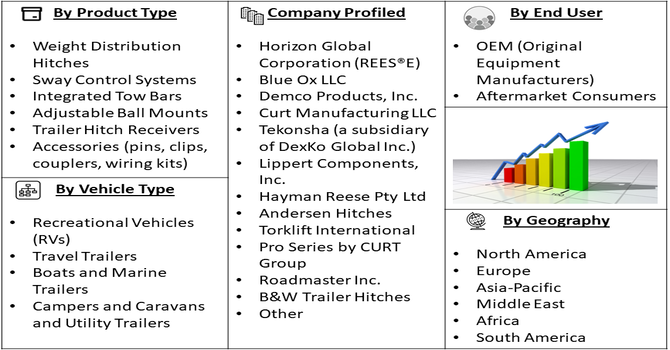
Segmentation: The global recreational tow bar market is segmented by Product Type (Weight Distribution Hitches, Sway Control Systems, Integrated Tow Bars, Adjustable Ball Mounts, Trailer Hitch Receivers and Accessories (pins, clips, couplers, wiring kits)), Vehicle Type (Recreational Vehicles (RVs), Travel Trailers, Boats and Marine Trailers, Campers and Caravans and Utility Trailers), End User (OEM (Original Equipment Manufacturers) and Aftermarket Consumers), Distribution Channel (Offline Retail (Dealerships, Specialty Stores, Supermarkets) and Online Retail / E-Commerce Platforms), and Geography (North America, Europe, Asia-Pacific, Middle East and Africa, and South America). The report provides the value (in USD million) for the above segments.
For Detailed Market Segmentation - Get a Free Sample PDF
Market Drivers:
The global recreational tow bar market is driven by the increasing popularity of RV travel, camping, and outdoor recreational activities. Rising disposable incomes, expanding leisure time, and the growing adventure tourism industry have led more consumers to purchase RVs, trailers, and boats, boosting demand for towing solutions. Consumers seek safer and more convenient towing experiences, increasing adoption of weight distribution hitches, sway control systems, and integrated tow bars. Additionally, government support for tourism infrastructure, such as campgrounds and RV parks, further fuels market expansion. This trend ensures continuous growth in both OEM and aftermarket recreational tow bar segments.
Technological innovation in tow bar systems is a key driver of market growth. Modern solutions integrate weight distribution, sway control, and electronic monitoring to improve towing stability, safety, and ease of use. Advances in corrosion-resistant materials, lightweight alloys, and modular designs extend product durability and performance.
In 2022, Horizon Global Corporation launched the REESE Dual Cam II, an all-in-one weight distribution and sway control towing solution, enhancing the global recreational tow bar market. The integrated system improved towing safety, convenience, and performance for recreational vehicles, driving consumer adoption, strengthening brand presence, and supporting growth in the automotive aftermarket and dealer networks worldwide. Smart tow bars with electronic sway detection and sensor-assisted hitching enhance user experience, particularly for long-distance or heavy towing. Partnerships between RV manufacturers and tow bar companies drive innovation and product customization. These technological improvements increase consumer confidence, accelerate adoption, and expand market demand across recreational vehicles, trailers, and marine applications worldwide.
Market Restraints
High costs and maintenance requirements pose a restraint on the global recreational tow bar market. Premium weight distribution hitches, sway control systems, and integrated tow bars often require significant upfront investment, making them less accessible to budget-conscious consumers. Additionally, routine maintenance, installation, and periodic inspections are necessary to ensure safety and longevity, which can be time-consuming and costly. Limited awareness of proper usage and maintenance may reduce adoption, particularly in emerging markets. Until lower-cost, durable, and user-friendly solutions are more widely available, these economic and operational barriers will continue to restrict the market’s potential growth despite rising interest in recreational towing activities.
The recreational tow bar market positively impacts the global economy by supporting the RV, tourism, and outdoor recreation sectors. Enhanced towing safety and convenience enable broader participation in travel and leisure activities, increasing consumer spending and boosting related industries such as campgrounds, fuel, and automotive services. The market also generates employment opportunities in manufacturing, retail, and aftermarket services. Technological innovation in tow bars improves product safety and reliability, reducing accidents and associated healthcare costs. Rising disposable income and disposable leisure time in developed and emerging regions drive market expansion, contributing to economic growth while promoting outdoor recreational lifestyles worldwide.
Segmental Analysis:
The weight distribution hitches segment is expected to witness the highest growth over the forecast period due to increasing demand for safe and stable towing solutions. These hitches evenly distribute trailer weight across the tow vehicle, reducing sway, enhancing control, and improving braking efficiency. Rising popularity of RV travel, camping, and outdoor recreation has increased consumer awareness of towing safety, boosting adoption. Technological advancements, including integrated sway control and adjustable designs, further enhance usability and performance. Both aftermarket and OEM adoption are expanding, making weight distribution hitches a key growth driver in the global recreational tow bar market.
The recreational vehicles (RVs) solutions segment is expected to witness the highest growth over the forecast period as RV travel and outdoor tourism continue to rise globally. Tow bars, weight distribution hitches, and sway control systems are essential for RV owners to ensure safe, efficient towing. Growing disposable incomes, increasing adventure tourism, and lifestyle shifts toward mobile living and family vacations are driving demand for reliable towing solutions. Manufacturers are developing RV-specific products with enhanced durability, integrated sway prevention, and ease of installation. This segment benefits from strong aftermarket and OEM adoption, fueling consistent growth in the global market.
The OEM segment is expected to witness the highest growth over the forecast period due to increasing collaboration between tow bar manufacturers and RV, trailer, and camper producers. OEM integration ensures high-quality, vehicle-specific towing solutions, improving safety, convenience, and overall user experience. Rising demand for pre-installed towing systems in new RVs, boats, and campers encourages OEM adoption. Technological advancements, including modular hitches and integrated sway control, support OEM partnerships. Additionally, consumer preference for ready-to-use towing solutions over aftermarket installations drives market growth. OEM-focused strategies strengthen brand loyalty and accelerate adoption, making this segment a key contributor to global recreational tow bar market expansion.
North America is expected to witness the highest growth in the recreational tow bar market over the forecast period due to the region’s strong RV culture, high disposable incomes, and extensive outdoor tourism infrastructure. Widespread adoption of weight distribution hitches, sway control systems, and integrated tow bars is fueled by safety awareness and regulatory standards. For instance, in 2022, Airstream partnered with Blue Ox to produce trailer-specific SwayPro and TrackPro weight distribution hitches, enhancing towing safety and performance. This collaboration strengthened the global recreational tow bar market by improving product accessibility, driving consumer adoption, and promoting awareness through educational initiatives on sway prevention and optimized towing solutions worldwide.
The U.S. and Canada have well-established OEM and aftermarket distribution networks, including dealerships and e-commerce platforms, increasing accessibility. Technological innovation, combined with high recreational vehicle ownership and a growing adventure tourism industry, positions North America as the largest and fastest-growing regional market globally.
| Report Matrics | Details |
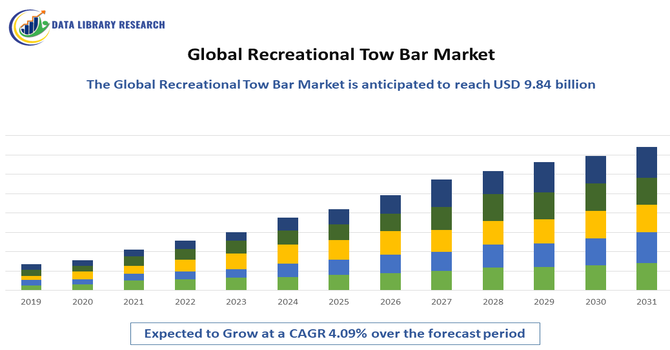
| Market Size Value | USD 9.84 billion |
| Growth Rate | CAGR of 4.09 % |
| Forecast | 2026-2033 |
| Historical data | 2021-2024 |
| Base Year | 2025 |
| Report Coverage | Forecasted revenue, company rating, competitive environment, growth drivers, and trends |
| Segment Coverage | Type, Application, End-User, Geography |
| Regional Scope | North America, Europe, Asia Pacific, Middle East |
| Customized scope | Free customization of reports (With 3 months Analysis Support ) |
| To Learn More About This Report | Request a Free Sample Copy |
The recreational tow bar market is highly competitive, featuring global players, specialized manufacturers, and aftermarket service providers. Companies compete through product innovation, quality, safety features, and brand recognition. Strategic partnerships with RV manufacturers, distribution networks, and e-commerce platforms enhance market reach. Leading players focus on developing advanced weight distribution systems, integrated sway control, and corrosion-resistant materials. High entry barriers, including safety certifications and technological expertise, limit new entrants. Market consolidation through mergers and acquisitions is common to expand portfolios and geographic presence. Continuous R&D, customer-centric design, and adherence to regulatory standards define competitive advantage in the global recreational tow bar market.
The major players for above market are:
Recent Development
Q1. What are the main growth-driving factors for this market?
The primary driver is the rising popularity of outdoor recreational activities and "overlanding" among millennials and retirees. Increased sales of SUVs and light trucks, which are commonly used for towing boats, trailers, and bike racks, further fuel demand. Additionally, advancements in lightweight, high-strength materials make modern tow bars more appealing.
Q2. What are the main restraining factors for this market?
Growth is hindered by the rising popularity of compact electric vehicles, which often have limited towing capacities or manufacturer restrictions. Additionally, fluctuating raw material prices for steel and aluminum increase production costs. Stringent safety regulations and complex installation requirements in certain regions can also deter DIY consumers from making purchases.
Q3. Which segment is expected to witness high growth?
The weight distribution hitches segment is expected to witness the highest growth over the forecast period due to rising demand for safer, more stable towing. These hitches evenly distribute trailer weight, reduce sway, and enhance control, making them essential for RVs, trailers, and boats, driving adoption in both OEM and aftermarket markets.
Q4. Who are the top major players for this market?
Key market leaders include Brink Group, Horizon Global Corporation, Curt Manufacturing, and Westfalia-Automotive. Other significant contributors are Bosal, B&W Trailer Hitches, and Blue Ox. These companies maintain dominance through extensive distribution networks, strategic partnerships with automotive OEMs, and constant innovation in quick-release and high-capacity towing technologies.
Q5. Which country is the largest player?
The United States is the largest player in the recreational tow bar market. This leadership is driven by a deep-rooted culture of camping, boating, and long-distance road trips. Furthermore, the high domestic penetration of heavy-duty pickup trucks and large SUVs provides a massive installed base for towing accessory sales.
Data Library Research are conducted by industry experts who offer insight on industry structure, market segmentations technology assessment and competitive landscape (CL), and penetration, as well as on emerging trends. Their analysis is based on primary interviews (~ 80%) and secondary research (~ 20%) as well as years of professional expertise in their respective industries. Adding to this, by analysing historical trends and current market positions, our analysts predict where the market will be headed for the next five years. Furthermore, the varying trends of segment & categories geographically presented are also studied and the estimated based on the primary & secondary research.
In this particular report from the supply side Data Library Research has conducted primary surveys (interviews) with the key level executives (VP, CEO’s, Marketing Director, Business Development Manager and SOFT) of the companies that active & prominent as well as the midsized organization
FIGURE 1: DLR RESEARH PROCESS
Extensive primary research was conducted to gain a deeper insight of the market and industry performance. The analysis is based on both primary and secondary research as well as years of professional expertise in the respective industries.
In addition to analysing current and historical trends, our analysts predict where the market is headed over the next five years.
It varies by segment for these categories geographically presented in the list of market tables. Speaking about this particular report we have conducted primary surveys (interviews) with the key level executives (VP, CEO’s, Marketing Director, Business Development Manager and many more) of the major players active in the market.
Secondary ResearchSecondary research was mainly used to collect and identify information useful for the extensive, technical, market-oriented, and Friend’s study of the Global Extra Neutral Alcohol. It was also used to obtain key information about major players, market classification and segmentation according to the industry trends, geographical markets, and developments related to the market and technology perspectives. For this study, analysts have gathered information from various credible sources, such as annual reports, sec filings, journals, white papers, SOFT presentations, and company web sites.
Market Size EstimationBoth, top-down and bottom-up approaches were used to estimate and validate the size of the Global market and to estimate the size of various other dependent submarkets in the overall Extra Neutral Alcohol. The key players in the market were identified through secondary research and their market contributions in the respective geographies were determined through primary and secondary research.
Forecast Model