
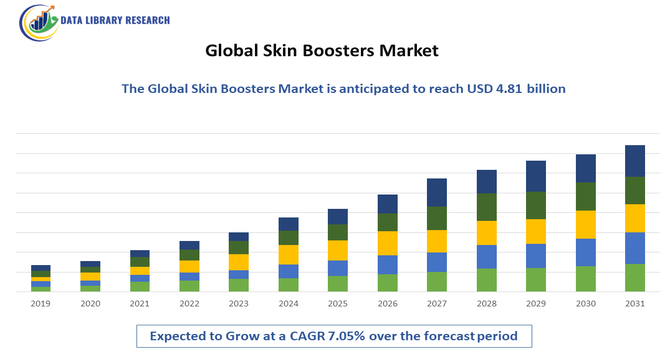
Get Complete Analysis Of The Report - Download Updated Free Sample PDF
The global skin boosters market growth is being driven primarily by rising demand for minimally invasive, natural-looking aesthetic treatments consumers increasingly prefer injectable hydrators and mesotherapy over surgery for skin rejuvenation alongside advances in hyaluronic-acid and bioactive formulations that improve efficacy and safety. Rapid expansion of medical-spa and dermatology clinics, greater availability of trained practitioners, and expanding distribution in high-growth regions (particularly Asia-Pacific) have improved access and affordability, further boosting uptake.
The global skin boosters market includes continued dominance of hyaluronic-acid (HA) formulations and a strong shift toward mesotherapy-style injectable hydrators that prioritize skin quality (texture, elasticity and radiance) over volumizing—driving product innovation and clinician adoption. Regional innovation hubs, especially South Korea, are accelerating interest in alternative bioactive boosters (polynucleotides / PDRN like Rejuran, exosome-based serums and other regenerative ingredients), which are crossing over from Asia into Western clinics and fueling demand for novel, science-forward treatments.
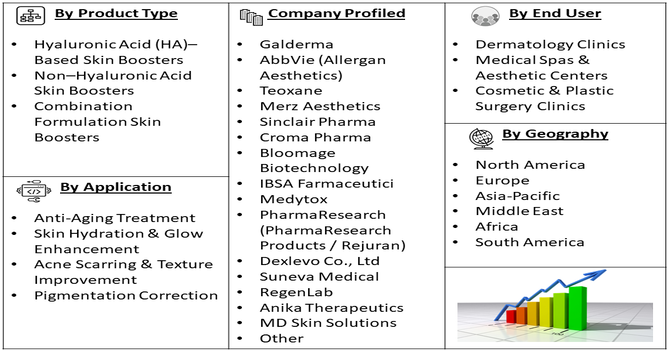
Segmentation: Global Skin Boosters Market is segmented By Product Type (Hyaluronic Acid (HA)–Based Skin Boosters, Non–Hyaluronic Acid Skin Boosters, Combination Formulation Skin Boosters), Ingredient Type (Stabilized HA Boosters, Non-Stabilized HA Boosters, Polynucleotide (PN/PDRN) Boosters, Exosome-Based Boosters, Collagen-Stimulating Boosters), Treatment Type (Mesotherapy-Based Skin Boosters, Microinjection / Injectable Skin Boosters, Microneedling with Booster Infusion), Application (Anti-Aging Treatment, Skin Hydration & Glow Enhancement, Acne Scarring & Texture Improvement, Pigmentation Correction), End User (Dermatology Clinics, Medical Spas & Aesthetic Centers, Cosmetic & Plastic Surgery Clinics), and Geography (North America, Europe, Asia-Pacific, Middle East and Africa, and South America). The report provides the value (in USD million) for the above segments.
For Detailed Market Segmentation - Get a Free Sample PDF
Market Drivers:
A major driver of the global skin boosters market is the rapid shift in consumer preference toward non-surgical, minimally invasive cosmetic enhancements. Skin boosters—such as hyaluronic acid microinjections and polynucleotide (PN/PDRN) therapies—offer visible improvements in skin hydration, elasticity, fine lines, and overall radiance without altering facial structure, making them highly attractive to a wide demographic. For instance, in 2024, The ISAPS survey revealing a 5.5% rise in surgical and over 19.1 million non-surgical procedures had highlighted growing consumer preference for minimally invasive treatments. This surge in demand had driven the Global Skin Boosters Market, encouraging product innovation, wider adoption, and increased investment in non-surgical aesthetic solutions worldwide. This shift toward “skin quality treatments” rather than structural corrections is heavily supporting the growth of the skin boosters market globally.
Continuous innovation in injectable technologies and bioactive formulations is another key growth driver. Early-generation skin boosters relied primarily on simple hyaluronic acid gels, but today’s market is witnessing advanced formulations such as cross-linked HA boosters, polynucleotide (PN/PDRN) regenerative injectables, peptide complexes, amino acid blends, and exosome-based boosters. For instance, in May 2023, Allergan Aesthetics’ FDA approval of SKINVIVE™ by JUVÉDERM had marked a breakthrough in intradermal microdroplet HA injections. Its minimally invasive, all-skin-type applicability had advanced formulation innovation, improved treatment precision and comfort, and stimulated growth in the Global Skin Boosters Market by expanding adoption of technologically sophisticated, patient-friendly skin enhancement solutions.
Additionally, improvements in injection techniques, device-assisted delivery (microneedling pens, jet injectors), and combination treatment protocols have expanded the clinical use-cases of skin boosters. This steady wave of technological advancement continues to increase treatment efficacy, broaden indications, and reinforce the market’s upward trajectory.
Market Restraints
The key challenge is the high cost of treatment, as skin boosters often require multiple sessions and periodic maintenance, making them less accessible to price-sensitive consumers, especially in developing regions. Another restraint is the risk of side effects and procedure-related complications—such as bruising, swelling, allergic reactions, or improper injection techniques—which can deter new users and require skilled practitioners to minimize risks. Additionally, the market is affected by regulatory variability across countries, with stringent approval processes and compliance requirements that delay product launches and increase development costs for manufacturers.
The Global Skin Boosters Market has had significant socioeconomic impacts, driven by rising consumer awareness of aesthetic treatments, increasing disposable incomes, and the desire for minimally invasive cosmetic procedures. The market’s growth has created employment opportunities across healthcare, dermatology, and cosmetic sectors, including skilled practitioners, product developers, and marketing professionals. It has also stimulated investment in research, innovation, and distribution networks, contributing to economic activity in both developed and emerging regions. However, high treatment costs may limit accessibility, potentially exacerbating social disparities in beauty and wellness. Thus, the market supports economic growth, technological advancement, and lifestyle-oriented consumer spending worldwide.
Segmental Analysis:
Hyaluronic Acid–based skin boosters dominate the market due to their exceptional hydrating properties, biocompatibility, and proven safety profile. These boosters help improve skin elasticity, radiance, and overall texture by delivering deep hydration through microinjections. Their high demand is driven by their ability to offer natural-looking results, minimal downtime, and wide clinical acceptance. Continuous innovation in stabilized and cross-linked HA formulations is further strengthening this segment’s growth and expanding its use across anti-aging and rejuvenation treatments.
Polynucleotide (PN/PDRN) boosters are emerging as one of the fastest-growing ingredient segments due to their regenerative and anti-inflammatory properties. These DNA-based injectables promote tissue repair, collagen synthesis, and improved skin elasticity. Originating from advanced aesthetic markets such as South Korea, PN/PDRN boosters are gaining global popularity as they offer long-lasting skin rejuvenation benefits compared to traditional HA formulations. Their rising adoption in treating aging skin, acne scars, and dull texture makes this segment a high-potential growth driver.
Microinjection-based injectable skin boosters represent the most widely adopted treatment method, providing precise delivery of active ingredients into the dermal layers. This technique ensures uniform distribution, effective hydration, and predictable clinical outcomes. It is preferred by dermatologists due to its efficiency, versatility, and suitability for treating fine lines, wrinkles, and skin dullness. The rising availability of trained injectors and growing patient acceptance of minimally invasive procedures continue to fuel the strong growth of this segment.
Skin hydration and glow enhancement remain the largest application area for skin boosters, as consumers increasingly seek treatments that improve overall skin quality rather than alter facial features. Skin boosters effectively restore moisture balance, improve dermal thickness, and enhance radiance—making them ideal for patients seeking refreshed, healthy-looking skin. Increased awareness of “skin quality treatments” and the popularity of glass skin and dewy skin trends globally are significantly boosting demand in this segment.
Dermatology clinics hold a major share of the market due to their high patient footfall, access to certified specialists, and availability of advanced injection techniques. These clinics are often the first choice for patients seeking safe, professional aesthetic treatments. The ability of dermatologists to customize treatment plans, manage complications, and integrate skin boosters with complementary procedures (such as lasers or microneedling) enhances patient trust and drives growth in this segment.
North America region is expected to witness the highest growth over the forecast period, driven by strong consumer adoption of advanced aesthetic treatments, high disposable incomes, and a rapidly expanding network of dermatology clinics and medical spas offering skin booster procedures. @@@@ The region benefits from early availability of innovative formulations, strong presence of leading aesthetic brands, and increasing acceptance of minimally invasive, skin-quality–focused treatments among both younger and aging populations. For instance,
Moreover, the rising awareness of preventive aesthetics, coupled with continuous product approvals and technological advancements, is further accelerating market growth across the United States and Canada.
To Learn More About This Report - Request a Free Sample Copy
The global skin boosters market is highly competitive, characterized by the presence of several key players focusing on product innovation, strategic collaborations, and geographic expansion to strengthen their market position. Leading companies such as Galderma, AbbVie (Allergan Aesthetics), Teoxane, Merz Aesthetics, Sinclair Pharma, and Croma Pharma dominate the market with a wide portfolio of hyaluronic acid–based and bioactive skin booster products. Competitive strategies such as collaborations with dermatology clinics, medical spas, and aesthetic centers, along with marketing campaigns highlighting minimally invasive and regenerative treatments, are driving market growth and helping these companies capture a larger share of the rapidly growing skin boosters market.
Key Players:
Recent Development
Q1. What are the main growth-driving factors for this market?
The market is primarily driven by the rising consumer demand for minimally invasive cosmetic procedures and a strong focus on preventative skincare. Social media and rising awareness of skin health have increased the popularity of treatments that improve overall skin quality, hydration, and texture without the significant downtime associated with traditional surgery. The increasing aging population also contributes significantly to this demand.
Q2. What are the main restraining factors for this market?
One significant restraining factor is the high cost of skin booster treatments, especially when considering the necessity of repeated sessions for sustained results, which limits accessibility for middle-income consumers. Additionally, safety concerns and the fear of potential side effects like bruising or swelling, alongside a lack of standardized regulatory guidelines in some regions, can deter potential customers.
Q3. Which segment is expected to witness high growth?
The Hyaluronic Acid (HA) Ingredient segment is expected to maintain high growth, given HA's proven efficacy in deep skin hydration and elasticity improvement. Furthermore, the Male Gender segment is projected to grow rapidly, as men increasingly seek out non-invasive aesthetic treatments to improve appearance, driven by rising self-care consciousness and evolving beauty standards.
Q4. Who are the top major players for this market?
The Global Skin Boosters Market features strong competition among leading aesthetic pharmaceutical companies. Top major players include AbbVie Inc. (Allergan), known for its extensive portfolio of fillers, Galderma, Merz Aesthetics, and specialized companies like IBSA Farmaceutici Italia Srl (maker of Profhilo) and Teoxane. These players focus heavily on R&D for better formulations.
Q5. Which country is the largest player?
North America holds the largest market share globally, largely fueled by the high disposable income of consumers, strong healthcare infrastructure, and widespread acceptance of cosmetic procedures, particularly in the United States. However, the Asia-Pacific region, led by countries like South Korea and China, is projected to be the fastest-growing market due to favorable beauty trends and increased medical tourism.
Data Library Research are conducted by industry experts who offer insight on industry structure, market segmentations technology assessment and competitive landscape (CL), and penetration, as well as on emerging trends. Their analysis is based on primary interviews (~ 80%) and secondary research (~ 20%) as well as years of professional expertise in their respective industries. Adding to this, by analysing historical trends and current market positions, our analysts predict where the market will be headed for the next five years. Furthermore, the varying trends of segment & categories geographically presented are also studied and the estimated based on the primary & secondary research.
In this particular report from the supply side Data Library Research has conducted primary surveys (interviews) with the key level executives (VP, CEO’s, Marketing Director, Business Development Manager and SOFT) of the companies that active & prominent as well as the midsized organization
FIGURE 1: DLR RESEARH PROCESS
Extensive primary research was conducted to gain a deeper insight of the market and industry performance. The analysis is based on both primary and secondary research as well as years of professional expertise in the respective industries.
In addition to analysing current and historical trends, our analysts predict where the market is headed over the next five years.
It varies by segment for these categories geographically presented in the list of market tables. Speaking about this particular report we have conducted primary surveys (interviews) with the key level executives (VP, CEO’s, Marketing Director, Business Development Manager and many more) of the major players active in the market.
Secondary ResearchSecondary research was mainly used to collect and identify information useful for the extensive, technical, market-oriented, and Friend’s study of the Global Extra Neutral Alcohol. It was also used to obtain key information about major players, market classification and segmentation according to the industry trends, geographical markets, and developments related to the market and technology perspectives. For this study, analysts have gathered information from various credible sources, such as annual reports, sec filings, journals, white papers, SOFT presentations, and company web sites.
Market Size EstimationBoth, top-down and bottom-up approaches were used to estimate and validate the size of the Global market and to estimate the size of various other dependent submarkets in the overall Extra Neutral Alcohol. The key players in the market were identified through secondary research and their market contributions in the respective geographies were determined through primary and secondary research.
Forecast Model