Smart Self-balancing Electric Scooter Market Overview and Analysis
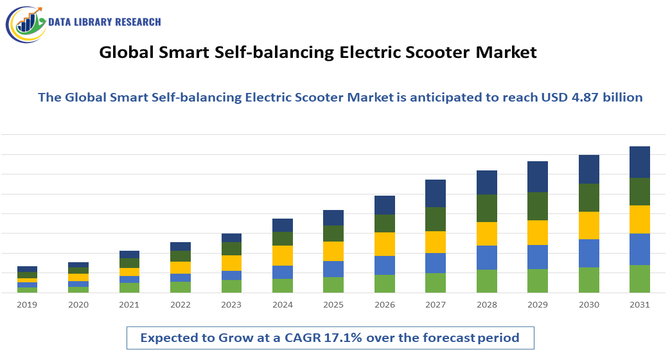
The Global Smart Self-balancing Electric Scooter Market is currently USD 2.5 billion in 2026, It is anticipated to grow at a CAGR of 17.1% during the forecast period, 2026-2033, reaching USD 4.87 billion in 2033.
Get Complete Analysis Of The Report - Download Updated Free Sample PDF
The Global Smart Self-balancing Electric Scooter Market includes compact, battery-powered scooters that maintain balance using gyroscopic technology and sensors, allowing riders to steer by shifting their weight. These scooters often feature smart connectivity, mobile apps, GPS tracking, and safety features like speed control and LED lighting. Widely used for short-distance travel, campus mobility, and urban commuting, they appeal to consumers seeking eco-friendly and convenient transport. Market growth is driven by rising demand for micro-mobility solutions, increasing urban congestion, and advancements in battery and sensor technology.
Smart Self-balancing Electric Scooter Market Latest Trends
The global smart self-balancing electric scooter market is evolving rapidly, driven by advances in battery technology, lightweight materials, and IoT connectivity. Manufacturers are integrating smart features such as mobile app control, GPS tracking, and anti-theft systems to improve user experience and safety. Shared mobility services are also expanding in urban areas, increasing scooter accessibility. Additionally, demand is rising for compact, foldable designs that support last-mile commuting and eco-friendly travel.
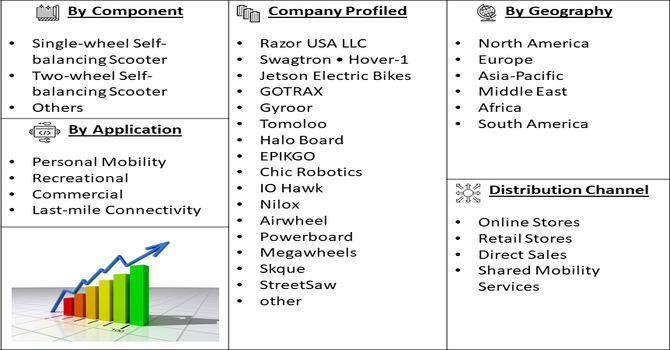
Segmentation: The Global Smart Self-balancing Electric Scooter Market is Segmented by Product Type (Single-wheel Self-balancing Scooter, Two-wheel Self-balancing Scooter (Hoverboard-style) and Others), Motor Power (Below 250 W, 250–500 W, and Above 500 W), Battery Type (Lithium-ion Battery, Lead-acid Battery and Others), Application (Personal Mobility, Recreational, Commercial and Last-mile Connectivity), Distribution Channel (Online Stores, Retail Stores, Direct Sales and Shared Mobility Services), and Geography (North America, Europe, Asia-Pacific, Middle East and Africa, and South America). The report provides the value (in USD million) for the above segments.
For Detailed Market Segmentation - Get a Free Sample PDF
Market Drivers:
- Rising Demand for Last-mile Mobility
The global smart self-balancing electric scooter market is being driven by growing demand for last-mile transportation in congested urban areas. As cities face traffic congestion and parking challenges, consumers and commuters are turning to compact, eco-friendly mobility devices for short trips. Self-balancing scooters offer a convenient alternative for commuting between transit hubs, workplaces, and homes. Their lightweight design and ease of use make them ideal for quick, short-distance travel. As urbanization continues and public transportation networks expand, the need for efficient last-mile solutions is expected to fuel market growth.
- Technological Advancements and Smart Features
Advancements in battery technology, sensors, and IoT connectivity are driving growth in the smart self-balancing electric scooter market. Modern models now feature improved range, faster charging, and enhanced stability through gyroscopic balancing systems. Smart features such as mobile app integration, GPS tracking, anti-theft systems, and speed control enhance user experience and safety. In October 2025, NAVEE’s launch of the XT5 Pro all-terrain electric scooter strengthened the global smart self-balancing electric scooter market by raising performance and sustainability expectations. Its advanced design and smart features highlighted growing technological innovation in the sector, while online availability expanded consumer access. This development reinforced the trend toward more powerful, feature-rich scooters and increased competition across the industry. Manufacturers are also incorporating better build materials and advanced motors to increase performance and durability. These technological improvements make scooters more reliable and appealing, encouraging wider adoption among urban commuters, students, and recreational users.
Market Restraints:
- Safety Concerns and Regulatory Restrictions
Safety concerns and regulatory restrictions pose significant restraints on the smart self-balancing electric scooter market. The risk of accidents and injuries due to high speeds, poor rider control, and uneven surfaces has led to increased scrutiny in many regions. Governments and local authorities often impose strict rules on where scooters can be used, speed limits, and age restrictions. These regulations can limit market expansion, especially in areas with inadequate infrastructure such as bike lanes and smooth pavements. Additionally, concerns about battery fires and device reliability can reduce consumer confidence, slowing adoption in some markets.
Socioeconomic Impact on Smart Self-balancing Electric Scooter Market
Smart self-balancing electric scooters contribute to sustainable urban mobility by reducing reliance on cars and lowering carbon emissions. They offer affordable and convenient transportation for short distances, helping improve access to jobs, education, and services in congested cities. The market also supports economic activity through manufacturing, retail, and shared mobility operations, creating jobs and supporting local businesses. However, increased scooter usage raises safety and public space management concerns, prompting cities to invest in infrastructure and regulations. Overall, these scooters can enhance mobility equity and reduce commuting costs, while encouraging environmentally friendly transport alternatives.
Segmental Analysis
- Two-wheel Self-balancing Scooter (Hoverboard-style) segment is expected to witness highest growth over the forecast period
The two-wheel self-balancing scooter (hoverboard-style) segment is expected to witness the highest growth over the forecast period. These scooters are popular due to their stability, compact design, and user-friendly operation, making them ideal for urban commuters and recreational users. Manufacturers are increasingly improving safety features and performance, which boosts consumer confidence and adoption. The hoverboard-style format also appeals to younger users and those seeking a fun, portable mode of transport. As last-mile mobility needs rise, this segment is expected to expand rapidly, supported by growing demand for lightweight, affordable, and technologically advanced personal mobility devices.
- 250–500 W segment is expected to witness highest growth over the forecast period
The 250–500 W motor power segment is expected to experience the highest growth over the forecast period as it offers a balance of performance and efficiency. Scooters in this range deliver sufficient power for daily commuting while maintaining battery life and portability. They are well-suited for urban environments with moderate slopes and short to medium distance travel. This segment appeals to both adults and teenagers seeking reliable performance without the higher costs and energy demands of more powerful models. As consumers prioritize practicality, ride stability, and value, the 250–500 W category is expected to dominate market growth.
- Commercial and Last-mile Connectivity segment is expected to witness highest growth over the forecast period
The commercial and last-mile connectivity segment is expected to witness the highest growth over the forecast period due to increasing demand from businesses and urban transport systems. Companies are adopting self-balancing scooters for campus mobility, facility management, tourism services, and security patrols. Additionally, as public transit networks expand, scooters are used for short-distance travel between stations and final destinations, providing a convenient and sustainable solution. The rise of shared mobility services and rental fleets also supports growth in this segment, making scooters more accessible to a wider population and reinforcing their role in modern urban transportation.
- Direct Sales and Shared Mobility Services segment is expected to witness highest growth over the forecast period
The direct sales and shared mobility services segment is expected to witness the highest growth over the forecast period as consumers increasingly seek convenient ownership and access options. Direct sales through online and retail channels allow users to purchase scooters for personal use, while shared mobility services offer flexible, pay-as-you-go access without ownership costs. Shared scooters are especially popular in cities, campuses, and tourist destinations, expanding market reach and user adoption. As more companies invest in rental fleets and app-based access systems, the combined growth of direct sales and shared mobility is expected to drive market expansion significantly.
- Asia-Pacific Region is expected to witness highest growth over the forecast period
The Asia-Pacific region is expected to witness the highest growth over the forecast period due to rapid urbanization, rising disposable incomes, and increasing demand for eco-friendly transportation. Countries in this region are investing heavily in smart city infrastructure, which supports the adoption of personal mobility devices like self-balancing scooters.
The presence of major manufacturers and a strong consumer base also contributes to market growth. For instance, in January 2026, OMOWAY’s successful Pre-A and Pre-A+ funding rounds strengthened the Asia-Pacific smart self-balancing electric scooter market by supporting mass production and wider distribution of its flagship OMO X model. The investment accelerated technological development and helped expand the company’s presence across the region, boosting competition and adoption of advanced two-wheeled smart mobility devices in key Asia-Pacific markets.
Additionally, expanding shared mobility services and last-mile connectivity initiatives in major cities boost demand. As governments promote sustainable transport solutions and technological innovation, the Asia-Pacific market is expected to lead global growth in this sector.
| Report Matrics |
Details |
| Market Size Value |
USD 4.87 billion |
| Growth Rate |
CAGR of 17.1% |
| Forecast |
2026-2033 |
| Historical data |
2021-2024 |
| Base Year |
2025 |
| Report Coverage |
Forecasted revenue, company rating, competitive environment, growth drivers, and trends |
| Segment Coverage |
Type, Application, End-User, Geography |
| Regional Scope |
North America, Europe, Asia Pacific, Middle East |
| Customized scope |
Free customization of reports (With 3 months Analysis Support ) |
| To Learn More About This Report |
Request a Free Sample Copy |
Smart Self-balancing Electric Scooter Market Competitive Landscape
The competitive landscape of the smart self-balancing electric scooter market is fragmented, featuring established personal mobility brands, tech startups, and shared mobility operators. Key players compete on product innovation, battery life, range, build quality, and smart features like app integration and GPS tracking. Price and safety certifications are also important differentiators, especially in regions with strict regulations. Partnerships with ride-sharing platforms and urban mobility programs help companies expand their market reach. Continuous innovation and aggressive marketing strategies are common, as companies strive to lead in both consumer sales and shared mobility deployments. Market consolidation and strategic alliances are expected as the industry matures.
The major players for above market are:
- Razor USA LLC
- Swagtron • Hover-1
- Jetson Electric Bikes
- GOTRAX
- Gyroor
- Tomoloo
- Halo Board
- EPIKGO
- Chic Robotics
- IO Hawk
- Nilox
- Airwheel
- Powerboard
- Megawheels
- Skque
- StreetSaw
Recent Development
- In January 2026, Segway’s launch of an expanded e-bike lineup and a new electric dirt bike strengthened the global smart self-balancing electric scooter market by broadening consumer interest in micromobility and reinforcing the brand’s leadership. The move increased demand for electric personal transportation and encouraged innovation across the industry, boosting competition and adoption of smart mobility solutions worldwide.
- In October 2025, iGoWise’s preorder launch of the BeiGo X4 smart electric trike strengthened the global smart self-balancing electric scooter market by expanding interest in compact, accessible electric mobility options. The made-in-India trike addressed urban transport needs across age and ability levels, promoting wider adoption of personal electric vehicles. This development also encouraged innovation in micro-mobility design and increased competitive pressure in the broader electric scooter and last-mile mobility sector.
Frequently Asked Questions (FAQ) :
Q1. What are the main growth-driving factors for this market?
The market is primarily driven by the rising demand for eco-friendly personal mobility solutions in congested urban areas. Increasing fuel prices and growing environmental awareness push consumers toward electric alternatives. Furthermore, advancements in sensor technology and battery efficiency have improved safety and range, making these scooters attractive for short-distance daily commuting.
Q2. What are the main restraining factors for this market?
Growth is hampered by stringent government regulations regarding the use of self-balancing vehicles on public roads and sidewalks. Safety concerns, including high-profile battery fire incidents and rider injuries, have led to product recalls and negative perceptions. High initial costs compared to traditional kick-scooters also limit adoption in price-sensitive emerging regions.
Q3. Which segment is expected to witness high growth?
The dual-wheel segment is expected to witness the highest growth due to its superior stability and ease of use for beginners. Unlike unicycles, dual-wheel scooters appeal to a broader demographic, including the elderly and children. Their increasing integration with smart features like Bluetooth connectivity and mobile app tracking further boosts popularity.
Q4. Who are the top major players for this market?
The market is dominated by Ninebot (which acquired Segway), Xiaomi Corporation, and Razor USA LLC. Other significant players include Hovertrax, Swagtron, and Koowheel. These companies maintain their leadership through continuous R&D, strong global distribution networks, and strategic branding that targets both tech enthusiasts and urban commuters seeking efficient transportation.
Q5. Which country is the largest player?
China is the largest player in this market, serving as both the leading manufacturer and a massive consumer base. The country's dominance is supported by its advanced electronic manufacturing infrastructure and government subsidies for electric vehicle production. Cities like Shenzhen serve as global hubs for the innovation and export of devices.
List of Figures
Figure 1: Global Smart Self-balancing Electric Scooter Market Revenue Breakdown (USD Billion, %) by Region, 2022 & 2029
Figure 2: Global Smart Self-balancing Electric Scooter Market Value Share (%), By Segment 1, 2022 & 2029
Figure 3: Global Smart Self-balancing Electric Scooter Market Forecast (USD Billion), by Sub-Segment 1, 2018-2029
Figure 4: Global Smart Self-balancing Electric Scooter Market Forecast (USD Billion), by Sub-Segment 2, 2018-2029
Figure 5: Global Smart Self-balancing Electric Scooter Market Value Share (%), By Segment 2, 2022 & 2029
Figure 6: Global Smart Self-balancing Electric Scooter Market Forecast (USD Billion), by Sub-Segment 1, 2018-2029
Figure 7: Global Smart Self-balancing Electric Scooter Market Forecast (USD Billion), by Sub-Segment 2, 2018-2029
Figure 8: Global Smart Self-balancing Electric Scooter Market Forecast (USD Billion), by Sub-Segment 3, 2018-2029
Figure 9: Global Smart Self-balancing Electric Scooter Market Forecast (USD Billion), by Others, 2018-2029
Figure 10: Global Smart Self-balancing Electric Scooter Market Value Share (%), By Segment 3, 2022 & 2029
Figure 11: Global Smart Self-balancing Electric Scooter Market Forecast (USD Billion), by Sub-Segment 1, 2018-2029
Figure 12: Global Smart Self-balancing Electric Scooter Market Forecast (USD Billion), by Sub-Segment 2, 2018-2029
Figure 13: Global Smart Self-balancing Electric Scooter Market Forecast (USD Billion), by Sub-Segment 3, 2018-2029
Figure 14: Global Smart Self-balancing Electric Scooter Market Forecast (USD Billion), by Others, 2018-2029
Figure 15: Global Smart Self-balancing Electric Scooter Market Value (USD Billion), by Region, 2022 & 2029
Figure 16: North America Smart Self-balancing Electric Scooter Market Value Share (%), By Segment 1, 2022 & 2029
Figure 17: North America Smart Self-balancing Electric Scooter Market Forecast (USD Billion), by Sub-Segment 1, 2018-2029
Figure 18: North America Smart Self-balancing Electric Scooter Market Forecast (USD Billion), by Sub-Segment 2, 2018-2029
Figure 19: North America Smart Self-balancing Electric Scooter Market Value Share (%), By Segment 2, 2022 & 2029
Figure 20: North America Smart Self-balancing Electric Scooter Market Forecast (USD Billion), by Sub-Segment 1, 2018-2029
Figure 21: North America Smart Self-balancing Electric Scooter Market Forecast (USD Billion), by Sub-Segment 2, 2018-2029
Figure 22: North America Smart Self-balancing Electric Scooter Market Forecast (USD Billion), by Sub-Segment 3, 2018-2029
Figure 23: North America Smart Self-balancing Electric Scooter Market Forecast (USD Billion), by Others, 2018-2029
Figure 24: North America Smart Self-balancing Electric Scooter Market Value Share (%), By Segment 3, 2022 & 2029
Figure 25: North America Smart Self-balancing Electric Scooter Market Forecast (USD Billion), by Sub-Segment 1, 2018-2029
Figure 26: North America Smart Self-balancing Electric Scooter Market Forecast (USD Billion), by Sub-Segment 2, 2018-2029
Figure 27: North America Smart Self-balancing Electric Scooter Market Forecast (USD Billion), by Sub-Segment 3, 2018-2029
Figure 28: North America Smart Self-balancing Electric Scooter Market Forecast (USD Billion), by Others, 2018-2029
Figure 29: North America Smart Self-balancing Electric Scooter Market Forecast (USD Billion), by U.S., 2018-2029
Figure 30: North America Smart Self-balancing Electric Scooter Market Forecast (USD Billion), by Canada, 2018-2029
Figure 31: Latin America Smart Self-balancing Electric Scooter Market Value Share (%), By Segment 1, 2022 & 2029
Figure 32: Latin America Smart Self-balancing Electric Scooter Market Forecast (USD Billion), by Sub-Segment 1, 2018-2029
Figure 33: Latin America Smart Self-balancing Electric Scooter Market Forecast (USD Billion), by Sub-Segment 2, 2018-2029
Figure 34: Latin America Smart Self-balancing Electric Scooter Market Value Share (%), By Segment 2, 2022 & 2029
Figure 35: Latin America Smart Self-balancing Electric Scooter Market Forecast (USD Billion), by Sub-Segment 1, 2018-2029
Figure 36: Latin America Smart Self-balancing Electric Scooter Market Forecast (USD Billion), by Sub-Segment 2, 2018-2029
Figure 37: Latin America Smart Self-balancing Electric Scooter Market Forecast (USD Billion), by Sub-Segment 3, 2018-2029
Figure 38: Latin America Smart Self-balancing Electric Scooter Market Forecast (USD Billion), by Others, 2018-2029
Figure 39: Latin America Smart Self-balancing Electric Scooter Market Value Share (%), By Segment 3, 2022 & 2029
Figure 40: Latin America Smart Self-balancing Electric Scooter Market Forecast (USD Billion), by Sub-Segment 1, 2018-2029
Figure 41: Latin America Smart Self-balancing Electric Scooter Market Forecast (USD Billion), by Sub-Segment 2, 2018-2029
Figure 42: Latin America Smart Self-balancing Electric Scooter Market Forecast (USD Billion), by Sub-Segment 3, 2018-2029
Figure 43: Latin America Smart Self-balancing Electric Scooter Market Forecast (USD Billion), by Others, 2018-2029
Figure 44: Latin America Smart Self-balancing Electric Scooter Market Forecast (USD Billion), by Brazil, 2018-2029
Figure 45: Latin America Smart Self-balancing Electric Scooter Market Forecast (USD Billion), by Mexico, 2018-2029
Figure 46: Latin America Smart Self-balancing Electric Scooter Market Forecast (USD Billion), by Rest of Latin America, 2018-2029
Figure 47: Europe Smart Self-balancing Electric Scooter Market Value Share (%), By Segment 1, 2022 & 2029
Figure 48: Europe Smart Self-balancing Electric Scooter Market Forecast (USD Billion), by Sub-Segment 1, 2018-2029
Figure 49: Europe Smart Self-balancing Electric Scooter Market Forecast (USD Billion), by Sub-Segment 2, 2018-2029
Figure 50: Europe Smart Self-balancing Electric Scooter Market Value Share (%), By Segment 2, 2022 & 2029
Figure 51: Europe Smart Self-balancing Electric Scooter Market Forecast (USD Billion), by Sub-Segment 1, 2018-2029
Figure 52: Europe Smart Self-balancing Electric Scooter Market Forecast (USD Billion), by Sub-Segment 2, 2018-2029
Figure 53: Europe Smart Self-balancing Electric Scooter Market Forecast (USD Billion), by Sub-Segment 3, 2018-2029
Figure 54: Europe Smart Self-balancing Electric Scooter Market Forecast (USD Billion), by Others, 2018-2029
Figure 55: Europe Smart Self-balancing Electric Scooter Market Value Share (%), By Segment 3, 2022 & 2029
Figure 56: Europe Smart Self-balancing Electric Scooter Market Forecast (USD Billion), by Sub-Segment 1, 2018-2029
Figure 57: Europe Smart Self-balancing Electric Scooter Market Forecast (USD Billion), by Sub-Segment 2, 2018-2029
Figure 58: Europe Smart Self-balancing Electric Scooter Market Forecast (USD Billion), by Sub-Segment 3, 2018-2029
Figure 59: Europe Smart Self-balancing Electric Scooter Market Forecast (USD Billion), by Others, 2018-2029
Figure 60: Europe Smart Self-balancing Electric Scooter Market Forecast (USD Billion), by U.K., 2018-2029
Figure 61: Europe Smart Self-balancing Electric Scooter Market Forecast (USD Billion), by Germany, 2018-2029
Figure 62: Europe Smart Self-balancing Electric Scooter Market Forecast (USD Billion), by France, 2018-2029
Figure 63: Europe Smart Self-balancing Electric Scooter Market Forecast (USD Billion), by Italy, 2018-2029
Figure 64: Europe Smart Self-balancing Electric Scooter Market Forecast (USD Billion), by Spain, 2018-2029
Figure 65: Europe Smart Self-balancing Electric Scooter Market Forecast (USD Billion), by Russia, 2018-2029
Figure 66: Europe Smart Self-balancing Electric Scooter Market Forecast (USD Billion), by Rest of Europe, 2018-2029
Figure 67: Asia Pacific Smart Self-balancing Electric Scooter Market Value Share (%), By Segment 1, 2022 & 2029
Figure 68: Asia Pacific Smart Self-balancing Electric Scooter Market Forecast (USD Billion), by Sub-Segment 1, 2018-2029
Figure 69: Asia Pacific Smart Self-balancing Electric Scooter Market Forecast (USD Billion), by Sub-Segment 2, 2018-2029
Figure 70: Asia Pacific Smart Self-balancing Electric Scooter Market Value Share (%), By Segment 2, 2022 & 2029
Figure 71: Asia Pacific Smart Self-balancing Electric Scooter Market Forecast (USD Billion), by Sub-Segment 1, 2018-2029
Figure 72: Asia Pacific Smart Self-balancing Electric Scooter Market Forecast (USD Billion), by Sub-Segment 2, 2018-2029
Figure 73: Asia Pacific Smart Self-balancing Electric Scooter Market Forecast (USD Billion), by Sub-Segment 3, 2018-2029
Figure 74: Asia Pacific Smart Self-balancing Electric Scooter Market Forecast (USD Billion), by Others, 2018-2029
Figure 75: Asia Pacific Smart Self-balancing Electric Scooter Market Value Share (%), By Segment 3, 2022 & 2029
Figure 76: Asia Pacific Smart Self-balancing Electric Scooter Market Forecast (USD Billion), by Sub-Segment 1, 2018-2029
Figure 77: Asia Pacific Smart Self-balancing Electric Scooter Market Forecast (USD Billion), by Sub-Segment 2, 2018-2029
Figure 78: Asia Pacific Smart Self-balancing Electric Scooter Market Forecast (USD Billion), by Sub-Segment 3, 2018-2029
Figure 79: Asia Pacific Smart Self-balancing Electric Scooter Market Forecast (USD Billion), by Others, 2018-2029
Figure 80: Asia Pacific Smart Self-balancing Electric Scooter Market Forecast (USD Billion), by China, 2018-2029
Figure 81: Asia Pacific Smart Self-balancing Electric Scooter Market Forecast (USD Billion), by India, 2018-2029
Figure 82: Asia Pacific Smart Self-balancing Electric Scooter Market Forecast (USD Billion), by Japan, 2018-2029
Figure 83: Asia Pacific Smart Self-balancing Electric Scooter Market Forecast (USD Billion), by Australia, 2018-2029
Figure 84: Asia Pacific Smart Self-balancing Electric Scooter Market Forecast (USD Billion), by Southeast Asia, 2018-2029
Figure 85: Asia Pacific Smart Self-balancing Electric Scooter Market Forecast (USD Billion), by Rest of Asia Pacific, 2018-2029
Figure 86: Middle East & Africa Smart Self-balancing Electric Scooter Market Value Share (%), By Segment 1, 2022 & 2029
Figure 87: Middle East & Africa Smart Self-balancing Electric Scooter Market Forecast (USD Billion), by Sub-Segment 1, 2018-2029
Figure 88: Middle East & Africa Smart Self-balancing Electric Scooter Market Forecast (USD Billion), by Sub-Segment 2, 2018-2029
Figure 89: Middle East & Africa Smart Self-balancing Electric Scooter Market Value Share (%), By Segment 2, 2022 & 2029
Figure 90: Middle East & Africa Smart Self-balancing Electric Scooter Market Forecast (USD Billion), by Sub-Segment 1, 2018-2029
Figure 91: Middle East & Africa Smart Self-balancing Electric Scooter Market Forecast (USD Billion), by Sub-Segment 2, 2018-2029
Figure 92: Middle East & Africa Smart Self-balancing Electric Scooter Market Forecast (USD Billion), by Sub-Segment 3, 2018-2029
Figure 93: Middle East & Africa Smart Self-balancing Electric Scooter Market Forecast (USD Billion), by Others, 2018-2029
Figure 94: Middle East & Africa Smart Self-balancing Electric Scooter Market Value Share (%), By Segment 3, 2022 & 2029
Figure 95: Middle East & Africa Smart Self-balancing Electric Scooter Market Forecast (USD Billion), by Sub-Segment 1, 2018-2029
Figure 96: Middle East & Africa Smart Self-balancing Electric Scooter Market Forecast (USD Billion), by Sub-Segment 2, 2018-2029
Figure 97: Middle East & Africa Smart Self-balancing Electric Scooter Market Forecast (USD Billion), by Sub-Segment 3, 2018-2029
Figure 98: Middle East & Africa Smart Self-balancing Electric Scooter Market Forecast (USD Billion), by Others, 2018-2029
Figure 99: Middle East & Africa Smart Self-balancing Electric Scooter Market Forecast (USD Billion), by GCC, 2018-2029
Figure 100: Middle East & Africa Smart Self-balancing Electric Scooter Market Forecast (USD Billion), by South Africa, 2018-2029
Figure 101: Middle East & Africa Smart Self-balancing Electric Scooter Market Forecast (USD Billion), by Rest of Middle East & Africa, 2018-2029
List of Tables
Table 1: Global Smart Self-balancing Electric Scooter Market Revenue (USD Billion) Forecast, by Segment 1, 2018-2029
Table 2: Global Smart Self-balancing Electric Scooter Market Revenue (USD Billion) Forecast, by Segment 2, 2018-2029
Table 3: Global Smart Self-balancing Electric Scooter Market Revenue (USD Billion) Forecast, by Segment 3, 2018-2029
Table 4: Global Smart Self-balancing Electric Scooter Market Revenue (USD Billion) Forecast, by Region, 2018-2029
Table 5: North America Smart Self-balancing Electric Scooter Market Revenue (USD Billion) Forecast, by Segment 1, 2018-2029
Table 6: North America Smart Self-balancing Electric Scooter Market Revenue (USD Billion) Forecast, by Segment 2, 2018-2029
Table 7: North America Smart Self-balancing Electric Scooter Market Revenue (USD Billion) Forecast, by Segment 3, 2018-2029
Table 8: North America Smart Self-balancing Electric Scooter Market Revenue (USD Billion) Forecast, by Country, 2018-2029
Table 9: Europe Smart Self-balancing Electric Scooter Market Revenue (USD Billion) Forecast, by Segment 1, 2018-2029
Table 10: Europe Smart Self-balancing Electric Scooter Market Revenue (USD Billion) Forecast, by Segment 2, 2018-2029
Table 11: Europe Smart Self-balancing Electric Scooter Market Revenue (USD Billion) Forecast, by Segment 3, 2018-2029
Table 12: Europe Smart Self-balancing Electric Scooter Market Revenue (USD Billion) Forecast, by Country, 2018-2029
Table 13: Latin America Smart Self-balancing Electric Scooter Market Revenue (USD Billion) Forecast, by Segment 1, 2018-2029
Table 14: Latin America Smart Self-balancing Electric Scooter Market Revenue (USD Billion) Forecast, by Segment 2, 2018-2029
Table 15: Latin America Smart Self-balancing Electric Scooter Market Revenue (USD Billion) Forecast, by Segment 3, 2018-2029
Table 16: Latin America Smart Self-balancing Electric Scooter Market Revenue (USD Billion) Forecast, by Country, 2018-2029
Table 17: Asia Pacific Smart Self-balancing Electric Scooter Market Revenue (USD Billion) Forecast, by Segment 1, 2018-2029
Table 18: Asia Pacific Smart Self-balancing Electric Scooter Market Revenue (USD Billion) Forecast, by Segment 2, 2018-2029
Table 19: Asia Pacific Smart Self-balancing Electric Scooter Market Revenue (USD Billion) Forecast, by Segment 3, 2018-2029
Table 20: Asia Pacific Smart Self-balancing Electric Scooter Market Revenue (USD Billion) Forecast, by Country, 2018-2029
Table 21: Middle East & Africa Smart Self-balancing Electric Scooter Market Revenue (USD Billion) Forecast, by Segment 1, 2018-2029
Table 22: Middle East & Africa Smart Self-balancing Electric Scooter Market Revenue (USD Billion) Forecast, by Segment 2, 2018-2029
Table 23: Middle East & Africa Smart Self-balancing Electric Scooter Market Revenue (USD Billion) Forecast, by Segment 3, 2018-2029
Table 24: Middle East & Africa Smart Self-balancing Electric Scooter Market Revenue (USD Billion) Forecast, by Country, 2018-2029
Research Process
Data Library Research are conducted by industry experts who offer insight on
industry structure, market segmentations technology assessment and competitive landscape (CL), and penetration, as well as on emerging trends. Their analysis is based on primary interviews (~ 80%) and secondary research (~ 20%) as well as years of professional expertise in their respective industries. Adding to this, by analysing historical trends and current market positions, our analysts predict where the market will be headed for the next five years. Furthermore, the varying trends of segment & categories geographically presented are also studied and the estimated based on the primary & secondary research.
In this particular report from the supply side Data Library Research has conducted primary surveys (interviews) with the key level executives (VP, CEO’s, Marketing Director, Business Development Manager
and SOFT) of the companies that active & prominent as well as the midsized organization
FIGURE 1: DLR RESEARH PROCESS
![research-methodology1]()
Primary Research
Extensive primary research was conducted to gain a deeper insight of the market and industry performance. The analysis is based on both primary and secondary research as well as years of professional expertise in the respective industries.
In addition to analysing current and historical trends, our analysts predict where the market is headed over the next five years.
It varies by segment for these categories geographically presented in the list of market tables. Speaking about this particular report we have conducted primary surveys (interviews) with the key level executives (VP, CEO’s, Marketing Director, Business Development Manager and many more) of the major players active in the market.
Secondary Research
Secondary research was mainly used to collect and identify information useful for the extensive, technical, market-oriented, and Friend’s study of the Global Extra Neutral Alcohol. It was also used to obtain key information about major players, market classification and segmentation according to the industry trends, geographical markets, and developments related to the market and technology perspectives. For this study, analysts have gathered information from various credible sources, such as annual reports, sec filings, journals, white papers, SOFT presentations, and company web sites.
Market Size Estimation
Both, top-down and bottom-up approaches were used to estimate and validate the size of the Global market and to estimate the size of various other dependent submarkets in the overall Extra Neutral Alcohol. The key players in the market were identified through secondary research and their market contributions in the respective geographies were determined through primary and secondary research.
Forecast Model
![research-methodology2]()