
Get Complete Analysis Of The Report - Download Updated Free Sample PDF
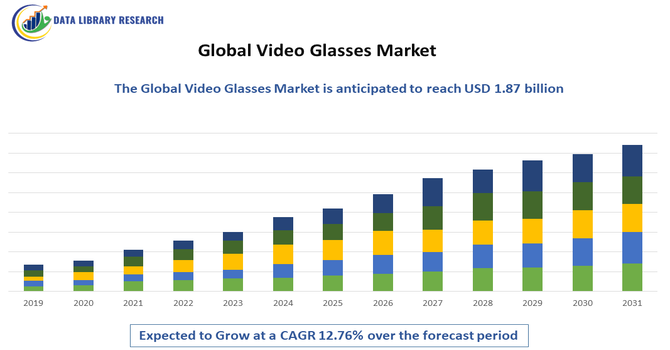
The global video glasses market refers to wearable devices that combine eyewear with video recording, streaming, and display capabilities. These smart glasses are used for entertainment, sports, professional applications, and augmented reality experiences. Growing consumer interest, technological advancements, and rising demand for hands-free video capture drive market expansion worldwide.
The growth in the global video glasses market is driven by rising demand for immersive entertainment, increasing use of AR/VR in gaming and training, advancements in lightweight wearable displays, expanding applications in healthcare and industry, growing interest in hands-free recording, and broader adoption of smart wearable technologies supported by improving connectivity and processing power.
The global video glasses market is experiencing rapid innovation driven by the integration of augmented and virtual reality, high-definition micro-displays, and improved battery efficiency. Lightweight and ergonomic designs are becoming more common as manufacturers focus on enhancing user comfort for extended wear. Demand is expanding beyond entertainment into healthcare, education, field services, and logistics, where hands-free visualization improves productivity and accuracy. The rise of remote collaboration and digital training is further accelerating adoption.
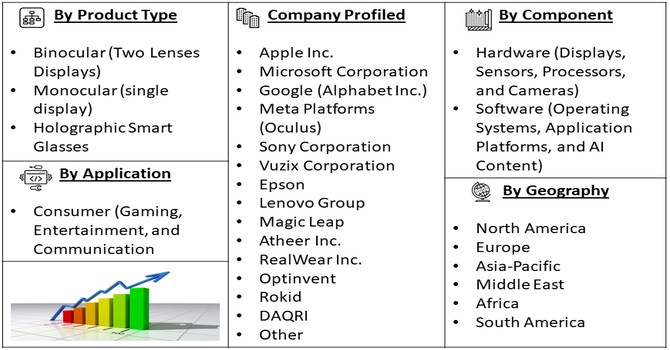
Segmentation: The Global Video Glasses Market is segmented by Product Type (Binocular (Two Lenses Displays), Monocular (single display), and Holographic Smart Glasses), Component (Hardware (Displays, Sensors, Processors, and Cameras) and Software (Operating Systems, Application Platforms, and AI Content), Application (Consumer (Gaming, Entertainment, and Communication) and Enterprise (Healthcare, Manufacturing, Logistics, and Retail) and Geography (North America, Europe, Asia-Pacific, Middle East and Africa, and South America). The report provides the value (in USD million) for the above segments.
For Detailed Market Segmentation - Get a Free Sample PDF
Market Drivers:
The major driver of the global video glasses market is the rapidly growing demand for immersive and hands-free visual experiences across entertainment, gaming, and professional applications. Consumers increasingly seek portable, high-quality wearable displays that offer cinematic viewing, augmented reality overlays, and interactive features without relying on traditional screens. In professional environments—such as healthcare, manufacturing, field services, and logistics—video glasses provide real-time visual guidance, remote collaboration, and improved operational accuracy. These capabilities enhance productivity and reduce human error, encouraging businesses to adopt wearable technologies as part of digital transformation efforts.
The another significant driver is the continuous technological advancement in optics, sensors, connectivity, and processing power. Modern video glasses incorporate lightweight materials, high-definition displays, improved battery life, and seamless integration with smartphones, cloud platforms, and AI-based applications.
In April 2025, Nokia’s showcase of AI-era networking solutions advanced optics, connectivity, and AI integration by enabling scalable, efficient cloud and data center networks. This development indirectly supported the global video glasses market, enhancing real-time data processing, low-latency streaming, and AR/VR performance, driving innovation and adoption in wearable visual technologies. These innovations enhance usability, making wearables more comfortable and efficient for long-duration use. Industries are increasingly adopting AR-enabled glasses for tasks like equipment maintenance, surgical assistance, remote inspections, and training simulations, benefiting from real-time data overlays and improved situational awareness.
Market Restraints:
Despite strong growth prospects, the global video glasses market faces challenges related to high costs, privacy concerns, and limited consumer awareness. Advanced models with AR/VR capabilities, specialized sensors, and high-resolution optics often come with premium price tags, restricting adoption among price-sensitive users and small businesses. Additionally, privacy risks—such as unauthorized recording, data collection, and potential misuse of facial or environmental capture—create hesitation among consumers and regulators. Many users also remain unfamiliar with wearable display technologies, leading to slow acceptance outside tech-savvy groups.
The socioeconomic impact of the global video glasses market is substantial, influencing workforce productivity, education quality, and accessibility. In industrial and medical settings, video glasses enable real-time guidance, reducing errors and enhancing worker training. They support remote assistance, lowering operational costs and bridging skill gaps in underserved regions. In education, immersive learning improves engagement and knowledge retention. The market also stimulates job creation in manufacturing, software development, and content creation. However, widespread adoption raises concerns about digital inequality and data privacy. Overall, video glasses contribute to technological empowerment, economic growth, and the development of more efficient and connected communities.
Segmental Analysis:
The binocular segment is expected to witness the highest growth as demand rises for immersive, high-resolution viewing experiences in entertainment, gaming, and professional applications. Binocular video glasses offer enhanced depth perception, wider fields of view, and superior visual clarity, making them ideal for AR/VR environments. Their ability to deliver realistic 3D visualization supports training, simulation, and remote assistance across industries. With advancements in lightweight optics and ergonomic designs, binocular models are becoming more comfortable for extended use. Increased adoption in education, defense, and industrial workflows further accelerates their dominance, positioning this segment for robust expansion throughout the forecast period.
The operating systems segment is expected to witness the highest growth due to the rising demand for more intelligent, interactive, and customizable wearable experiences. Modern video glasses are increasingly equipped with advanced operating systems that support app integration, gesture controls, voice commands, and seamless connectivity with smartphones and cloud platforms. These OS-enabled systems offer enhanced processing capabilities, improved user interfaces, and greater compatibility with AR/VR applications, making them essential for enterprise and consumer use. As developers create specialized apps for healthcare, logistics, and entertainment, the value of integrated operating systems continues to grow, driving widespread adoption and strengthening market expansion.
The healthcare segment is expected to witness the highest growth as medical professionals increasingly adopt video glasses for surgical assistance, remote consultations, medical training, and real-time diagnostics. These devices enable hands-free viewing of patient data, imaging results, and procedural guidance directly within the clinician’s field of vision. They enhance precision, reduce errors, and improve collaboration, especially in telemedicine and emergency care. Video glasses also support augmented reality overlays that assist in minimally invasive procedures. As healthcare institutions prioritize digital transformation and efficiency, the integration of wearable visualization tools continues to rise, positioning the segment for strong and sustained growth.
The North American region is expected to witness the highest growth due to strong technological infrastructure, rapid adoption of AR/VR applications, and significant investments from leading tech companies. Industries such as healthcare, military, manufacturing, and entertainment increasingly utilize video glasses to enhance training, productivity, and remote operations. For instance, in April 2025, Meta’s next-generation smart glasses, featuring a display and wrist-worn XR controller, strengthened North America’s position in the global video glasses market. The innovation boosted regional adoption, accelerated AR/VR integration, and enhanced consumer and enterprise interest, driving technological advancement and reinforcing North America as a key growth hub in wearable visual technologies.
High consumer awareness, supportive regulatory environments, and widespread integration of 5G further accelerate demand. The region also benefits from a strong ecosystem of hardware developers, software providers, and innovation-driven startups. With continuous advancements and early adoption of emerging technologies, North America remains a key driver of market expansion throughout the forecast period.
To Learn More About This Report - Request a Free Sample Copy
The competitive landscape of the global video glasses market features a mix of established technology companies and innovative startups focused on AR/VR wearables. Key players compete on display clarity, battery performance, comfort, and integration with existing digital ecosystems. Companies are investing in R&D to develop high-resolution optics, lightweight frames, and advanced sensors that improve user experience. Strategic partnerships with healthcare, defense, and industrial firms are becoming essential for market expansion. Pricing strategies vary widely, with premium models targeting professional applications and affordable versions appealing to consumers.
The major players for this market are:
Recent Development
Q1. What are the main growth-driving factors for this market?
The rapid adoption of Augmented Reality (AR) and Virtual Reality (VR) technologies across major industries is the primary driver. Businesses are using video glasses for hands-free workflow optimization, remote expert assistance, and employee training, leading to higher efficiency.
Q2. What are the main restraining factors for this market?
Key restraining factors include the high cost of premium video glasses, which limits mass consumer market penetration. Another major barrier is the limited battery life, which affects usability during extended sessions, especially in enterprise environments. Concerns regarding user data privacy and the social acceptability of wearing camera-equipped glasses in public also slow down widespread adoption.
Q3. Which segment is expected to witness high growth?
The Commercial/Enterprise application segment, covering manufacturing, healthcare, and logistics, is expected to see the highest growth. These industries heavily invest in immersive training simulators and remote guidance tools, which provide immediate returns on investment. Within consumer products, the segment focused on Gaming and Entertainment will also experience significant expansion as hardware costs decrease and content availability increases.
Q4. Who are the top major players for this market?
The market is led by major technology firms and hardware specialists. Top players include established names like Meta (with Ray-Ban Meta and Quest), Microsoft (HoloLens), and Vuzix Corporation, alongside Asian giants such as Seiko Epson and TCL. Competition revolves around developing improved optics, larger fields of view, and strong developer ecosystems for content creation.
Q5. Which country is the largest player?
North America, primarily driven by the United States, holds the largest current market share. This dominance is due to the presence of key technology developers, early enterprise adoption, and significant government and military investment in AR/VR training.
Data Library Research are conducted by industry experts who offer insight on industry structure, market segmentations technology assessment and competitive landscape (CL), and penetration, as well as on emerging trends. Their analysis is based on primary interviews (~ 80%) and secondary research (~ 20%) as well as years of professional expertise in their respective industries. Adding to this, by analysing historical trends and current market positions, our analysts predict where the market will be headed for the next five years. Furthermore, the varying trends of segment & categories geographically presented are also studied and the estimated based on the primary & secondary research.
In this particular report from the supply side Data Library Research has conducted primary surveys (interviews) with the key level executives (VP, CEO’s, Marketing Director, Business Development Manager and SOFT) of the companies that active & prominent as well as the midsized organization
FIGURE 1: DLR RESEARH PROCESS
Extensive primary research was conducted to gain a deeper insight of the market and industry performance. The analysis is based on both primary and secondary research as well as years of professional expertise in the respective industries.
In addition to analysing current and historical trends, our analysts predict where the market is headed over the next five years.
It varies by segment for these categories geographically presented in the list of market tables. Speaking about this particular report we have conducted primary surveys (interviews) with the key level executives (VP, CEO’s, Marketing Director, Business Development Manager and many more) of the major players active in the market.
Secondary ResearchSecondary research was mainly used to collect and identify information useful for the extensive, technical, market-oriented, and Friend’s study of the Global Extra Neutral Alcohol. It was also used to obtain key information about major players, market classification and segmentation according to the industry trends, geographical markets, and developments related to the market and technology perspectives. For this study, analysts have gathered information from various credible sources, such as annual reports, sec filings, journals, white papers, SOFT presentations, and company web sites.
Market Size EstimationBoth, top-down and bottom-up approaches were used to estimate and validate the size of the Global market and to estimate the size of various other dependent submarkets in the overall Extra Neutral Alcohol. The key players in the market were identified through secondary research and their market contributions in the respective geographies were determined through primary and secondary research.
Forecast Model