
Get Complete Analysis Of The Report - Download Updated Free Sample PDF
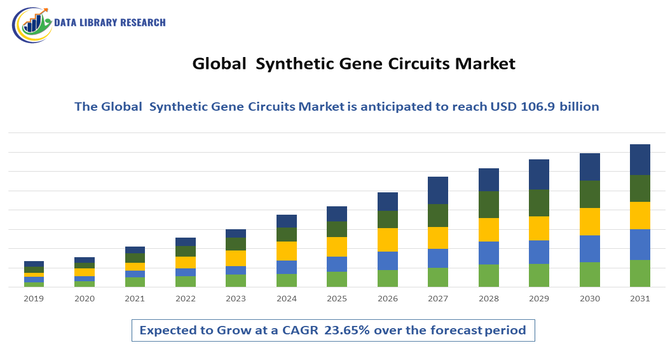
The Global Synthetic Gene Circuits Market refers to the ecosystem of technologies, platforms, tools, and biological constructs used to design, assemble, and deploy engineered genetic circuits that control cellular behaviour. Synthetic gene circuits are programmable DNA-based systems that function like logic circuits in cells to sense inputs and produce defined biological outputs. These systems are applied in therapeutic development, diagnostics, biosensing, metabolic engineering, industrial biotechnology, and agriculture. Growth in this market is driven by advances in CRISPR and DNA synthesis, rising R&D investment, and expanding applications in precision medicine and sustainable bio-manufacturing. The market continues to expand as demand for programmable cellular systems increases globally.
Key trends in the synthetic gene circuits market include rapid technological advancements in gene editing and high-throughput DNA synthesis, driving down design and testing costs and accelerating commercialization. There is strong adoption of AI and machine learning for circuit design optimization, enabling sophisticated and reliable biological systems. Markets are expanding beyond healthcare into industrial biotechnology, environmental sensing, and agriculture. North America remains dominant due to established biotech infrastructure, while Asia-Pacific is emerging fast with growing investments in life sciences. Increased M&A activity and strategic collaborations among academic institutions, startups, and large biotech players are reshaping competitive dynamics, boosting innovation and market consolidation.
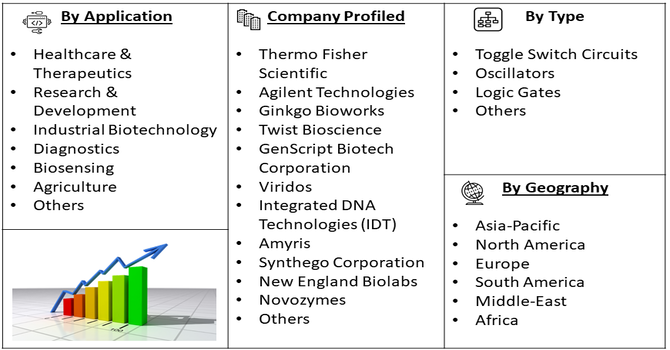
Segmentation: The Global Synthetic Gene Circuits Market is segmented by Product Type (Toggle Switch Circuits, Oscillators, Logic Gates and Others), Application (Healthcare & Therapeutics, Research & Development, Industrial Biotechnology, Diagnostics & Biosensing, Agriculture and Others), End-User (Academic & Research Institutes, Biotechnology & Pharmaceutical Companies, Industrial Biomanufacturing Firms and Others), and Geography (North America, Europe, Asia-Pacific, Middle East and Africa, and South America). The report provides the value (in USD million) for the above segments.
For Detailed Market Segmentation - Get a Free Sample PDF
Market Drivers:
The primary driver of the synthetic gene circuits market is rapid technological progress in enabling tools such as CRISPR-based editing, advanced DNA synthesis, and high-throughput screening platforms. For instance, in January 2026, The Progeria Research Foundation partnered with Forge Biologics to manufacture SamPro-2, an investigational gene therapy for Progeria. The agreement strengthened global synthetic gene circuits commercialization and accelerated momentum in CRISPR-based editing by expanding manufacturing capabilities, clinical translation efforts, and investment in precision genetic therapies.
These innovations reduce the cost and complexity of designing, building, and testing genetic circuits, making programmable biological systems more accessible to industry and research institutions. Integration of artificial intelligence and computational design tools further optimizes circuit performance, reliability, and scalability. Such technological maturation increases adoption across therapeutics, diagnostics, industrial biotechnology, and environmental applications, while promoting expansion of customized organism engineering and personalized medicine development.
Another major driver is expanding application demand across multiple sectors, including healthcare, agriculture, environmental monitoring, and industrial biotechnology. Synthetic gene circuits enable innovative approaches to cell-based therapies, real-time biosensing, metabolic pathway optimization, and programmable biomanufacturing, addressing complex challenges that traditional methods cannot.
Rising investments by pharmaceutical and biotechnology companies, alongside growing R&D in academic institutions, are increasing uptake of gene circuit technologies. For instance, in February 2026, Indian Union Minister, Dr Jitendra Singh announced the first national call for the BIRAC–RDI Fund under India’s INR 1 lakh crore RDI initiative. The move accelerated government support for biotech infrastructure, fostered innovation in high-impact biotechnology, and strengthened growth and investment for this market. The growing prevalence of chronic diseases, demand for precision medicine, and focus on sustainable manufacturing solutions further stimulate market growth, driving wider adoption and commercial implementation of engineered biological systems.
Market Restraints:
A key restraint for the synthetic gene circuits market is regulatory uncertainty and ethical concerns around engineered biological systems. Lack of harmonized frameworks across regions can slow product approvals, increase compliance costs, and create barriers to global market entry. Public concerns about genetically modified organisms, biosafety risks, and ethical implications of reprogramming living cells may limit acceptance, especially in agricultural and environmental applications. Ensuring robust safety assessment protocols and engaging proactively with policymakers and communities are essential to address these challenges. Regulatory hesitancy may delay commercialization and deter investment, constraining short-term market expansion despite technological progress.
The synthetic gene circuits market is transforming society by enabling innovative solutions in healthcare, sustainability, and industrial productivity. Gene circuits facilitate precision therapies and advanced diagnostics, potentially reducing healthcare costs and improving patient outcomes. Industrial applications improve the efficiency of biologically produced materials, fuels, and chemicals, supporting sustainable manufacturing and reducing reliance on petrochemical processes. Agricultural gene circuits can promote stress-resilient crops and environmental biosensors. Economic impacts include job creation in biotech R&D, manufacturing, and associated services, while spurring investments and competitive advantage for countries with strong life sciences ecosystems. Ethical, regulatory, and public acceptance issues remain social considerations.
Segmental Analysis:
The toggle switch circuits segment is anticipated to experience the fastest growth in the synthetic gene circuits market over the forecast period due to its foundational role in programmable cellular behavior. As one of the earliest and most versatile gene circuit designs, toggle switches enable stable, bistable gene expression, making them indispensable for controlled therapeutic applications, biosensing, and synthetic biology research. Increased demand from biotechnology and pharmaceutical companies for robust genetic control systems, coupled with improved design tools and reduced DNA synthesis costs, fuels adoption. Their simplicity, reliability, and compatibility with various host organisms further drive integration into advanced therapies and industrial bioprocesses, positioning toggle switch circuits at the forefront of market expansion.
The healthcare and therapeutics segment is projected to register the highest growth in the global synthetic gene circuits market due to rising interest in precision medicine and advanced cell and gene therapies. Synthetic gene circuits can regulate therapeutic gene expression, improve safety controls in engineered cell therapies, and enable programmable drug delivery, making them highly attractive for complex disease treatment. Increasing prevalence of chronic and rare diseases, strong investment by pharmaceutical companies, and supportive regulatory frameworks for innovative biologics are accelerating adoption. Continuous advancements in CRISPR and other editing platforms enhance circuit design precision, expanding clinical applications. As a result, the healthcare and therapeutics segment is expected to outpace other application areas throughout the forecast period.
The academic & research institutes segment is expected to witness the highest growth among end-user categories in the synthetic gene circuits market. Research organizations and universities are primary drivers of early innovation, developing foundational circuit designs, computational tools, and novel applications. Growing government and private funding for synthetic biology research, especially in North America and Europe, is enabling high-throughput screening, functional genomics studies, and proof-of-concept demonstrations. Academic collaborations with industry accelerate technology transfer and commercialization potential, increasing demand for gene circuit platforms and related consumables. Furthermore, integration of artificial intelligence and machine learning methodologies in research workflows enhances circuit performance optimization, reinforcing academic demand. As a result, this segment is poised for rapid expansion through the forecast horizon.
The North American region is projected to lead growth in the global synthetic gene circuits market during the forecast period, driven by strong biotechnology infrastructure, robust R&D investment, and presence of major industry players.
The United States, in particular, has significant academic and commercial activity in synthetic biology, supported by government initiatives and venture capital funding that accelerates innovation and commercialization. For instance, in October 2025, Engineers at Massachusetts Institute of Technology developed a promoter editing system that precisely controlled synthetic gene expression levels after delivery. This advancement improved therapeutic reliability, enhanced cell reprogramming efficiency, and increased industry confidence, thereby accelerating innovation, clinical adoption, and investment growth across North America’s synthetic gene circuits market.
Moreover, the advanced healthcare systems and early adoption of cutting-edge technologies in therapeutics, diagnostics, and industrial biotech further propel demand for synthetic gene circuit platforms. Additionally, collaborative ecosystems linking universities, biotech firms, and government research agencies reinforce technology development and market uptake. These combined factors position North America as the fastest expanding regional market for synthetic gene circuits.
To Learn More About This Report - Request a Free Sample Copy
The competitive landscape of the global synthetic gene circuits market is dynamic and innovation-driven, featuring a mix of established biotech corporations, specialized synthetic biology firms, startup innovators, and academic spin-offs. Companies compete on technology platforms, intellectual property portfolios, design tools, and end-to-end solutions for gene circuit assembly and validation. Strategic partnerships, acquisitions, and collaborative R&D are common strategies to strengthen market positions. Firms focus on expanding applications across therapeutics, industrial use, biosensing, and agricultural biotechnology. The increasing influx of venture funding and government support fuels rapid development cycles, while market consolidation is expected as larger players integrate cutting-edge technology from emerging entrants.
The major players are:
Recent Development
Q1. What is the main growth-driving factors for this market?
Market expansion is fuelled by advancements in CRISPR-based gene editing and declining costs of DNA synthesis. Increasing demand for personalized medicine and "programmable" therapies for cancer and genetic disorders is a key driver. Additionally, rising investments in synthetic biology by governments and venture capitalists are accelerating commercial applications.
Q2. What are the main restraining factors for this market?
Growth is challenged by stringent regulatory hurdles and ethical concerns regarding the environmental impact of engineered organisms. High technical complexity and the unpredictability of biological systems often lead to high R&D failure rates. Furthermore, intellectual property disputes and a shortage of specialized talent can slow down innovation cycles.
Q3. Which segment is expected to witness high growth?
The Therapeutics application segment is poised for rapid growth as gene circuits are increasingly used in "smart" cell therapies. From a product perspective, Circuit-Specific Synthetic Regulatory Elements (like promoters and riboswitches) are witnessing high demand due to their essential role in controlling precise gene expression.
Q4. Who are the top major players for this market?
The competitive landscape features specialized biotech innovators and synthetic biology platform leaders. Key players include Ginkgo Bioworks, Twist Bioscience, and GenScript Biotech. Other significant contributors driving the market through advanced design tools and synthesis services include Precigen, Sangamo Therapeutics, Synthego, and TeselaGen Biotechnology.
Q5. Which country is the largest player?
The United States is the dominant player, of the global market share. Its leadership is cemented by a robust ecosystem of top-tier research universities, significant funding from agencies like the NIH, and a high concentration of pioneering biotech firms focused on regenerative medicine.
Data Library Research are conducted by industry experts who offer insight on industry structure, market segmentations technology assessment and competitive landscape (CL), and penetration, as well as on emerging trends. Their analysis is based on primary interviews (~ 80%) and secondary research (~ 20%) as well as years of professional expertise in their respective industries. Adding to this, by analysing historical trends and current market positions, our analysts predict where the market will be headed for the next five years. Furthermore, the varying trends of segment & categories geographically presented are also studied and the estimated based on the primary & secondary research.
In this particular report from the supply side Data Library Research has conducted primary surveys (interviews) with the key level executives (VP, CEO’s, Marketing Director, Business Development Manager and SOFT) of the companies that active & prominent as well as the midsized organization
FIGURE 1: DLR RESEARH PROCESS
Extensive primary research was conducted to gain a deeper insight of the market and industry performance. The analysis is based on both primary and secondary research as well as years of professional expertise in the respective industries.
In addition to analysing current and historical trends, our analysts predict where the market is headed over the next five years.
It varies by segment for these categories geographically presented in the list of market tables. Speaking about this particular report we have conducted primary surveys (interviews) with the key level executives (VP, CEO’s, Marketing Director, Business Development Manager and many more) of the major players active in the market.
Secondary ResearchSecondary research was mainly used to collect and identify information useful for the extensive, technical, market-oriented, and Friend’s study of the Global Extra Neutral Alcohol. It was also used to obtain key information about major players, market classification and segmentation according to the industry trends, geographical markets, and developments related to the market and technology perspectives. For this study, analysts have gathered information from various credible sources, such as annual reports, sec filings, journals, white papers, SOFT presentations, and company web sites.
Market Size EstimationBoth, top-down and bottom-up approaches were used to estimate and validate the size of the Global market and to estimate the size of various other dependent submarkets in the overall Extra Neutral Alcohol. The key players in the market were identified through secondary research and their market contributions in the respective geographies were determined through primary and secondary research.
Forecast Model