
4D Ultrasonic Instrument Market Overview and Analysis

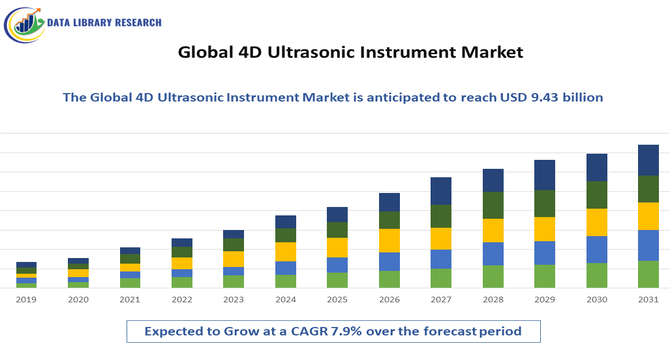
The Global 4D Ultrasonic Instrument Market size accounted for USD 3.07 billion in 2025 and is predicted to surpass around USD 9.43 billion by 2032 growing with a CAGR of 7.9% from 2025-2032.

The Global 4D Ultrasonic Instrument Market refers to the industry focused on developing, manufacturing, and distributing advanced ultrasound systems that provide real-time 3D imaging with temporal (4D) visualization for medical diagnostics. The Global 4D Ultrasonic Instrument Market is experiencing robust growth, primarily driven by the rising demand for advanced diagnostic imaging technologies in healthcare. The increasing prevalence of chronic diseases, high-risk pregnancies, and the growing need for early and accurate detection of fetal and cardiac abnormalities are key factors fueling market expansion. Technological advancements, such as real-time 4D imaging and enhanced image resolution, have significantly improved diagnostic accuracy, encouraging healthcare providers to adopt these instruments. Additionally, the rising awareness of maternal and fetal health, coupled with increasing investments in healthcare infrastructure, particularly in emerging economies, is further propelling market growth.

4D Ultrasonic Instrument Market Latest Trends

The global 4D ultrasound instrument market is witnessing transformative trends in 2025, driven by significant technological advancements and evolving clinical demands. Artificial Intelligence (AI) integration is at the forefront, enhancing diagnostic accuracy through automated image interpretation, real-time guidance, and predictive analytics, thereby streamlining workflows and reducing human error. Furthermore, the application of 4D ultrasound is expanding beyond obstetrics to include cardiology, oncology, and neurology, with innovations like High-Intensity Focused Ultrasound (HIFU) enabling non-invasive treatments for conditions such as uterine fibroids and pancreatic tumors. Collectively, these trends are reshaping the landscape of diagnostic imaging, making it more accessible, efficient, and precise.

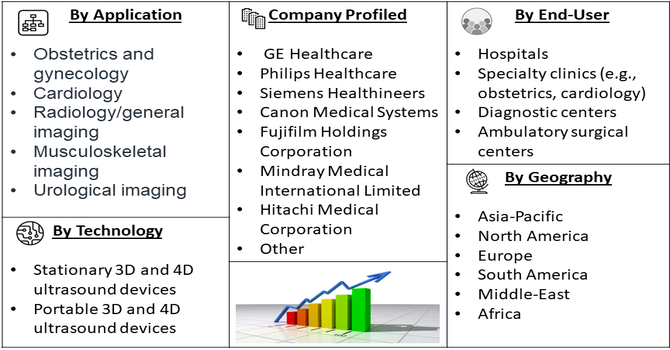
Segmentation: Global 4D Ultrasonic Instrument Market is segmented By Technology (Stationary 3D and 4D ultrasound devices, Portable 3D and 4D ultrasound devices), Portability (Trolley or cart-based ultrasound systems, Compact/handheld ultrasound systems, Point-of-care (PoC) ultrasound systems), Application(Obstetrics and gynecology, Cardiology, Radiology/general imaging, Musculoskeletal imaging, Urological imaging), End-User (Hospitals, Specialty clinics (e.g., obstetrics, cardiology), Diagnostic centers, Ambulatory surgical centers), and Geography (North America, Europe, Asia-Pacific, Middle East and Africa, and South America). The report provides the value (in USD million) for the above segments.
Market Drivers:

  • Rising Demand for Advanced Diagnostic Imaging in Healthcare

The growing prevalence of chronic diseases, high-risk pregnancies, and cardiovascular disorders has significantly increased the demand for precise and non-invasive diagnostic tools. For instance, in 2024, the CDC reported that approximately 805,000 people in the United States experienced a heart attack each year. Of these, 605,000 were first-time heart attacks, while 200,000 occurred in individuals who had previously suffered a heart attack. 4D ultrasonic instruments provide real-time, high-resolution imaging, enabling healthcare professionals to monitor fetal development, detect congenital abnormalities, and assess cardiac function more accurately. Unlike traditional 2D or 3D ultrasound systems, 4D ultrasonography allows dynamic visualization, offering a comprehensive view of organ structures and movement, which improves diagnostic confidence. This demand is further fueled by hospitals and diagnostic centers aiming to enhance patient outcomes, reduce misdiagnosis, and adopt state-of-the-art imaging technologies.

  • Technological Advancements and Integration with AI and Portable Systems

Rapid technological innovations are a major driver in the 4D ultrasonic instrument market. The integration of artificial intelligence (AI) and machine learning algorithms allows for automated image analysis, anomaly detection, and workflow optimization, reducing human error and increasing efficiency. Furthermore, advancements in miniaturization have led to portable and handheld 4D ultrasound devices, expanding access to point-of-care diagnostics in remote areas, emergency care, and home healthcare. For instance, in February 2025, PIUR IMAGING, a global player in tomographic 3D ultrasound technology, received FDA clearance for PIUR tUS inside, integrated with select GE HealthCare LOGIQ ultrasound systems. This approval enabled U.S. healthcare providers to enhance imaging workflows and utilize advanced AI-supported 3D imaging capabilities. These innovations not only improve image quality and diagnostic speed but also support early detection and timely intervention, making 4D ultrasonic instruments more attractive to healthcare providers globally.

Market Restraints:

  • High Initial and Operational Costs

Advanced 4D ultrasound systems come with significant capital expenditures, often exceeding USD 100,000. This high cost includes not only the purchase price but also ongoing maintenance, software updates, and specialized training for operators. Such financial burdens can deter smaller clinics, hospitals in emerging markets, and point-of-care facilities from adopting these technologies. Moreover, the cost-intensive nature of advanced 4D ultrasound systems can limit accessibility and slow market penetration in price-sensitive regions. Even with high diagnostic value, smaller healthcare providers may prioritize more affordable imaging alternatives, delaying widespread adoption. This has prompted manufacturers to explore leasing models, modular systems, and portable solutions to reduce upfront expenses and expand reach, ultimately supporting broader utilization of 4D ultrasound technology in both developed and emerging healthcare markets.

Socio economic Impact on 4D Ultrasonic Instrument Market

The Global 4D Ultrasound Technology Market has had significant socioeconomic impacts by enhancing diagnostic capabilities and improving patient care across multiple medical disciplines, including cardiology, obstetrics, and critical care. By providing real-time, high-resolution imaging, 4D ultrasound has enabled earlier detection of complex conditions, reducing hospitalizations, treatment costs, and long-term healthcare burdens. The technology has also stimulated employment and skill development in healthcare and biomedical engineering sectors, fostering innovation and high-tech workforce growth. However, high capital costs and maintenance requirements have limited adoption in smaller clinics and emerging markets, highlighting disparities in access. Overall, 4D ultrasound technology has strengthened healthcare quality, promoted medical education, and driven economic growth within the global medical imaging industry.

Segmental Analysis:

  • Portable 3D and 4D Ultrasound Devices segment is expected to witness highest growth over the forecast period

Portable 3D and 4D ultrasound devices are witnessing significant adoption due to their compact design, ease of transportation, and ability to deliver real-time imaging comparable to stationary systems. These devices are particularly favored in emergency care, outpatient facilities, and remote healthcare settings where space and mobility are critical. The growing preference for bedside diagnostics, coupled with technological advancements like AI-assisted imaging and wireless connectivity, enhances their utility. This segment is expected to show strong growth as hospitals and clinics seek flexible imaging solutions that reduce patient movement and streamline workflow.

  • Point-of-Care (PoC) Ultrasound Systems segment is expected to witness highest growth over the forecast period

Point-of-care ultrasound systems allow healthcare professionals to perform imaging at the patient’s bedside, enabling immediate diagnosis and treatment decisions. These systems are increasingly used in critical care units, emergency rooms, and home healthcare services. Their rapid deployment, combined with user-friendly interfaces and high-resolution imaging, makes them indispensable for quick assessments of cardiac function, obstetric monitoring, and trauma evaluation. The growing demand for decentralized and patient-centric care is driving the expansion of this segment globally.

  • Obstetrics and Gynecology segment is expected to witness highest growth over the forecast period

The obstetrics and gynecology segment dominates the application spectrum for 4D ultrasonic instruments. These devices provide real-time visualization of the fetus, helping monitor growth, detect congenital anomalies, and assess maternal-fetal health accurately. The high adoption rate is driven by increasing awareness of maternal health, rising prenatal care standards, and the ability of 4D ultrasound to offer detailed imaging for fetal heart rate, facial features, and movement. The segment is expected to grow steadily as more healthcare providers integrate advanced imaging in routine prenatal care.

  • Hospitals segment is expected to witness highest growth over the forecast period

Hospitals are the largest end-users of 4D ultrasonic instruments due to their high patient volumes and diverse diagnostic needs. Large-scale hospitals invest in advanced imaging systems to provide comprehensive diagnostic services across multiple departments, including obstetrics, cardiology, and radiology. The demand is further driven by the need for precise diagnostics, high throughput, and integration with hospital information systems (HIS). Hospitals in emerging economies are also expanding infrastructure, creating a growing market for 4D ultrasound systems.

  • North America region is expected to witness highest growth over the forecast period

North America is a leading market for 4D ultrasonic instruments, driven by advanced healthcare infrastructure, high healthcare expenditure, and early adoption of innovative medical technologies. The presence of major market players, widespread awareness of maternal and cardiac health, and reimbursement support for advanced imaging procedures contribute to strong regional growth.

The United States, in particular, is a key contributor due to high adoption rates in hospitals and diagnostic centers, supported by continuous technological innovation and regulatory support. For instance, in 2021, CAE Healthcare launched CAE Vimedix 3.2, an advanced simulation software offering enhanced fidelity, ultrasonography realism, 3D/4D ultrasound, and multiplanar reconstruction (MPR) across its platform. The system enabled remote ultrasound training in cardiology, emergency medicine, ICU, and Ob/Gyn, featuring a library of over 200 pathologies. It supported virtual lectures, lesson-building, ICCU e-learning, and hands-on practice with manikins and probes, including transgastric abdominal ultrasonography exercises. The launch aimed to improve cognitive and psychomotor skills, ensuring medical students and professionals achieved clinical preparedness and patient safety in critical care scenarios. Thus, such developments are fueling the growth of the studied market in this region.

4D Ultrasonic Instrument Market Competitive Landscape

The global 4D ultrasonic instrument market is characterized by a competitive landscape featuring a mix of established multinational corporations and specialized regional players. These companies are actively engaged in product innovation, strategic partnerships, and expanding their market presence to cater to the growing demand for advanced imaging solutions in healthcare. Key players are focusing on integrating artificial intelligence, enhancing image quality, and developing portable systems to meet diverse clinical needs across various applications, including obstetrics, cardiology, and musculoskeletal imaging.

Key Players:

  • GE Healthcare
  • Philips Healthcare
  • Siemens Healthineers
  • Canon Medical Systems
  • Fujifilm Holdings Corporation
  • Mindray Medical International Limited
  • Hitachi Medical Corporation
  • Esaote S.p.A.
  • Konica Minolta Healthcare
  • Samsung Medison
  • Shenzhen Mindray Bio-Medical Electronics Co., Ltd.
  • Alpinion Medical Systems Co., Ltd.
  • Analogic Corporation
  • Shimadzu Corporation
  • Toshiba Corporation
  • Hologic, Inc.
  • Carestream Health
  • Delphinus Medical Technologies, Inc.
  • CHISON MEDICAL TECHNOLOGIES CO., LTD
  • SonaCare Medical

Recent Development

  • In August 2025, GE HealthCare (Nasdaq: GEHC) launched the Vivid Pioneer, an advanced cardiovascular ultrasound system with 2D, 4D, and color flow imaging, receiving CE Mark and U.S. FDA 510(k) clearance. With CVDs as the leading global cause of death, early detection remained critical. The launch boosted demand for 4D ultrasound systems, accelerated high-resolution imaging adoption, and spurred innovation and competition, strengthening growth in the Global 4D Ultrasonic Instrument Market.


  • In August 2024, Siemens Healthineers received FDA clearance for the ACUSON Origin, a cardiovascular ultrasound system enhanced with AI-powered features to improve efficiency in diagnostics, structural heart disease, and electrophysiology procedures. Exclusively with this system, the AcuNav Lumos 4D ICE catheter provided advanced intracardiac imaging for complex cardiac interventions. The launch boosted adoption of AI-enabled 4D ultrasound systems, enhanced precision in cardiovascular diagnostics, and drove innovation and competition among manufacturers, contributing to the growth of the Global 4D Ultrasonic Instrument Market.


Frequently Asked Questions (FAQ) :

Q1. What are the main growth driving factors for this market?

The market is mainly driven by the growing demand for advanced diagnostic imaging, especially for applications like fetal, cardiac, and abdominal scans. Key factors include continuous technological advancements leading to more portable and user-friendly devices, an aging global population requiring more sophisticated diagnostic tools, and increasing emphasis on preventative healthcare and early disease detection. The superior, real-time visualization of 4D ultrasound allows for more accurate diagnoses, bolstering adoption in various medical settings.

Q2. What are the main restraining factors for this market?

The primary constraints are the high initial cost of purchasing and maintaining advanced 4D ultrasonic instruments. This financial burden is particularly challenging for smaller healthcare facilities and providers in developing regions. Additionally, the need for specialized training for medical professionals to effectively operate and utilize the complex 4D systems acts as another barrier to widespread adoption and market penetration.

Q3. Which segment is expected to witness high growth?

The "Portable 4D Ultrasonic Instrument" segment is anticipated to witness significant growth. This is due to the rising trend of point-of-care diagnostics, which requires compact and easily movable systems. The demand for improved accessibility in remote or underserved areas, coupled with technological advancements leading to miniaturization and enhanced functionality, drives the high growth of portable and handheld devices.

Q4. Who are the top major players for this market?

The global market for 4D ultrasonic instruments is dominated by a few key multinational healthcare technology companies. The top major players include industry giants like GE HealthCare, Koninklijke Philips N.V. (Philips Healthcare), and Siemens Healthineers. Other significant players are FUJIFILM Corporation and Canon Medical Systems Corporation, all known for their advanced product portfolios and extensive R&D.

Q5. Which country is the largest player?

Based on market share and adoption of advanced systems, the North American region, with the United States as a major contributor, currently holds the largest share of the 4D ultrasonic instrument market. This dominance is primarily driven by high healthcare expenditure, established advanced healthcare infrastructure, and the early adoption of new, sophisticated imaging technologies.

4D Ultrasonic Instrument MARKET STUDY GLOBAL MARKET ANALYSIS, INSIGHTS AND FORECAST, 2022-2029

    1. Introduction

    • 1.1. Research Scope
    • 1.2. Market Segmentation
    • 1.3. Research Methodology
    • 1.4. Definitions and Assumptions

    2. Executive Summary

      3. Market Dynamics

      • 3.1. Market Drivers
      • 3.2. Market Restraints
      • 3.3. Market Opportunities

      4. Key Insights

      • 4.1. Key Emerging Trends – For Major Countries
      • 4.2. Latest Technological Advancement
      • 4.3. Regulatory Landscape
      • 4.4. Industry SWOT Analysis
      • 4.5. Porters Five Forces Analysis

      5. Global 4D Ultrasonic Instrument Market Analysis (USD Billion), Insights and Forecast, 2018-2029

      • 5.1. Key Findings / Summary
      • 5.2. Market Analysis, Insights and Forecast – By Segment 1
        • 5.2.1. Sub-Segment 1
        • 5.2.2. Sub-Segment 2
      • 5.3. Market Analysis, Insights and Forecast – By Segment 2
        • 5.3.1. Sub-Segment 1
        • 5.3.2. Sub-Segment 2
        • 5.3.3. Sub-Segment 3
        • 5.3.4. Others
      • 5.4. Market Analysis, Insights and Forecast – By Segment 3
        • 5.4.1. Sub-Segment 1
        • 5.4.2. Sub-Segment 2
        • 5.4.3. Sub-Segment 3
        • 5.4.4. Others
      • 5.5. Market Analysis, Insights and Forecast – By Region
        • 5.5.1. North America
        • 5.5.2. Latin America
        • 5.5.3. Europe
        • 5.5.4. Asia Pacific
        • 5.5.5. Middle East and Africa

      6. North America 4D Ultrasonic Instrument Market Analysis (USD Billion), Insights and Forecast, 2018-2029

      • 6.1. Key Findings / Summary
      • 6.2. Market Analysis, Insights and Forecast – By Segment 1
        • 6.2.1. Sub-Segment 1
        • 6.2.2. Sub-Segment 2
      • 6.3. Market Analysis, Insights and Forecast – By Segment 2
        • 6.3.1. Sub-Segment 1
        • 6.3.2. Sub-Segment 2
        • 6.3.3. Sub-Segment 3
        • 6.3.4. Others
      • 6.4. Market Analysis, Insights and Forecast – By Segment 3
        • 6.4.1. Sub-Segment 1
        • 6.4.2. Sub-Segment 2
        • 6.4.3. Sub-Segment 3
        • 6.4.4. Others
      • 6.5. Market Analysis, Insights and Forecast – By Country
        • 6.5.1. U.S.
        • 6.5.2. Canada

      7. Latin America 4D Ultrasonic Instrument Market Analysis (USD Billion), Insights and Forecast, 2018-2029

      • 7.1. Key Findings / Summary
      • 7.2. Market Analysis, Insights and Forecast – By Segment 1
        • 7.2.1. Sub-Segment 1
        • 7.2.2. Sub-Segment 2
      • 7.3. Market Analysis, Insights and Forecast – By Segment 2
        • 7.3.1. Sub-Segment 1
        • 7.3.2. Sub-Segment 2
        • 7.3.3. Sub-Segment 3
        • 7.3.4. Others
      • 7.4. Market Analysis, Insights and Forecast – By Segment 3
        • 7.4.1. Sub-Segment 1
        • 7.4.2. Sub-Segment 2
        • 7.4.3. Sub-Segment 3
        • 7.4.4. Others
      • 7.5. Insights and Forecast – By Country
        • 7.5.1. Brazil
        • 7.5.2. Mexico
        • 7.5.3. Rest of Latin America

      8. Europe 4D Ultrasonic Instrument Market Analysis (USD Billion), Insights and Forecast, 2018-2029

      • 8.1. Key Findings / Summary
      • 8.2. Market Analysis, Insights and Forecast – By Segment 1
        • 8.2.1. Sub-Segment 1
        • 8.2.2. Sub-Segment 2
      • 8.3. Market Analysis, Insights and Forecast – By Segment 2
        • 8.3.1. Sub-Segment 1
        • 8.3.2. Sub-Segment 2
        • 8.3.3. Sub-Segment 3
        • 8.3.4. Others
      • 8.4. Market Analysis, Insights and Forecast – By Segment 3
        • 8.4.1. Sub-Segment 1
        • 8.4.2. Sub-Segment 2
        • 8.4.3. Sub-Segment 3
        • 8.4.4. Others
      • 8.5. Market Analysis, Insights and Forecast – By Country
        • 8.5.1. UK
        • 8.5.2. Germany
        • 8.5.3. France
        • 8.5.4. Italy
        • 8.5.5. Spain
        • 8.5.6. Russia
        • 8.5.7. Rest of Europe

      9. Asia Pacific 4D Ultrasonic Instrument Market Analysis (USD Billion), Insights and Forecast, 2018-2029

      • 9.1. Key Findings / Summary
      • 9.2. Market Analysis, Insights and Forecast – By Segment 1
        • 9.2.1. Sub-Segment 1
        • 9.2.2. Sub-Segment 2
      • 9.3. Market Analysis, Insights and Forecast – By Segment 2
        • 9.3.1. Sub-Segment 1
        • 9.3.2. Sub-Segment 2
        • 9.3.3. Sub-Segment 3
        • 9.3.4. Others
      • 9.4. Market Analysis, Insights and Forecast – By Segment 3
        • 9.4.1. Sub-Segment 1
        • 9.4.2. Sub-Segment 2
        • 9.4.3. Sub-Segment 3
        • 9.4.4. Others
      • 9.5. Market Analysis, Insights and Forecast – By Country
        • 9.5.1. China
        • 9.5.2. India
        • 9.5.3. Japan
        • 9.5.4. Australia
        • 9.5.5. South East Asia
        • 9.5.6. Rest of Asia Pacific

      10. Middle East & Africa 4D Ultrasonic Instrument Market Analysis (USD Billion), Insights and Forecast, 2018-2029

      • 10.1. Key Findings / Summary
      • 10.2. Market Analysis, Insights and Forecast – By Segment 1
        • 10.2.1. Sub-Segment 1
        • 10.2.2. Sub-Segment 2
      • 10.3. Market Analysis, Insights and Forecast – By Segment 2
        • 10.3.1. Sub-Segment 1
        • 10.3.2. Sub-Segment 2
        • 10.3.3. Sub-Segment 3
        • 10.3.4. Others
      • 10.4. Market Analysis, Insights and Forecast – By Segment 3
        • 10.4.1. Sub-Segment 1
        • 10.4.2. Sub-Segment 2
        • 10.4.3. Sub-Segment 3
        • 10.4.4. Others
      • 10.5. Market Analysis, Insights and Forecast – By Country
        • 10.5.1. GCC
        • 10.5.2. South Africa
        • 10.5.3. Rest of Middle East & Africa

      11. Competitive Analysis

      • 11.1. Company Market Share Analysis, 2018
      • 11.2. Key Industry Developments
      • 11.3. Company Profile
        • 11.3.1. Company 1
          • 11.3.1.1. Business Overview
          • 11.3.1.2. Segment 1 & Service Offering
          • 11.3.1.3. Overall Revenue
          • 11.3.1.4. Geographic Presence
          • 11.3.1.5. Recent Development
        *Similar details will be provided for the following companies
        • 11.3.2. Company 2
        • 11.3.3. Company 3
        • 11.3.4. Company 4
        • 11.3.5. Company 5
        • 11.3.6. Company 6
        • 11.3.7. Company 7
        • 11.3.8. Company 8
        • 11.3.9. Company 9
        • 11.3.10. Company 10
        • 11.3.11. Company 11
        • 11.3.12. Company 12
      List of Figures

      Figure 1: Global 4D Ultrasonic Instrument Market Revenue Breakdown (USD Billion, %) by Region, 2022 & 2029
      Figure 2: Global 4D Ultrasonic Instrument Market Value Share (%), By Segment 1, 2022 & 2029
      Figure 3: Global 4D Ultrasonic Instrument Market Forecast (USD Billion), by Sub-Segment 1, 2018-2029
      Figure 4: Global 4D Ultrasonic Instrument Market Forecast (USD Billion), by Sub-Segment 2, 2018-2029
      Figure 5: Global 4D Ultrasonic Instrument Market Value Share (%), By Segment 2, 2022 & 2029
      Figure 6: Global 4D Ultrasonic Instrument Market Forecast (USD Billion), by Sub-Segment 1, 2018-2029
      Figure 7: Global 4D Ultrasonic Instrument Market Forecast (USD Billion), by Sub-Segment 2, 2018-2029
      Figure 8: Global 4D Ultrasonic Instrument Market Forecast (USD Billion), by Sub-Segment 3, 2018-2029
      Figure 9: Global 4D Ultrasonic Instrument Market Forecast (USD Billion), by Others, 2018-2029
      Figure 10: Global 4D Ultrasonic Instrument Market Value Share (%), By Segment 3, 2022 & 2029
      Figure 11: Global 4D Ultrasonic Instrument Market Forecast (USD Billion), by Sub-Segment 1, 2018-2029
      Figure 12: Global 4D Ultrasonic Instrument Market Forecast (USD Billion), by Sub-Segment 2, 2018-2029
      Figure 13: Global 4D Ultrasonic Instrument Market Forecast (USD Billion), by Sub-Segment 3, 2018-2029
      Figure 14: Global 4D Ultrasonic Instrument Market Forecast (USD Billion), by Others, 2018-2029
      Figure 15: Global 4D Ultrasonic Instrument Market Value (USD Billion), by Region, 2022 & 2029
      Figure 16: North America 4D Ultrasonic Instrument Market Value Share (%), By Segment 1, 2022 & 2029
      Figure 17: North America 4D Ultrasonic Instrument Market Forecast (USD Billion), by Sub-Segment 1, 2018-2029
      Figure 18: North America 4D Ultrasonic Instrument Market Forecast (USD Billion), by Sub-Segment 2, 2018-2029
      Figure 19: North America 4D Ultrasonic Instrument Market Value Share (%), By Segment 2, 2022 & 2029
      Figure 20: North America 4D Ultrasonic Instrument Market Forecast (USD Billion), by Sub-Segment 1, 2018-2029
      Figure 21: North America 4D Ultrasonic Instrument Market Forecast (USD Billion), by Sub-Segment 2, 2018-2029
      Figure 22: North America 4D Ultrasonic Instrument Market Forecast (USD Billion), by Sub-Segment 3, 2018-2029
      Figure 23: North America 4D Ultrasonic Instrument Market Forecast (USD Billion), by Others, 2018-2029
      Figure 24: North America 4D Ultrasonic Instrument Market Value Share (%), By Segment 3, 2022 & 2029
      Figure 25: North America 4D Ultrasonic Instrument Market Forecast (USD Billion), by Sub-Segment 1, 2018-2029
      Figure 26: North America 4D Ultrasonic Instrument Market Forecast (USD Billion), by Sub-Segment 2, 2018-2029
      Figure 27: North America 4D Ultrasonic Instrument Market Forecast (USD Billion), by Sub-Segment 3, 2018-2029
      Figure 28: North America 4D Ultrasonic Instrument Market Forecast (USD Billion), by Others, 2018-2029
      Figure 29: North America 4D Ultrasonic Instrument Market Forecast (USD Billion), by U.S., 2018-2029
      Figure 30: North America 4D Ultrasonic Instrument Market Forecast (USD Billion), by Canada, 2018-2029
      Figure 31: Latin America 4D Ultrasonic Instrument Market Value Share (%), By Segment 1, 2022 & 2029
      Figure 32: Latin America 4D Ultrasonic Instrument Market Forecast (USD Billion), by Sub-Segment 1, 2018-2029
      Figure 33: Latin America 4D Ultrasonic Instrument Market Forecast (USD Billion), by Sub-Segment 2, 2018-2029
      Figure 34: Latin America 4D Ultrasonic Instrument Market Value Share (%), By Segment 2, 2022 & 2029
      Figure 35: Latin America 4D Ultrasonic Instrument Market Forecast (USD Billion), by Sub-Segment 1, 2018-2029
      Figure 36: Latin America 4D Ultrasonic Instrument Market Forecast (USD Billion), by Sub-Segment 2, 2018-2029
      Figure 37: Latin America 4D Ultrasonic Instrument Market Forecast (USD Billion), by Sub-Segment 3, 2018-2029
      Figure 38: Latin America 4D Ultrasonic Instrument Market Forecast (USD Billion), by Others, 2018-2029
      Figure 39: Latin America 4D Ultrasonic Instrument Market Value Share (%), By Segment 3, 2022 & 2029
      Figure 40: Latin America 4D Ultrasonic Instrument Market Forecast (USD Billion), by Sub-Segment 1, 2018-2029
      Figure 41: Latin America 4D Ultrasonic Instrument Market Forecast (USD Billion), by Sub-Segment 2, 2018-2029
      Figure 42: Latin America 4D Ultrasonic Instrument Market Forecast (USD Billion), by Sub-Segment 3, 2018-2029
      Figure 43: Latin America 4D Ultrasonic Instrument Market Forecast (USD Billion), by Others, 2018-2029
      Figure 44: Latin America 4D Ultrasonic Instrument Market Forecast (USD Billion), by Brazil, 2018-2029
      Figure 45: Latin America 4D Ultrasonic Instrument Market Forecast (USD Billion), by Mexico, 2018-2029
      Figure 46: Latin America 4D Ultrasonic Instrument Market Forecast (USD Billion), by Rest of Latin America, 2018-2029
      Figure 47: Europe 4D Ultrasonic Instrument Market Value Share (%), By Segment 1, 2022 & 2029
      Figure 48: Europe 4D Ultrasonic Instrument Market Forecast (USD Billion), by Sub-Segment 1, 2018-2029
      Figure 49: Europe 4D Ultrasonic Instrument Market Forecast (USD Billion), by Sub-Segment 2, 2018-2029
      Figure 50: Europe 4D Ultrasonic Instrument Market Value Share (%), By Segment 2, 2022 & 2029
      Figure 51: Europe 4D Ultrasonic Instrument Market Forecast (USD Billion), by Sub-Segment 1, 2018-2029
      Figure 52: Europe 4D Ultrasonic Instrument Market Forecast (USD Billion), by Sub-Segment 2, 2018-2029
      Figure 53: Europe 4D Ultrasonic Instrument Market Forecast (USD Billion), by Sub-Segment 3, 2018-2029
      Figure 54: Europe 4D Ultrasonic Instrument Market Forecast (USD Billion), by Others, 2018-2029
      Figure 55: Europe 4D Ultrasonic Instrument Market Value Share (%), By Segment 3, 2022 & 2029
      Figure 56: Europe 4D Ultrasonic Instrument Market Forecast (USD Billion), by Sub-Segment 1, 2018-2029
      Figure 57: Europe 4D Ultrasonic Instrument Market Forecast (USD Billion), by Sub-Segment 2, 2018-2029
      Figure 58: Europe 4D Ultrasonic Instrument Market Forecast (USD Billion), by Sub-Segment 3, 2018-2029
      Figure 59: Europe 4D Ultrasonic Instrument Market Forecast (USD Billion), by Others, 2018-2029
      Figure 60: Europe 4D Ultrasonic Instrument Market Forecast (USD Billion), by U.K., 2018-2029
      Figure 61: Europe 4D Ultrasonic Instrument Market Forecast (USD Billion), by Germany, 2018-2029
      Figure 62: Europe 4D Ultrasonic Instrument Market Forecast (USD Billion), by France, 2018-2029
      Figure 63: Europe 4D Ultrasonic Instrument Market Forecast (USD Billion), by Italy, 2018-2029
      Figure 64: Europe 4D Ultrasonic Instrument Market Forecast (USD Billion), by Spain, 2018-2029
      Figure 65: Europe 4D Ultrasonic Instrument Market Forecast (USD Billion), by Russia, 2018-2029
      Figure 66: Europe 4D Ultrasonic Instrument Market Forecast (USD Billion), by Rest of Europe, 2018-2029
      Figure 67: Asia Pacific 4D Ultrasonic Instrument Market Value Share (%), By Segment 1, 2022 & 2029
      Figure 68: Asia Pacific 4D Ultrasonic Instrument Market Forecast (USD Billion), by Sub-Segment 1, 2018-2029
      Figure 69: Asia Pacific 4D Ultrasonic Instrument Market Forecast (USD Billion), by Sub-Segment 2, 2018-2029
      Figure 70: Asia Pacific 4D Ultrasonic Instrument Market Value Share (%), By Segment 2, 2022 & 2029
      Figure 71: Asia Pacific 4D Ultrasonic Instrument Market Forecast (USD Billion), by Sub-Segment 1, 2018-2029
      Figure 72: Asia Pacific 4D Ultrasonic Instrument Market Forecast (USD Billion), by Sub-Segment 2, 2018-2029
      Figure 73: Asia Pacific 4D Ultrasonic Instrument Market Forecast (USD Billion), by Sub-Segment 3, 2018-2029
      Figure 74: Asia Pacific 4D Ultrasonic Instrument Market Forecast (USD Billion), by Others, 2018-2029
      Figure 75: Asia Pacific 4D Ultrasonic Instrument Market Value Share (%), By Segment 3, 2022 & 2029
      Figure 76: Asia Pacific 4D Ultrasonic Instrument Market Forecast (USD Billion), by Sub-Segment 1, 2018-2029
      Figure 77: Asia Pacific 4D Ultrasonic Instrument Market Forecast (USD Billion), by Sub-Segment 2, 2018-2029
      Figure 78: Asia Pacific 4D Ultrasonic Instrument Market Forecast (USD Billion), by Sub-Segment 3, 2018-2029
      Figure 79: Asia Pacific 4D Ultrasonic Instrument Market Forecast (USD Billion), by Others, 2018-2029
      Figure 80: Asia Pacific 4D Ultrasonic Instrument Market Forecast (USD Billion), by China, 2018-2029
      Figure 81: Asia Pacific 4D Ultrasonic Instrument Market Forecast (USD Billion), by India, 2018-2029
      Figure 82: Asia Pacific 4D Ultrasonic Instrument Market Forecast (USD Billion), by Japan, 2018-2029
      Figure 83: Asia Pacific 4D Ultrasonic Instrument Market Forecast (USD Billion), by Australia, 2018-2029
      Figure 84: Asia Pacific 4D Ultrasonic Instrument Market Forecast (USD Billion), by Southeast Asia, 2018-2029
      Figure 85: Asia Pacific 4D Ultrasonic Instrument Market Forecast (USD Billion), by Rest of Asia Pacific, 2018-2029
      Figure 86: Middle East & Africa 4D Ultrasonic Instrument Market Value Share (%), By Segment 1, 2022 & 2029
      Figure 87: Middle East & Africa 4D Ultrasonic Instrument Market Forecast (USD Billion), by Sub-Segment 1, 2018-2029
      Figure 88: Middle East & Africa 4D Ultrasonic Instrument Market Forecast (USD Billion), by Sub-Segment 2, 2018-2029
      Figure 89: Middle East & Africa 4D Ultrasonic Instrument Market Value Share (%), By Segment 2, 2022 & 2029
      Figure 90: Middle East & Africa 4D Ultrasonic Instrument Market Forecast (USD Billion), by Sub-Segment 1, 2018-2029
      Figure 91: Middle East & Africa 4D Ultrasonic Instrument Market Forecast (USD Billion), by Sub-Segment 2, 2018-2029
      Figure 92: Middle East & Africa 4D Ultrasonic Instrument Market Forecast (USD Billion), by Sub-Segment 3, 2018-2029
      Figure 93: Middle East & Africa 4D Ultrasonic Instrument Market Forecast (USD Billion), by Others, 2018-2029
      Figure 94: Middle East & Africa 4D Ultrasonic Instrument Market Value Share (%), By Segment 3, 2022 & 2029
      Figure 95: Middle East & Africa 4D Ultrasonic Instrument Market Forecast (USD Billion), by Sub-Segment 1, 2018-2029
      Figure 96: Middle East & Africa 4D Ultrasonic Instrument Market Forecast (USD Billion), by Sub-Segment 2, 2018-2029
      Figure 97: Middle East & Africa 4D Ultrasonic Instrument Market Forecast (USD Billion), by Sub-Segment 3, 2018-2029
      Figure 98: Middle East & Africa 4D Ultrasonic Instrument Market Forecast (USD Billion), by Others, 2018-2029
      Figure 99: Middle East & Africa 4D Ultrasonic Instrument Market Forecast (USD Billion), by GCC, 2018-2029
      Figure 100: Middle East & Africa 4D Ultrasonic Instrument Market Forecast (USD Billion), by South Africa, 2018-2029
      Figure 101: Middle East & Africa 4D Ultrasonic Instrument Market Forecast (USD Billion), by Rest of Middle East & Africa, 2018-2029 
      List of Tables
      Table 1: Global 4D Ultrasonic Instrument Market Revenue (USD Billion) Forecast, by Segment 1, 2018-2029
      Table 2: Global 4D Ultrasonic Instrument Market Revenue (USD Billion) Forecast, by Segment 2, 2018-2029
      Table 3: Global 4D Ultrasonic Instrument Market Revenue (USD Billion) Forecast, by Segment 3, 2018-2029
      Table 4: Global 4D Ultrasonic Instrument Market Revenue (USD Billion) Forecast, by Region, 2018-2029
      Table 5: North America 4D Ultrasonic Instrument Market Revenue (USD Billion) Forecast, by Segment 1, 2018-2029
      Table 6: North America 4D Ultrasonic Instrument Market Revenue (USD Billion) Forecast, by Segment 2, 2018-2029
      Table 7: North America 4D Ultrasonic Instrument Market Revenue (USD Billion) Forecast, by Segment 3, 2018-2029
      Table 8: North America 4D Ultrasonic Instrument Market Revenue (USD Billion) Forecast, by Country, 2018-2029
      Table 9: Europe 4D Ultrasonic Instrument Market Revenue (USD Billion) Forecast, by Segment 1, 2018-2029
      Table 10: Europe 4D Ultrasonic Instrument Market Revenue (USD Billion) Forecast, by Segment 2, 2018-2029
      Table 11: Europe 4D Ultrasonic Instrument Market Revenue (USD Billion) Forecast, by Segment 3, 2018-2029
      Table 12: Europe 4D Ultrasonic Instrument Market Revenue (USD Billion) Forecast, by Country, 2018-2029
      Table 13: Latin America 4D Ultrasonic Instrument Market Revenue (USD Billion) Forecast, by Segment 1, 2018-2029
      Table 14: Latin America 4D Ultrasonic Instrument Market Revenue (USD Billion) Forecast, by Segment 2, 2018-2029
      Table 15: Latin America 4D Ultrasonic Instrument Market Revenue (USD Billion) Forecast, by Segment 3, 2018-2029
      Table 16: Latin America 4D Ultrasonic Instrument Market Revenue (USD Billion) Forecast, by Country, 2018-2029
      Table 17: Asia Pacific 4D Ultrasonic Instrument Market Revenue (USD Billion) Forecast, by Segment 1, 2018-2029
      Table 18: Asia Pacific 4D Ultrasonic Instrument Market Revenue (USD Billion) Forecast, by Segment 2, 2018-2029
      Table 19: Asia Pacific 4D Ultrasonic Instrument Market Revenue (USD Billion) Forecast, by Segment 3, 2018-2029
      Table 20: Asia Pacific 4D Ultrasonic Instrument Market Revenue (USD Billion) Forecast, by Country, 2018-2029
      Table 21: Middle East & Africa 4D Ultrasonic Instrument Market Revenue (USD Billion) Forecast, by Segment 1, 2018-2029
      Table 22: Middle East & Africa 4D Ultrasonic Instrument Market Revenue (USD Billion) Forecast, by Segment 2, 2018-2029
      Table 23: Middle East & Africa 4D Ultrasonic Instrument Market Revenue (USD Billion) Forecast, by Segment 3, 2018-2029
      Table 24: Middle East & Africa 4D Ultrasonic Instrument Market Revenue (USD Billion) Forecast, by Country, 2018-2029
      Research Process

      Data Library Research are conducted by industry experts who offer insight on industry structure, market segmentations technology assessment and competitive landscape (CL), and penetration, as well as on emerging trends. Their analysis is based on primary interviews (~ 80%) and secondary research (~ 20%) as well as years of professional expertise in their respective industries. Adding to this, by analysing historical trends and current market positions, our analysts predict where the market will be headed for the next five years. Furthermore, the varying trends of segment & categories geographically presented are also studied and the estimated based on the primary & secondary research.

      In this particular report from the supply side Data Library Research has conducted primary surveys (interviews) with the key level executives (VP, CEO’s, Marketing Director, Business Development Manager and SOFT) of the companies that active & prominent as well as the midsized organization

      FIGURE 1: DLR RESEARH PROCESS

      research-methodology1

      Primary Research

      Extensive primary research was conducted to gain a deeper insight of the market and industry performance. The analysis is based on both primary and secondary research as well as years of professional expertise in the respective industries.

      In addition to analysing current and historical trends, our analysts predict where the market is headed over the next five years.

      It varies by segment for these categories geographically presented in the list of market tables. Speaking about this particular report we have conducted primary surveys (interviews) with the key level executives (VP, CEO’s, Marketing Director, Business Development Manager and many more) of the major players active in the market.

      Secondary Research

      Secondary research was mainly used to collect and identify information useful for the extensive, technical, market-oriented, and Friend’s study of the Global Extra Neutral Alcohol. It was also used to obtain key information about major players, market classification and segmentation according to the industry trends, geographical markets, and developments related to the market and technology perspectives. For this study, analysts have gathered information from various credible sources, such as annual reports, sec filings, journals, white papers, SOFT presentations, and company web sites.

      Market Size Estimation

      Both, top-down and bottom-up approaches were used to estimate and validate the size of the Global market and to estimate the size of various other dependent submarkets in the overall Extra Neutral Alcohol. The key players in the market were identified through secondary research and their market contributions in the respective geographies were determined through primary and secondary research.

      Forecast Model

      research-methodology2

      Happy to Assist You

      If you have a question?

      info@datalibraryresearch.com

      IND : +91 955 279 0357

      Browse Related Reports