
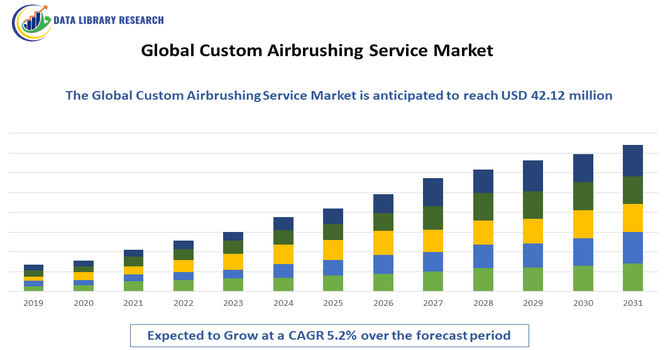
The Global Custom Airbrushing Service Market size is anticipated to be valued at USD 25.23 million in 2026, with a projected growth to USD 42.12 million by 2033, growing with a CAGR of 5.2% from 2026-2033.
Get Complete Analysis Of The Report - Download Updated Free Sample PDF
The Global Custom Airbrushing Service Market includes professional services that apply detailed, customized airbrushed artwork on products, surfaces, or media using specialized airbrush equipment and techniques. It spans applications such as automotive (cars, bikes), apparel, helmets, promotional merchandise, murals, cosmetic makeup, cake decorating, and fine art. These services are sought by consumers and businesses desiring unique, personalized visual aesthetics. Market activities involve consultation, design customization, paint selection, and technical airbrushing execution. Growth is driven by rising personalization trends, expanding creative industries, and demand for bespoke branding or aesthetic enhancement across commercial, recreational, and artistic use cases globally.
Key trends include rising consumer demand for personalization and bespoke design, driven by social media influence and individual expression. Custom airbrushing is expanding beyond automotive into fashion, home décor, and consumer electronics, reflecting broader creative applications. Integration of digital design tools, graphic tablets, and AI-assisted pattern creation enhances design precision and client interaction. Additionally, eco-friendly paints and coatings are gaining traction amid sustainability concerns. Live airbrushing at events and experiential marketing further fuels market visibility. The growth of e commerce has enabled artists and service providers to reach global audiences, offering online previews, virtual consultations, and remote design approvals.
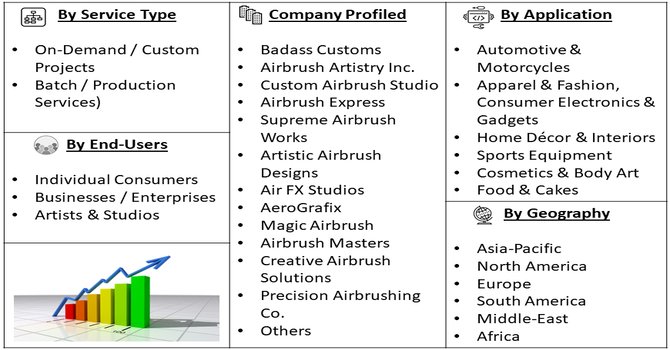
Segmentation: The Global Custom Airbrushing Service Market is segmented by Application (Automotive & Motorcycles, Apparel & Fashion, Consumer Electronics & Gadgets, Home Décor & Interiors, Sports Equipment, Cosmetics & Body Art and Food & Cakes), End-Use (Individual Consumers, Businesses / Enterprises and Artists & Studios), Service Type (On-Demand / Custom Projects and Batch / Production Services), and Geography (North America, Europe, Asia-Pacific, Middle East and Africa, and South America). The report provides the value (in USD million) for the above segments.
For Detailed Market Segmentation - Get a Free Sample PDF
Market Drivers:
A primary driver is the growing consumer preference for personalized and unique products. Individuals and businesses are increasingly seeking customization to differentiate their possessions—with airbrushing offering bespoke aesthetic expression. This trend is amplified by social media influence and rising disposable incomes in emerging markets. Personalized automotive graphics, custom apparel, and unique promotional items appeal to customers desiring distinct identities. Moreover, customization adds emotional and perceived economic value, encouraging repeat and premium service purchases. As brand experiences and individual storytelling become more important, demand for custom airbrushing services continues to increase across automotive, fashion, and lifestyle segments globally.
Another driver is the expansion of airbrushing into diverse application segments beyond traditional automotive use. Custom airbrushing is increasingly applied in fashion, interior décor, sporting goods, consumer electronics, cosmetics (makeup and body art), and event entertainment. This diversification broadens customer bases and revenue streams for service providers. Businesses use airbrushing for branding, packaging, and experiential marketing, while individuals seek artistic expression in apparel and accessories. Advances in airbrush technology and versatile paints enable high quality outcomes on varied substrates. The shift toward experiential retail and bespoke consumer experiences further incentivizes adoption, expanding market potential across multiple industries and demographics.
Market Restraints:
A key restraint is the significant skill and training required to deliver high quality custom airbrushing services. Mastery of techniques, color blending, and design execution demands substantial practice and artistic proficiency. This creates barriers to entry for new service providers and limits scalability for independent artists. Additionally, training and skill development require time and investment, while inconsistent service quality can deter clients. Dependence on individual artist reputation makes business growth challenging. The subjective nature of design preferences can result in revisions and increased costs. These factors restrict uniform service standards and make it difficult for small providers to compete with digitally automated customization solutions.
The market supports creative employment for artists, designers, and technicians, contributing to cultural and economic vibrancy in creative sectors. It enhances small business opportunities by enabling customization services for local retailers, automotive workshops, and event planners. Personalized airbrushing fosters consumer self expression and cultural diversity in design aesthetics. Additionally, it promotes craftsmanship education as skilled techniques remain integral despite digital design tools. Revenue generated supports allied industries like paints, airbrush equipment manufacturers, and art supply retailers. In tourism and events, live airbrushing attracts participants, boosting local engagement. The market also contributes to brand differentiation for businesses seeking unique promotional products.
Segmental Analysis:
The apparel and fashion segment is expected to witness the highest growth over the forecast period due to rising consumer demand for personalized and trendy clothing. Customized airbrushing allows individuals to express personal style on T-shirts, jackets, sneakers, and other wearable items, making products unique and visually appealing. Social media influence and celebrity endorsements are further driving interest in bespoke fashion. Fashion brands are also incorporating airbrushed designs into limited-edition collections to attract younger demographics. The growth of e-commerce platforms enables broader access to custom apparel services, allowing remote design approvals and delivery. As personalization becomes a mainstream trend, apparel and fashion are driving global airbrushing market growth.
The businesses and enterprises segment is projected to witness the highest growth due to increasing demand for branding, promotional merchandise, and experiential marketing. Companies use custom airbrushing on products, signage, uniforms, and giveaways to differentiate their brand identity and engage customers. Events, trade shows, and corporate campaigns frequently incorporate airbrushed designs to create memorable visual experiences. The trend is particularly strong in automotive, consumer electronics, and retail sectors, where unique visual aesthetics add commercial value. Businesses also prefer batch production services with consistent quality for large-scale campaigns. Rising investments in marketing and brand differentiation strategies globally are driving significant adoption of custom airbrushing services in the corporate sector.
The batch or production services segment is expected to witness the highest growth due to demand for consistent, large-volume customized designs for promotional, retail, and corporate purposes. Companies and brands increasingly require multiple identical items, such as apparel, merchandise, or branded products, where quality and uniformity are critical. Batch services enable efficiency and cost-effectiveness while maintaining high artistic standards. Technological advances in automated airbrushing, stencils, and digital design integration support scalability. Rising adoption by enterprises, event organizers, and retailers for marketing campaigns and product launches further fuels growth. This segment benefits from repeat orders, long-term contracts, and the increasing popularity of personalized yet standardized product offerings globally.
North America is expected to witness the highest growth in the custom airbrushing service market due to high consumer spending, a strong fashion and automotive culture, and widespread adoption of personalized products. The United States and Canada have a growing base of individual consumers seeking bespoke apparel, accessories, and automotive designs, supported by advanced e-commerce platforms and digital design tools. Businesses increasingly leverage airbrushing for branding, events, and promotional merchandise, creating robust B2B demand. The region’s creative industries, including entertainment, sports, and interior design, further stimulate market adoption. Technological innovation, skilled workforce availability, and rising disposable incomes combine to make North America a leading growth region for custom airbrushing services.
| Report Matrics | Details |
| Market Size Value | USD 42.12 million |
| Growth Rate | CAGR of 5.2 % |
| Forecast | 2026-2033 |
| Historical data | 2021-2024 |
| Base Year | 2025 |
| Report Coverage | Forecasted revenue, company rating, competitive environment, growth drivers, and trends |
| Segment Coverage | Type, Application, End-User, Geography |
| Regional Scope | North America, Europe, Asia Pacific, Middle East |
| Customized scope | Free customization of reports (With 3 months' analysis support) |
| To Learn More About This Report | Request a Free Sample Copy |
The competitive landscape is highly fragmented, with numerous independent artists, small studios, and specialized service providers operating alongside larger creative agencies. Differentiation is achieved through artistic skill, niche specialization (e.g., automotive, apparel, cosmetics), and digital design integration. Local reputation, portfolio quality, and custom design capabilities determine market positioning. Larger players leverage partnerships with automotive dealerships, fashion brands, and event organizers for consistent demand. Online platforms and social media have become essential for visibility and client acquisition. Price competitiveness, turnaround time, and innovation in design offerings further shape competition. Collaboration with accessory manufacturers and participation in trade shows also strengthen market presence.
The major players are:
Recent Development
Q1. What is the main growth-driving factors for this market?
Growth is primarily driven by the rising demand for hyper-personalization in automotive, gaming, and luxury goods. The "custom culture" social media trend encourages consumers to seek unique, hand-painted designs. Additionally, technological advancements in low-VOC paints and precision airbrush tools allow for faster, higher-quality finishes across diverse surfaces like textiles and hardware.
Q2. What are the main restraining factors for this market?
The market is significantly challenged by the high cost of skilled manual labor, as professional airbrushing is a time-intensive craft. The emergence of high-resolution digital UV printing offers a cheaper, faster alternative for mass-customization. Furthermore, strict environmental regulations regarding paint fumes and chemical disposal increase overhead costs for small boutique studios.
Q3. Which segment is expected to witness high growth?
The apparel and fashion segment is expected to witness the highest growth over the forecast period due to rising consumer demand for personalized and trendy clothing. Custom airbrushing enables unique designs on apparel and accessories, driven by social media influence, e-commerce accessibility, and growing preference for self-expression through personalized fashion globally.
Q4. Who are the top major players for this market?
The competitive landscape is fragmented, consisting of specialized design houses and equipment leaders like Iwata-Medea, Harder & Steenbeck, and Badger Air-Brush Co. Key service-oriented players and studios driving innovation include Coast Airbrush, West Coast Customs, Airbrush Action, The Airbrush Company, and a vast network of independent professional boutique artists.
Q5. Which country is the largest player?
The United States is the largest market player, accounted majority of global revenue in 2026. Its dominance is supported by a deep-rooted automotive custom culture and high per-capita spending on hobbyist gear. However, Japan remains a critical center for technical excellence, while China leads in the volume of airbrushed consumer goods exports.
Data Library Research are conducted by industry experts who offer insight on industry structure, market segmentations technology assessment and competitive landscape (CL), and penetration, as well as on emerging trends. Their analysis is based on primary interviews (~ 80%) and secondary research (~ 20%) as well as years of professional expertise in their respective industries. Adding to this, by analysing historical trends and current market positions, our analysts predict where the market will be headed for the next five years. Furthermore, the varying trends of segment & categories geographically presented are also studied and the estimated based on the primary & secondary research.
In this particular report from the supply side Data Library Research has conducted primary surveys (interviews) with the key level executives (VP, CEO’s, Marketing Director, Business Development Manager and SOFT) of the companies that active & prominent as well as the midsized organization
FIGURE 1: DLR RESEARH PROCESS
Extensive primary research was conducted to gain a deeper insight of the market and industry performance. The analysis is based on both primary and secondary research as well as years of professional expertise in the respective industries.
In addition to analysing current and historical trends, our analysts predict where the market is headed over the next five years.
It varies by segment for these categories geographically presented in the list of market tables. Speaking about this particular report we have conducted primary surveys (interviews) with the key level executives (VP, CEO’s, Marketing Director, Business Development Manager and many more) of the major players active in the market.
Secondary ResearchSecondary research was mainly used to collect and identify information useful for the extensive, technical, market-oriented, and Friend’s study of the Global Extra Neutral Alcohol. It was also used to obtain key information about major players, market classification and segmentation according to the industry trends, geographical markets, and developments related to the market and technology perspectives. For this study, analysts have gathered information from various credible sources, such as annual reports, sec filings, journals, white papers, SOFT presentations, and company web sites.
Market Size EstimationBoth, top-down and bottom-up approaches were used to estimate and validate the size of the Global market and to estimate the size of various other dependent submarkets in the overall Extra Neutral Alcohol. The key players in the market were identified through secondary research and their market contributions in the respective geographies were determined through primary and secondary research.
Forecast Model