
Fanless Industrial Control Computer Market Overview and Analysis

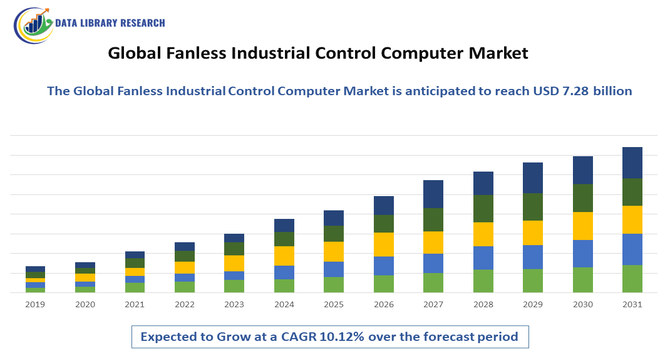
The Global Fanless Industrial Control Computer Market, valued at USD 3.15 billion in 2025, is on track to reach USD 7.28 billion by 2032, driven by an impressive 13.5% from 2025-2032.

The global fanless industrial control computer market covers rugged, passively cooled computing systems designed for harsh environments. These compact, reliable units support automation, monitoring, and real-time control across manufacturing, energy, transportation, and IoT applications, emphasizing durability, low maintenance, thermal efficiency, and consistent performance in challenging industrial conditions around the world.

Growth of the global fanless industrial control computer market is driven by rising automation across manufacturing and process industries, increasing demand for rugged, maintenance-free systems, expanding use of IoT and edge computing, stricter reliability and safety requirements, growth in smart factories, and the need for energy-efficient, thermally stable computing in harsh industrial environments.

Fanless Industrial Control Computer Market Latest Trends:

The global fanless industrial control computer market is witnessing strong growth due to rising industrial automation and the widespread adoption of Industry 4.0 technologies. Manufacturers are shifting toward rugged, compact, and maintenance-free systems that perform reliably in harsh environments with dust, vibration, and extreme temperatures. The expansion of IIoT and edge computing is increasing demand for fanless units that can process data locally and support real-time decision-making.

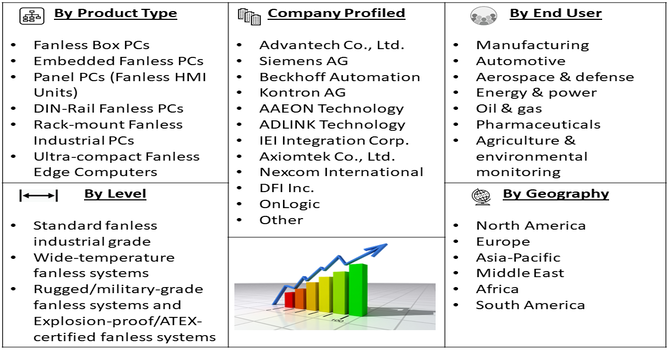
Segmentation: The Global Fanless Industrial Control Computer Market is segmented by Type (Fanless Box PCs, Embedded Fanless PCs, Panel PCs (Fanless HMI Units), DIN-Rail Fanless PCs, Rack-mount Fanless Industrial PCs, Ultra-compact Fanless Edge Computers), Processor Type (x86-based (Intel, AMD), ARM-based, and RISC-based industrial processors), Cooling & Ruggedization Level (Standard fanless industrial grade, Wide-temperature fanless systems, Rugged/military-grade fanless systems and Explosion-proof/ATEX-certified fanless systems), Storage Type (SSD-based fanless systems, eMMC/embedded storage and Hybrid storage systems), End-Use Industry (Manufacturing, Automotive, Aerospace & defense, Energy & power, Oil & gas, Pharmaceuticals, Agriculture & environmental monitoring and Other End Users), and Geography (North America, Europe, Asia-Pacific, Middle East and Africa, and South America). The report provides the value (in USD million) for the above segments.
Market Drivers:

  • Rising Industrial Automation and Industry 4.0 Adoption

The global fanless industrial control computer market is significantly driven by rapid industrial automation and the widespread implementation of Industry 4.0 technologies. As factories transition to smart manufacturing, demand increases for rugged, reliable, and maintenance-free computing solutions that support continuous operation.

Fanless systems offer high durability in environments with dust, shock, vibration, and extreme temperatures, making them ideal for automation equipment, robotics, and real-time monitoring. Their ability to integrate with sensors, PLCs, and industrial networks enables seamless data flow and operational efficiency. This accelerating shift toward digitized and intelligent production processes continues to propel strong market growth worldwide.

  • Growing Deployment of Edge Computing and IIoT

Another major growth driver is the expanding use of Industrial Internet of Things (IIoT) devices and the rising adoption of edge computing across industrial sectors. Fanless industrial computers provide localized data processing, reduced latency, and real-time analytics, which are essential for predictive maintenance, quality control, and smart asset management.

In March 2025, ASUS IoT partnered with ACTE to launch the Configure-to-Order Service (CTOS) in the Nordics, enabling tailored industrial computing solutions. This enhanced flexibility supported edge computing and IIoT adoption, driving growth in industrial automation, healthcare, retail, transportation, and the fanless control computer market. As organizations seek to enhance efficiency by moving computation closer to the source, fanless edge devices become critical for decentralized control architectures. This trend is especially strong in manufacturing, energy, transportation, and remote operations.

Market Restraints:

  • High Initial Cost and Integration Challenges

Despite strong demand, the market faces restraints related to the high upfront cost of fanless industrial control systems and the complexities involved in integrating them into existing infrastructure. Ruggedized components, wide-temperature hardware, and industrial-grade certifications increase production costs, making these systems more expensive than conventional PCs. Additionally, many industries operate with legacy equipment and communication protocols, requiring customization, engineering resources, or additional interface modules. This can lengthen deployment timelines and raise implementation costs. For small and mid-size enterprises, these financial and technical barriers can slow adoption, despite long-term benefits in reliability, maintenance reduction, and operational efficiency.

Socioeconomic Impact on Fanless Industrial Control Computer Market

The adoption of fanless industrial control computers contributes to higher productivity, improved operational safety, and more efficient resource utilization across industries. By enabling automation and real-time monitoring, these systems help reduce downtime, enhance product quality, and lower operating costs, strengthening industrial competitiveness. While automation may shift certain manual roles, it also creates new opportunities in technical fields such as systems integration, robotics, and data analytics. Energy-efficient, low-maintenance designs support sustainability goals by reducing power consumption and waste.

Segmental Analysis:

  • Panel PCs (Fanless HMI Units) segment is expected to witness highest growth over the forecast period

Panel PCs with fanless HMI capabilities are expected to witness the highest growth due to increasing adoption of interactive, touchscreen-based interfaces across industrial environments. These systems combine display, processing, and control functions in a sealed, rugged design ideal for dusty or moisture-prone settings. As factories modernize, operators require intuitive HMIs for real-time visualization, equipment control, and data access on production floors. The demand for hygienic, easy-to-clean units is rising in food, pharmaceuticals, and electronics manufacturing. Additionally, integration with automation software, IIoT platforms, and edge computing solutions positions fanless Panel PCs as essential components of next-generation smart factory infrastructures.

  • ARM-based segment is expected to witness highest growth over the forecast period

The ARM-based segment is expected to grow rapidly due to increasing interest in energy-efficient, compact, and cost-effective industrial computing architectures. ARM processors offer low heat generation, making them ideal for fanless designs that operate reliably in constrained or harsh environments. Their expanding ecosystem, improved performance, and compatibility with Linux-based industrial operating systems enhance their appeal for edge computing, IoT applications, and embedded automation tasks. Industries increasingly seek lightweight systems that support real-time control while minimizing power consumption. With ARM architectures advancing into higher-performance tiers and supporting AI workloads, their adoption in industrial control is accelerating, driving strong segment growth.

  • SSD-based fanless systems segment is expected to witness highest growth over the forecast period

SSD-based fanless systems are projected to experience the highest growth as industries prioritize reliability, speed, and resilience in mission-critical operations. Solid-state drives offer superior durability compared to HDDs, with no moving parts, reduced vibration sensitivity, and longer operational life—qualities essential for industrial environments. Their faster boot times, improved data throughput, and lower power consumption support real-time monitoring, analytics, and edge computing functions. As data volumes increase and industrial networks expand, SSD-based storage ensures stable performance and minimal downtime. The rising adoption of predictive maintenance and high-speed control applications further strengthens demand for SSD-equipped fanless systems across sectors.

  • Manufacturing segment is expected to witness highest growth over the forecast period

The manufacturing sector is expected to see the highest growth as global industries accelerate digital transformation, automation, and smart factory initiatives. Fanless industrial computers support robotics, machine vision, quality inspection, predictive maintenance, and real-time production monitoring, making them central to modern manufacturing workflows. Their rugged, maintenance-free design ensures uninterrupted operation in environments exposed to dust, vibration, and temperature fluctuations. As manufacturers adopt IIoT devices, edge analytics, and human-machine interfaces, demand for reliable computing platforms increases significantly. The shift toward mass customization, flexible production lines, and energy-efficient operations further drives the adoption of fanless control systems across diverse manufacturing sub-sectors.

  • Asia-Pacific region is expected to witness highest growth over the forecast period

The Asia-Pacific region is expected to witness the highest growth due to rapid industrialization, strong manufacturing bases, and expanding investments in automation technologies. Countries like China, Japan, South Korea, and India are adopting smart manufacturing, robotics, and IIoT solutions at a fast pace, driving demand for rugged fanless control computers.

The region’s growth in electronics, automotive, semiconductors, and energy sectors further boosts adoption. For instance, in September 2025, BIOSTAR launched the EdgeComp MU-N150, a compact 0.6L fanless industrial PC with Intel N150 “Twin Lake” SoC, offering industrial-grade durability. It supported edge computing, automation, and HMI applications, boosting IIoT adoption and driving fanless industrial PC growth in Asia-Pacific.

Furthermore, the government initiatives promoting digital transformation, industrial modernization, and local production of automation equipment enhance market momentum. Additionally, the proliferation of small and medium enterprises adopting cost-effective automation solutions positions Asia-Pacific as the fastest-expanding regional market.

Fanless Industrial Control Computer Market Competitive Landscape:

The competitive landscape is characterized by a mix of global industrial computer manufacturers and specialized solution providers offering a wide range of fanless systems tailored for demanding environments. Companies compete on durability, thermal efficiency, customization options, and support for advanced functions such as AI processing, wireless connectivity, and edge analytics. Product innovation focuses on modular designs, broader temperature tolerance, improved compatibility with automation platforms, and enhanced cybersecurity. Price competitiveness and after-sales support also play significant roles in market differentiation.

The major players for above market are:

  • Advantech Co., Ltd.
  • Siemens AG
  • Beckhoff Automation
  • Kontron AG
  • AAEON Technology
  • ADLINK Technology
  • IEI Integration Corp.
  • Axiomtek Co., Ltd.
  • Nexcom International
  • DFI Inc.
  • OnLogic
  • ARBOR Technology
  • Neousys Technology
  • Winmate Inc.
  • B&R Industrial Automation
  • Lanner Electronics
  • IBASE Technology
  • Rockwell Automation
  • Mitsubishi Electric Corporation
  • ASRock Industrial

Recent Development

  • In October 2025, Advantech, introduced the MIC-780, the first fanless industrial box PC featuring Intel Core Ultra Processors with an integrated NPU. Designed for industrial AI workloads, it offered robust processing, modular expansion, and rugged edge deployment capabilities.


  • In July 2025, Avalue Technology Inc., released the EPS-RPR fanless rugged embedded system, addressing rising edge AI demand. The high-performance, flexible platform supported smart manufacturing, autonomous vehicles, and intelligent retail, amid projections of the Edge AI Box PC market doubling by 2033.


Frequently Asked Questions (FAQ) :

Q1. What are the main growth-driving factors for this market?

The biggest driver is the widespread push for Industry 4.0 and factory automation, requiring rugged computing at the machine level. Fanless industrial computers are ideal because they resist dust, vibration, and temperature extremes without overheating. Their reliability and low maintenance requirements make them essential for real-time data processing and control in harsh industrial settings.

Q2. What are the main restraining factors for this market?

The main limitation is the higher cost compared to traditional fan-cooled PCs, due to the specialized heat dissipation hardware required. Furthermore, fanless systems often offer slightly lower peak processing power, as they rely on passive cooling, which can be a restraint for extremely complex or computationally demanding industrial applications.

Q3. Which segment is expected to witness high growth?

The Manufacturing segment is poised for the highest growth, driven by aggressive adoption of Industry 4.0 and smart factory initiatives. This transition requires rugged fanless control computers to manage robotics, vision systems, and IoT data directly on the shop floor. Their durability and resistance to dust and heat ensure maximized production uptime and efficiency in automation processes.

Q4. Who are the top major players for this market?

The Fanless Industrial Control Computer market is led by companies specializing in industrial automation hardware. Key players include large global manufacturers like Advantech, Siemens, Beckhoff Automation, Kontron, and DFI. These companies compete by offering robust, certified systems designed for specific vertical industrial sectors.

Q5. Which country is the largest player?

China and the Asia Pacific region as a whole collectively hold the largest market share. This dominance is driven by massive investment in manufacturing capacity, widespread government support for rapid industrialization, and the massive consumer electronics and semiconductor production base located in the region.

Fanless Industrial Control Computer MARKET STUDY GLOBAL MARKET ANALYSIS, INSIGHTS AND FORECAST, 2022-2029

    1. Introduction

    • 1.1. Research Scope
    • 1.2. Market Segmentation
    • 1.3. Research Methodology
    • 1.4. Definitions and Assumptions

    2. Executive Summary

      3. Market Dynamics

      • 3.1. Market Drivers
      • 3.2. Market Restraints
      • 3.3. Market Opportunities

      4. Key Insights

      • 4.1. Key Emerging Trends – For Major Countries
      • 4.2. Latest Technological Advancement
      • 4.3. Regulatory Landscape
      • 4.4. Industry SWOT Analysis
      • 4.5. Porters Five Forces Analysis

      5. Global Fanless Industrial Control Computer Market Analysis (USD Billion), Insights and Forecast, 2018-2029

      • 5.1. Key Findings / Summary
      • 5.2. Market Analysis, Insights and Forecast – By Segment 1
        • 5.2.1. Sub-Segment 1
        • 5.2.2. Sub-Segment 2
      • 5.3. Market Analysis, Insights and Forecast – By Segment 2
        • 5.3.1. Sub-Segment 1
        • 5.3.2. Sub-Segment 2
        • 5.3.3. Sub-Segment 3
        • 5.3.4. Others
      • 5.4. Market Analysis, Insights and Forecast – By Segment 3
        • 5.4.1. Sub-Segment 1
        • 5.4.2. Sub-Segment 2
        • 5.4.3. Sub-Segment 3
        • 5.4.4. Others
      • 5.5. Market Analysis, Insights and Forecast – By Region
        • 5.5.1. North America
        • 5.5.2. Latin America
        • 5.5.3. Europe
        • 5.5.4. Asia Pacific
        • 5.5.5. Middle East and Africa

      6. North America Fanless Industrial Control Computer Market Analysis (USD Billion), Insights and Forecast, 2018-2029

      • 6.1. Key Findings / Summary
      • 6.2. Market Analysis, Insights and Forecast – By Segment 1
        • 6.2.1. Sub-Segment 1
        • 6.2.2. Sub-Segment 2
      • 6.3. Market Analysis, Insights and Forecast – By Segment 2
        • 6.3.1. Sub-Segment 1
        • 6.3.2. Sub-Segment 2
        • 6.3.3. Sub-Segment 3
        • 6.3.4. Others
      • 6.4. Market Analysis, Insights and Forecast – By Segment 3
        • 6.4.1. Sub-Segment 1
        • 6.4.2. Sub-Segment 2
        • 6.4.3. Sub-Segment 3
        • 6.4.4. Others
      • 6.5. Market Analysis, Insights and Forecast – By Country
        • 6.5.1. U.S.
        • 6.5.2. Canada

      7. Latin America Fanless Industrial Control Computer Market Analysis (USD Billion), Insights and Forecast, 2018-2029

      • 7.1. Key Findings / Summary
      • 7.2. Market Analysis, Insights and Forecast – By Segment 1
        • 7.2.1. Sub-Segment 1
        • 7.2.2. Sub-Segment 2
      • 7.3. Market Analysis, Insights and Forecast – By Segment 2
        • 7.3.1. Sub-Segment 1
        • 7.3.2. Sub-Segment 2
        • 7.3.3. Sub-Segment 3
        • 7.3.4. Others
      • 7.4. Market Analysis, Insights and Forecast – By Segment 3
        • 7.4.1. Sub-Segment 1
        • 7.4.2. Sub-Segment 2
        • 7.4.3. Sub-Segment 3
        • 7.4.4. Others
      • 7.5. Insights and Forecast – By Country
        • 7.5.1. Brazil
        • 7.5.2. Mexico
        • 7.5.3. Rest of Latin America

      8. Europe Fanless Industrial Control Computer Market Analysis (USD Billion), Insights and Forecast, 2018-2029

      • 8.1. Key Findings / Summary
      • 8.2. Market Analysis, Insights and Forecast – By Segment 1
        • 8.2.1. Sub-Segment 1
        • 8.2.2. Sub-Segment 2
      • 8.3. Market Analysis, Insights and Forecast – By Segment 2
        • 8.3.1. Sub-Segment 1
        • 8.3.2. Sub-Segment 2
        • 8.3.3. Sub-Segment 3
        • 8.3.4. Others
      • 8.4. Market Analysis, Insights and Forecast – By Segment 3
        • 8.4.1. Sub-Segment 1
        • 8.4.2. Sub-Segment 2
        • 8.4.3. Sub-Segment 3
        • 8.4.4. Others
      • 8.5. Market Analysis, Insights and Forecast – By Country
        • 8.5.1. UK
        • 8.5.2. Germany
        • 8.5.3. France
        • 8.5.4. Italy
        • 8.5.5. Spain
        • 8.5.6. Russia
        • 8.5.7. Rest of Europe

      9. Asia Pacific Fanless Industrial Control Computer Market Analysis (USD Billion), Insights and Forecast, 2018-2029

      • 9.1. Key Findings / Summary
      • 9.2. Market Analysis, Insights and Forecast – By Segment 1
        • 9.2.1. Sub-Segment 1
        • 9.2.2. Sub-Segment 2
      • 9.3. Market Analysis, Insights and Forecast – By Segment 2
        • 9.3.1. Sub-Segment 1
        • 9.3.2. Sub-Segment 2
        • 9.3.3. Sub-Segment 3
        • 9.3.4. Others
      • 9.4. Market Analysis, Insights and Forecast – By Segment 3
        • 9.4.1. Sub-Segment 1
        • 9.4.2. Sub-Segment 2
        • 9.4.3. Sub-Segment 3
        • 9.4.4. Others
      • 9.5. Market Analysis, Insights and Forecast – By Country
        • 9.5.1. China
        • 9.5.2. India
        • 9.5.3. Japan
        • 9.5.4. Australia
        • 9.5.5. South East Asia
        • 9.5.6. Rest of Asia Pacific

      10. Middle East & Africa Fanless Industrial Control Computer Market Analysis (USD Billion), Insights and Forecast, 2018-2029

      • 10.1. Key Findings / Summary
      • 10.2. Market Analysis, Insights and Forecast – By Segment 1
        • 10.2.1. Sub-Segment 1
        • 10.2.2. Sub-Segment 2
      • 10.3. Market Analysis, Insights and Forecast – By Segment 2
        • 10.3.1. Sub-Segment 1
        • 10.3.2. Sub-Segment 2
        • 10.3.3. Sub-Segment 3
        • 10.3.4. Others
      • 10.4. Market Analysis, Insights and Forecast – By Segment 3
        • 10.4.1. Sub-Segment 1
        • 10.4.2. Sub-Segment 2
        • 10.4.3. Sub-Segment 3
        • 10.4.4. Others
      • 10.5. Market Analysis, Insights and Forecast – By Country
        • 10.5.1. GCC
        • 10.5.2. South Africa
        • 10.5.3. Rest of Middle East & Africa

      11. Competitive Analysis

      • 11.1. Company Market Share Analysis, 2018
      • 11.2. Key Industry Developments
      • 11.3. Company Profile
        • 11.3.1. Company 1
          • 11.3.1.1. Business Overview
          • 11.3.1.2. Segment 1 & Service Offering
          • 11.3.1.3. Overall Revenue
          • 11.3.1.4. Geographic Presence
          • 11.3.1.5. Recent Development
        *Similar details will be provided for the following companies
        • 11.3.2. Company 2
        • 11.3.3. Company 3
        • 11.3.4. Company 4
        • 11.3.5. Company 5
        • 11.3.6. Company 6
        • 11.3.7. Company 7
        • 11.3.8. Company 8
        • 11.3.9. Company 9
        • 11.3.10. Company 10
        • 11.3.11. Company 11
        • 11.3.12. Company 12
      List of Figures

      Figure 1: Global Fanless Industrial Control Computer Market Revenue Breakdown (USD Billion, %) by Region, 2022 & 2029
      Figure 2: Global Fanless Industrial Control Computer Market Value Share (%), By Segment 1, 2022 & 2029
      Figure 3: Global Fanless Industrial Control Computer Market Forecast (USD Billion), by Sub-Segment 1, 2018-2029
      Figure 4: Global Fanless Industrial Control Computer Market Forecast (USD Billion), by Sub-Segment 2, 2018-2029
      Figure 5: Global Fanless Industrial Control Computer Market Value Share (%), By Segment 2, 2022 & 2029
      Figure 6: Global Fanless Industrial Control Computer Market Forecast (USD Billion), by Sub-Segment 1, 2018-2029
      Figure 7: Global Fanless Industrial Control Computer Market Forecast (USD Billion), by Sub-Segment 2, 2018-2029
      Figure 8: Global Fanless Industrial Control Computer Market Forecast (USD Billion), by Sub-Segment 3, 2018-2029
      Figure 9: Global Fanless Industrial Control Computer Market Forecast (USD Billion), by Others, 2018-2029
      Figure 10: Global Fanless Industrial Control Computer Market Value Share (%), By Segment 3, 2022 & 2029
      Figure 11: Global Fanless Industrial Control Computer Market Forecast (USD Billion), by Sub-Segment 1, 2018-2029
      Figure 12: Global Fanless Industrial Control Computer Market Forecast (USD Billion), by Sub-Segment 2, 2018-2029
      Figure 13: Global Fanless Industrial Control Computer Market Forecast (USD Billion), by Sub-Segment 3, 2018-2029
      Figure 14: Global Fanless Industrial Control Computer Market Forecast (USD Billion), by Others, 2018-2029
      Figure 15: Global Fanless Industrial Control Computer Market Value (USD Billion), by Region, 2022 & 2029
      Figure 16: North America Fanless Industrial Control Computer Market Value Share (%), By Segment 1, 2022 & 2029
      Figure 17: North America Fanless Industrial Control Computer Market Forecast (USD Billion), by Sub-Segment 1, 2018-2029
      Figure 18: North America Fanless Industrial Control Computer Market Forecast (USD Billion), by Sub-Segment 2, 2018-2029
      Figure 19: North America Fanless Industrial Control Computer Market Value Share (%), By Segment 2, 2022 & 2029
      Figure 20: North America Fanless Industrial Control Computer Market Forecast (USD Billion), by Sub-Segment 1, 2018-2029
      Figure 21: North America Fanless Industrial Control Computer Market Forecast (USD Billion), by Sub-Segment 2, 2018-2029
      Figure 22: North America Fanless Industrial Control Computer Market Forecast (USD Billion), by Sub-Segment 3, 2018-2029
      Figure 23: North America Fanless Industrial Control Computer Market Forecast (USD Billion), by Others, 2018-2029
      Figure 24: North America Fanless Industrial Control Computer Market Value Share (%), By Segment 3, 2022 & 2029
      Figure 25: North America Fanless Industrial Control Computer Market Forecast (USD Billion), by Sub-Segment 1, 2018-2029
      Figure 26: North America Fanless Industrial Control Computer Market Forecast (USD Billion), by Sub-Segment 2, 2018-2029
      Figure 27: North America Fanless Industrial Control Computer Market Forecast (USD Billion), by Sub-Segment 3, 2018-2029
      Figure 28: North America Fanless Industrial Control Computer Market Forecast (USD Billion), by Others, 2018-2029
      Figure 29: North America Fanless Industrial Control Computer Market Forecast (USD Billion), by U.S., 2018-2029
      Figure 30: North America Fanless Industrial Control Computer Market Forecast (USD Billion), by Canada, 2018-2029
      Figure 31: Latin America Fanless Industrial Control Computer Market Value Share (%), By Segment 1, 2022 & 2029
      Figure 32: Latin America Fanless Industrial Control Computer Market Forecast (USD Billion), by Sub-Segment 1, 2018-2029
      Figure 33: Latin America Fanless Industrial Control Computer Market Forecast (USD Billion), by Sub-Segment 2, 2018-2029
      Figure 34: Latin America Fanless Industrial Control Computer Market Value Share (%), By Segment 2, 2022 & 2029
      Figure 35: Latin America Fanless Industrial Control Computer Market Forecast (USD Billion), by Sub-Segment 1, 2018-2029
      Figure 36: Latin America Fanless Industrial Control Computer Market Forecast (USD Billion), by Sub-Segment 2, 2018-2029
      Figure 37: Latin America Fanless Industrial Control Computer Market Forecast (USD Billion), by Sub-Segment 3, 2018-2029
      Figure 38: Latin America Fanless Industrial Control Computer Market Forecast (USD Billion), by Others, 2018-2029
      Figure 39: Latin America Fanless Industrial Control Computer Market Value Share (%), By Segment 3, 2022 & 2029
      Figure 40: Latin America Fanless Industrial Control Computer Market Forecast (USD Billion), by Sub-Segment 1, 2018-2029
      Figure 41: Latin America Fanless Industrial Control Computer Market Forecast (USD Billion), by Sub-Segment 2, 2018-2029
      Figure 42: Latin America Fanless Industrial Control Computer Market Forecast (USD Billion), by Sub-Segment 3, 2018-2029
      Figure 43: Latin America Fanless Industrial Control Computer Market Forecast (USD Billion), by Others, 2018-2029
      Figure 44: Latin America Fanless Industrial Control Computer Market Forecast (USD Billion), by Brazil, 2018-2029
      Figure 45: Latin America Fanless Industrial Control Computer Market Forecast (USD Billion), by Mexico, 2018-2029
      Figure 46: Latin America Fanless Industrial Control Computer Market Forecast (USD Billion), by Rest of Latin America, 2018-2029
      Figure 47: Europe Fanless Industrial Control Computer Market Value Share (%), By Segment 1, 2022 & 2029
      Figure 48: Europe Fanless Industrial Control Computer Market Forecast (USD Billion), by Sub-Segment 1, 2018-2029
      Figure 49: Europe Fanless Industrial Control Computer Market Forecast (USD Billion), by Sub-Segment 2, 2018-2029
      Figure 50: Europe Fanless Industrial Control Computer Market Value Share (%), By Segment 2, 2022 & 2029
      Figure 51: Europe Fanless Industrial Control Computer Market Forecast (USD Billion), by Sub-Segment 1, 2018-2029
      Figure 52: Europe Fanless Industrial Control Computer Market Forecast (USD Billion), by Sub-Segment 2, 2018-2029
      Figure 53: Europe Fanless Industrial Control Computer Market Forecast (USD Billion), by Sub-Segment 3, 2018-2029
      Figure 54: Europe Fanless Industrial Control Computer Market Forecast (USD Billion), by Others, 2018-2029
      Figure 55: Europe Fanless Industrial Control Computer Market Value Share (%), By Segment 3, 2022 & 2029
      Figure 56: Europe Fanless Industrial Control Computer Market Forecast (USD Billion), by Sub-Segment 1, 2018-2029
      Figure 57: Europe Fanless Industrial Control Computer Market Forecast (USD Billion), by Sub-Segment 2, 2018-2029
      Figure 58: Europe Fanless Industrial Control Computer Market Forecast (USD Billion), by Sub-Segment 3, 2018-2029
      Figure 59: Europe Fanless Industrial Control Computer Market Forecast (USD Billion), by Others, 2018-2029
      Figure 60: Europe Fanless Industrial Control Computer Market Forecast (USD Billion), by U.K., 2018-2029
      Figure 61: Europe Fanless Industrial Control Computer Market Forecast (USD Billion), by Germany, 2018-2029
      Figure 62: Europe Fanless Industrial Control Computer Market Forecast (USD Billion), by France, 2018-2029
      Figure 63: Europe Fanless Industrial Control Computer Market Forecast (USD Billion), by Italy, 2018-2029
      Figure 64: Europe Fanless Industrial Control Computer Market Forecast (USD Billion), by Spain, 2018-2029
      Figure 65: Europe Fanless Industrial Control Computer Market Forecast (USD Billion), by Russia, 2018-2029
      Figure 66: Europe Fanless Industrial Control Computer Market Forecast (USD Billion), by Rest of Europe, 2018-2029
      Figure 67: Asia Pacific Fanless Industrial Control Computer Market Value Share (%), By Segment 1, 2022 & 2029
      Figure 68: Asia Pacific Fanless Industrial Control Computer Market Forecast (USD Billion), by Sub-Segment 1, 2018-2029
      Figure 69: Asia Pacific Fanless Industrial Control Computer Market Forecast (USD Billion), by Sub-Segment 2, 2018-2029
      Figure 70: Asia Pacific Fanless Industrial Control Computer Market Value Share (%), By Segment 2, 2022 & 2029
      Figure 71: Asia Pacific Fanless Industrial Control Computer Market Forecast (USD Billion), by Sub-Segment 1, 2018-2029
      Figure 72: Asia Pacific Fanless Industrial Control Computer Market Forecast (USD Billion), by Sub-Segment 2, 2018-2029
      Figure 73: Asia Pacific Fanless Industrial Control Computer Market Forecast (USD Billion), by Sub-Segment 3, 2018-2029
      Figure 74: Asia Pacific Fanless Industrial Control Computer Market Forecast (USD Billion), by Others, 2018-2029
      Figure 75: Asia Pacific Fanless Industrial Control Computer Market Value Share (%), By Segment 3, 2022 & 2029
      Figure 76: Asia Pacific Fanless Industrial Control Computer Market Forecast (USD Billion), by Sub-Segment 1, 2018-2029
      Figure 77: Asia Pacific Fanless Industrial Control Computer Market Forecast (USD Billion), by Sub-Segment 2, 2018-2029
      Figure 78: Asia Pacific Fanless Industrial Control Computer Market Forecast (USD Billion), by Sub-Segment 3, 2018-2029
      Figure 79: Asia Pacific Fanless Industrial Control Computer Market Forecast (USD Billion), by Others, 2018-2029
      Figure 80: Asia Pacific Fanless Industrial Control Computer Market Forecast (USD Billion), by China, 2018-2029
      Figure 81: Asia Pacific Fanless Industrial Control Computer Market Forecast (USD Billion), by India, 2018-2029
      Figure 82: Asia Pacific Fanless Industrial Control Computer Market Forecast (USD Billion), by Japan, 2018-2029
      Figure 83: Asia Pacific Fanless Industrial Control Computer Market Forecast (USD Billion), by Australia, 2018-2029
      Figure 84: Asia Pacific Fanless Industrial Control Computer Market Forecast (USD Billion), by Southeast Asia, 2018-2029
      Figure 85: Asia Pacific Fanless Industrial Control Computer Market Forecast (USD Billion), by Rest of Asia Pacific, 2018-2029
      Figure 86: Middle East & Africa Fanless Industrial Control Computer Market Value Share (%), By Segment 1, 2022 & 2029
      Figure 87: Middle East & Africa Fanless Industrial Control Computer Market Forecast (USD Billion), by Sub-Segment 1, 2018-2029
      Figure 88: Middle East & Africa Fanless Industrial Control Computer Market Forecast (USD Billion), by Sub-Segment 2, 2018-2029
      Figure 89: Middle East & Africa Fanless Industrial Control Computer Market Value Share (%), By Segment 2, 2022 & 2029
      Figure 90: Middle East & Africa Fanless Industrial Control Computer Market Forecast (USD Billion), by Sub-Segment 1, 2018-2029
      Figure 91: Middle East & Africa Fanless Industrial Control Computer Market Forecast (USD Billion), by Sub-Segment 2, 2018-2029
      Figure 92: Middle East & Africa Fanless Industrial Control Computer Market Forecast (USD Billion), by Sub-Segment 3, 2018-2029
      Figure 93: Middle East & Africa Fanless Industrial Control Computer Market Forecast (USD Billion), by Others, 2018-2029
      Figure 94: Middle East & Africa Fanless Industrial Control Computer Market Value Share (%), By Segment 3, 2022 & 2029
      Figure 95: Middle East & Africa Fanless Industrial Control Computer Market Forecast (USD Billion), by Sub-Segment 1, 2018-2029
      Figure 96: Middle East & Africa Fanless Industrial Control Computer Market Forecast (USD Billion), by Sub-Segment 2, 2018-2029
      Figure 97: Middle East & Africa Fanless Industrial Control Computer Market Forecast (USD Billion), by Sub-Segment 3, 2018-2029
      Figure 98: Middle East & Africa Fanless Industrial Control Computer Market Forecast (USD Billion), by Others, 2018-2029
      Figure 99: Middle East & Africa Fanless Industrial Control Computer Market Forecast (USD Billion), by GCC, 2018-2029
      Figure 100: Middle East & Africa Fanless Industrial Control Computer Market Forecast (USD Billion), by South Africa, 2018-2029
      Figure 101: Middle East & Africa Fanless Industrial Control Computer Market Forecast (USD Billion), by Rest of Middle East & Africa, 2018-2029 
      List of Tables
      Table 1: Global Fanless Industrial Control Computer Market Revenue (USD Billion) Forecast, by Segment 1, 2018-2029
      Table 2: Global Fanless Industrial Control Computer Market Revenue (USD Billion) Forecast, by Segment 2, 2018-2029
      Table 3: Global Fanless Industrial Control Computer Market Revenue (USD Billion) Forecast, by Segment 3, 2018-2029
      Table 4: Global Fanless Industrial Control Computer Market Revenue (USD Billion) Forecast, by Region, 2018-2029
      Table 5: North America Fanless Industrial Control Computer Market Revenue (USD Billion) Forecast, by Segment 1, 2018-2029
      Table 6: North America Fanless Industrial Control Computer Market Revenue (USD Billion) Forecast, by Segment 2, 2018-2029
      Table 7: North America Fanless Industrial Control Computer Market Revenue (USD Billion) Forecast, by Segment 3, 2018-2029
      Table 8: North America Fanless Industrial Control Computer Market Revenue (USD Billion) Forecast, by Country, 2018-2029
      Table 9: Europe Fanless Industrial Control Computer Market Revenue (USD Billion) Forecast, by Segment 1, 2018-2029
      Table 10: Europe Fanless Industrial Control Computer Market Revenue (USD Billion) Forecast, by Segment 2, 2018-2029
      Table 11: Europe Fanless Industrial Control Computer Market Revenue (USD Billion) Forecast, by Segment 3, 2018-2029
      Table 12: Europe Fanless Industrial Control Computer Market Revenue (USD Billion) Forecast, by Country, 2018-2029
      Table 13: Latin America Fanless Industrial Control Computer Market Revenue (USD Billion) Forecast, by Segment 1, 2018-2029
      Table 14: Latin America Fanless Industrial Control Computer Market Revenue (USD Billion) Forecast, by Segment 2, 2018-2029
      Table 15: Latin America Fanless Industrial Control Computer Market Revenue (USD Billion) Forecast, by Segment 3, 2018-2029
      Table 16: Latin America Fanless Industrial Control Computer Market Revenue (USD Billion) Forecast, by Country, 2018-2029
      Table 17: Asia Pacific Fanless Industrial Control Computer Market Revenue (USD Billion) Forecast, by Segment 1, 2018-2029
      Table 18: Asia Pacific Fanless Industrial Control Computer Market Revenue (USD Billion) Forecast, by Segment 2, 2018-2029
      Table 19: Asia Pacific Fanless Industrial Control Computer Market Revenue (USD Billion) Forecast, by Segment 3, 2018-2029
      Table 20: Asia Pacific Fanless Industrial Control Computer Market Revenue (USD Billion) Forecast, by Country, 2018-2029
      Table 21: Middle East & Africa Fanless Industrial Control Computer Market Revenue (USD Billion) Forecast, by Segment 1, 2018-2029
      Table 22: Middle East & Africa Fanless Industrial Control Computer Market Revenue (USD Billion) Forecast, by Segment 2, 2018-2029
      Table 23: Middle East & Africa Fanless Industrial Control Computer Market Revenue (USD Billion) Forecast, by Segment 3, 2018-2029
      Table 24: Middle East & Africa Fanless Industrial Control Computer Market Revenue (USD Billion) Forecast, by Country, 2018-2029
      Research Process

      Data Library Research are conducted by industry experts who offer insight on industry structure, market segmentations technology assessment and competitive landscape (CL), and penetration, as well as on emerging trends. Their analysis is based on primary interviews (~ 80%) and secondary research (~ 20%) as well as years of professional expertise in their respective industries. Adding to this, by analysing historical trends and current market positions, our analysts predict where the market will be headed for the next five years. Furthermore, the varying trends of segment & categories geographically presented are also studied and the estimated based on the primary & secondary research.

      In this particular report from the supply side Data Library Research has conducted primary surveys (interviews) with the key level executives (VP, CEO’s, Marketing Director, Business Development Manager and SOFT) of the companies that active & prominent as well as the midsized organization

      FIGURE 1: DLR RESEARH PROCESS

      research-methodology1

      Primary Research

      Extensive primary research was conducted to gain a deeper insight of the market and industry performance. The analysis is based on both primary and secondary research as well as years of professional expertise in the respective industries.

      In addition to analysing current and historical trends, our analysts predict where the market is headed over the next five years.

      It varies by segment for these categories geographically presented in the list of market tables. Speaking about this particular report we have conducted primary surveys (interviews) with the key level executives (VP, CEO’s, Marketing Director, Business Development Manager and many more) of the major players active in the market.

      Secondary Research

      Secondary research was mainly used to collect and identify information useful for the extensive, technical, market-oriented, and Friend’s study of the Global Extra Neutral Alcohol. It was also used to obtain key information about major players, market classification and segmentation according to the industry trends, geographical markets, and developments related to the market and technology perspectives. For this study, analysts have gathered information from various credible sources, such as annual reports, sec filings, journals, white papers, SOFT presentations, and company web sites.

      Market Size Estimation

      Both, top-down and bottom-up approaches were used to estimate and validate the size of the Global market and to estimate the size of various other dependent submarkets in the overall Extra Neutral Alcohol. The key players in the market were identified through secondary research and their market contributions in the respective geographies were determined through primary and secondary research.

      Forecast Model

      research-methodology2