
Get Complete Analysis Of The Report - Download Updated Free Sample PDF
The Global Medical Tourism Franchise Market refers to the industry where healthcare providers, clinics, and hospitals offer franchised services to international patients seeking medical treatments abroad. These franchises provide standardized, high-quality healthcare, including elective surgeries, wellness programs, and specialized treatments, often at lower costs than domestic options. Growth is driven by rising healthcare costs, increasing patient mobility, demand for advanced medical procedures, and favorable government policies promoting medical tourism.
The global medical tourism franchise market is evolving with rising demand for affordable, high-quality healthcare services across borders. Patients increasingly seek elective surgeries, cosmetic procedures, dental care, fertility treatments, and wellness services through franchised healthcare networks. Digital platforms, teleconsultations, and online patient coordination services are improving access and transparency. Additionally, partnerships between hospitals, travel agencies, and insurance providers are strengthening service delivery.
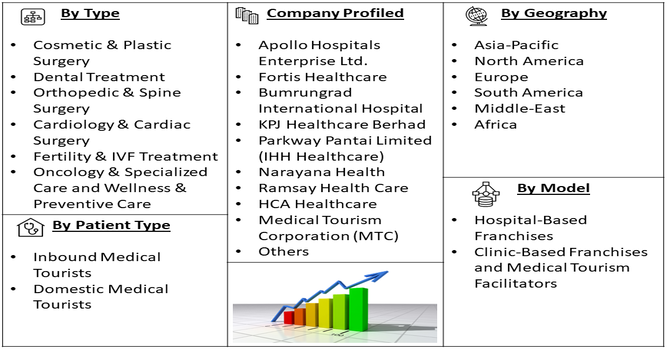
Segmentation: The Global Medical Tourism Franchise Market is segmented by Treatment Type (Cosmetic & Plastic Surgery, Dental Treatment, Orthopedic & Spine Surgery, Cardiology & Cardiac Surgery, Fertility & IVF Treatment, Oncology & Specialized Care and Wellness & Preventive Care), Service Model (Hospital-Based Franchises, Clinic-Based Franchises and Medical Tourism Facilitators), Patient Type (Inbound Medical Tourists and Domestic Medical Tourists), and Geography (North America, Europe, Asia-Pacific, Middle East and Africa, and South America). The report provides the value (in USD million) for the above segments.
For Detailed Market Segmentation - Get a Free Sample PDF
Market Drivers:
Rising healthcare costs and extended waiting periods in developed countries are major drivers of the global medical tourism franchise market. Patients increasingly seek affordable treatment options abroad for procedures such as orthopedic surgery, dental care, cosmetic surgery, and cardiac treatments. For instance, in June 2025, Vaidam Health acquired MediJourney to enhance its global medical tourism capabilities by integrating hospital partnerships, advanced case management, and AI-driven patient navigation. This consolidation boosts the Global Medical Tourism Franchise Market by improving service efficiency and patient experience, while addressing rising healthcare costs and long waiting times through streamlined, technology-enabled access to affordable, timely medical care worldwide.
Medical tourism franchises offer standardized services, internationally accredited facilities, and transparent pricing, making cross-border healthcare more reliable. Shorter waiting times and access to advanced medical technologies further attract patients. As cost pressures and capacity constraints persist in domestic healthcare systems, demand for franchised medical tourism services continues to grow globally.
The expansion of internationally accredited hospitals and clinics has significantly driven the medical tourism franchise market. Franchising enables healthcare providers to replicate successful treatment models, ensure consistent service quality, and build global brand trust. Accreditation from international bodies enhances patient confidence and safety perceptions. Strategic partnerships with travel agencies, insurers, and facilitators simplify the patient journey. For instance, in December 2023, the American Hospital Association (AHA) introduced a Patient Safety Initiative focused on improving health outcomes, care quality, and patient safety, with participation from over 1,500 hospitals nationwide. This initiative strengthened global confidence in standardized, high-quality healthcare delivery, positively influencing the Global Medical Tourism Franchise Market by enhancing trust, accreditation standards, and international patient appeal.
Market Restraints:
Regulatory complexities and legal uncertainties act as key restraints in the global medical tourism franchise market. Differences in healthcare regulations, malpractice laws, and insurance coverage across countries create operational challenges for franchised providers. Ethical concerns related to patient safety, data privacy, and continuity of care may discourage potential patients. Visa restrictions, travel risks, and geopolitical instability can further impact patient mobility. Additionally, lack of standardized global regulations complicates franchise expansion and compliance. These factors may limit market growth despite increasing demand for affordable and accessible international healthcare services.
Medical tourism franchises contribute significantly to socioeconomic development by generating revenue, employment, and foreign exchange for host countries. The sector supports job creation in healthcare, hospitality, transportation, and tourism services. Increased patient inflow encourages investments in medical infrastructure, technology, and professional training. Local communities benefit from improved healthcare facilities and service quality. Additionally, medical tourism franchises help reduce global healthcare disparities by providing affordable treatment options to international patients. The growth of this market strengthens healthcare accessibility, stimulates economic growth, and enhances the global reputation of medical tourism destinations.
Segmental Analysis:
The Cosmetic & Plastic Surgery segment is expected to witness the highest growth due to increasing demand for affordable aesthetic procedures, such as rhinoplasty, liposuction, breast augmentation, and facial rejuvenation. Patients seek destinations offering high-quality care at significantly lower costs than domestic markets. Medical tourism franchises provide standardized procedures, skilled surgeons, and internationally accredited facilities, increasing patient confidence. Rising social media influence, growing acceptance of cosmetic enhancements, and shorter recovery timelines further drive demand. These factors collectively position cosmetic and plastic surgery as the fastest-growing treatment segment over the forecast period.
The Hospital-Based Franchises segment is projected to experience the highest growth as patients increasingly prefer comprehensive healthcare facilities for complex procedures. These franchises offer advanced infrastructure, multidisciplinary expertise, emergency care, and internationally accredited standards under a trusted brand. Hospital-based models enable seamless integration of diagnostics, surgery, post-operative care, and rehabilitation, improving patient outcomes. Strong global branding, partnerships with insurers, and digital patient coordination enhance market reach. As demand for high-quality, end-to-end medical services grows, hospital-based franchises are expected to dominate the medical tourism franchise market during the forecast period.
The Inbound Medical Tourists segment is expected to grow rapidly as patients from high-cost healthcare regions travel abroad for affordable, quality treatments. Medical tourism franchises simplify cross-border care through standardized services, transparent pricing, and international accreditations. Improved global connectivity, medical visas, and digital consultation platforms further support inbound travel. Patients benefit from shorter waiting times and access to specialized procedures. This rising flow of international patients strengthens franchise expansion, increases foreign revenue, and positions inbound medical tourism as a key growth contributor to the global medical tourism franchise market.
The Asia-Pacific region is projected to witness the highest growth in the medical tourism franchise market due to its cost advantages, advanced medical infrastructure, and skilled healthcare professionals. Countries such as India, Thailand, Malaysia, Singapore, and South Korea attract large volumes of international patients seeking high-quality treatments at competitive prices. For instance, In January 2024, Ferns N Petals launched MediJourney, a medical tourism venture offering services across 30+ treatment segments, including cardiology and oncology. This initiative strengthened the Asia-Pacific medical tourism franchise market by improving care coordination, simplifying medical travel, and expanding access to diversified, standardized healthcare services for international patients, thereby supporting regional market growth and competitiveness.
Similarly, 2022 data from the Malaysia Healthcare Travel Council (MHTC), Malaysia welcomed around 850,000 healthcare travelers, reflecting a 51.5% increase from approximately 561,000 visitors in 2021. This strong rebound highlighted growing regional demand and reinforced Asia-Pacific’s position as a leading medical tourism destination, supporting rapid expansion of medical tourism franchise networks through higher patient inflows, increased revenues, and improved investor confidence across the region.
Government support, medical tourism policies, and expanding hospital franchise networks further fuel growth. The region’s strong reputation in cosmetic surgery, cardiac care, and wellness tourism positions Asia-Pacific as a global hub for franchised medical tourism services over the forecast period.
| Report Matrics | Details |
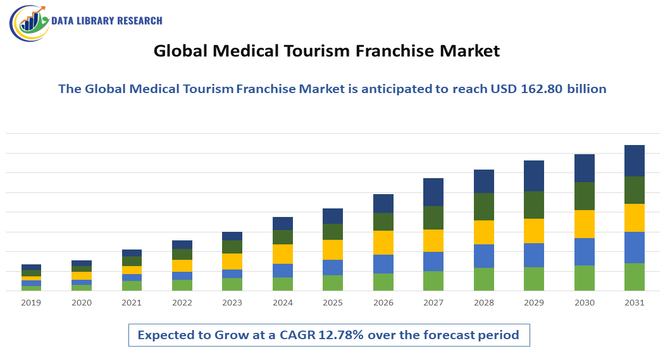
| Market Size Value | USD 162.80 billion |
| Growth Rate | CAGR of 12.78 % |
| Forecast | 2026-2033 |
| Historical data | 2021-2024 |
| Base Year | 2025 |
| Report Coverage | Forecasted revenue, company rating, competitive environment, growth drivers, and trends |
| Segment Coverage | Type, Application, End-User, Geography |
| Regional Scope | North America, Europe, Asia Pacific, Middle East |
| Customized scope | Free customization of reports (With 3 months Analysis Support ) |
| To Learn More About This Report | Request a Free Sample Copy |
The competitive landscape of the global medical tourism franchise market is fragmented and competitive, with hospitals, specialty clinics, and healthcare facilitators operating franchise models. Key players compete on treatment quality, international accreditation, pricing transparency, and patient experience. Strong brand reputation, global partnerships, and digital outreach strategies are critical for success. Many franchises focus on specialization in areas such as cosmetic surgery, orthopedics, cardiology, and dental care. Strategic alliances with travel agencies and insurers enhance service offerings. Continuous innovation, patient-centric services, and global network expansion remain central to maintaining competitiveness in this market.
Key Players:
Recent Development
Q1. What are the main growth-driving factors for this market?
The market is growing because patients are seeking high-quality medical procedures at a fraction of the cost found in their home countries. Long waiting lists for surgeries in domestic healthcare systems also drive people abroad. The franchise model adds a layer of trust, providing patients with standardized care, verified doctors, and pre-arranged travel logistics through recognized brands.
Q2. What are the main restraining factors for this market?
Growth is hindered by concerns over post-operative care and the difficulty of handling medical complications once a patient returns home. Travel restrictions and shifting political stability in popular destinations can also disrupt operations. Furthermore, legal complexities regarding malpractice insurance and cross-border liability make it challenging for franchises to operate uniformly across different international jurisdictions.
Q3. Which segment is expected to witness high growth?
The Cosmetic and Dental Surgery segment is expected to see the highest growth. These procedures are often not covered by traditional insurance, making the significant cost savings of medical tourism highly attractive. Because these treatments are typically elective and have predictable recovery times, they are perfectly suited for the organized, package-based approach of a franchise network.
Q4. Who are the top major players for this market?
The market is led by international hospital groups and specialized medical travel facilitators. Key players include Apollo Hospitals, Bumrungrad International, KPJ Healthcare, and specialized agencies like Medical Tourism Corporation. These organizations dominate by establishing "branch" offices or franchised referral centers globally that provide local patients with direct pathways to their main international surgical hubs.
Q5. Which country is the largest player?
Thailand is a leading player in the medical tourism franchise market. It has successfully branded itself as a global hub for world-class healthcare combined with luxury recovery environments. With a high density of JCI-accredited hospitals and a government that actively promotes medical travel, Thailand attracts millions of international patients and hosts some of the most successful healthcare franchise models.
Data Library Research are conducted by industry experts who offer insight on industry structure, market segmentations technology assessment and competitive landscape (CL), and penetration, as well as on emerging trends. Their analysis is based on primary interviews (~ 80%) and secondary research (~ 20%) as well as years of professional expertise in their respective industries. Adding to this, by analysing historical trends and current market positions, our analysts predict where the market will be headed for the next five years. Furthermore, the varying trends of segment & categories geographically presented are also studied and the estimated based on the primary & secondary research.
In this particular report from the supply side Data Library Research has conducted primary surveys (interviews) with the key level executives (VP, CEO’s, Marketing Director, Business Development Manager and SOFT) of the companies that active & prominent as well as the midsized organization
FIGURE 1: DLR RESEARH PROCESS
Extensive primary research was conducted to gain a deeper insight of the market and industry performance. The analysis is based on both primary and secondary research as well as years of professional expertise in the respective industries.
In addition to analysing current and historical trends, our analysts predict where the market is headed over the next five years.
It varies by segment for these categories geographically presented in the list of market tables. Speaking about this particular report we have conducted primary surveys (interviews) with the key level executives (VP, CEO’s, Marketing Director, Business Development Manager and many more) of the major players active in the market.
Secondary ResearchSecondary research was mainly used to collect and identify information useful for the extensive, technical, market-oriented, and Friend’s study of the Global Extra Neutral Alcohol. It was also used to obtain key information about major players, market classification and segmentation according to the industry trends, geographical markets, and developments related to the market and technology perspectives. For this study, analysts have gathered information from various credible sources, such as annual reports, sec filings, journals, white papers, SOFT presentations, and company web sites.
Market Size EstimationBoth, top-down and bottom-up approaches were used to estimate and validate the size of the Global market and to estimate the size of various other dependent submarkets in the overall Extra Neutral Alcohol. The key players in the market were identified through secondary research and their market contributions in the respective geographies were determined through primary and secondary research.
Forecast Model