
Get Complete Analysis Of The Report - Download Updated Free Sample PDF
The Global Milk Pasteurization Machines Market encompasses equipment used to heat-treat milk and dairy products to eliminate harmful microorganisms while preserving nutritional quality and taste. These machines are widely adopted across dairy processing units, commercial farms, and small-scale producers. Rising consumer awareness of food safety, increasing dairy consumption, and stringent regulatory standards are driving market growth. Technological advancements, including automated systems and energy-efficient designs, further enhance processing efficiency, product consistency, and scalability, making pasteurization machines essential in the global dairy industry.
The Global Milk Pasteurization Machines Market has witnessed significant innovation, with trends leaning toward automation, energy-efficient systems, and smart monitoring technologies. Rising adoption of continuous flow pasteurizers, ultra-high temperature (UHT) processing, and inline sterilization enhances product safety and shelf life. Additionally, growing consumer preference for organic and hygienically processed dairy products has spurred the development of customizable pasteurization machines for small- and large-scale producers.
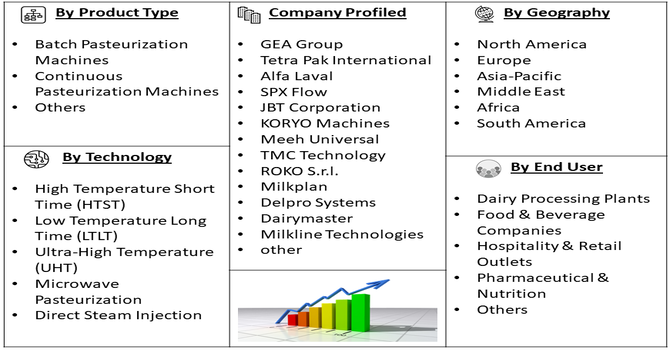
Segmentation: The Global Milk Pasteurization Machines Market is segmented by Type (Batch Pasteurization Machines, Continuous Pasteurization Machines and Others), Capacity (Up to 1,000 L/hr, 1,001–5,000 L/hr, 5,001–10,000 L/hr and Above 10,000 L/hr), End-User Industry (Dairy Processing Plants, Food & Beverage Companies, Hospitality & Retail Outlets, Pharmaceutical & Nutrition and Others), Technology (High Temperature Short Time (HTST), Low Temperature Long Time (LTLT), Ultra-High Temperature (UHT), Microwave Pasteurization, and Direct Steam Injection), and Geography (North America, Europe, Asia-Pacific, Middle East and Africa, and South America). The report provides the value (in USD million) for the above segments.
For Detailed Market Segmentation - Get a Free Sample PDF
Market Drivers:
The rising global demand for safe and high-quality dairy products is a major driver for the milk pasteurization machines market. Consumers are becoming more health-conscious, seeking milk and dairy products free from harmful bacteria and pathogens. Urbanization, changing lifestyles, and the increasing consumption of value-added dairy products such as flavored milk, yogurt, and cheese are contributing to this growth. For instance, Agriculture and Horticulture Development Board 2025 reported that, in 2024, Poland contributed 9% of total EU milk production which has grown from 1.9% in 2019 to 3.9% in 2024. Similarly, in UK Milk production is expected to grow marginally by 0.7% in 2025–2034 compared to the previous decade.
Dairy processing companies are investing in advanced pasteurization machines to ensure consistent quality, enhance shelf life, and meet stringent food safety regulations. This trend is particularly prominent in emerging economies where dairy consumption is rapidly increasing, boosting market demand.
Technological innovations in pasteurization machines are driving market growth by improving efficiency, product quality, and operational safety. Modern machines feature advanced automation, IoT-enabled monitoring, precise temperature control, and energy-efficient systems that reduce operational costs and minimize human error.
The integration of smart sensors and real-time monitoring allows manufacturers to maintain consistent quality standards and comply with stringent food safety regulations. For instance, In February 2024, DuPont Water Solutions introduced the FilmTec Hypershell NF245XD nanofiltration elements for the dairy industry, featuring enhanced membrane chemistry and superior chemical resistance. These elements provide up to 20% longer service life and 10% higher productivity than standard alternatives. Their adoption is expected to advance the global milk pasteurization machines market by enabling more efficient, automated processing, supporting technological innovations, and improving overall operational performance in dairy processing facilities worldwide.
Market Restraints:
The key restraints limiting the growth of the global milk pasteurization machines market is the high initial investment and ongoing maintenance costs associated with advanced equipment. Continuous and UHT pasteurization machines, in particular, require substantial capital for installation, specialized infrastructure, and skilled operators. Small and medium-sized dairy businesses often find it challenging to afford these systems, which can slow adoption in developing regions. Additionally, regular maintenance, calibration, and occasional replacement of parts increase operational expenses. These cost-related barriers restrict the market potential, especially in price-sensitive markets, and may prompt some players to continue using traditional, less efficient pasteurization methods.
The milk pasteurization machines market plays a crucial role in public health by ensuring safe dairy consumption, reducing risks of foodborne diseases, and improving nutritional standards globally. By enabling efficient milk processing, these machines support dairy farmers and small-scale producers, increasing productivity and income potential. The technology also fosters rural employment and strengthens supply chains in emerging economies. Furthermore, widespread pasteurization contributes to economic growth by enabling dairy exports, promoting industrial-scale operations, and reducing healthcare costs associated with contaminated milk. Enhanced product safety boosts consumer confidence, supporting broader adoption of processed dairy products and driving socio-economic benefits worldwide.
Segmental Analysis:
The continuous pasteurization machines segment is expected to witness the highest growth over the forecast period due to its ability to handle large-scale milk processing efficiently and consistently. These machines provide higher throughput compared to batch systems, reducing processing time while maintaining product quality and safety. Growing industrialization of the dairy sector and increasing demand for packaged milk and value-added products are driving adoption. Additionally, continuous systems are compatible with advanced automation and monitoring technologies, which appeal to large dairy manufacturers. Their efficiency, reliability, and scalability make them the preferred choice for modern dairy processing plants worldwide.
The 1,001–5,000 liters per hour capacity segment is expected to witness significant growth over the forecast period, primarily driven by medium-sized dairy operations and regional producers. This segment strikes a balance between affordability and production efficiency, making it attractive for expanding dairy businesses. Urbanization and rising milk consumption in developing countries are creating demand for machines capable of moderate-scale processing. Additionally, this capacity allows producers to meet safety standards, ensure product consistency, and supply packaged milk and dairy products to local and regional markets. The scalability and adaptability of machines in this range support market expansion.
The dairy processing plants segment is projected to witness the highest growth over the forecast period as industrial-scale milk and dairy product consumption rises globally. These plants require reliable and high-capacity pasteurization machines to ensure compliance with food safety regulations and meet consumer demand for safe, long-lasting products. Increasing production of value-added dairy items, including yogurt, cheese, and flavored milk, is further boosting adoption. Additionally, advancements in automation and energy-efficient technologies make pasteurization more cost-effective for large processors. The expansion of organized dairy sectors in emerging economies is expected to drive significant investment in advanced pasteurization equipment within processing plants.
The High Temperature Short Time (HTST) pasteurization segment is expected to witness the highest growth over the forecast period due to its efficiency, effectiveness, and ability to preserve milk quality. HTST technology rapidly heats milk to eliminate harmful microorganisms while maintaining flavor, nutrients, and freshness. It is widely adopted in medium- and large-scale dairy operations, particularly in regions with strict food safety standards. Rising demand for packaged and extended-shelf-life dairy products is further fueling growth. Additionally, HTST systems are compatible with automation and continuous processing, reducing labor and operational costs, which makes them the preferred choice for modern dairy processors worldwide.
The Asia Pacific region is expected to witness the highest growth over the forecast period due to increasing milk consumption, urbanization, and rising disposable incomes in countries such as India, China, and Southeast Asia.
Expanding dairy production and modernization of dairy infrastructure are driving demand for efficient pasteurization machines. For instance, in April 2024, DeLaval, formed a strategic partnership with SERAP, a global expert in manufacturing cooling tanks. DeLaval-branded milk coolers, designed and sourced from SERAP with customized technical specifications, are expected to enhance dairy processing efficiency in the Asia Pacific region. This collaboration is likely to drive adoption of advanced pasteurization systems, improve milk quality, and support the growing demand for processed dairy products across the region.
Similarly, in 2025, India’s Dairy Sector, reported that India’s dairy sector has experienced remarkable growth, with milk production increasing by 63.56%, from 146.30 million tonnes in 2014–15 to 239.30 million tonnes in 2023–24, reflecting an annual growth rate of 5.7%. As the world’s largest milk producer, India’s expanding dairy output is driving demand for advanced milk pasteurization machines in the Asia-Pacific region, boosting adoption of automated, high-capacity systems to ensure safety, quality, and efficiency in processing.
Additionally, governments are implementing strict food safety regulations and supporting organized dairy sectors, which encourages investment in advanced technologies. The growing preference for packaged and value-added dairy products, coupled with industrialization of milk processing, positions Asia Pacific as a high-growth market for pasteurization equipment over the forecast period.
| Report Matrics | Details |
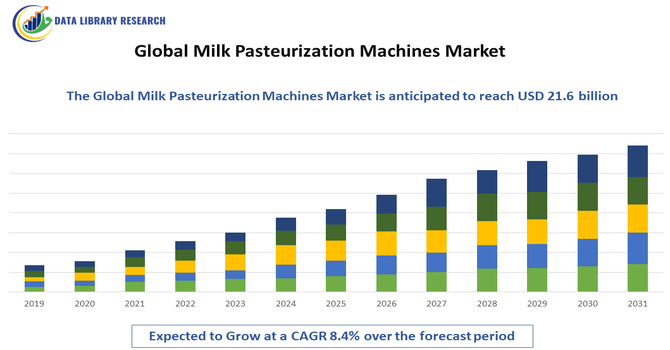
| Market Size Value | USD 21.6 billion |
| Growth Rate | CAGR of 8.4 % |
| Forecast | 2026-2033 |
| Historical data | 2021-2024 |
| Base Year | 2025 |
| Report Coverage | Forecasted revenue, company rating, competitive environment, growth drivers, and trends |
| Segment Coverage | Type, Application, End-User, Geography |
| Regional Scope | North America, Europe, Asia Pacific, Middle East |
| Customized scope | Free customization of reports (With 3 months Analysis Support ) |
| To Learn More About This Report | Request a Free Sample Copy |
The competitive landscape of the Global Milk Pasteurization Machines Market is characterized by a mix of established multinational manufacturers and specialized regional players. Leading companies focus on product innovation, automation, and energy efficiency to differentiate themselves, while strategic mergers, acquisitions, and partnerships are common to expand market reach. Companies invest in research and development to deliver high-capacity, low-maintenance, and environmentally friendly pasteurizers. Market players also emphasize after-sales services and customized solutions to meet varying client needs across industrial, commercial, and artisanal dairy sectors. Price competitiveness and technological differentiation remain key factors driving market share and global expansion.
The major players for above market are:
Recent Development
Q1. What are the main growth-driving factors for this market?
The primary driver is the rising global demand for safe, long-lasting dairy products and stricter government regulations regarding food safety. As urbanization increases, the need for processed milk that can be transported over long distances grows. Additionally, advancements in energy-efficient heating technologies help dairy producers reduce operational costs while maintaining high quality.
Q2. What are the main restraining factors for this market?
Growth is hindered by the high initial cost of industrial-grade pasteurization equipment, which is often unaffordable for small-scale farmers in developing regions. Maintenance requirements and the need for a stable power supply also present challenges. Furthermore, the rising popularity of plant-based milk alternatives is slightly slowing the demand for traditional dairy equipment.
Q3. Which segment is expected to witness high growth?
The HTST (High-Temperature Short-Time) segment is expected to see the highest growth. This method is preferred because it effectively kills harmful bacteria while preserving the milk's flavor and nutritional value better than older methods. It is highly efficient for continuous, large-scale production, making it the top choice for modern dairy plants.
Q4. Who are the top major players for this market?
The market is led by global engineering firms specializing in food processing technology. Key players include Tetra Pak, GEA Group, SPX FLOW, Alfa Laval, and Krones. These companies dominate by offering integrated solutions that combine pasteurization with cooling and packaging, ensuring a seamless and hygienic production line for global dairy brands.
Q5. Which country is the largest player?
China is currently the largest player in this market. The country has seen a massive surge in domestic milk consumption and is investing heavily in large-scale, modern dairy infrastructure to ensure food security. With rapid industrialization and the presence of some of the world's largest dairy companies, China leads in equipment demand.
Data Library Research are conducted by industry experts who offer insight on industry structure, market segmentations technology assessment and competitive landscape (CL), and penetration, as well as on emerging trends. Their analysis is based on primary interviews (~ 80%) and secondary research (~ 20%) as well as years of professional expertise in their respective industries. Adding to this, by analysing historical trends and current market positions, our analysts predict where the market will be headed for the next five years. Furthermore, the varying trends of segment & categories geographically presented are also studied and the estimated based on the primary & secondary research.
In this particular report from the supply side Data Library Research has conducted primary surveys (interviews) with the key level executives (VP, CEO’s, Marketing Director, Business Development Manager and SOFT) of the companies that active & prominent as well as the midsized organization
FIGURE 1: DLR RESEARH PROCESS
Extensive primary research was conducted to gain a deeper insight of the market and industry performance. The analysis is based on both primary and secondary research as well as years of professional expertise in the respective industries.
In addition to analysing current and historical trends, our analysts predict where the market is headed over the next five years.
It varies by segment for these categories geographically presented in the list of market tables. Speaking about this particular report we have conducted primary surveys (interviews) with the key level executives (VP, CEO’s, Marketing Director, Business Development Manager and many more) of the major players active in the market.
Secondary ResearchSecondary research was mainly used to collect and identify information useful for the extensive, technical, market-oriented, and Friend’s study of the Global Extra Neutral Alcohol. It was also used to obtain key information about major players, market classification and segmentation according to the industry trends, geographical markets, and developments related to the market and technology perspectives. For this study, analysts have gathered information from various credible sources, such as annual reports, sec filings, journals, white papers, SOFT presentations, and company web sites.
Market Size EstimationBoth, top-down and bottom-up approaches were used to estimate and validate the size of the Global market and to estimate the size of various other dependent submarkets in the overall Extra Neutral Alcohol. The key players in the market were identified through secondary research and their market contributions in the respective geographies were determined through primary and secondary research.
Forecast Model