
Get Complete Analysis Of The Report - Download Updated Free Sample PDF
The Global Personal Brain Trainer Market refers to the worldwide industry offering tools, apps, programs, and services designed to improve cognitive skills like memory, focus, and problem-solving. It includes digital platforms, games, wearable devices, and personalized training plans for users of all ages. Growth is driven by rising awareness of mental fitness, aging populations, and demand for accessible brain health solutions in education, healthcare, and workplace settings.
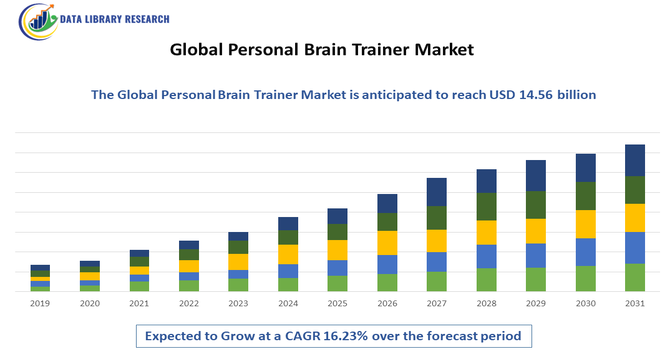
The Global Personal Brain Trainer Market is expanding rapidly as digital brain training tools and cognitive enhancement programs gain widespread use. Adoption of mobile and AI-powered platforms is increasing, with gamified exercises, personalized training regimens, and immersive VR/AR experiences becoming standard features to boost engagement. Users across age groups, from students to older adults, are turning to apps and software for memory, focus, and mental agility improvement. Preventive cognitive care and integration into corporate wellness and education systems are key growth drivers.
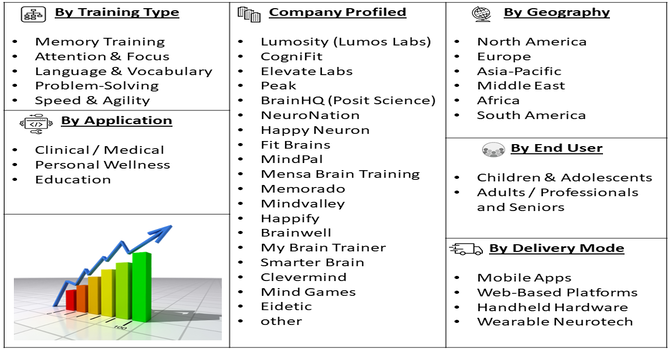
Segmentation: The Personal Brain Trainer Market is segmented by Training Type (Memory Training, Attention & Focus, Language & Vocabulary, Problem-Solving and Speed & Agility), Delivery Mode (Mobile Apps, Web-Based Platforms, Handheld Hardware and Wearable Neurotech), End-User (Children & Adolescents, Adults / Professionals and Seniors), Application (Clinical / Medical, Personal Wellness, and Education), and Geography (North America, Europe, Asia-Pacific, Middle East and Africa, and South America). The report provides the value (in USD million) for the above segments.
For Detailed Market Segmentation - Get a Free Sample PDF
Market Drivers:
Growing global awareness of cognitive health and mental fitness is a major driver of the Personal Brain Trainer Market. Individuals increasingly recognize the importance of maintaining memory, attention, and problem-solving skills alongside physical health. For instance, in December 2025, BrainyZap’s 66-Day Brain Transformation Program highlighted rising awareness of cognitive health by addressing focus, discipline, and emotional resilience in students. It also influenced the Global Stem Cell Pharmacy Market by showcasing the integration of structured cognitive development with advanced neurological and regenerative research.
This trend is especially strong among aging populations seeking preventive solutions to delay cognitive decline, as well as students and professionals aiming to enhance academic and workplace performance. Public discussions around brain health, stress management, and lifelong learning have normalized the use of brain training tools. As a result, consumers are more willing to adopt digital brain trainers as part of their daily wellness routines.
Technological innovation is significantly driving the growth of the global personal brain trainer market. The integration of artificial intelligence, machine learning, and data analytics enables highly personalized training programs that adapt to individual user performance. Features such as progress tracking, real-time feedback, and adaptive difficulty levels enhance perceived effectiveness.
Additionally, the widespread use of smartphones and improved internet connectivity allows brain training solutions to reach a global audience, supporting scalability and continuous market expansion across education, healthcare, and corporate wellness sectors. For instance, in October 2023, Sens.ai’s global launch accelerated advancements in digital and AI technologies through real-time, closed-loop neurofeedback and biosignal-driven personalization. Its sophisticated brain–body system also supports the Global Stem Cell Pharmacy Market by complementing regenerative therapies with precision cognitive monitoring, recovery optimization, and data-driven neurological performance enhancement.
Market Restraints:
A key restraint for the Global Personal Brain Trainer Market is skepticism regarding the scientific effectiveness of brain training programs. Some users and healthcare professionals question whether cognitive improvements gained through training transfer to real-world tasks. Inconsistent clinical evidence and varying product quality across providers contribute to doubts about long-term benefits. This skepticism can reduce adoption, especially among older adults and institutional buyers such as schools and healthcare organizations.
The personal brain trainer industry is influencing socioeconomic outcomes by promoting cognitive health and productivity across populations. Widespread use of brain training tools supports preventive health strategies, especially among aging demographics, helping delay cognitive decline and reducing long-term healthcare burdens. Integration into schools enhances learning and problem-solving skills, while employers increasingly include brain training in wellness programs to improve employee focus, performance, and job satisfaction. Access to affordable digital solutions is bridging gaps in cognitive fitness awareness and creating new opportunities for education and employment. However, cost and digital literacy barriers still limit access in lower-income regions, highlighting ongoing inequality challenges.
Segmental Analysis:
The Memory Training segment is expected to witness the highest growth over the forecast period due to increasing concerns about memory decline across all age groups. Seniors are adopting memory-focused programs to maintain cognitive independence, while students and professionals use them to enhance learning and information retention. Rising awareness of age-related cognitive conditions and the emphasis on preventive mental healthcare further support demand. Memory training exercises are among the most easily measurable and relatable brain training outcomes, increasing user trust and engagement. Continuous improvements in personalization and progress tracking also make memory training solutions more appealing and widely adopted.
The Mobile Apps segment is projected to experience the highest growth owing to widespread smartphone penetration and the convenience of on-the-go access. Mobile brain training apps offer flexibility, affordability, and ease of use, making them attractive to a broad user base.
App-based platforms also allow frequent updates, personalization through AI, and integration with wearable devices. For instance, in August 2024, Neuriva’s Brain Gym App boosted the Mobile Apps segment by offering free access to premium, personalized cognitive training with tailored sessions and regular updates. This development also influenced the Global Stem Cell Pharmacy Market by demonstrating digital tools' role in enhancing neurological health and therapy outcomes. Subscription-based pricing models further support scalability. As digital lifestyles expand globally, mobile apps continue to dominate the delivery of personal brain training solutions.
The Professionals and Seniors segment is expected to grow the fastest as both groups increasingly prioritize cognitive performance and mental health. Professionals seek brain training tools to improve focus, productivity, decision-making, and stress management in competitive work environments. Seniors adopt these solutions to maintain memory, attention, and overall cognitive function as part of healthy aging strategies. Rising life expectancy and longer working careers further amplify demand. Digital platforms designed with age-friendly interfaces and goal-oriented training programs are making adoption easier. Together, these factors position professionals and seniors as key growth contributors to the market.
The Personal Wellness segment is anticipated to witness the highest growth as mental fitness becomes a core component of holistic health. Consumers increasingly view brain training as part of daily self-care routines, alongside physical exercise and mindfulness practices. Growing awareness of stress, burnout, and mental fatigue is driving individuals to seek proactive solutions for cognitive balance and emotional resilience. Personal wellness-focused brain trainers emphasize habit building, relaxation, and long-term mental well-being rather than clinical intervention. The availability of affordable, personalized digital solutions further supports adoption, making personal wellness a major growth engine in the market.
North America is expected to record the highest growth over the forecast period due to strong digital infrastructure and high awareness of cognitive health. Early adoption of advanced technologies such as AI-driven personalization and data analytics supports market expansion in the region.
In June 2025, Jukestir’s emergence as a coordination-focused punching bag is strengthening North America’s Personal Brain Trainer Market by blending physical fitness with cognitive training. Its adoption in neurological rehabilitation labs, Parkinson’s programs, and elite athletic centers highlights growing demand for brain-based fitness solutions. Featuring on a top-ranked wellness podcast further amplifies awareness, reinforcing the region’s leadership in innovative, neuroscience-driven training tools that support rehabilitation, performance enhancement, and holistic brain–body wellness.
Furthermore, a large aging population, combined with a strong focus on preventive healthcare and wellness, drives demand for brain training solutions. Additionally, widespread use of mobile apps and corporate wellness programs accelerates adoption among professionals. The presence of major market players and ongoing innovation further strengthens North America’s leadership position in the global personal brain trainer market.
| Report Matrics | Details |
| Market Size Value | USD 14.56 billion |
| Growth Rate | CAGR of 16.23 % |
| Forecast | 2026-2033 |
| Historical data | 2021-2024 |
| Base Year | 2025 |
| Report Coverage | Forecasted revenue, company rating, competitive environment, growth drivers, and trends |
| Segment Coverage | Type, Application, End-User, Geography |
| Regional Scope | North America, Europe, Asia Pacific, Middle East |
| Customized scope | Free customization of reports (With 3 months Analysis Support ) |
| To Learn More About This Report | Request a Free Sample Copy |
The competitive landscape of the global brain trainer market is dynamic and moderately concentrated, featuring both established global brands and innovative niche players. Major companies invest heavily in research, AI, and adaptive technologies to differentiate offerings and improve training effectiveness. Regional firms tailor products to local languages and cultural needs, while strategic partnerships with healthcare, education, and corporate sectors expand market reach. Mergers and acquisitions are shaping competition, enabling larger firms to scale more rapidly and integrate advanced features. Emerging startups challenge incumbents with specialized, user-centric solutions, increasing overall market innovation and choice for consumers.
The major players for above market:
| Report Matrics | Details |
| Market Size Value | USD 14.56 billion |
| Growth Rate | CAGR of 16.23 % |
| Forecast | 2026-2033 |
| Historical data | 2021-2024 |
| Base Year | 2025 |
| Report Coverage | Forecasted revenue, company rating, competitive environment, growth drivers, and trends |
| Segment Coverage | Type, Application, End-User, Geography |
| Regional Scope | North America, Europe, Asia Pacific, Middle East |
| Customized scope | Free customization of reports (With 3 months Analysis Support ) |
| To Learn More About This Report | Request a Free Sample Copy |
Recent Development
Q1. What are the main growth-driving factors for this market?
The primary driver is the growing global focus on mental health and cognitive longevity. As populations age, there is an increased desire to delay the onset of dementia and memory loss. Additionally, the high-pressure competitive environment for students and professionals is fueling demand for "cognitive enhancement" tools that promise to improve focus, processing speed, and problem-solving skills through digital exercises.
Q2. What are the main restraining factors for this market?
The market is limited by skepticism regarding the scientific validity of "brain training" claims. Many health experts argue that "gaming" improvements do not always translate to real-world intelligence. Furthermore, the high subscription costs for premium apps and the time commitment required for results can lead to high user churn. Lack of standardized clinical regulations also makes it difficult for consumers to distinguish between effective tools and simple entertainment.
Q3. Which segment is expected to witness high growth?
The Mobile App-based Training segment is expected to witness the highest growth. Because almost everyone owns a smartphone, these platforms offer the most accessible and affordable way to practice daily cognitive drills. The integration of AI to personalize difficulty levels in real-time makes these apps highly engaging, allowing users to train their brains during commutes or short breaks.
Q4. Who are the top major players for this market?
The market is led by companies that combine neuroscience with gamification. Key players include Lumosity (Lumos Labs), Elevate, Peak, and CogniFit. These companies dominate by offering diverse exercise suites and detailed progress tracking, often collaborating with academic institutions to validate their training methods and appeal to a more health-conscious demographic.
Q5. Which country is the largest player?
The United States is the largest player in this market. This is due to a strong culture of self-improvement, high digital literacy, and significant investment in "ed-tech" and wellness startups. The presence of major silicon valley tech firms and a large population of aging "baby boomers" looking for cognitive health solutions drive consistent market leadership and innovation.
Data Library Research are conducted by industry experts who offer insight on industry structure, market segmentations technology assessment and competitive landscape (CL), and penetration, as well as on emerging trends. Their analysis is based on primary interviews (~ 80%) and secondary research (~ 20%) as well as years of professional expertise in their respective industries. Adding to this, by analysing historical trends and current market positions, our analysts predict where the market will be headed for the next five years. Furthermore, the varying trends of segment & categories geographically presented are also studied and the estimated based on the primary & secondary research.
In this particular report from the supply side Data Library Research has conducted primary surveys (interviews) with the key level executives (VP, CEO’s, Marketing Director, Business Development Manager and SOFT) of the companies that active & prominent as well as the midsized organization
FIGURE 1: DLR RESEARH PROCESS
Extensive primary research was conducted to gain a deeper insight of the market and industry performance. The analysis is based on both primary and secondary research as well as years of professional expertise in the respective industries.
In addition to analysing current and historical trends, our analysts predict where the market is headed over the next five years.
It varies by segment for these categories geographically presented in the list of market tables. Speaking about this particular report we have conducted primary surveys (interviews) with the key level executives (VP, CEO’s, Marketing Director, Business Development Manager and many more) of the major players active in the market.
Secondary ResearchSecondary research was mainly used to collect and identify information useful for the extensive, technical, market-oriented, and Friend’s study of the Global Extra Neutral Alcohol. It was also used to obtain key information about major players, market classification and segmentation according to the industry trends, geographical markets, and developments related to the market and technology perspectives. For this study, analysts have gathered information from various credible sources, such as annual reports, sec filings, journals, white papers, SOFT presentations, and company web sites.
Market Size EstimationBoth, top-down and bottom-up approaches were used to estimate and validate the size of the Global market and to estimate the size of various other dependent submarkets in the overall Extra Neutral Alcohol. The key players in the market were identified through secondary research and their market contributions in the respective geographies were determined through primary and secondary research.
Forecast Model