
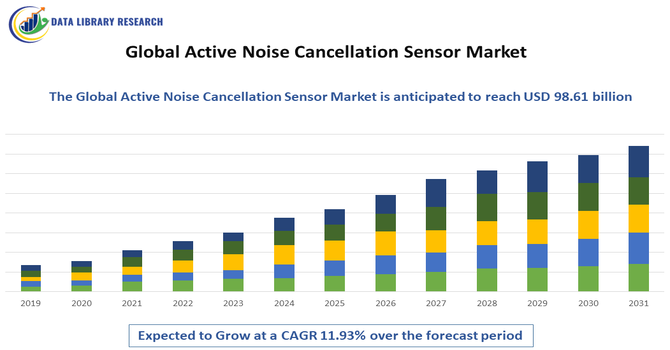
Get Complete Analysis Of The Report - Download Updated Free Sample PDF
The Global Active Noise Cancellation (ANC) Sensor Market refers to the worldwide sector focused on sensors and associated components that enable active noise cancellation systems, particularly in automotive and consumer applications. ANC sensors detect ambient sound levels and feed data to control units, which generate inverse sound waves to cancel unwanted noise, enhancing comfort and acoustic quality. The market serves automotive manufacturers, consumer electronics producers, aerospace, and industrial equipment sectors, driven by growing demand for quieter environments and advanced sound management. Rising adoption in electric vehicles, premium cars, audio devices, and smart systems is propelling market expansion.
Key trends in the Active Noise Cancellation Sensor Market include integration with advanced driver assistance systems (ADAS) and digital signal processing (DSP) technologies to optimize real time noise control. Automotive applications dominate due to increasing consumer demand for cabin comfort and the rise of electric vehicles, which lack engine noise and thus require sophisticated ANC solutions. Multi microphone sensor arrays and AI enhanced algorithms are improving performance across varied noise environments. Additionally, adoption beyond vehicles into consumer electronics and industrial equipment is expanding, as noise pollution concerns grow. Asia Pacific is emerging as a major growth region, supported by robust automotive production and rapid urbanization.
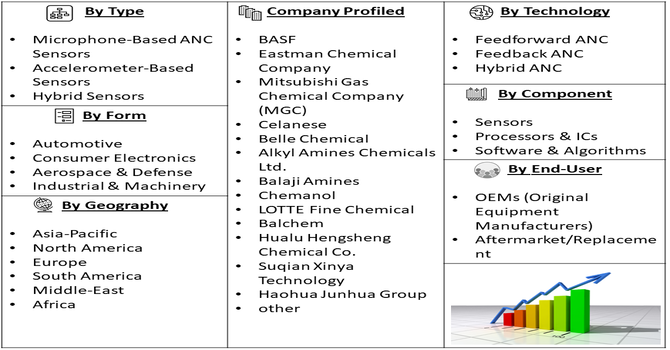
Segmentation: The Active Noise Cancellation Sensor Market is segmented by Sensor Type (Microphone-Based ANC Sensors, Accelerometer-Based Sensors and Hybrid Sensors), Application (Automotive, Consumer Electronics, Aerospace & Defense and Industrial & Machinery), Technology (Feedforward ANC, Feedback ANC, and Hybrid ANC), Component (Sensors, Processors & ICs and Software & Algorithms), End-User (OEMs (Original Equipment Manufacturers) and Aftermarket/Replacement), and Geography (North America, Europe, Asia-Pacific, Middle East and Africa, and South America). The report provides the value (in USD million) for the above segments.
For Detailed Market Segmentation - Get a Free Sample PDF
Market Drivers:
A primary driver of the Active Noise Cancellation Sensor Market is escalating consumer demand for noise free environments, especially in automotive cabins and consumer electronics. As comfort becomes a key differentiator in vehicle purchasing decisions, automakers integrate ANC systems to reduce road, wind, and engine noise, making sensors essential components.
Similarly, in audio devices such as premium headphones and smart speakers, active noise control enhances listening experiences by isolating desired sounds. For instance, in November 2023, TDK’s release of compact MAF1005FR noise suppression filters enhanced the Global Active Noise Cancellation Sensor Market by promoting integration of miniature ANC components in smartphones, tablets, and wearable devices, boosting demand for precision sensors and supporting the growth of portable consumer electronics requiring high-quality sound and noise reduction. Growing urbanization, increasing awareness of noise pollution’s health effects, and rising adoption of electric vehicles—where the absence of engine noise makes other noises more perceptible—further amplify market demand.
Another significant driver is the rapid growth of the electric vehicle (EV) market, which necessitates advanced noise management solutions. Electric motors generate less mechanical noise than traditional engines, making ambient sounds—such as tire, wind, and road noise—more noticeable. This increases reliance on active noise cancellation systems, which require precise ANC sensors to detect and counteract unwanted sound frequencies effectively. As global EV sales continue rising and automakers seek to enhance cabin comfort, demand for sophisticated ANC sensor technology expands. Additionally, regulatory focus on improved acoustic environments in transportation supports broader market adoption.
Market Restraints:
A key restraint for the Active Noise Cancellation Sensor Market is the high costs associated with advanced ANC system integration, which can limit adoption, particularly in price sensitive segments. Complex sensor arrays, sophisticated DSP units, and calibration software increase production expenses. In automotive applications, integrating ANC systems adds to overall vehicle costs, often restricting their inclusion to premium or luxury models. Moreover, detection and processing algorithms require significant engineering efforts and testing across diverse cabin environments, further raising development investments. These cost barriers can slow uptake among mid range manufacturers and delay widespread ANC deployment in mainstream products, hindering short term market expansion.
The Active Noise Cancellation Sensor Market positively impacts socioeconomic conditions by enhancing quality of life and occupational comfort. In vehicles, ANC systems reduce fatigue and stress, contributing to safer, more enjoyable travel experiences. In consumer electronics, noise cancellation improves user satisfaction in noisy urban environments. Growth in this market stimulates high tech manufacturing jobs, R&D investments, and supply chain development across semiconductor and sensor industries. Increased production in regions like Asia Pacific supports economic growth and technology adoption. Furthermore, advancing noise management aligns with public health goals—mitigating chronic noise exposure that can lead to hearing loss and stress related ailments—thereby addressing broader societal wellbeing.
Segmental Analysis:
The Accelerometer-Based Sensors segment is projected to witness the highest growth in the Global Active Noise Cancellation (ANC) Sensor Market due to their ability to detect structural vibrations and mechanical noise in vehicles, machinery, and consumer electronics. These sensors enable precise cancellation of low-frequency sounds that conventional microphones may not effectively capture. Increasing adoption in electric vehicles, premium automobiles, and industrial equipment is driving demand. The growth is also supported by technological advancements in microelectromechanical systems (MEMS), allowing compact, high-performance accelerometers. Rising consumer expectations for quieter cabins and immersive audio experiences in headphones and smart devices further boost the market for accelerometer-based ANC sensors globally.
The Aerospace & Defense segment is expected to witness the highest growth in the ANC sensor market due to the critical need for reducing noise in aircraft cabins, cockpits, and military vehicles. Noise reduction enhances passenger comfort, operational safety, and crew concentration, especially in high-speed aircraft or helicopters. Advanced ANC sensors are increasingly integrated with vibration detection and DSP systems to mitigate engine, wind, and structural noise. Growing investments in defense and commercial aviation, alongside stringent regulations for cabin noise reduction, are driving adoption. Additionally, demand for lightweight, energy-efficient, and high-performance ANC solutions in modern aerospace applications is further supporting the market expansion in this segment globally.
The Hybrid ANC segment is projected to witness the highest growth due to its ability to combine feedforward and feedback active noise cancellation techniques, providing superior performance across diverse environments. Hybrid ANC systems are increasingly used in premium automobiles, headphones, and smart audio devices to deliver enhanced low- and high-frequency noise suppression. The rising adoption of electric vehicles, which expose cabin occupants to amplified road and wind noise, is driving demand. Advancements in digital signal processing algorithms and real-time noise analysis enable hybrid systems to adapt dynamically, improving sound quality and comfort. Consumer preference for premium audio experiences is further propelling hybrid ANC market growth globally.
The Software & Algorithms segment is expected to witness the highest growth in the Global ANC Sensor Market due to the increasing demand for intelligent noise management solutions. Advanced algorithms, including adaptive filtering, machine learning, and real-time signal processing, enhance the performance of ANC systems in vehicles, headphones, and industrial applications. As consumers seek immersive, distortion-free audio experiences, manufacturers are investing in software to optimize cancellation across varying noise environments. Additionally, integration of ANC software with connected devices, IoT systems, and electric vehicles boosts the market. Continuous innovation in DSP algorithms and AI-based noise prediction models ensures software remains a critical growth driver in the ANC sensor ecosystem.
The Aftermarket/Replacement segment is projected to witness the highest growth due to rising consumer demand for retrofitted ANC systems in vehicles, headphones, and industrial equipment. Many consumers seek upgrades to enhance cabin comfort, reduce mechanical noise, or improve audio experiences in existing products. The segment benefits from increased awareness of ANC benefits, ease of installation, and availability of plug-and-play solutions. Growing popularity of aftermarket audio devices, smart headsets, and portable ANC accessories further stimulates market expansion. Additionally, rising vehicle electrification and long product lifecycles create opportunities for replacement sensors and modules. Cost-effective retrofitting options drive adoption, making the aftermarket segment a key growth contributor globally.
The North American region is expected to witness the highest growth in the Global ANC Sensor Market due to strong adoption of advanced automotive technologies, premium consumer electronics, and aerospace innovations. High penetration of electric and autonomous vehicles has increased the need for precise noise cancellation in cabins.
Additionally, widespread use of headphones, smart speakers, and wearable devices supports growing demand for high-performance ANC sensors. For instance, in September 2025, Apple launched AirPods Pro 3 at USD 249 with heart-rate sensors, upgraded active noise cancellation, USB-C charging, and powered by the custom H2 chip, enhancing health monitoring and audio performance.
Investments in research and development by leading tech companies and sensor manufacturers, coupled with regulatory focus on occupational and environmental noise reduction, further drive growth. Strong consumer awareness, urbanization, and rising disposable incomes position North America as a key regional market for ANC sensor technologies.
To Learn More About This Report - Request a Free Sample Copy
The competitive landscape of the Global Active Noise Cancellation Sensor Market is moderately concentrated, with major semiconductor and automotive suppliers at the forefront. Key players invest in R&D to deliver advanced ANC sensor modules, multi array microphones, and integrated DSP solutions. Partnerships between sensor manufacturers and automotive OEMs are common to develop optimized, real time ANC systems. Technology firms also target consumer electronics applications, enhancing cross sector competitiveness. Regional players, particularly in Asia Pacific, leverage cost advantages and proximity to automotive and electronics hubs to expand market share. Market competition focuses on innovation, integration capabilities, and sensor accuracy, with companies striving to offer low power, high performance solutions suitable for electric or autonomous vehicles and next generation smart devices.
The major players are:
Recent Development
Q1. What are the main growth-driving factors for this market?
Market growth is propelled by the rising demand for high-fidelity consumer electronics and the expansion of hybrid work, making noise-canceling headsets essential productivity tools. Additionally, the automotive sector is integrating these sensors into "smart cockpits" and electric vehicles (EVs) to manage cabin acoustics and reduce road-induced noise.
Q2. What are the main restraining factors for this market?
Growth is restricted by the high cost and technical complexity of proprietary ANC silicon and multi-microphone calibration. Stringent manufacturing tolerances and the need for significant R&D investment create high entry barriers. Furthermore, power consumption challenges in small, battery-operated wearables can limit the deployment of sophisticated, multi-sensor adaptive arrays.
Q3. Which segment is expected to witness high growth?
The Hybrid ANC segment is expected to witness the highest growth due to its superior noise cancellation performance by combining feedforward and feedback techniques. Rising demand in premium headphones, electric vehicles, and smart devices drives adoption, enhancing audio quality and user comfort globally.
Q4. Who are the top major players for this market?
The competitive landscape is led by semiconductor and audio giants, including Sony, Bose, and Apple. Key component and system innovators include Molex, Harman (Samsung), STMicroelectronics, Analog Devices (ADI), and Asahi Kasei Microdevices (AKM), which provide the high-precision MEMS microphones and digital signal processors (DSPs) required for ANC.
Q5. Which country is the largest player?
The United States is the largest player, commanding over majority of the global market. Its leadership is driven by early regulatory adoption of noise-control standards, a robust ecosystem of tech giants like Apple and Bose, and significant R&D spending in the automotive and aerospace industries focused on acoustic comfort.
Data Library Research are conducted by industry experts who offer insight on industry structure, market segmentations technology assessment and competitive landscape (CL), and penetration, as well as on emerging trends. Their analysis is based on primary interviews (~ 80%) and secondary research (~ 20%) as well as years of professional expertise in their respective industries. Adding to this, by analysing historical trends and current market positions, our analysts predict where the market will be headed for the next five years. Furthermore, the varying trends of segment & categories geographically presented are also studied and the estimated based on the primary & secondary research.
In this particular report from the supply side Data Library Research has conducted primary surveys (interviews) with the key level executives (VP, CEO’s, Marketing Director, Business Development Manager and SOFT) of the companies that active & prominent as well as the midsized organization
FIGURE 1: DLR RESEARH PROCESS
Extensive primary research was conducted to gain a deeper insight of the market and industry performance. The analysis is based on both primary and secondary research as well as years of professional expertise in the respective industries.
In addition to analysing current and historical trends, our analysts predict where the market is headed over the next five years.
It varies by segment for these categories geographically presented in the list of market tables. Speaking about this particular report we have conducted primary surveys (interviews) with the key level executives (VP, CEO’s, Marketing Director, Business Development Manager and many more) of the major players active in the market.
Secondary ResearchSecondary research was mainly used to collect and identify information useful for the extensive, technical, market-oriented, and Friend’s study of the Global Extra Neutral Alcohol. It was also used to obtain key information about major players, market classification and segmentation according to the industry trends, geographical markets, and developments related to the market and technology perspectives. For this study, analysts have gathered information from various credible sources, such as annual reports, sec filings, journals, white papers, SOFT presentations, and company web sites.
Market Size EstimationBoth, top-down and bottom-up approaches were used to estimate and validate the size of the Global market and to estimate the size of various other dependent submarkets in the overall Extra Neutral Alcohol. The key players in the market were identified through secondary research and their market contributions in the respective geographies were determined through primary and secondary research.
Forecast Model