
Get Complete Analysis Of The Report - Download Updated Free Sample PDF
The Global Ultrasonic Homogenizer Machine Market is experiencing strong growth driven by the rising global demand for poultry products, which in turn fuels the need for efficient poultry processing equipment like chicken plucker machines. Increasing poultry consumption—propelled by population growth, urbanization, and a shift towards protein rich diets—has led commercial processors and poultry farms to adopt mechanized plucking solutions to boost throughput and operational efficiency. Automated plucker machines significantly reduce processing time compared to manual methods and help facilities meet stringent food safety and hygiene standards required by regulatory bodies, driving their adoption worldwide. Additionally, labor shortages and high labor costs in food processing sectors are compelling poultry producers to invest in automated equipment, further accelerating market growth.
The Global Chicken Plucker Machine Market is being shaped by several key trends that reflect broader shifts in poultry processing and technology adoption. A major trend is the growing integration of automation and smart technologies within plucking equipment. Manufacturers are incorporating IoT sensors and AI based systems to monitor performance in real time, optimize plucking efficiency, and reduce manual oversight, which enhances productivity and reduces waste. Such innovations also help poultry processors maintain consistent quality across different bird sizes and types. Sustainability and energy efficiency are increasingly important, with modern machines designed to minimize water usage, cut power consumption, and use durable, easy to clean materials that support hygiene and reduce environmental impact. This shift aligns with strict food safety regulations and rising industry focus on environmentally responsible production.
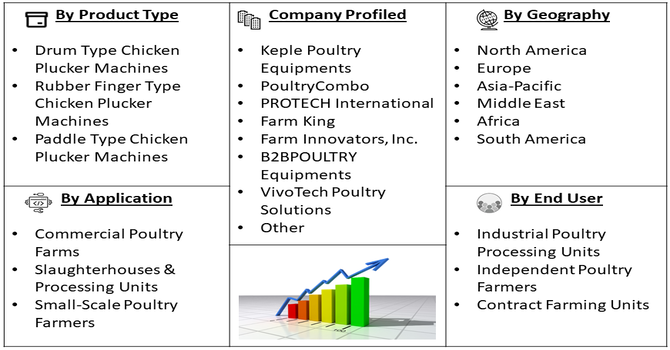
Segmentation: Global Chicken Plucker Machine Market is segmented By Type (Drum Type Chicken Plucker Machines, Rubber Finger Type Chicken Plucker Machines, Paddle Type Chicken Plucker Machines), By Capacity (Small Scale (Below 500 birds/hour), Medium Scale (500–2000 birds/hour), Large Scale (Above 2000 birds/hour), By Application (Commercial Poultry Farms, Slaughterhouses & Processing Units, Small-Scale Poultry Farmers), By End User (Industrial Poultry Processing Units, Independent Poultry Farmers, Contract Farming Units), and Geography (North America, Europe, Asia-Pacific, Middle East and Africa, and South America). The report provides the value (in USD million) for the above segments.
For Detailed Market Segmentation - Get a Free Sample PDF
Market Drivers:
A major driver of the chicken plucker machine market is the growing global consumption of poultry meat and eggs, driven by population growth, urbanization, and increasing awareness of protein-rich diets. As consumer demand rises, poultry producers and commercial farms are under pressure to enhance productivity and process larger volumes efficiently. In 2025, United States Department of Agriculture (USDA) reported that, global poultry meat production is projected to reach 151.4 million metric tons in 2025, maintaining its position as the most produced and consumed animal protein worldwide.
Chicken plucker machines allow for rapid and uniform feather removal, significantly reducing processing time compared to manual plucking. This increased efficiency helps producers meet high-volume demand while maintaining consistent product quality, making automated pluckers a critical investment for scaling operations.
The adoption of chicken plucker machines is further propelled by labor shortages and rising labor costs in the poultry processing sector. Manual plucking is labor-intensive, time-consuming, and prone to inconsistencies, whereas automated machines streamline the process, improve hygiene, and enhance overall operational efficiency. Modern plucker machines, often equipped with rubber finger or drum mechanisms, enable high throughput with minimal human intervention. This reduction in dependency on manual labor not only lowers operational costs but also minimizes human error and contamination risks, driving market growth in both commercial farms and industrial processing units worldwide.
Market Restraints:
The major restraints for the chicken plucker machine market is the high upfront cost associated with purchasing advanced plucking equipment, especially large-capacity or automated models. Small-scale poultry farmers and emerging-market producers may find these machines financially challenging, limiting widespread adoption. Additionally, these machines require regular maintenance, periodic replacement of rubber fingers, and occasional motor servicing to ensure optimal performance and hygiene compliance. The combination of initial capital expenditure and ongoing operational costs can act as a barrier for cost-sensitive customers, particularly in developing regions.
Chicken plucker machines can face technical limitations depending on bird size, type, and feather density. For instance, inconsistent plucking or damage to skin may occur if machines are not properly calibrated or if birds vary significantly in size. Some machines may also have limited processing capacity per cycle, making them less suitable for extremely large-scale operations without multiple units. These operational challenges necessitate skilled handling and regular monitoring, which can restrict efficiency and limit adoption among smaller operators or those lacking technical expertise.
The Chicken Plucker Machine Market has significant socioeconomic impacts by transforming poultry processing, improving efficiency, and reducing labor-intensive work. By automating feather removal, these machines enhance productivity in small- and large-scale farms, lower operational costs, and improve hygiene standards, contributing to safer food production. The market also creates employment opportunities in manufacturing, maintenance, and distribution, while supporting ancillary industries like agriculture machinery and poultry supply chains. Increased mechanization enables farmers to scale operations and meet growing consumer demand, improving income stability and rural livelihoods. Overall, the adoption of chicken plucker machines fosters economic growth, food security, and technological advancement in the poultry sector globally.
Segmental Analysis:
Rubber finger type chicken plucker machines dominate the market due to their efficiency, gentle plucking action, and adaptability to various bird sizes. The flexible rubber fingers remove feathers effectively without damaging skin, making them popular among both commercial and small-scale poultry operations. Their durability and ease of maintenance contribute significantly to their market value in USD million.
Medium-scale machines are widely adopted by commercial poultry farms and small slaughterhouses that require moderate throughput without the high cost of large-scale systems. They provide an ideal balance of efficiency, affordability, and operational flexibility, driving significant market growth.
The adoption of chicken plucker machines also has environmental and social benefits. By streamlining poultry processing, these machines reduce waste, energy consumption, and water usage compared to traditional manual methods. Improved efficiency lowers costs and product prices, increasing accessibility for consumers. Collectively, this fosters sustainable practices, enhances food security, and supports the socioeconomic development of communities reliant on poultry farming.
Slaughterhouses and processing units represent a key application segment as high-volume feather removal is critical for operational efficiency and hygiene compliance. Adoption of automated chicken pluckers reduces manual labor, processing time, and contamination risks, enhancing productivity and supporting industry growth.
Industrial poultry processing units are major end users due to their need for high-capacity, reliable, and automated plucking solutions. These units handle large volumes daily, making efficiency, consistency, and maintenance ease crucial factors for selecting chicken plucker machines.
Small- and medium-sized poultry farms particularly benefit from chicken plucker machines, as mechanization reduces dependence on manual labor, shortens processing time, and minimizes post-slaughter losses. This enables farmers to increase production capacity, improve profitability, and supply larger markets efficiently. The resulting economic empowerment supports rural development, encourages entrepreneurship, and strengthens local poultry industries, driving sustained growth and adoption of innovative poultry processing technologies worldwide.
North America region is expected to witness the highest growth over the forecast period, driven by the increasing adoption of automated chicken plucker machines across commercial poultry farms and industrial processing units. Rising labor costs, coupled with a strong emphasis on operational efficiency and food safety, are motivating producers to mechanize feather removal processes.
The USDA projected a 2% increase in US’s chicken meat production in 2025, reaching 151.4 million metric tons. This growth is driven by rising consumer demand, cost competitiveness relative to other meats, and enhanced production efficiency, reflecting the poultry industry’s ability to meet market needs while supporting expanding supply chains worldwide.
In 2024, North America’s chicken plucker machine market saw significant growth driven by technological innovations and strategic collaborations. Allana Group expanded operations with integrated solutions, while leading manufacturers incorporated automation, AI, and IoT-enabled features in plucking machines. These advancements enhanced operational efficiency, reduced labor dependence, and strengthened adoption across poultry processing facilities in the region.
The region also benefits from advanced manufacturing technologies, high-quality standards, and early adoption of innovative poultry processing equipment, including energy-efficient and high-capacity pluckers. Growing demand for poultry products, driven by health-conscious consumers seeking protein-rich diets, further supports North America’s position as the fastest-growing market globally.
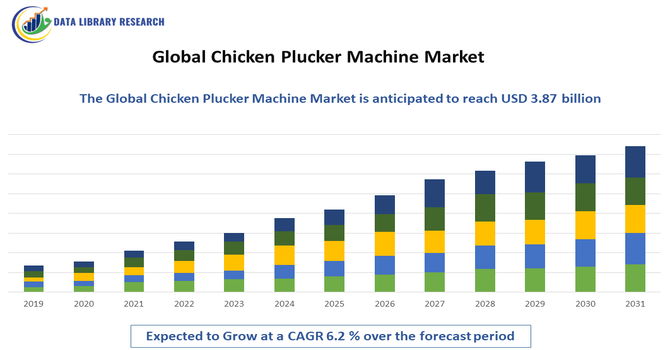
| Market Size Value | USD 3.87 billion |
| Growth Rate | CAGR of 6.2 % |
| Forecast | 2026-2033 |
| Historical data | 2021-2024 |
| Base Year | 2025 |
| Report Coverage | Forecasted revenue, company rating, competitive environment, growth drivers, and trends |
| Segment Coverage | Type, Application, End-User, Geography |
| Regional Scope | North America, Europe, Asia Pacific, Middle East |
| Customized scope | Free customization of reports (With 3 months' Analysis Support ) |
| To Learn More About This Report | Request a Free Sample Copy |
The Global Chicken Plucker Machine Market is competitive, with numerous regional and global manufacturers striving to innovate and expand their footprint across poultry farms, slaughterhouses, and processing units. Companies are focusing on technological improvements such as energy efficient motors, durable rubber finger designs, customizable capacity options, and user friendly automation to differentiate their product offerings. Strategic initiatives include partnerships with poultry equipment distributors, enhanced after sales support, wider product portfolios spanning small to industrial scale machines, and marketing efforts targeting emerging markets. Price competitiveness, product reliability, and localized service networks are key factors shaping competition as demand for mechanized plucking continues to grow globally.
The major players for this market are:
Recent Development
Q1. What are the main growth-driving factors for this market?
The primary driver is the rising global demand for poultry meat, which requires faster processing than manual labor can provide. Automation helps farmers and butcher shops save time and reduce labor costs. Additionally, stricter hygiene standards in the food industry encourage the use of stainless-steel machines that are easier to clean and sanitize than traditional methods.
Q2. What are the main restraining factors for this market?
Growth is limited by the high cost of electricity and the initial investment required for high-capacity industrial machines, which can be too expensive for small family farms. Maintenance is also a factor, as the rubber "fingers" used to pluck feathers wear out and need frequent replacement. In some regions, traditional manual processing remains the cheaper alternative.
Q3. Which segment is expected to witness high growth?
The Automatic/Industrial Plucker segment is expected to see the highest growth. Large-scale poultry processing plants are increasingly upgrading to fully automated systems to keep up with massive supermarket orders. These machines can process hundreds of birds per hour with very little human help, making them essential for high-volume meat production and global export.
Q4. Who are the top major players for this market?
The market is led by global agricultural equipment manufacturers and specialized food processing firms. Key players include Marel, Baader, Bayle SA, Meyn Food Processing, and Featherman Equipment. These companies dominate by offering a range of machines, from small tabletop models for hobby farmers to massive, conveyor-belt systems for international food corporations.
Q5. Which country is the largest player?
China is the largest player in the chicken plucker machine market. It has the world’s largest poultry industry and is a major hub for manufacturing affordable agricultural machinery. Both the high local consumption of chicken and the export of low-cost, durable plucking machines to farmers worldwide keep China in the top global position.
Data Library Research are conducted by industry experts who offer insight on industry structure, market segmentations technology assessment and competitive landscape (CL), and penetration, as well as on emerging trends. Their analysis is based on primary interviews (~ 80%) and secondary research (~ 20%) as well as years of professional expertise in their respective industries. Adding to this, by analysing historical trends and current market positions, our analysts predict where the market will be headed for the next five years. Furthermore, the varying trends of segment & categories geographically presented are also studied and the estimated based on the primary & secondary research.
In this particular report from the supply side Data Library Research has conducted primary surveys (interviews) with the key level executives (VP, CEO’s, Marketing Director, Business Development Manager and SOFT) of the companies that active & prominent as well as the midsized organization
FIGURE 1: DLR RESEARH PROCESS
Extensive primary research was conducted to gain a deeper insight of the market and industry performance. The analysis is based on both primary and secondary research as well as years of professional expertise in the respective industries.
In addition to analysing current and historical trends, our analysts predict where the market is headed over the next five years.
It varies by segment for these categories geographically presented in the list of market tables. Speaking about this particular report we have conducted primary surveys (interviews) with the key level executives (VP, CEO’s, Marketing Director, Business Development Manager and many more) of the major players active in the market.
Secondary ResearchSecondary research was mainly used to collect and identify information useful for the extensive, technical, market-oriented, and Friend’s study of the Global Extra Neutral Alcohol. It was also used to obtain key information about major players, market classification and segmentation according to the industry trends, geographical markets, and developments related to the market and technology perspectives. For this study, analysts have gathered information from various credible sources, such as annual reports, sec filings, journals, white papers, SOFT presentations, and company web sites.
Market Size EstimationBoth, top-down and bottom-up approaches were used to estimate and validate the size of the Global market and to estimate the size of various other dependent submarkets in the overall Extra Neutral Alcohol. The key players in the market were identified through secondary research and their market contributions in the respective geographies were determined through primary and secondary research.
Forecast Model