Large-Scale Housing Construction Market Overview and Analysis
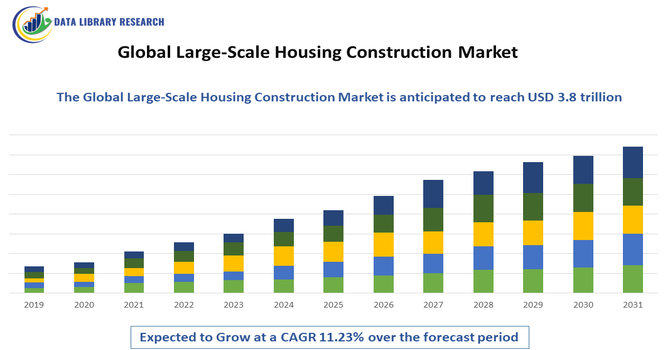
- The Residential Construction Industry is expected to grow from USD 1.85 trillion in 2025 to USD 3.8 trillion by 2032, growing with a CAGR of 11.23% from 2025-2032.
Get Complete Analysis Of The Report - Download Updated Free Sample PDF
The Global Large-Scale Housing Construction Market refers to the worldwide industry focused on planning, designing, and building extensive residential projects, including apartment complexes, housing estates, and multi-unit developments. It encompasses activities from land acquisition and project financing to construction, infrastructure development, and post-construction management. The market includes contractors, developers, and construction technology providers, and is influenced by trends in smart housing, green building practices, and advanced construction materials.
Large-Scale Housing Construction Market Latest Trends
The Global Large-Scale Housing Construction Market is experiencing rapid evolution driven by urbanization, population growth, and rising demand for affordable housing. Key trends include the adoption of sustainable and green building practices, smart home technologies, and prefabricated construction methods that improve efficiency and reduce costs. Increasing use of advanced construction materials, digital project management tools, and Building Information Modeling (BIM) enhances design accuracy and project execution.
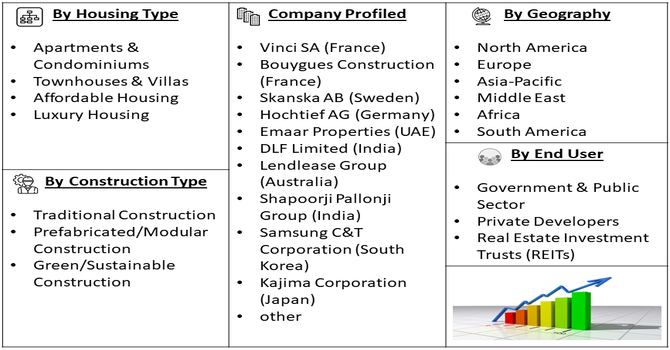
Segmentation: The Global Large-Scale Housing Construction Market is Housing Type (Apartments & Condominiums, Townhouses & Villas, Affordable Housing and Luxury Housing), Construction Type (Traditional Construction, Prefabricated/Modular Construction and Green/Sustainable Construction), End User (Government & Public Sector, Private Developers and Real Estate Investment Trusts (REITs)), and Geography (North America, Europe, Asia-Pacific, Middle East and Africa, and South America). The report provides the value (in USD million) for the above segments.
For Detailed Market Segmentation - Get a Free Sample PDF
Market Drivers:
- Urbanization and Population Growth
Rapid urbanization and increasing population in developing and emerging economies have been major drivers for large-scale housing construction. Growing urban populations create high demand for residential units, including apartments, townhouses, and affordable housing complexes. Governments and private developers are investing heavily in urban infrastructure to accommodate this growth. The trend is especially strong in Asia-Pacific and Africa, where expanding cities require large housing projects to prevent overcrowding and slum development. Consequently, urban planning initiatives, rising middle-class populations, and migration to metropolitan areas continue to stimulate demand for large-scale, organized residential construction.
- Government Housing Policies and Incentives
Government policies and incentives have significantly fueled growth in large-scale housing construction. Programs promoting affordable housing, public-private partnerships, and subsidies for developers encourage large residential projects. Tax incentives, low-interest financing, and grants reduce project costs and improve profitability for developers. Additionally, initiatives for sustainable and green housing motivate companies to adopt advanced technologies and eco-friendly materials. Such policy-driven support enhances housing supply, improves urban living conditions, and attracts private investment. Regulatory frameworks ensuring quality and safety further drive confidence in large-scale projects, making government backing a key market growth factor globally.
Market Restraints:
- High Construction Costs and Resource Limitations
High construction costs and limited availability of resources pose a significant restraint for the large-scale housing construction market. Rising prices of raw materials such as steel, cement, and timber increase project budgets, reducing profitability. Labor shortages, skilled workforce gaps, and logistical challenges further complicate project execution. Delays due to land acquisition, regulatory approvals, and environmental clearances add additional costs and risks. These financial and operational constraints can limit the pace and scale of residential projects, particularly in emerging markets, slowing market growth despite strong demand for urban housing.
Socioeconomic Impact on Large-Scale Housing Construction Market
Large-scale housing construction significantly influences socioeconomic development by creating employment opportunities across engineering, labor, and management sectors. Affordable housing initiatives improve living standards, reduce overcrowding, and enhance social well-being in urban areas. Infrastructure development associated with these projects stimulates local economies, boosts property values, and supports access to education, healthcare, and public services. Additionally, the sector attracts domestic and foreign investment, promoting economic growth. However, rapid urban construction can strain local resources and environmental sustainability, requiring careful planning to balance economic benefits with social and ecological responsibility in growing urban regions.
Segmental Analysis:
- Affordable Housing segment is expected to witness highest growth over the forecast period
The Affordable Housing segment is projected to witness the fastest growth due to rising demand for cost-effective residential units in urban areas worldwide. Rapid population growth, migration to cities, and government initiatives promoting low-cost housing are driving developers to focus on large-scale, affordable projects. Subsidies, tax incentives, and public-private partnerships further encourage investment in this segment. Affordable housing improves living standards, reduces overcrowding, and addresses social inequalities, making it a strategic priority for policymakers. Consequently, this segment is expected to dominate market expansion over the forecast period, especially in emerging economies with high urban housing demand.
- Prefabricated/Modular Construction segment is expected to witness highest growth over the forecast period
The Prefabricated/Modular Construction segment is expected to grow rapidly due to its efficiency, cost-effectiveness, and reduced construction timelines. Factory-built modules are assembled on-site, minimizing labor requirements, material waste, and project delays. This method is particularly appealing for large-scale housing projects, where time and budget constraints are critical. Additionally, advancements in modular technology, improved design flexibility, and growing adoption of sustainable building practices are accelerating acceptance. Governments and private developers increasingly recognize modular construction as a solution to meet urban housing demand quickly and efficiently, making it one of the fastest-growing construction methods globally.
- Government & Public Sector segment is expected to witness highest growth over the forecast period
The Government & Public Sector segment is anticipated to see the highest growth as authorities invest in large-scale housing projects to address urbanization and housing shortages. Public initiatives often focus on affordable housing, social housing, and urban redevelopment programs. Governments collaborate with private developers through public-private partnerships (PPPs) to deliver scalable, quality residential projects. Policies providing financial incentives, regulatory support, and streamlined approvals further encourage project execution. With the rising need for organized urban planning and improved living standards, the public sector continues to be a key driver of large-scale housing construction, especially in developing regions.
- Asia-Pacific Region segment is expected to witness highest growth over the forecast period
The Asia-Pacific region is projected to experience the highest growth in large-scale housing construction due to rapid urbanization, population expansion, and rising middle-class income. Countries like China, India, and Southeast Asian nations are witnessing significant demand for residential units, including affordable and high-density housing.
In 2025, Bank of America’s USD 7.8 billion in debt and equity financing significantly influenced the Asia-Pacific Large-Scale Housing Construction Market by demonstrating the impact of large-scale investment in affordable housing. By supporting the creation and preservation of thousands of residential units and promoting community stability, the initiative highlighted the value of integrated financing strategies for housing development. Its model encouraged similar investment approaches in Asia-Pacific, fostering urban residential construction, improving access to essential services, and driving growth in large-scale housing projects across the region.
Government initiatives promoting urban infrastructure, housing subsidies, and smart city development further stimulate growth. Adoption of prefabricated construction and sustainable building practices enhances project efficiency and scalability. With favorable economic conditions, foreign investments, and technological advancements, the Asia-Pacific region is expected to lead global expansion in large-scale housing construction over the forecast period.
| Report Matrics |
Details |
| Market Size Value |
USD 3.8 trillion |
| Growth Rate |
CAGR of 11.23 % |
| Forecast |
2026-2033 |
| Historical data |
2021-2024 |
| Base Year |
2025 |
| Report Coverage |
Forecasted revenue, company rating, competitive environment, growth drivers, and trends |
| Segment Coverage |
Type, Application, End-User, Geography |
| Regional Scope |
North America, Europe, Asia Pacific, Middle East |
| Customized scope |
Free customization of reports (With 3 months Analysis Support ) |
| To Learn More About This Report |
Request a Free Sample Copy |
Large-Scale Housing Construction Market Competitive Landscape
The competitive landscape of the Global Large-Scale Housing Construction Market is characterized by both multinational construction firms and regional developers. Market players compete based on project scale, cost efficiency, quality of construction, sustainability practices, and technological integration such as modular construction and smart home features. Strategic partnerships with governments, real estate developers, and technology providers enhance market positioning. Mergers, acquisitions, and joint ventures are common to expand geographical reach and capabilities. Companies differentiate themselves through innovation, compliance with regulations, and delivery timelines, fostering intense competition while driving industry growth, efficiency, and adoption of advanced construction technologies globally.
The major players for above market are:
- Vinci SA (France)
- Bouygues Construction (France)
- Skanska AB (Sweden)
- Hochtief AG (Germany)
- Emaar Properties (UAE)
- DLF Limited (India)
- Lendlease Group (Australia)
- Shapoorji Pallonji Group (India)
- Samsung C&T Corporation (South Korea)
- Kajima Corporation (Japan)
- Obayashi Corporation (Japan)
- Bechtel Corporation (USA)
- Turner Construction Company (USA)
- Bouygues Immobilier (France)
- Henderson Land Development (Hong Kong)
- China Overseas Land & Investment Ltd. (COLI)
- Reliance Infrastructure (India)
Recent Development
- In September 2025, USD 1 billion joint venture between Manulife IM and TruAmerica Multifamily boosted the Global Large-Scale Housing Construction Market by accelerating affordable housing development. The acquisition of income-restricted, tax-credit-backed properties increased large-scale residential construction, encouraged public-private collaborations, and highlighted the growing demand for cost-effective, high-quality housing worldwide.
- In July 2025, Jonathan Rose Companies’ USD 660 million Affordable Housing Preservation Fund VI boosted North America’s large-scale housing construction by accelerating the acquisition, preservation, and upgrading of affordable and mixed-income multifamily units, driving urban residential development and encouraging similar private-sector investments.
Frequently Asked Questions (FAQ) :
Q1. What are the main growth-driving factors for this market?
The market is primarily driven by rapid urbanization and a growing global population that requires affordable living spaces. Governments are launching massive housing initiatives to reduce shortages, while the rise of modular and prefabricated construction techniques is making large-scale projects faster and more cost-effective to complete than traditional building methods.
Q2. What are the main restraining factors for this market?
Growth is often hindered by the rising costs of raw materials like steel and concrete, along with high interest rates that make financing difficult. Additionally, strict environmental regulations and a shortage of skilled labor can delay projects. Land scarcity in major cities also makes it harder to start new developments.
Q3. Which segment is expected to witness high growth?
The Affordable Housing segment is expected to see the highest growth. Because many cities face a severe housing crisis, there is a massive push for high-density, low-cost residential buildings. Both governments and private investors are prioritizing these projects to accommodate low-to-middle-income families and young professionals in urban areas.
Q4. Who are the top major players for this market?
The market is led by massive global construction firms and real estate developers. Key players include China State Construction Engineering, Vinci, Bechtel, Lennar Corporation, and DR Horton. These companies dominate by managing thousands of units simultaneously and using advanced supply chain logistics to keep large-scale projects on track.
Q5. Which country is the largest player?
China is the largest player in the large-scale housing construction market. The country has undergone unprecedented urban expansion, leading to the construction of entire new cities and massive high-rise residential complexes. Its state-backed construction giants and immense domestic demand for modern housing keep China at the forefront of the industry.
List of Figures
Figure 1: Global Large-Scale Housing Construction Market Revenue Breakdown (USD Billion, %) by Region, 2022 & 2029
Figure 2: Global Large-Scale Housing Construction Market Value Share (%), By Segment 1, 2022 & 2029
Figure 3: Global Large-Scale Housing Construction Market Forecast (USD Billion), by Sub-Segment 1, 2018-2029
Figure 4: Global Large-Scale Housing Construction Market Forecast (USD Billion), by Sub-Segment 2, 2018-2029
Figure 5: Global Large-Scale Housing Construction Market Value Share (%), By Segment 2, 2022 & 2029
Figure 6: Global Large-Scale Housing Construction Market Forecast (USD Billion), by Sub-Segment 1, 2018-2029
Figure 7: Global Large-Scale Housing Construction Market Forecast (USD Billion), by Sub-Segment 2, 2018-2029
Figure 8: Global Large-Scale Housing Construction Market Forecast (USD Billion), by Sub-Segment 3, 2018-2029
Figure 9: Global Large-Scale Housing Construction Market Forecast (USD Billion), by Others, 2018-2029
Figure 10: Global Large-Scale Housing Construction Market Value Share (%), By Segment 3, 2022 & 2029
Figure 11: Global Large-Scale Housing Construction Market Forecast (USD Billion), by Sub-Segment 1, 2018-2029
Figure 12: Global Large-Scale Housing Construction Market Forecast (USD Billion), by Sub-Segment 2, 2018-2029
Figure 13: Global Large-Scale Housing Construction Market Forecast (USD Billion), by Sub-Segment 3, 2018-2029
Figure 14: Global Large-Scale Housing Construction Market Forecast (USD Billion), by Others, 2018-2029
Figure 15: Global Large-Scale Housing Construction Market Value (USD Billion), by Region, 2022 & 2029
Figure 16: North America Large-Scale Housing Construction Market Value Share (%), By Segment 1, 2022 & 2029
Figure 17: North America Large-Scale Housing Construction Market Forecast (USD Billion), by Sub-Segment 1, 2018-2029
Figure 18: North America Large-Scale Housing Construction Market Forecast (USD Billion), by Sub-Segment 2, 2018-2029
Figure 19: North America Large-Scale Housing Construction Market Value Share (%), By Segment 2, 2022 & 2029
Figure 20: North America Large-Scale Housing Construction Market Forecast (USD Billion), by Sub-Segment 1, 2018-2029
Figure 21: North America Large-Scale Housing Construction Market Forecast (USD Billion), by Sub-Segment 2, 2018-2029
Figure 22: North America Large-Scale Housing Construction Market Forecast (USD Billion), by Sub-Segment 3, 2018-2029
Figure 23: North America Large-Scale Housing Construction Market Forecast (USD Billion), by Others, 2018-2029
Figure 24: North America Large-Scale Housing Construction Market Value Share (%), By Segment 3, 2022 & 2029
Figure 25: North America Large-Scale Housing Construction Market Forecast (USD Billion), by Sub-Segment 1, 2018-2029
Figure 26: North America Large-Scale Housing Construction Market Forecast (USD Billion), by Sub-Segment 2, 2018-2029
Figure 27: North America Large-Scale Housing Construction Market Forecast (USD Billion), by Sub-Segment 3, 2018-2029
Figure 28: North America Large-Scale Housing Construction Market Forecast (USD Billion), by Others, 2018-2029
Figure 29: North America Large-Scale Housing Construction Market Forecast (USD Billion), by U.S., 2018-2029
Figure 30: North America Large-Scale Housing Construction Market Forecast (USD Billion), by Canada, 2018-2029
Figure 31: Latin America Large-Scale Housing Construction Market Value Share (%), By Segment 1, 2022 & 2029
Figure 32: Latin America Large-Scale Housing Construction Market Forecast (USD Billion), by Sub-Segment 1, 2018-2029
Figure 33: Latin America Large-Scale Housing Construction Market Forecast (USD Billion), by Sub-Segment 2, 2018-2029
Figure 34: Latin America Large-Scale Housing Construction Market Value Share (%), By Segment 2, 2022 & 2029
Figure 35: Latin America Large-Scale Housing Construction Market Forecast (USD Billion), by Sub-Segment 1, 2018-2029
Figure 36: Latin America Large-Scale Housing Construction Market Forecast (USD Billion), by Sub-Segment 2, 2018-2029
Figure 37: Latin America Large-Scale Housing Construction Market Forecast (USD Billion), by Sub-Segment 3, 2018-2029
Figure 38: Latin America Large-Scale Housing Construction Market Forecast (USD Billion), by Others, 2018-2029
Figure 39: Latin America Large-Scale Housing Construction Market Value Share (%), By Segment 3, 2022 & 2029
Figure 40: Latin America Large-Scale Housing Construction Market Forecast (USD Billion), by Sub-Segment 1, 2018-2029
Figure 41: Latin America Large-Scale Housing Construction Market Forecast (USD Billion), by Sub-Segment 2, 2018-2029
Figure 42: Latin America Large-Scale Housing Construction Market Forecast (USD Billion), by Sub-Segment 3, 2018-2029
Figure 43: Latin America Large-Scale Housing Construction Market Forecast (USD Billion), by Others, 2018-2029
Figure 44: Latin America Large-Scale Housing Construction Market Forecast (USD Billion), by Brazil, 2018-2029
Figure 45: Latin America Large-Scale Housing Construction Market Forecast (USD Billion), by Mexico, 2018-2029
Figure 46: Latin America Large-Scale Housing Construction Market Forecast (USD Billion), by Rest of Latin America, 2018-2029
Figure 47: Europe Large-Scale Housing Construction Market Value Share (%), By Segment 1, 2022 & 2029
Figure 48: Europe Large-Scale Housing Construction Market Forecast (USD Billion), by Sub-Segment 1, 2018-2029
Figure 49: Europe Large-Scale Housing Construction Market Forecast (USD Billion), by Sub-Segment 2, 2018-2029
Figure 50: Europe Large-Scale Housing Construction Market Value Share (%), By Segment 2, 2022 & 2029
Figure 51: Europe Large-Scale Housing Construction Market Forecast (USD Billion), by Sub-Segment 1, 2018-2029
Figure 52: Europe Large-Scale Housing Construction Market Forecast (USD Billion), by Sub-Segment 2, 2018-2029
Figure 53: Europe Large-Scale Housing Construction Market Forecast (USD Billion), by Sub-Segment 3, 2018-2029
Figure 54: Europe Large-Scale Housing Construction Market Forecast (USD Billion), by Others, 2018-2029
Figure 55: Europe Large-Scale Housing Construction Market Value Share (%), By Segment 3, 2022 & 2029
Figure 56: Europe Large-Scale Housing Construction Market Forecast (USD Billion), by Sub-Segment 1, 2018-2029
Figure 57: Europe Large-Scale Housing Construction Market Forecast (USD Billion), by Sub-Segment 2, 2018-2029
Figure 58: Europe Large-Scale Housing Construction Market Forecast (USD Billion), by Sub-Segment 3, 2018-2029
Figure 59: Europe Large-Scale Housing Construction Market Forecast (USD Billion), by Others, 2018-2029
Figure 60: Europe Large-Scale Housing Construction Market Forecast (USD Billion), by U.K., 2018-2029
Figure 61: Europe Large-Scale Housing Construction Market Forecast (USD Billion), by Germany, 2018-2029
Figure 62: Europe Large-Scale Housing Construction Market Forecast (USD Billion), by France, 2018-2029
Figure 63: Europe Large-Scale Housing Construction Market Forecast (USD Billion), by Italy, 2018-2029
Figure 64: Europe Large-Scale Housing Construction Market Forecast (USD Billion), by Spain, 2018-2029
Figure 65: Europe Large-Scale Housing Construction Market Forecast (USD Billion), by Russia, 2018-2029
Figure 66: Europe Large-Scale Housing Construction Market Forecast (USD Billion), by Rest of Europe, 2018-2029
Figure 67: Asia Pacific Large-Scale Housing Construction Market Value Share (%), By Segment 1, 2022 & 2029
Figure 68: Asia Pacific Large-Scale Housing Construction Market Forecast (USD Billion), by Sub-Segment 1, 2018-2029
Figure 69: Asia Pacific Large-Scale Housing Construction Market Forecast (USD Billion), by Sub-Segment 2, 2018-2029
Figure 70: Asia Pacific Large-Scale Housing Construction Market Value Share (%), By Segment 2, 2022 & 2029
Figure 71: Asia Pacific Large-Scale Housing Construction Market Forecast (USD Billion), by Sub-Segment 1, 2018-2029
Figure 72: Asia Pacific Large-Scale Housing Construction Market Forecast (USD Billion), by Sub-Segment 2, 2018-2029
Figure 73: Asia Pacific Large-Scale Housing Construction Market Forecast (USD Billion), by Sub-Segment 3, 2018-2029
Figure 74: Asia Pacific Large-Scale Housing Construction Market Forecast (USD Billion), by Others, 2018-2029
Figure 75: Asia Pacific Large-Scale Housing Construction Market Value Share (%), By Segment 3, 2022 & 2029
Figure 76: Asia Pacific Large-Scale Housing Construction Market Forecast (USD Billion), by Sub-Segment 1, 2018-2029
Figure 77: Asia Pacific Large-Scale Housing Construction Market Forecast (USD Billion), by Sub-Segment 2, 2018-2029
Figure 78: Asia Pacific Large-Scale Housing Construction Market Forecast (USD Billion), by Sub-Segment 3, 2018-2029
Figure 79: Asia Pacific Large-Scale Housing Construction Market Forecast (USD Billion), by Others, 2018-2029
Figure 80: Asia Pacific Large-Scale Housing Construction Market Forecast (USD Billion), by China, 2018-2029
Figure 81: Asia Pacific Large-Scale Housing Construction Market Forecast (USD Billion), by India, 2018-2029
Figure 82: Asia Pacific Large-Scale Housing Construction Market Forecast (USD Billion), by Japan, 2018-2029
Figure 83: Asia Pacific Large-Scale Housing Construction Market Forecast (USD Billion), by Australia, 2018-2029
Figure 84: Asia Pacific Large-Scale Housing Construction Market Forecast (USD Billion), by Southeast Asia, 2018-2029
Figure 85: Asia Pacific Large-Scale Housing Construction Market Forecast (USD Billion), by Rest of Asia Pacific, 2018-2029
Figure 86: Middle East & Africa Large-Scale Housing Construction Market Value Share (%), By Segment 1, 2022 & 2029
Figure 87: Middle East & Africa Large-Scale Housing Construction Market Forecast (USD Billion), by Sub-Segment 1, 2018-2029
Figure 88: Middle East & Africa Large-Scale Housing Construction Market Forecast (USD Billion), by Sub-Segment 2, 2018-2029
Figure 89: Middle East & Africa Large-Scale Housing Construction Market Value Share (%), By Segment 2, 2022 & 2029
Figure 90: Middle East & Africa Large-Scale Housing Construction Market Forecast (USD Billion), by Sub-Segment 1, 2018-2029
Figure 91: Middle East & Africa Large-Scale Housing Construction Market Forecast (USD Billion), by Sub-Segment 2, 2018-2029
Figure 92: Middle East & Africa Large-Scale Housing Construction Market Forecast (USD Billion), by Sub-Segment 3, 2018-2029
Figure 93: Middle East & Africa Large-Scale Housing Construction Market Forecast (USD Billion), by Others, 2018-2029
Figure 94: Middle East & Africa Large-Scale Housing Construction Market Value Share (%), By Segment 3, 2022 & 2029
Figure 95: Middle East & Africa Large-Scale Housing Construction Market Forecast (USD Billion), by Sub-Segment 1, 2018-2029
Figure 96: Middle East & Africa Large-Scale Housing Construction Market Forecast (USD Billion), by Sub-Segment 2, 2018-2029
Figure 97: Middle East & Africa Large-Scale Housing Construction Market Forecast (USD Billion), by Sub-Segment 3, 2018-2029
Figure 98: Middle East & Africa Large-Scale Housing Construction Market Forecast (USD Billion), by Others, 2018-2029
Figure 99: Middle East & Africa Large-Scale Housing Construction Market Forecast (USD Billion), by GCC, 2018-2029
Figure 100: Middle East & Africa Large-Scale Housing Construction Market Forecast (USD Billion), by South Africa, 2018-2029
Figure 101: Middle East & Africa Large-Scale Housing Construction Market Forecast (USD Billion), by Rest of Middle East & Africa, 2018-2029
List of Tables
Table 1: Global Large-Scale Housing Construction Market Revenue (USD Billion) Forecast, by Segment 1, 2018-2029
Table 2: Global Large-Scale Housing Construction Market Revenue (USD Billion) Forecast, by Segment 2, 2018-2029
Table 3: Global Large-Scale Housing Construction Market Revenue (USD Billion) Forecast, by Segment 3, 2018-2029
Table 4: Global Large-Scale Housing Construction Market Revenue (USD Billion) Forecast, by Region, 2018-2029
Table 5: North America Large-Scale Housing Construction Market Revenue (USD Billion) Forecast, by Segment 1, 2018-2029
Table 6: North America Large-Scale Housing Construction Market Revenue (USD Billion) Forecast, by Segment 2, 2018-2029
Table 7: North America Large-Scale Housing Construction Market Revenue (USD Billion) Forecast, by Segment 3, 2018-2029
Table 8: North America Large-Scale Housing Construction Market Revenue (USD Billion) Forecast, by Country, 2018-2029
Table 9: Europe Large-Scale Housing Construction Market Revenue (USD Billion) Forecast, by Segment 1, 2018-2029
Table 10: Europe Large-Scale Housing Construction Market Revenue (USD Billion) Forecast, by Segment 2, 2018-2029
Table 11: Europe Large-Scale Housing Construction Market Revenue (USD Billion) Forecast, by Segment 3, 2018-2029
Table 12: Europe Large-Scale Housing Construction Market Revenue (USD Billion) Forecast, by Country, 2018-2029
Table 13: Latin America Large-Scale Housing Construction Market Revenue (USD Billion) Forecast, by Segment 1, 2018-2029
Table 14: Latin America Large-Scale Housing Construction Market Revenue (USD Billion) Forecast, by Segment 2, 2018-2029
Table 15: Latin America Large-Scale Housing Construction Market Revenue (USD Billion) Forecast, by Segment 3, 2018-2029
Table 16: Latin America Large-Scale Housing Construction Market Revenue (USD Billion) Forecast, by Country, 2018-2029
Table 17: Asia Pacific Large-Scale Housing Construction Market Revenue (USD Billion) Forecast, by Segment 1, 2018-2029
Table 18: Asia Pacific Large-Scale Housing Construction Market Revenue (USD Billion) Forecast, by Segment 2, 2018-2029
Table 19: Asia Pacific Large-Scale Housing Construction Market Revenue (USD Billion) Forecast, by Segment 3, 2018-2029
Table 20: Asia Pacific Large-Scale Housing Construction Market Revenue (USD Billion) Forecast, by Country, 2018-2029
Table 21: Middle East & Africa Large-Scale Housing Construction Market Revenue (USD Billion) Forecast, by Segment 1, 2018-2029
Table 22: Middle East & Africa Large-Scale Housing Construction Market Revenue (USD Billion) Forecast, by Segment 2, 2018-2029
Table 23: Middle East & Africa Large-Scale Housing Construction Market Revenue (USD Billion) Forecast, by Segment 3, 2018-2029
Table 24: Middle East & Africa Large-Scale Housing Construction Market Revenue (USD Billion) Forecast, by Country, 2018-2029
Research Process
Data Library Research are conducted by industry experts who offer insight on
industry structure, market segmentations technology assessment and competitive landscape (CL), and penetration, as well as on emerging trends. Their analysis is based on primary interviews (~ 80%) and secondary research (~ 20%) as well as years of professional expertise in their respective industries. Adding to this, by analysing historical trends and current market positions, our analysts predict where the market will be headed for the next five years. Furthermore, the varying trends of segment & categories geographically presented are also studied and the estimated based on the primary & secondary research.
In this particular report from the supply side Data Library Research has conducted primary surveys (interviews) with the key level executives (VP, CEO’s, Marketing Director, Business Development Manager
and SOFT) of the companies that active & prominent as well as the midsized organization
FIGURE 1: DLR RESEARH PROCESS
![research-methodology1]()
Primary Research
Extensive primary research was conducted to gain a deeper insight of the market and industry performance. The analysis is based on both primary and secondary research as well as years of professional expertise in the respective industries.
In addition to analysing current and historical trends, our analysts predict where the market is headed over the next five years.
It varies by segment for these categories geographically presented in the list of market tables. Speaking about this particular report we have conducted primary surveys (interviews) with the key level executives (VP, CEO’s, Marketing Director, Business Development Manager and many more) of the major players active in the market.
Secondary Research
Secondary research was mainly used to collect and identify information useful for the extensive, technical, market-oriented, and Friend’s study of the Global Extra Neutral Alcohol. It was also used to obtain key information about major players, market classification and segmentation according to the industry trends, geographical markets, and developments related to the market and technology perspectives. For this study, analysts have gathered information from various credible sources, such as annual reports, sec filings, journals, white papers, SOFT presentations, and company web sites.
Market Size Estimation
Both, top-down and bottom-up approaches were used to estimate and validate the size of the Global market and to estimate the size of various other dependent submarkets in the overall Extra Neutral Alcohol. The key players in the market were identified through secondary research and their market contributions in the respective geographies were determined through primary and secondary research.
Forecast Model
![research-methodology2]()
