
Get Complete Analysis Of The Report - Download Updated Free Sample PDF
The Global Walk-behind Suction Sweeper Market refers to the worldwide industry focused on manufacturing, selling, and using walk-behind machines that clean floors by sweeping debris and sucking it into a collection system. These sweepers are commonly used in warehouses, factories, parking areas, malls, and public spaces. The market includes manual, battery-powered, and electric models, along with related parts and services. Growth is driven by rising cleanliness standards, urbanization, and demand for efficient cleaning solutions. Key players compete on performance, durability, price, and sustainability across commercial and industrial applications globally. Technological innovation and regional regulations also influence market development worldwide.
The Global Walk-behind Suction Sweeper Market is evolving with increasing demand for efficient, ergonomic, and eco-friendly cleaning equipment. There’s a clear shift toward battery-powered and electric models as businesses prioritize sustainability and reduced operational costs. Integration of advanced features such as adjustable suction settings, dust control technology, and modular components improves performance and ease of maintenance. Urbanization and expansion of commercial spaces like malls, airports, and industrial parks are fueling adoption.
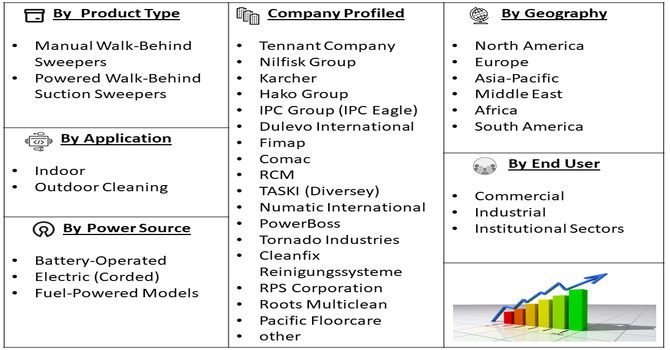
Segmentation: The Global Walk-behind Suction Sweeper Market can be segmented by Product Type (Manual Walk-Behind Sweepers and Powered Walk-Behind Suction Sweepers), Power Source (Battery-Operated, Electric (Corded), and Fuel-Powered Models), Application (Indoor and Outdoor Cleaning), End Users (Commercial, Industrial, and Institutional Sectors), and Geography (North America, Europe, Asia-Pacific, Middle East and Africa, and South America). The report provides the value (in USD million) for the above segments.
For Detailed Market Segmentation - Get a Free Sample PDF
Market Drivers:
The increasing need for efficient, time-saving cleaning solutions is a major driver of the Global Walk-behind Suction Sweeper Market. Commercial and industrial facilities such as warehouses, factories, airports, and shopping malls require consistent, high-quality cleaning to meet hygiene standards and operational efficiency goals.
Walk-behind suction sweepers significantly reduce cleaning time and labor effort compared to manual methods while delivering better dust control and surface cleanliness. As businesses focus on productivity and cost optimization, investment in mechanized cleaning equipment is growing. This trend is further supported by rising awareness of workplace safety and cleanliness, encouraging broader adoption across industries and public infrastructure.
Rapid urbanization and continuous infrastructure development worldwide are strongly driving the demand for walk-behind suction sweepers. Expanding urban areas lead to increased construction of commercial complexes, transportation hubs, healthcare facilities, and educational institutions, all of which require regular and effective floor cleaning. For instance, in 2024, the United Nations reported that the number of megacities—urban areas with over 10 million residents—is projected to increase from 37 to 48 within the next decade.
Governments and private operators are investing heavily in maintaining clean public spaces to enhance urban living standards and public health. Walk-behind suction sweepers offer an ideal balance between performance and affordability for medium-sized areas. Their versatility for both indoor and outdoor applications makes them suitable for diverse environments, supporting steady market growth across developing and developed regions alike.
Market Restraints:
High initial investment and ongoing maintenance costs act as a key restraint for the Global Walk-behind Suction Sweeper Market. Advanced models equipped with battery systems, high-efficiency filters, and durable components can be expensive, limiting adoption among small businesses and budget-constrained municipalities. In addition to purchase costs, expenses related to battery replacement, spare parts, and skilled servicing increase total ownership costs. For price-sensitive markets, manual cleaning or low-cost alternatives remain preferred options. Lack of awareness about long-term cost savings and productivity benefits further restricts penetration, especially in emerging economies where capital expenditure decisions are made cautiously.
Walk-behind suction sweepers positively impact societies by enhancing cleanliness in public and private spaces, contributing to healthier environments and reduced respiratory health risks. They improve productivity by enabling faster, more thorough cleaning compared to manual methods, freeing labor for higher-skilled tasks. In emerging economies, adoption supports job creation within equipment sales, service, and maintenance sectors. Cleaner urban and industrial areas promote tourism, business operations, and worker safety. However, cost barriers can limit access for small businesses and municipalities with constrained budgets. Subsidies and financing options help broaden use, while technology shifts—like battery power—reduce long-term energy expenses and environmental footprints.
Segmental Analysis:
The powered walk-behind suction sweepers segment is expected to witness the highest growth over the forecast period due to increasing demand for mechanized and efficient cleaning solutions. These machines offer superior performance, reduced manual effort, and consistent cleaning quality compared to manual sweepers. Growing adoption across commercial and industrial facilities, driven by labor shortages and rising wage costs, is further accelerating demand. Powered models also support advanced features such as improved dust filtration, adjustable suction, and ergonomic designs. As organizations prioritize productivity, safety, and hygiene compliance, powered walk-behind suction sweepers are becoming the preferred choice for medium-scale cleaning operations worldwide.
Fuel-powered walk-behind suction sweepers are expected to witness the highest growth over the forecast period due to their strong performance in demanding outdoor and industrial environments. These models provide higher power output and longer operating durations compared to electric or battery-operated alternatives, making them suitable for large outdoor spaces and heavy debris conditions. Industries such as construction, manufacturing, and municipal services prefer fuel-powered units for their reliability and mobility in areas with limited access to electrical infrastructure. Despite increasing environmental regulations, technological improvements aimed at reducing emissions and improving fuel efficiency continue to support growth in this segment.
The outdoor cleaning segment is projected to experience the highest growth over the forecast period, driven by expanding urban infrastructure and increased focus on maintaining clean public spaces. Areas such as parking lots, sidewalks, industrial yards, and transportation hubs generate large volumes of dust and debris, requiring robust cleaning solutions. Walk-behind suction sweepers are well-suited for outdoor environments due to their mobility, durability, and ability to handle uneven surfaces. Government initiatives aimed at improving city cleanliness and environmental hygiene further boost adoption. Rising construction activity and industrial expansion also contribute to sustained demand for outdoor cleaning applications globally.
The institutional sectors segment is expected to witness the highest growth over the forecast period as schools, hospitals, government buildings, and healthcare facilities emphasize hygiene and safety standards. These institutions require frequent and reliable cleaning to prevent the spread of infections and maintain regulatory compliance. Walk-behind suction sweepers offer efficient dust removal and noise-controlled operation, making them suitable for sensitive environments. Increased government spending on public infrastructure and healthcare facilities, particularly in developing regions, further supports market expansion. Additionally, growing awareness of indoor air quality and sanitation standards is driving institutions to invest in advanced cleaning equipment.
The Asia-Pacific region is expected to witness the highest growth over the forecast period due to rapid urbanization, industrialization, and expanding commercial infrastructure across countries such as China, India, Japan, and Southeast Asian nations.
Increasing construction of shopping centers, airports, railway stations, manufacturing facilities, and public institutions is driving demand for efficient cleaning equipment. For instance, in 2022, Indian Railways implemented mechanized cleaning at major stations to improve hygiene, sanitation, and cleanliness. Cleaning operations were carried out using high-pressure water jets, floor scrubbers, walk-behind and ride-on scrubber dryers, vacuum cleaners, and road sweepers, including for non-conducive surfaces. This initiative boosted awareness and adoption of mechanized cleaning solutions, positively influencing demand for walk-behind suction sweepers across the Asia-Pacific region.
Rising awareness of hygiene standards, coupled with government initiatives to improve public cleanliness, further supports market growth. Additionally, the growing presence of manufacturing hubs and logistics warehouses increases the need for reliable outdoor and indoor cleaning solutions. For instance, In May 2024, Nilfisk Group partnered with LionsBot to create a new autonomous cleaning machine aimed at small to medium-sized areas, including retail spaces, kindergartens, and clinics. The machine was designed to improve efficiency and reliability in everyday cleaning tasks, highlighting Nilfisk’s commitment to delivering practical and intelligent cleaning solutions across a variety of environments. Thus, all these factors are fuelling this market’s growth in this region.
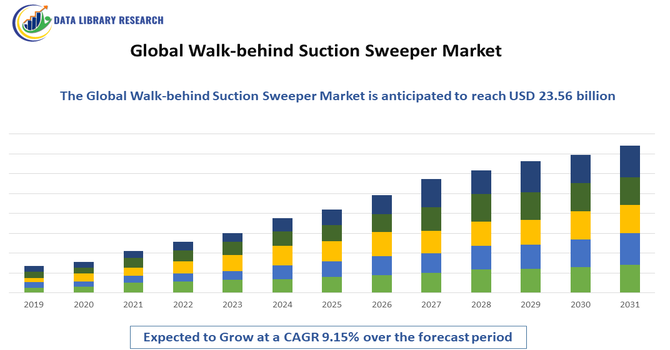
| Report Matrics | Details |
| Market Size Value | USD 23.56 billion |
| Growth Rate | CAGR of 9.15 % |
| Forecast | 2026-2033 |
| Historical data | 2021-2024 |
| Base Year | 2025 |
| Report Coverage | Forecasted revenue, company rating, competitive environment, growth drivers, and trends |
| Segment Coverage | Type, Application, End-User, Geography |
| Regional Scope | North America, Europe, Asia Pacific, Middle East |
| Customized scope | Free customization of reports (With 3 months Analysis Support ) |
| To Learn More About This Report | Request a Free Sample Copy |
The competitive landscape in the Global Walk-behind Suction Sweeper Market features a mix of established industrial equipment manufacturers and specialized cleaning solution brands. Key competitors differentiate through product durability, energy efficiency, ease of use, after-sales support, and price. Some focus on modular designs and proprietary technologies, while others leverage global distribution networks to reach diverse markets. Competitive strategies include expanding product portfolios to cover various floor types and environments, investing in R&D for battery and filtration innovations, and offering value-added services such as training and maintenance contracts. Strategic partnerships with facility management companies and targeted regional marketing campaigns help firms secure long-term contracts and market share across commercial and industrial sectors.
The major players for above market are:
Recent Development
Q1. What are the main growth-driving factors for this market?
The primary driver is the intensifying focus on urban cleanliness and strict environmental regulations regarding dust emissions. Rapid industrialization and the expansion of commercial spaces like warehouses and malls require efficient cleaning. Furthermore, the shift toward electric-powered sweepers attracts eco-conscious municipalities looking to reduce noise pollution and carbon footprints in public areas.
Q2. What are the main restraining factors for this market?
High initial procurement costs and maintenance expenses for advanced suction systems act as significant deterrents, particularly for small-scale enterprises. Additionally, the availability of low-cost manual labor in developing regions reduces the urgency for automation. Technical limitations, such as the inability to handle large debris or extremely wet waste, also hinder adoption.
Q3. Which segment is expected to witness high growth?
The Electric/Battery-powered segment is poised for rapid growth. As global sustainability mandates tighten, industries and local governments are transitioning away from internal combustion engines. These sweepers offer lower operating costs, quieter performance for residential areas, and zero emissions, making them ideal for indoor facilities and modern urban environments.
Q4. Who are the top major players for this market?
The market is dominated by prominent manufacturers including Kärcher, Nilfisk, Tennant Company, and Hako Group. Other significant players include Bucher Municipal, Dulevo International, and Fimap. These companies maintain their competitive edge through robust R&D, specialized filtration technology, and expansive global service networks that cater to industrial and municipal clients.
Q5. Which country is the largest player?
China is currently the largest player and a major manufacturing hub for walk-behind suction sweepers. Massive investments in "Smart City" initiatives and large-scale infrastructure projects drive high domestic demand. Furthermore, Chinese manufacturers are aggressively expanding their export footprints, offering cost-competitive, technologically advanced solutions to global markets in Europe and Asia.
Data Library Research are conducted by industry experts who offer insight on industry structure, market segmentations technology assessment and competitive landscape (CL), and penetration, as well as on emerging trends. Their analysis is based on primary interviews (~ 80%) and secondary research (~ 20%) as well as years of professional expertise in their respective industries. Adding to this, by analysing historical trends and current market positions, our analysts predict where the market will be headed for the next five years. Furthermore, the varying trends of segment & categories geographically presented are also studied and the estimated based on the primary & secondary research.
In this particular report from the supply side Data Library Research has conducted primary surveys (interviews) with the key level executives (VP, CEO’s, Marketing Director, Business Development Manager and SOFT) of the companies that active & prominent as well as the midsized organization
FIGURE 1: DLR RESEARH PROCESS
Extensive primary research was conducted to gain a deeper insight of the market and industry performance. The analysis is based on both primary and secondary research as well as years of professional expertise in the respective industries.
In addition to analysing current and historical trends, our analysts predict where the market is headed over the next five years.
It varies by segment for these categories geographically presented in the list of market tables. Speaking about this particular report we have conducted primary surveys (interviews) with the key level executives (VP, CEO’s, Marketing Director, Business Development Manager and many more) of the major players active in the market.
Secondary ResearchSecondary research was mainly used to collect and identify information useful for the extensive, technical, market-oriented, and Friend’s study of the Global Extra Neutral Alcohol. It was also used to obtain key information about major players, market classification and segmentation according to the industry trends, geographical markets, and developments related to the market and technology perspectives. For this study, analysts have gathered information from various credible sources, such as annual reports, sec filings, journals, white papers, SOFT presentations, and company web sites.
Market Size EstimationBoth, top-down and bottom-up approaches were used to estimate and validate the size of the Global market and to estimate the size of various other dependent submarkets in the overall Extra Neutral Alcohol. The key players in the market were identified through secondary research and their market contributions in the respective geographies were determined through primary and secondary research.
Forecast Model