
Get Complete Analysis Of The Report - Download Updated Free Sample PDF
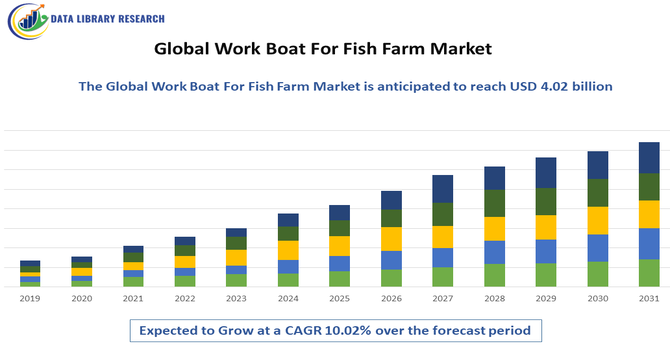
The Global Work Boat for Fish Farm Market refers to the worldwide business of designing, building, selling, and servicing specialized boats used in aquaculture operations. These work boats support daily fish farm tasks such as feeding, net handling, cleaning, monitoring fish health, transporting staff, and moving equipment. The market includes small and large vessels powered by diesel, hybrid, or electric systems, used in coastal and offshore farms. Growth is driven by rising seafood demand, sustainable farming practices, and automation.
The Global Work Boat for Fish Farm Market is changing as fish farming grows around the world. Fish farm operators want boats that are safer, easier to use, and able to handle many tasks. There is rising interest in electric and hybrid work boats because they lower fuel costs and reduce pollution. Technology is also playing a bigger role, with GPS, automated feeding systems, and monitoring tools becoming common. Demand is especially strong in regions with large aquaculture industries, such as Asia Pacific and Europe. Buyers prefer reliable, durable boats that can be customized for their specific farm needs.
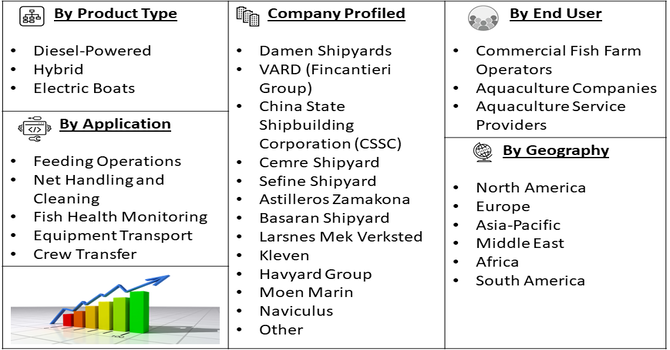
Segmentation: The Global Work Boat for Fish Farm Market is segmented by (Small Work Boats, Medium Work Boats, and Large Work Boats), Propulsion Type (Diesel-Powered, Hybrid, and Electric Boats), Application (Feeding Operations, Net Handling and Cleaning, Fish Health Monitoring, Equipment Transport, and Crew Transfer), Farm Location (Coastal Fish Farms and Offshore Fish Farms), End User (Commercial Fish Farm Operators, Aquaculture Companies, and Aquaculture Service Providers), and Geography (North America, Europe, Asia-Pacific, Middle East and Africa, and South America). The report provides the value (in USD million) for the above segments.
For Detailed Market Segmentation - Get a Free Sample PDF
Market Drivers:
The increasing global demand for seafood is a key driver for the work boat market in fish farming. As populations grow and diets shift toward protein-rich foods, aquaculture production is expanding rapidly. Fish farms rely heavily on specialized work boats to manage daily operations efficiently, including feeding, net handling, fish health monitoring, and transport. This rising demand pushes fish farm operators to invest in modern, reliable work boats to increase productivity, reduce losses, and meet quality standards. Consequently, the market is witnessing continuous growth, with new vessels designed for efficiency, automation, and sustainability.
Technological innovations are significantly driving the growth of work boats for fish farms. Modern vessels increasingly incorporate automation, GPS navigation, electric and hybrid propulsion systems, and remote monitoring tools. These technologies reduce labor requirements, enhance operational efficiency, and improve fish welfare. For instance, in 2025, The California Department of Fish and Wildlife awarded $2.5 million in grants to five projects supporting public recreational boating access. The initiatives aimed to prevent the spread of invasive golden mussels, enhance access to waterways, expand boating opportunities, and promote stewardship of the state’s aquatic resources.
Advanced work boats enable precise feeding, real-time health monitoring, and safer handling of nets and equipment. The push toward sustainable and environmentally friendly aquaculture further encourages the adoption of hybrid and electric boats. As fish farms seek cost-effective, high-performance solutions, manufacturers are responding with vessels that integrate technology, creating strong market growth opportunities worldwide.
Market Restraints:
A major restraint for the market is the high capital investment and ongoing maintenance costs of work boats. Modern vessels equipped with hybrid or electric engines, automation systems, and advanced monitoring tools require significant upfront expenditure, which can be a barrier for small and medium-sized fish farms. Additionally, operational maintenance, spare parts, and skilled labor add to the total cost of ownership. These financial challenges can limit adoption, particularly in emerging markets where aquaculture is still developing. Consequently, while demand is growing, cost considerations continue to restrain market expansion, especially for high-tech, multi-functional vessels.
Work boats used in fish farms support many jobs and help coastal and rural communities grow. They create employment in boat building, maintenance, logistics, and daily fish farm operations. Better work boats allow farms to operate more efficiently, helping produce affordable seafood and improving food security. As aquaculture expands, these boats help reduce physical labor and improve worker safety. Local manufacturing and servicing of work boats can strengthen regional economies and develop skilled labor. Overall, the market plays an important role in supporting sustainable aquaculture, income generation, and economic stability in areas that depend on fishing and farming activities.
Segmental Analysis:
The medium work boats segment is expected to witness the highest growth over the forecast period. These vessels strike a balance between capacity, operational flexibility, and cost, making them ideal for growing fish farms. Medium boats are capable of handling multiple tasks, including feeding, net cleaning, equipment transport, and crew transfer, while remaining maneuverable in both coastal and offshore environments. As fish farms expand in size and complexity, operators are increasingly investing in medium-sized vessels to improve operational efficiency and reduce reliance on multiple smaller boats. Rising demand for multipurpose, cost-effective solutions drives this segment’s rapid growth.
The electric boats segment is projected to see the highest growth in the coming years due to increasing focus on sustainability and operational efficiency. Fish farm operators are adopting electric propulsion to reduce fuel costs, emissions, and environmental impact. Technological advancements in battery life, charging infrastructure, and hybrid systems make electric boats increasingly viable for daily aquaculture operations. Additionally, regulatory pressures on emissions and environmental protection encourage the shift toward clean-energy vessels. With the dual benefits of lower operational costs and greener operations, electric work boats are expected to become a preferred choice for both small and large fish farms worldwide.
The fish health monitoring segment is expected to grow rapidly over the forecast period. Fish farms are increasingly investing in technologies that allow real-time monitoring of fish health, water quality, and environmental conditions. Work boats equipped with sensors, cameras, and data collection systems enable operators to detect diseases early, reduce mortality, and optimize feeding schedules. As aquaculture becomes more data-driven and focused on sustainability, the demand for vessels capable of supporting fish health monitoring rises. This trend is particularly strong in technologically advanced markets, where precise management of fish welfare is critical for regulatory compliance and maintaining high-quality seafood production.
The offshore fish farms segment is projected to witness the highest growth over the forecast period. Offshore operations require robust and specialized work boats capable of navigating deeper waters, handling heavier loads, and supporting large-scale feeding, maintenance, and monitoring tasks. Increasing demand for seafood, limitations in coastal farming areas, and technological advancements in offshore aquaculture are driving this growth. Operators are investing in versatile vessels that can operate safely and efficiently in open-water conditions. The need for durable, high-capacity, and technologically advanced work boats makes offshore fish farms a key growth driver within the global aquaculture support market.
The aquaculture companies segment is expected to witness the highest growth over the forecast period. Large-scale commercial operators increasingly rely on modern work boats to streamline daily operations, improve efficiency, and maintain fish health. These companies are adopting advanced vessels with automation, GPS, and hybrid or electric propulsion systems to reduce costs and enhance sustainability. The trend toward professionalized and industrialized fish farming requires investment in multipurpose work boats capable of feeding, cleaning, monitoring, and transporting equipment. As global seafood demand rises, aquaculture companies continue to expand operations, driving consistent growth in demand for modern work boats tailored to large-scale commercial needs.
North America is expected to witness the highest growth in the global work boat market over the forecast period. The region’s aquaculture industry is expanding due to increasing seafood demand, technological adoption, and government support for sustainable farming. Operators are investing in advanced work boats, including electric and hybrid vessels, to enhance efficiency, reduce environmental impact, and comply with strict regulations.
In 2024, Borealis and AKVA Group announced a breakthrough in sustainable aquaculture with a workboat hull made from renewable plastic. The vessel, unveiled in Mo i Rana, Norway, in Spring 2024, marked a major step for circular marine technology. Part of the Polarcirkel™ series, the boat combined practical design, reliability, and safety, performing across extreme temperatures from -40°C to +55°C. The introduction of renewable-plastic workboats could drive North America’s market toward more sustainable and energy-efficient vessels. It may encourage adoption of eco-friendly materials and circular technology in aquaculture operations across the region.
The focus on offshore aquaculture and high-value fish species further boosts demand for versatile, multipurpose work boats. Additionally, rising awareness of food safety and quality drives investment in vessels equipped with monitoring and automation systems, making North America a high-growth market.
| Report Matrics | Details |
| Market Size Value | USD 4.02 billion |
| Growth Rate | CAGR of 10.02 % |
| Forecast | 2026-2033 |
| Historical data | 2021-2024 |
| Base Year | 2025 |
| Report Coverage | Forecasted revenue, company rating, competitive environment, growth drivers, and trends |
| Segment Coverage | Type, Application, End-User, Geography |
| Regional Scope | North America, Europe, Asia Pacific, Middle East |
| Customized scope | Free customization of reports (With 3 months Analysis Support ) |
| To Learn More About This Report | Request a Free Sample Copy |
The Global Work Boat for Fish Farm Market is competitive, with both large shipbuilders and small specialized boat makers active in the space. Companies compete by offering strong, long-lasting boats with low operating costs. Some focus on advanced features like automation and eco-friendly engines, while others compete on price and customization. After-sales service, spare parts availability, and technical support are important factors for customers. Partnerships with fish farm operators help companies design better solutions and secure repeat business. As competition increases, manufacturers are working harder to improve quality, efficiency, and sustainability to stand out in the market.
The major players for this market are:
Recent Development
Q1. What are the main growth-driving factors for this market?
The primary driver is the rapid expansion of the global aquaculture industry as wild fish stocks decline. To meet rising seafood demand, farms are moving further offshore, requiring larger, more durable work boats. Additionally, the integration of automated feeding systems and crane technology on these vessels significantly improves operational efficiency.
Q2. What are the main restraining factors for this market?
Growth is limited by the high capital investment required to purchase and maintain specialized aluminum or steel work boats. Fluctuating fuel prices and strict environmental regulations regarding engine emissions also increase operating costs. Furthermore, economic volatility can lead to the postponement of large-scale fleet upgrades by smaller aquaculture businesses.
Q3. Which segment is expected to witness high growth?
The Electric and Hybrid Work Boats segment is expected to see the highest growth. As the aquaculture industry faces pressure to reduce its carbon footprint, farmers are switching to battery-powered vessels. These boats reduce noise pollution, which is better for fish health, and offer significant long-term savings on fuel.
Q4. Who are the top major players for this market?
The market is led by specialized shipbuilders known for durable maritime engineering. Key players include Moen Marin, Salthammer Sjøservice, Fitjar Mekaniske Verksted, Groeneveldt Marine Service, and Nauplius Workboats. These companies dominate by offering customizable catamarans and service vessels designed specifically to handle the harsh conditions of open-ocean farming.
Q5. Which country is the largest player?
Norway is the largest player in the work boat for fish farm market. As a global leader in salmon farming, Norway has the most advanced infrastructure and the highest demand for specialized service vessels. Its strict maritime standards and constant innovation in vessel design keep Norwegian shipbuilders at the forefront.
Data Library Research are conducted by industry experts who offer insight on industry structure, market segmentations technology assessment and competitive landscape (CL), and penetration, as well as on emerging trends. Their analysis is based on primary interviews (~ 80%) and secondary research (~ 20%) as well as years of professional expertise in their respective industries. Adding to this, by analysing historical trends and current market positions, our analysts predict where the market will be headed for the next five years. Furthermore, the varying trends of segment & categories geographically presented are also studied and the estimated based on the primary & secondary research.
In this particular report from the supply side Data Library Research has conducted primary surveys (interviews) with the key level executives (VP, CEO’s, Marketing Director, Business Development Manager and SOFT) of the companies that active & prominent as well as the midsized organization
FIGURE 1: DLR RESEARH PROCESS
Extensive primary research was conducted to gain a deeper insight of the market and industry performance. The analysis is based on both primary and secondary research as well as years of professional expertise in the respective industries.
In addition to analysing current and historical trends, our analysts predict where the market is headed over the next five years.
It varies by segment for these categories geographically presented in the list of market tables. Speaking about this particular report we have conducted primary surveys (interviews) with the key level executives (VP, CEO’s, Marketing Director, Business Development Manager and many more) of the major players active in the market.
Secondary ResearchSecondary research was mainly used to collect and identify information useful for the extensive, technical, market-oriented, and Friend’s study of the Global Extra Neutral Alcohol. It was also used to obtain key information about major players, market classification and segmentation according to the industry trends, geographical markets, and developments related to the market and technology perspectives. For this study, analysts have gathered information from various credible sources, such as annual reports, sec filings, journals, white papers, SOFT presentations, and company web sites.
Market Size EstimationBoth, top-down and bottom-up approaches were used to estimate and validate the size of the Global market and to estimate the size of various other dependent submarkets in the overall Extra Neutral Alcohol. The key players in the market were identified through secondary research and their market contributions in the respective geographies were determined through primary and secondary research.
Forecast Model