
Get Complete Analysis Of The Report - Download Updated Free Sample PDF
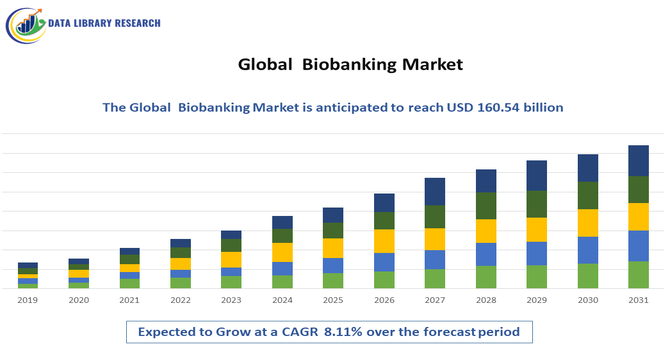
The Global Biobanking Market comprises facilities and services for collecting, processing, storing, and distributing biological specimens such as tissues, blood, DNA, cells, and associated data for research, clinical, and pharmaceutical applications.
Biobanks support translational medicine, genomic research, drug discovery, personalized treatments, and public health initiatives by preserving high quality biospecimens linked to clinical and demographic information. Market growth is driven by rising investment in life sciences research, expanding healthcare R&D, and increasing demand for human samples in oncology, immunology, and regenerative medicine studies. Ethical, regulatory, and data governance frameworks shape operations, while collaborations among research institutions, biopharma firms, and governments enhance specimen accessibility and utility.
The key trends in the Global Biobanking Market include digitization and data integration, where advanced informatics platforms link biospecimens with clinical and genomic data for analytics and AI driven insights. Cloud based sample management systems and blockchain technology enhance traceability, security, and interoperability. Standardization of protocols and quality controls improves specimen validity across biobanks. Increasing public private partnerships and collaborative networks enable shared resources and global access. Demand for disease specific and rare disease biobanks is rising, driven by precision medicine initiatives. Additionally, automation in sample processing, cryogenic storage, and robotic handling systems enhances efficiency and scalability, especially in high throughput biobanking environments.
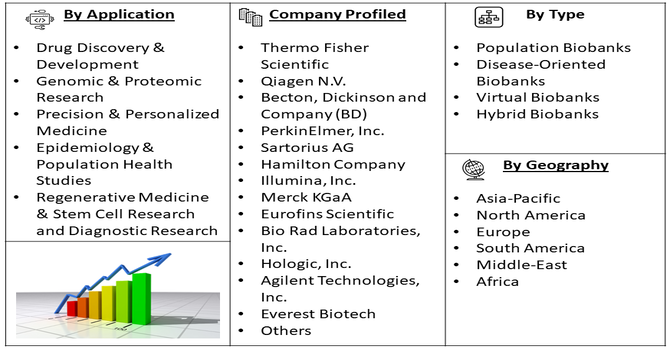
Segmentation: The Global Biobanking Market segmented by Biobank Type (Population Biobanks, Disease-Oriented Biobanks, Virtual Biobanks and Hybrid Biobanks), Sample Type (Blood & Blood Derivatives, Tissue Samples, DNA/RNA Samples, Cells, Serum & Plasma and Urine & Other Body Fluids), Application (Drug Discovery & Development, Genomic & Proteomic Research, Precision & Personalized Medicine, Epidemiology & Population Health Studies, Regenerative Medicine & Stem Cell Research and Diagnostic Research), and Geography (North America, Europe, Asia-Pacific, Middle East and Africa, and South America). The report provides the value (in USD million) for the above segments.
For Detailed Market Segmentation - Get a Free Sample PDF
Market Drivers:
A primary driver of the Global Biobanking Market is the expanding focus on precision medicine and genomic research. Biobanks provide essential high quality biological samples linked to clinical and genetic data, enabling researchers to identify biomarkers, understand disease mechanisms, and develop targeted therapies.
Increasing investment in oncology, immunology, and rare disease studies amplifies demand for well annotated specimen repositories. For instance, in July 2025, Dr. Jitendra Singh inaugurated India’s Phenome India "National Biobank" at CSIR-IGIB, establishing a longitudinal health database. The initiative accelerated precision medicine, supported genomic research, and strengthened India’s contribution to the Global Biobanking Market and personalized healthcare development.
Large scale initiatives, such as population based biobanks and longitudinal cohort studies, generate valuable datasets for predictive analytics and drug discovery. Integration of multi omics data with biospecimens supports personalized treatment strategies, improving clinical outcomes and driving growth in R&D activities across biopharma and academic sectors.
Another key driver is the expansion of research infrastructure and public private collaborations. Governments, academic institutions, and industry stakeholders invest heavily in building and upgrading biobanking facilities.
Strategic partnerships enhance specimen accessibility, shared resources, and research throughput, enabling large scale studies that were previously infeasible. Integration with national health systems and research networks improves sample diversity and data richness. For instance, in 2025, Elucidata partnered with Sapien Biosciences in India to convert over 300,000 patient samples into AI-ready, multimodal data for drug and diagnostic development. The collaboration strengthened research infrastructure, promoted public-private partnerships, and accelerated innovation and growth within the Global Biobanking Market.
Funding initiatives and policy support for healthcare innovation create favorable environments for biobank growth. Collaborative frameworks reduce duplication of efforts and operational costs, facilitate standardization, and accelerate translational research.
Market Restraints:
A significant restraint for the Biobanking Market is ethical, regulatory, and privacy challenges, which complicate specimen collection, data sharing, and cross border research. Informed consent frameworks, data protection laws, and ownership rights vary across jurisdictions, leading to compliance burdens and potential legal risks. Public concerns about data misuse, genetic privacy, and commercialization of biospecimens can hinder donor participation and erode trust. Complex ethical review processes and governance standards increase operational costs and slow research workflows. Balancing data accessibility with privacy safeguards requires robust security infrastructure and policy harmonization, which can be resource intensive and limit seamless global collaboration.
The Global Biobanking Market has profound socioeconomic impacts by accelerating medical research, improving drug development timelines, and fostering innovation in personalized healthcare. Biobanks support public health surveillance, epidemiology, and pandemic preparedness, contributing to better disease prevention and treatment strategies. The sector generates skilled employment in laboratory science, data management, and bioinformatics and attracts investment in life sciences infrastructure. Access to diverse biospecimens enables equitable research representation across populations, though disparities in resource allocation persist. Ethical governance and consent frameworks uphold donor rights, while collaborations between academia and industry stimulate economic growth and technological advancement. Biobanking also strengthens global health research networks and cross border scientific exchange.
Segmental Analysis:
The Disease-Oriented Biobanks segment is expected to witness the highest growth in the Global Biobanking Market due to the increasing prevalence of chronic and lifestyle-related diseases, including cancer, cardiovascular disorders, diabetes, and neurodegenerative conditions. These biobanks focus on collecting disease-specific biospecimens, enabling targeted research, biomarker discovery, and precision medicine initiatives. Growing investment in personalized healthcare and genomics research further drives demand for well-annotated, high-quality disease-oriented samples. Partnerships between pharmaceutical companies, hospitals, and research institutions enhance specimen accessibility and support translational studies. Technological advancements in cryopreservation, automation, and data analytics improve sample management, making disease-oriented biobanks critical for next-generation therapeutic development and diagnostics.
The Blood & Blood Derivatives segment is projected to experience the highest growth due to the high demand for plasma, serum, and whole blood in research, diagnostics, and therapeutic applications. Blood samples serve as primary sources for biomarker discovery, disease diagnosis, vaccine development, and translational research. Increasing prevalence of infectious diseases, cancer, and genetic disorders has fueled the need for extensive blood biobanks. Advanced storage techniques, including cryogenic and automated sample management, ensure long-term stability and quality. Moreover, rising government initiatives to promote blood donation and sample standardization, combined with collaborations among hospitals, research institutes, and pharmaceutical companies, are driving market expansion globally.
The Drug Discovery & Development segment is anticipated to witness the highest growth as pharmaceutical and biotechnology companies increasingly rely on biobanks for high-quality biospecimens and associated clinical data. These samples support preclinical studies, target identification, and clinical trials, enabling faster development of novel therapeutics and personalized treatments. Integration of multi-omics data with biobank resources enhances biomarker identification, efficacy testing, and safety profiling. Public-private partnerships and large-scale biobank networks facilitate access to diverse and disease-specific samples, reducing research timelines and costs. Growing emphasis on precision medicine, biologics, and rare disease therapies further strengthens the demand for biobanking solutions in drug development globally.
The North American region is expected to witness the highest growth in the Global Biobanking Market due to advanced healthcare infrastructure, high research expenditure, and strong presence of leading biobank operators. The U.S. and Canada have established large-scale population-based and disease-oriented biobanks that support genomic studies, precision medicine, and drug development. Government initiatives, such as NIH-funded biobanking programs, and collaborations between academic institutions and pharmaceutical companies accelerate adoption. Advanced IT infrastructure, cloud-based sample management, and AI-driven analytics facilitate efficient biobank operations. Rising awareness of personalized healthcare, chronic disease research, and biomarker-driven studies further reinforces North America as the fastest-growing region globally.
To Learn More About This Report - Request a Free Sample Copy
The competitive landscape of the Global Biobanking Market is moderate, driven by established biotech firms, specialized biobank operators, and integrated pharmaceutical and contract research organizations (CROs). Key players differentiate through broad specimen collections, data analytics capabilities, compliance with quality standards, and global reach. Strategic collaborations, mergers, and acquisitions strengthen service portfolios and geographic coverage. Investments in automation, digital infrastructure, and secure data platforms are critical competitive levers. Academic and government backed biobanks often collaborate with industry partners to enable translational research. Regulatory compliance, ethical data governance, and interoperability standards influence competitive positioning, while customized services for specific disease areas and research needs enhance market differentiation.
The major players are:
Recent Development
Q1. What is the main growth-driving factors for this market?
The primary growth drivers include the rising demand for personalized medicine and increased investments in genomic research. The rapid expansion of stem cell studies and regenerative medicine also significantly accelerates market demand for storing biological materials. Furthermore, the increasing prevalence of chronic diseases requiring long-term research and the growing focus on advanced drug discovery are fueling market expansion
Q2. What are the main restraining factors for this market?
A major restraint is the substantial upfront capital expenditure required for establishing and maintaining modern biobanking facilities with advanced equipment. High operational and storage costs limit adoption, particularly among small-scale research labs. Additionally, stringent and complex regulatory frameworks, including data privacy laws like GDPR, along with ethical concerns regarding informed consent, create significant operational challenges.
Q3. Who are the top major players for this market?
The competitive landscape features global life science conglomerates providing essential infrastructure and services. Key players consistently identified include Thermo Fisher Scientific Inc., Danaher Corporation (through Beckman Coulter), Merck KGaA, Qiagen N.V., and Becton, Dickinson and Company (BD). Other prominent companies are Hamilton Company, Tecan Trading AG, Lonza, and Avantor, Inc.
Q4. Which country is the largest player?
North America (specifically the United States) is consistently identified as a leading region with a significant market share, driven by advanced healthcare infrastructure, major research programs like "All of Us," and strong private funding.
Data Library Research are conducted by industry experts who offer insight on industry structure, market segmentations technology assessment and competitive landscape (CL), and penetration, as well as on emerging trends. Their analysis is based on primary interviews (~ 80%) and secondary research (~ 20%) as well as years of professional expertise in their respective industries. Adding to this, by analysing historical trends and current market positions, our analysts predict where the market will be headed for the next five years. Furthermore, the varying trends of segment & categories geographically presented are also studied and the estimated based on the primary & secondary research.
In this particular report from the supply side Data Library Research has conducted primary surveys (interviews) with the key level executives (VP, CEO’s, Marketing Director, Business Development Manager and SOFT) of the companies that active & prominent as well as the midsized organization
FIGURE 1: DLR RESEARH PROCESS
Extensive primary research was conducted to gain a deeper insight of the market and industry performance. The analysis is based on both primary and secondary research as well as years of professional expertise in the respective industries.
In addition to analysing current and historical trends, our analysts predict where the market is headed over the next five years.
It varies by segment for these categories geographically presented in the list of market tables. Speaking about this particular report we have conducted primary surveys (interviews) with the key level executives (VP, CEO’s, Marketing Director, Business Development Manager and many more) of the major players active in the market.
Secondary ResearchSecondary research was mainly used to collect and identify information useful for the extensive, technical, market-oriented, and Friend’s study of the Global Extra Neutral Alcohol. It was also used to obtain key information about major players, market classification and segmentation according to the industry trends, geographical markets, and developments related to the market and technology perspectives. For this study, analysts have gathered information from various credible sources, such as annual reports, sec filings, journals, white papers, SOFT presentations, and company web sites.
Market Size EstimationBoth, top-down and bottom-up approaches were used to estimate and validate the size of the Global market and to estimate the size of various other dependent submarkets in the overall Extra Neutral Alcohol. The key players in the market were identified through secondary research and their market contributions in the respective geographies were determined through primary and secondary research.
Forecast Model