
Get Complete Analysis Of The Report - Download Updated Free Sample PDF
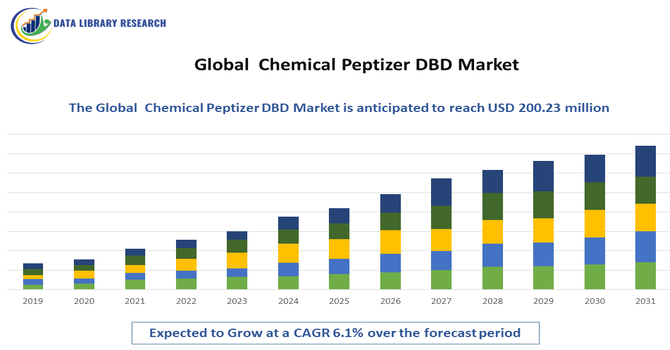
The Global Chemical Peptizer DBD Market refers to the international industry focused on the production, distribution, and utilization of DBD-based rubber peptizers, primarily 2,2′-dithiobisbenzanilide (DBD). These chemicals are used as processing additives in natural and synthetic rubber manufacturing to accelerate mastication, reduce plasticizing time, and improve mixing efficiency during rubber compounding. Peptizer DBD helps break polymer chains, enabling better dispersion and uniformity in rubber formulations. It is widely used in tire manufacturing, industrial rubber products, conveyor belts, and automotive components. Market growth is closely linked to global rubber demand, especially from the automotive sector and expanding industrial manufacturing activities worldwide.
The Global Chemical Peptizer DBD Market is witnessing several key trends driven by innovation in rubber processing and industrial automation. Manufacturers are increasingly focusing on high-purity and performance-enhanced formulations that improve rubber processing efficiency and product durability. Integration of automated dosing systems and advanced mixing technologies in rubber plants is optimizing the use of peptizers and reducing material waste. Sustainability is another major trend, with companies exploring eco-friendly formulations to comply with environmental regulations. Demand for high-performance tires, industrial hoses, and rubber seals is also influencing product innovation. Additionally, Asia-Pacific manufacturers are expanding production capacity to meet growing demand from automotive and industrial sectors.
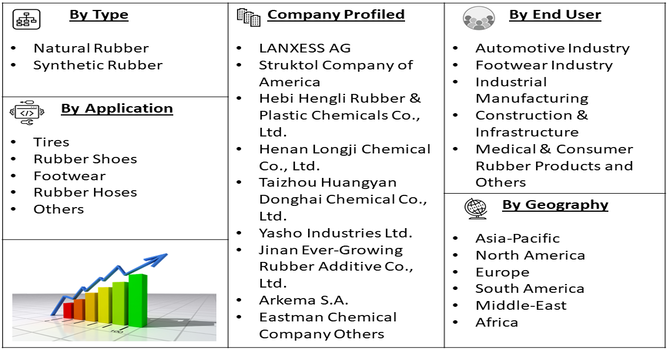
Segmentation: The Global Chemical Peptizer DBD Market is segmented by Type (Purity Level) (40% DBD, ≥90% DBD and Others), Application (Tires, Rubber Shoes and Footwear, Rubber Hoses and Others), Rubber Type (Natural Rubber and Synthetic Rubber), End-Use Industry (Automotive Industry, Footwear Industry, Industrial Manufacturing, Construction & Infrastructure, Medical & Consumer Rubber Products and Others), and Geography (North America, Europe, Asia-Pacific, Middle East and Africa, and South America). The report provides the value (in USD million) for the above segments.
For Detailed Market Segmentation - Get a Free Sample PDF
Market Drivers:
The primary drivers of the Chemical Peptizer DBD market is the expansion of the global tire and rubber manufacturing industry. Tire production accounts for a large share of natural rubber consumption worldwide, and manufacturers increasingly use peptizers to improve processing efficiency and reduce energy consumption. Peptizer DBD accelerates the breakdown of rubber polymer chains during mastication, allowing faster mixing and improved compound uniformity. As global automotive production grows, demand for high-performance tires, industrial belts, hoses, and rubber components also increases. This growing need for efficient rubber processing chemicals is expected to significantly boost demand for DBD peptizers in manufacturing facilities worldwide.
The increasing need for cost-efficient manufacturing processes is another key driver for the Chemical Peptizer DBD market. Peptizer DBD reduces plasticizing time and improves mixing performance during rubber processing, enabling manufacturers to lower energy usage and operational costs. By breaking down polymer clusters and improving dispersion within rubber compounds, the additive helps produce materials with consistent mechanical properties and better quality. Industrial sectors such as automotive, construction, and machinery rely heavily on rubber components, increasing the importance of efficient processing additives. As manufacturers seek to improve productivity and reduce production cycles, demand for high-performance peptizers like DBD continues to grow globally.
Market Restraints:
Environmental regulations and safety concerns regarding chemical additives act as a restraint for the Chemical Peptizer DBD market. Governments and regulatory agencies worldwide are tightening regulations related to chemical emissions, workplace safety, and environmental impact in manufacturing processes. Rubber additives, including peptizers, must comply with strict chemical safety standards and environmental policies. Compliance often requires additional testing, reformulation, and production adjustments, which increase operational costs for manufacturers. Furthermore, the growing focus on sustainable and bio-based alternatives in the chemical industry may reduce reliance on traditional synthetic additives. These regulatory pressures can slow market growth and create challenges for smaller producers entering the market.
The Chemical Peptizer DBD market contributes significantly to industrial development and employment across the global rubber supply chain. By improving rubber processing efficiency, peptizers reduce production time and energy consumption, lowering manufacturing costs for tire producers and industrial rubber manufacturers. This efficiency supports the growth of the automotive and transportation industries, which rely heavily on durable rubber components. The market also stimulates economic activity in chemical manufacturing hubs, particularly in Asia-Pacific countries such as China and India. Additionally, technological improvements in rubber processing enhance product performance and safety in transportation infrastructure. However, environmental and occupational safety regulations surrounding chemical additives continue to influence production practices.
Segmental Analysis:
The 40% DBD purity level segment is expected to witness the highest growth in the global Chemical Peptizer DBD market during the forecast period due to its cost efficiency and wide applicability in rubber processing. This grade provides an effective balance between performance and affordability, making it highly preferred among rubber manufacturers. It helps accelerate the mastication process of natural and synthetic rubber, reducing processing time and improving mixing efficiency in industrial operations. The increasing demand for rubber products such as tires, footwear, hoses, and conveyor belts is significantly boosting the use of 40% DBD formulations. Additionally, expanding rubber manufacturing activities in emerging economies are further supporting the rapid growth of this segment globally.
The rubber shoes and footwear segment is projected to experience the highest growth in the Chemical Peptizer DBD market due to the increasing global demand for durable, flexible, and cost-effective footwear products. Peptizer DBD plays an important role in improving rubber processability, enabling manufacturers to produce lightweight and high-quality rubber soles and components efficiently. The expansion of the footwear industry, particularly in developing economies, is contributing significantly to the growth of this segment. Rising urbanization, changing fashion trends, and increasing consumer spending on comfortable footwear are also driving demand. Additionally, large-scale manufacturing hubs in Asia are adopting advanced rubber processing additives, further increasing the consumption of DBD peptizers in footwear production.
The automotive industry segment is expected to witness the highest growth in the global Chemical Peptizer DBD market due to increasing vehicle production and rising demand for high-performance rubber components. Peptizer DBD is widely used in rubber processing for automotive tires, seals, gaskets, hoses, and belts, as it enhances the mastication process and improves compound consistency. As automotive manufacturers focus on durability, safety, and fuel efficiency, the demand for high-quality rubber materials continues to grow. Additionally, the expansion of electric vehicle production and increased investments in automotive manufacturing across emerging markets are further supporting the demand for rubber additives. These factors collectively drive strong growth in the automotive industry segment.
The Asia-Pacific region is expected to witness the highest growth in the global Chemical Peptizer DBD market due to rapid industrialization and the strong presence of rubber manufacturing industries. Countries such as China, India, Japan, South Korea, and Thailand are major producers of rubber products, including tires, footwear, and industrial components. The region benefits from abundant natural rubber supply, lower manufacturing costs, and expanding automotive production. Increasing investments in industrial infrastructure and rising domestic consumption of rubber products are also supporting market expansion. Furthermore, the growth of export-oriented rubber manufacturing sectors and favorable government policies promoting chemical and automotive industries are expected to significantly drive demand for chemical peptizer DBD in the Asia-Pacific region.
To Learn More About This Report - Request a Free Sample Copy
The Global Chemical Peptizer DBD Market is moderately consolidated, with several multinational chemical companies and specialized rubber additive manufacturers competing globally. Companies compete through product innovation, production efficiency, and strong distribution networks within the rubber industry. Leading players focus on developing high-performance additives that improve processing efficiency and compatibility with natural and synthetic rubber. Strategic partnerships with tire manufacturers and investments in research and development are common competitive strategies. Asian manufacturers are increasingly gaining market share due to cost-efficient production and proximity to major rubber manufacturing centers.
The major players are:
Q1. What are the main growth-driving factors for this market?
The growth is primarily driven by the rising demand for high-performance tires in the automotive sector, where DBD (2,2'-dibenzamido diphenyl disulfide) serves as a critical processing aid. It enhances rubber plasticization, reduces mixing time, and saves energy. Additionally, the shift toward green tires and eco-friendly manufacturing is boosting DBD adoption as a non-toxic alternative.
Q2. What are the main restraining factors for this market?
The market is restricted by volatility in raw material prices, particularly for benzene and sulfur derivatives. Overcapacity in the broader chemical sector and soft demand in the global automotive and housing markets also pressure profit margins. Furthermore, stringent environmental regulations requiring full solvent recycling and low-carbon production processes increase operational costs for manufacturers.
Q3. Which segment is expected to witness high growth?
The Automotive Industry segment is expected to witness the highest growth in the Chemical Peptizer DBD market due to rising vehicle production and increasing demand for high-performance rubber components. DBD peptizers enhance rubber processing efficiency, improve tire and seal quality, and support growing automotive manufacturing in emerging and developed markets.
Q4. Who are the top major players for this market?
The market is led by global chemical and rubber additive specialists, including LANXESS, Struktol, and Akrochem. Other key players driving innovation through advanced formulations and sustainable production include Yasho Industries, Hebi Hengli Rubber and Plastic, Henan Longji Chemical, Taizhou Huangyan Donghai Chemical, and Sinolegend (China) Chemical.
Q5. Which country is the largest player?
China is the largest player, accounting for the highest share of both production and consumption. Its dominance is anchored by a massive tire manufacturing industrial base and extensive vertical integration within chemical industrial parks. The country’s leadership is further supported by significant capacity additions and its role as a primary global exporter of rubber additives.
Data Library Research are conducted by industry experts who offer insight on industry structure, market segmentations technology assessment and competitive landscape (CL), and penetration, as well as on emerging trends. Their analysis is based on primary interviews (~ 80%) and secondary research (~ 20%) as well as years of professional expertise in their respective industries. Adding to this, by analysing historical trends and current market positions, our analysts predict where the market will be headed for the next five years. Furthermore, the varying trends of segment & categories geographically presented are also studied and the estimated based on the primary & secondary research.
In this particular report from the supply side Data Library Research has conducted primary surveys (interviews) with the key level executives (VP, CEO’s, Marketing Director, Business Development Manager and SOFT) of the companies that active & prominent as well as the midsized organization
FIGURE 1: DLR RESEARH PROCESS
Extensive primary research was conducted to gain a deeper insight of the market and industry performance. The analysis is based on both primary and secondary research as well as years of professional expertise in the respective industries.
In addition to analysing current and historical trends, our analysts predict where the market is headed over the next five years.
It varies by segment for these categories geographically presented in the list of market tables. Speaking about this particular report we have conducted primary surveys (interviews) with the key level executives (VP, CEO’s, Marketing Director, Business Development Manager and many more) of the major players active in the market.
Secondary ResearchSecondary research was mainly used to collect and identify information useful for the extensive, technical, market-oriented, and Friend’s study of the Global Extra Neutral Alcohol. It was also used to obtain key information about major players, market classification and segmentation according to the industry trends, geographical markets, and developments related to the market and technology perspectives. For this study, analysts have gathered information from various credible sources, such as annual reports, sec filings, journals, white papers, SOFT presentations, and company web sites.
Market Size EstimationBoth, top-down and bottom-up approaches were used to estimate and validate the size of the Global market and to estimate the size of various other dependent submarkets in the overall Extra Neutral Alcohol. The key players in the market were identified through secondary research and their market contributions in the respective geographies were determined through primary and secondary research.
Forecast Model