
Get Complete Analysis Of The Report - Download Updated Free Sample PDF
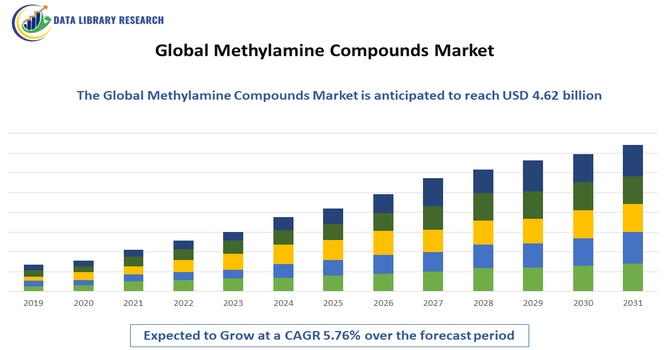
The Global Methylamine Compounds Market refers to the worldwide industry involved in the production, distribution, and application of methylamine chemicals (including mono , di , and trimethylamine). Methylamine is a key organic intermediate used across agrochemicals, pharmaceuticals, industrial solvents, water treatment, and specialty chemical sectors due to its versatility in synthesizing herbicides, drug intermediates and surfactants. The market value has been expanding steadily, driven by rising demand from end use industries and increasing investments in chemical production capacity. Growth is supported by robust industrial activity in Asia Pacific and technological advancements that improve production efficiency and environmental compliance.
The key trends shaping the global methylamine market include a shift towards sustainable and green production methods, such as catalytic and continuous flow processes that lower energy use and emissions. Manufacturers are investing in cleaner synthesis routes to satisfy stricter environmental regulations and enhance brand reputation. The market also shows increasing segmentation with high purity methylamine grades targeting pharmaceutical applications and solid or tablet formats for specialty uses. Additionally, emerging applications in electronics and battery solvents (e.g., N methylpyrrolidone) are expanding demand, especially in Asia Pacific. Regional production hubs, particularly China, are rapidly increasing capacity to serve global consumption.
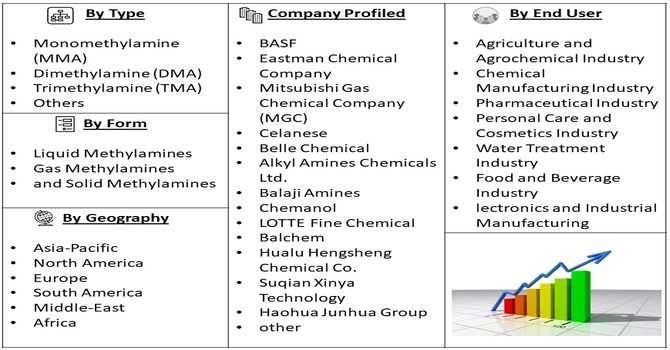
Segmentation: The Global Methylamine Compounds Market is segmented by Type (Monomethylamine (MMA), Dimethylamine (DMA), Trimethylamine (TMA) and Others), Form (Liquid Methylamines, Gas Methylamines and Solid Methylamines), End-Use Industry (Agriculture and Agrochemical Industry, Chemical Manufacturing Industry, Pharmaceutical Industry, Personal Care and Cosmetics Industry, Water Treatment Industry, Food and Beverage Industry and Electronics and Industrial Manufacturing), and Geography (North America, Europe, Asia-Pacific, Middle East and Africa, and South America). The report provides the value (in USD million) for the above segments.
For Detailed Market Segmentation - Get a Free Sample PDF
Market Drivers:
The expansion of the pharmaceutical industry is a primary driver for the methylamine market. Methylamine serves as a critical intermediate in synthesizing numerous APIs (active pharmaceutical ingredients) including antihistamines, analgesics, and cardiovascular drugs. Growth in global healthcare demand — driven by aging populations, rising chronic disease prevalence, and increasing R&D investments — directly fuels consumption of high purity methylamine compounds.
In February 2022, Eastman Chemical Company completed an expansion of its tertiary amine production capacity. The upgrade primarily focused on DIMLA 1214 and was implemented at manufacturing facilities in Ghent, Belgium, and Pace, Florida. This expansion was undertaken to enhance supply capabilities and better meet increasing global customer demand.
Emerging markets such as India and China, which are expanding their pharmaceutical manufacturing exports, further amplify demand. As the pharmaceutical sector continues to innovate and scale, the reliance on methylamine for cost effective intermediate production supports sustained market growth.
Methylamine is indispensable in producing herbicides, insecticides, and fungicides used to enhance crop protection and yields amid rising global food demand. With a growing world population and the need to optimize agricultural productivity, the use of methylamine based agrochemicals remains robust. Regulatory developments promoting low VOC and environmentally safer crop solutions further incentivize methylamine adoption. Rapid industrialization in regions like Asia Pacific and Latin America, where agricultural modernization is underway, reinforces this demand trajectory, making the agricultural chemicals segment a major consumption hub for methylamine intermediates.
Market Restraints:
Methylamine compounds are classified under volatile organic compounds (VOCs) and hazardous chemicals, requiring manufacturers to adhere to strict emissions, safety, and toxicity standards set by regulatory bodies like the EU’s REACH and the U.S. EPA. Compliance involves substantial investments in emission control systems, monitoring, and testing, increasing operational and capital expenditure — particularly burdensome for smaller producers. These regulatory pressures can slow capacity expansion and raise pricing pressures, limiting market accessibility and deterring new entrants while affecting overall industry profitability and growth.
The methylamine market has notable socioeconomic impacts. By supporting agrochemical production, it contributes to global food security and higher crop yields, especially in developing economies. Its role in pharmaceutical synthesis helps facilitate the production of essential medicines, supporting public health and employment across the chemical supply chain. Industrial use of methylamine derivatives underpins manufacturing sectors, driving economic activity and exports in chemical producing regions. However, the industry also faces social challenges: regulatory compliance for safety and environmental standards raises production costs and affects smaller firms. Moreover, hazardous handling of methylamine compounds necessitates stringent occupational safety measures to protect workers and communities near production sites.
Segmental Analysis:
The Trimethylamine (TMA) segment is expected to witness the highest growth in the global methylamine compounds market during the forecast period due to its expanding use in chemical synthesis and specialty applications. TMA is a crucial intermediate in the production of choline chloride, widely used as a feed additive in the livestock and poultry industries. Increasing global demand for high-quality animal nutrition products is significantly boosting TMA consumption. In addition, the compound is used in the manufacture of ion-exchange resins, surfactants, disinfectants, and flotation agents for mining operations. Rapid industrialization, increasing agricultural productivity requirements, and growth in specialty chemical manufacturing are expected to further accelerate the demand for trimethylamine worldwide.
The liquid methylamines segment is projected to record the fastest growth in the global methylamine compounds market due to its ease of handling, transportation, and integration into industrial chemical processes. Liquid methylamines, typically supplied as aqueous solutions, are widely preferred by manufacturers because they allow precise dosing and safer storage compared to gaseous forms. These solutions are extensively utilized in pharmaceutical synthesis, agrochemical production, water treatment chemicals, and solvent manufacturing. Increasing demand from large-scale chemical processing industries and growing pharmaceutical production capacity in emerging economies are further strengthening this segment’s growth outlook. Additionally, improvements in storage infrastructure and chemical logistics are making liquid methylamines more accessible, supporting rapid adoption across multiple industrial sectors.
The agriculture and agrochemical industry segment is expected to experience the highest growth in the global methylamine compounds market due to rising global food demand and increasing pressure to improve crop productivity. Methylamine derivatives are essential intermediates used in the formulation of herbicides, pesticides, and fungicides that protect crops against pests, weeds, and diseases. With the world population steadily increasing, farmers are adopting advanced crop protection chemicals to ensure higher yields and better food security. Developing regions, particularly in Asia and Latin America, are witnessing rapid modernization of agricultural practices, which is further increasing agrochemical consumption. This growing reliance on efficient crop protection solutions is expected to drive significant demand for methylamine compounds in agriculture.
The Asia-Pacific region is anticipated to witness the highest growth in the global methylamine compounds market due to rapid industrialization, expanding chemical manufacturing capacity, and strong demand from end-use industries.
Countries such as China, India, Japan, and South Korea have well-established pharmaceutical, agrochemical, and specialty chemical sectors that heavily rely on methylamine derivatives. For instance, in May 2025, BASF SE introduced a sustainable trimethylamine product line manufactured using certified renewable methanol, lowering carbon emissions by up to 50% compared with traditional production processes. The launch encourages sustainable chemical adoption in Asia-Pacific, prompting regional manufacturers to invest in low-carbon production technologies while strengthening BASF’s presence in environmentally regulated markets and advanced agrochemical supply chains.
The region also benefits from relatively lower production costs, abundant raw materials, and increasing investments in chemical infrastructure. Rising agricultural activity and growing pharmaceutical exports are further strengthening regional demand. For instance, in March 2026, China aims to increase grain production capacity to 725 million metric tons by 2030, focusing on yield gains via technology and seed innovation. This will strengthen the Asia-Pacific methylamine compounds market by boosting consumption from agricultural chemical manufacturers and encouraging regional production expansion to support rising farm productivity needs.
Additionally, supportive government policies promoting domestic chemical production and industrial development are encouraging manufacturers to expand capacity, making Asia-Pacific a key growth hub for methylamine compounds.
To Learn More About This Report - Request a Free Sample Copy
The competitive landscape of the global methylamine market is moderately concentrated among large multinational chemical producers with integrated production and robust distribution networks. Key global leaders include BASF, Eastman Chemical, and Mitsubishi Gas Chemical, which leverage technological expertise, scale, and regional reach to maintain market share. Established players focus on sustainability, capacity expansion, and product development to differentiate offerings, while regional producers in Asia (e.g., Belle Chemical, Hualu Hengsheng, LUXI Group) expand through aggressive capacity additions and localized supply. Competitive pressures are driven by cost, product purity, innovation in derivative applications, and navigating stringent environmental and safety regulations facing manufacturers globally.
The major players are:
Recent Development
Q1. What are the main growth-driving factors for this market?
Market growth is primarily propelled by the expanding pharmaceutical and agrochemical industries. Methylamines serve as critical intermediates for active pharmaceutical ingredients (APIs) and crop protection chemicals like herbicides and pesticides. Additionally, rising demand for lithium-ion batteries (using NMP solvents) and water treatment chemicals is accelerating global consumption.
Q2. What are the main restraining factors for this market?
Growth is significantly challenged by stringent environmental and safety regulations due to the toxic, flammable, and pungent nature of these compounds. Volatility in raw material prices—specifically methanol and ammonia—creates cost uncertainties for manufacturers. Furthermore, the high capital investment required for specialized pressurized storage and transport infrastructure limits market entry.
Q3. Which segment is expected to witness high growth?
The Trimethylamine (TMA) segment is expected to witness the highest growth in the methylamine compounds market due to its extensive use in animal feed additives, agrochemicals, and chemical intermediates. Rising demand for choline chloride in livestock nutrition and expanding agricultural activities are key factors driving increased consumption of trimethylamine globally.
Q4. Who are the top major players for this market?
The market features a mix of global chemical giants and specialized regional leaders, including BASF SE, Eastman Chemical Company, and Mitsubishi Gas Chemical (MGC). Other prominent players driving production and innovation include Alkyl Amines Chemicals, Balaji Amines, Celanese Corporation, Chemours, and China-based leaders like the Luxi Group.
Q5. Which country is the largest player?
China is the largest player, dominating both global production. Its leadership is anchored by a massive industrial base for agrochemicals and pharmaceuticals, extensive coal-to-chemical infrastructure, and a rapidly growing domestic supply chain for electronic-grade chemicals and battery materials.
Data Library Research are conducted by industry experts who offer insight on industry structure, market segmentations technology assessment and competitive landscape (CL), and penetration, as well as on emerging trends. Their analysis is based on primary interviews (~ 80%) and secondary research (~ 20%) as well as years of professional expertise in their respective industries. Adding to this, by analysing historical trends and current market positions, our analysts predict where the market will be headed for the next five years. Furthermore, the varying trends of segment & categories geographically presented are also studied and the estimated based on the primary & secondary research.
In this particular report from the supply side Data Library Research has conducted primary surveys (interviews) with the key level executives (VP, CEO’s, Marketing Director, Business Development Manager and SOFT) of the companies that active & prominent as well as the midsized organization
FIGURE 1: DLR RESEARH PROCESS
Extensive primary research was conducted to gain a deeper insight of the market and industry performance. The analysis is based on both primary and secondary research as well as years of professional expertise in the respective industries.
In addition to analysing current and historical trends, our analysts predict where the market is headed over the next five years.
It varies by segment for these categories geographically presented in the list of market tables. Speaking about this particular report we have conducted primary surveys (interviews) with the key level executives (VP, CEO’s, Marketing Director, Business Development Manager and many more) of the major players active in the market.
Secondary ResearchSecondary research was mainly used to collect and identify information useful for the extensive, technical, market-oriented, and Friend’s study of the Global Extra Neutral Alcohol. It was also used to obtain key information about major players, market classification and segmentation according to the industry trends, geographical markets, and developments related to the market and technology perspectives. For this study, analysts have gathered information from various credible sources, such as annual reports, sec filings, journals, white papers, SOFT presentations, and company web sites.
Market Size EstimationBoth, top-down and bottom-up approaches were used to estimate and validate the size of the Global market and to estimate the size of various other dependent submarkets in the overall Extra Neutral Alcohol. The key players in the market were identified through secondary research and their market contributions in the respective geographies were determined through primary and secondary research.
Forecast Model