
Get Complete Analysis Of The Report - Download Updated Free Sample PDF
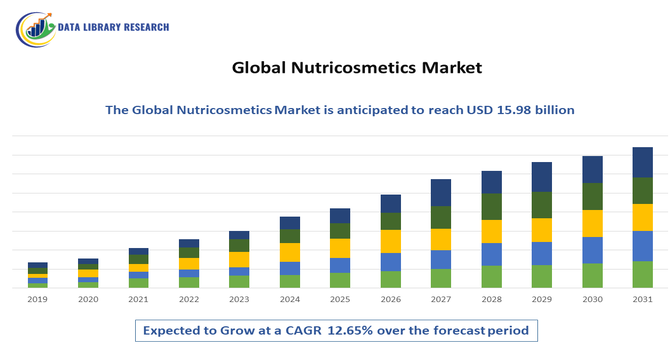
The Global Nutricosmetics Market refers to the segment of the beauty and wellness industry that focuses on ingestible products designed to support skin, hair, nails, and overall cosmetic appearance from the inside out. These products include dietary supplements, functional foods, beverages, and nutraceutical formulations containing vitamins, minerals, antioxidants, collagen, botanicals, and probiotics aimed at promoting beauty benefits. Growing consumer interest in holistic health, aging prevention, and personalized wellness has driven demand. Nutricosmetics bridge nutrition and beauty, addressing internal factors that influence external appearance. The market spans retail, online, pharmacy, and direct to consumer channels and targets a broad consumer demographic beyond traditional topical cosmetics.
The trends shaping the Global Nutricosmetics Market include increased demand for clean label, plant based, and scientifically backed formulations that emphasize transparency, sustainability, and efficacy. Personalized nutrition and tailored supplement blends are gaining traction, often supported by digital wellness platforms and diagnostic testing. The integration of beauty with overall health, particularly immune support and gut skin axis concepts, is expanding product portfolios. E commerce, social media influence, and influencer led marketing significantly fuel consumer awareness and reach. Functional beverages and gummies are becoming popular alternatives to traditional capsules. Additionally, cross industry collaborations between beauty brands, supplement manufacturers, and biotech firms foster innovation and market differentiation.
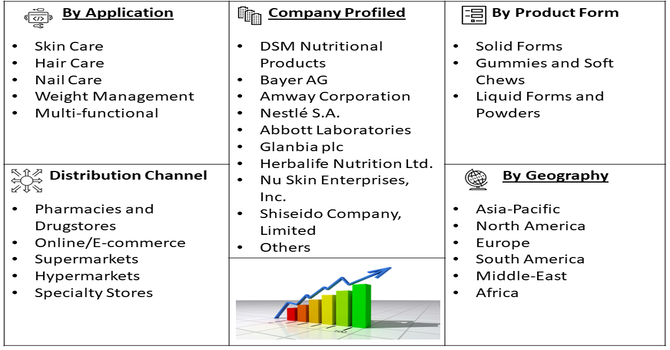
Segmentation: The Global Nutricosmetics Market is segmented by Product Form (Solid Forms, Gummies and Soft Chews, Liquid Forms and Powders), Ingredient Type (Collagen & Peptides, Vitamins, Carotenoids, Omega-3 Fatty Acids and Others), Application (Skin Care, Hair Care, Nail Care and Weight Management & Multi-functional), Distribution Channel (Pharmacies and Drugstores, Online/E-commerce, Supermarkets and Hypermarkets and Specialty Stores), and Geography (North America, Europe, Asia-Pacific, Middle East and Africa, and South America). The report provides the value (in USD million) for the above segments.
For Detailed Market Segmentation - Get a Free Sample PDF
Market Drivers:
The primary driver of the Global Nutricosmetics Market is the increasing consumer emphasis on holistic beauty and wellness. Consumers today view beauty as an outcome of overall health, leading to growing interest in internal solutions that support skin elasticity, hair strength, and anti aging.
Awareness of nutritional impacts on appearance—fueled by social media, wellness influencers, and health research—boosts demand for ingestible beauty products. For instance, in January 2025, Wellful acquired Ancient Nutrition, expanding its collagen protein and digestive health offerings. The acquisition strengthened distribution in natural retail channels, increased market share, and consolidated North America’s independent nutricosmetics sector, driving growth in collagen-based and functional beauty supplements.
Moreover, aging populations in developed regions are driving demand for age defying and skin rejuvenating supplements. This paradigm shift, from merely topical products to nutritionally supported beauty regimens, continues to expand the nutricosmetics market globally.
The expansion of e commerce and direct to consumer (DTC) models is another key driver for the Global Nutricosmetics Market. Online retail platforms offer broad product access, convenience, and personalized shopping experiences, enabling brands to reach diverse demographics worldwide. Digital channels facilitate targeted marketing, subscription services, and data driven personalization that enhance customer engagement and repeat purchases.
Social media and influencer marketing contribute to rapid product discovery and trend adoption. As mobile commerce grows, consumers increasingly purchase nutricosmetics online, bypassing traditional retail constraints. This shift accelerates global market penetration and supports the scalability of both established brands and emerging players.
Market Restraints:
A significant restraint in the Global Nutricosmetics Market is regulatory complexity and the challenge of scientific validation. Nutricosmetics lie at the intersection of cosmetics and dietary supplements, subject to varied regulatory frameworks across regions. Differing safety standards, health claim restrictions, and labeling requirements complicate product development and global distribution. Additionally, consumers are becoming more discerning, demanding clinical evidence and transparent efficacy data. The cost and time associated with rigorous scientific research and compliance can slow innovation, limit product portfolios, and create barriers to market entry—especially for smaller companies. Regulatory uncertainty in emerging markets also impacts investment decisions and consumer trust.
The Global Nutricosmetics Market has notable socioeconomic effects, including stimulating investment in health focused R&D, job creation in manufacturing, marketing, and retail, and expansion of wellness education and services. As consumers increasingly prioritize preventive health and beauty from within solutions, demand supports growth of allied sectors like dietary supplements and functional foods. Women and aging populations benefit from options that support confidence and quality of life. Nutricosmetics also generate revenue across e commerce and traditional retail, influencing global supply chains and export activity. However, affordability and access disparities persist across regions, highlighting socioeconomic divides in wellness consumption.
Segmental Analysis:
The Gummies and Soft Chews segment is expected to witness the highest growth in the Global Nutricosmetics Market due to increasing consumer preference for convenient, palatable, and enjoyable formats over traditional capsules and tablets. These products appeal to millennials and younger demographics seeking functional beauty supplements in tasty, easy-to-consume forms. Advancements in formulation technologies ensure nutrient stability, efficacy, and diverse flavor options, driving adoption. E-commerce and subscription models further boost accessibility and repeat purchase rates. As brands expand their gummies portfolio with collagen, antioxidants, and vitamins targeting hair, skin, and nails, this segment is projected to dominate growth during the forecast period.
The Collagen & Peptides segment is anticipated to experience the highest growth due to rising awareness of their anti-aging, skin-rejuvenating, and hair-strengthening benefits. Collagen supplements support elasticity, hydration, and structural integrity of skin, driving strong demand in the aging population. Peptide-enriched formulations enhance absorption and bioavailability, offering targeted results. Beauty-conscious consumers increasingly integrate these products into daily routines as part of holistic wellness regimens. Influencer marketing, clinical endorsements, and clinical trials validating efficacy have further increased consumer trust. Expanding product lines across beverages, powders, and soft chews make collagen and peptides a dominant growth driver in the nutricosmetics sector globally.
The Weight Management & Multi-functional segment is projected to witness significant growth as consumers increasingly seek products that combine beauty, health, and wellness benefits. Supplements that support weight management, metabolic health, and internal beauty simultaneously are gaining traction. Rising lifestyle diseases and a focus on preventive care amplify demand for multifunctional nutricosmetics. Brands are innovating products that combine vitamins, antioxidants, probiotics, and collagen to deliver holistic benefits in a single dose. Multi-functional formulations appeal to busy consumers seeking convenience and efficiency. This trend is reinforced by digital wellness guidance and personalized nutrition programs, fueling growth in this segment throughout the forecast period.
The Pharmacies and Drugstores segment is expected to witness the highest growth due to its accessibility, consumer trust, and professional recommendation channels. Nutricosmetics sold through pharmacies benefit from credibility associated with pharmacist guidance and perceived product safety. The retail environment allows brands to educate consumers about formulation efficacy, dosage, and health benefits, encouraging adoption among both preventive and therapeutic segments. Growth is further supported by expansion into urban and semi-urban areas, pharmacy loyalty programs, and bundling with other health products. This segment is increasingly integrating e-commerce and home delivery services to combine convenience with reliability, driving sustained market expansion.
The Asia-Pacific region is expected to witness the highest growth in the Global Nutricosmetics Market due to rising disposable income, growing beauty consciousness, and increasing urbanization.
Expanding middle-class populations in China, India, Japan, and Southeast Asia are adopting holistic wellness and anti-aging products. For instance, in January 2026, In-cosmetics Global showcased the Inner Beauty Zone, promoting “beauty-from-within” innovations. The initiative highlighted emerging nutricosmetic trends, inspiring Asia-Pacific brands to adopt advanced formulations and boosting regional awareness, investment, and growth in functional beauty and ingestible supplement markets. Similarly, in February 2024, Tosla Nutricosmetics partnered with Triije Architects to develop Tesla 3, its new headquarters. The facility centralized R&D, marketing, and operations, enhancing team efficiency and productivity, and marked a significant milestone in achieving the company’s long-term strategic goals.
E-commerce penetration, social media influence, and rising interest in natural, plant-based, and clean-label formulations amplify adoption. Regional manufacturers are innovating localized products tailored to specific skin and hair concerns, while international brands are entering emerging markets with strategic partnerships. Regulatory support and government wellness initiatives further drive growth, positioning Asia-Pacific as the fastest-growing region globally for nutricosmetics.
To Learn More About This Report - Request a Free Sample Copy
The Global Nutricosmetics Market is highly competitive and expanding, featuring multinational pharmaceutical and cosmetic companies alongside specialized nutraceutical innovators and startups. Competition centers on product efficacy, scientific validation, ingredient sourcing, branding, and consumer trust. Key players invest in clinical research, clean and natural formulations, and sustainable packaging to appeal to conscious consumers. Digital marketing and influencer partnerships are critical for visibility, while direct to consumer models and personalized nutrition services differentiate offerings. The landscape includes established global brands with extensive distribution networks as well as agile niche players targeting specific beauty needs. Strategic mergers, acquisitions, and partnerships continue to reshape market positioning and scale.
The major players are:
Recent Development
Q1. What are the main growth-driving factors for this market?
The market is primarily propelled by the "beauty-from-within" trend, where consumers link internal nutrition to external appearance. An aging global population seeking anti-aging solutions and a post-pandemic surge in preventive healthcare are key drivers. Additionally, clinical validation of ingredient bioavailability, such as hydrolyzed collagen, has significantly boosted consumer trust.
Q2. What are the main restraining factors for this market?
Growth is largely restrained by stringent and fragmented regulatory frameworks, with varying rules for "beauty supplements" across the US, EU, and Asia. High product costs and consumer skepticism regarding efficacy timelines also act as barriers. Furthermore, "pill fatigue" and a lack of awareness in developing regions limit consistent market penetration.
Q3. Which segment is expected to witness high growth?
The Gummies and Chewables segment is expected to witness the highest growth due to their "edible appeal" and popularity among younger demographics. While skincare remains the largest application, Hair and Nail Care is the fastest-growing sub-segment, driven by rising concerns over stress-induced hair loss and the growing male grooming trend.
Q4. Who are the top major players for this market?
The competitive landscape features a mix of specialized biotech firms and global conglomerates. Major players include Amway Corporation, Herbalife Nutrition, Suntory Holdings, Nestlé (via Innéov), and Beiersdorf AG. Other influential companies driving innovation include Vitabiotics, Shiseido, GNC Holdings, and ingredient leaders like BASF and DSM-Firmenich.
Q5. Which country is the largest player?
Japan remains the largest and most mature national player in the global nutricosmetics market. Its dominance is rooted in a long-standing cultural acceptance of functional foods and advanced research in marine collagen. However, the United States and China are rapidly closing the gap through aggressive e-commerce expansion and personalized digital health models.
Data Library Research are conducted by industry experts who offer insight on industry structure, market segmentations technology assessment and competitive landscape (CL), and penetration, as well as on emerging trends. Their analysis is based on primary interviews (~ 80%) and secondary research (~ 20%) as well as years of professional expertise in their respective industries. Adding to this, by analysing historical trends and current market positions, our analysts predict where the market will be headed for the next five years. Furthermore, the varying trends of segment & categories geographically presented are also studied and the estimated based on the primary & secondary research.
In this particular report from the supply side Data Library Research has conducted primary surveys (interviews) with the key level executives (VP, CEO’s, Marketing Director, Business Development Manager and SOFT) of the companies that active & prominent as well as the midsized organization
FIGURE 1: DLR RESEARH PROCESS
Extensive primary research was conducted to gain a deeper insight of the market and industry performance. The analysis is based on both primary and secondary research as well as years of professional expertise in the respective industries.
In addition to analysing current and historical trends, our analysts predict where the market is headed over the next five years.
It varies by segment for these categories geographically presented in the list of market tables. Speaking about this particular report we have conducted primary surveys (interviews) with the key level executives (VP, CEO’s, Marketing Director, Business Development Manager and many more) of the major players active in the market.
Secondary ResearchSecondary research was mainly used to collect and identify information useful for the extensive, technical, market-oriented, and Friend’s study of the Global Extra Neutral Alcohol. It was also used to obtain key information about major players, market classification and segmentation according to the industry trends, geographical markets, and developments related to the market and technology perspectives. For this study, analysts have gathered information from various credible sources, such as annual reports, sec filings, journals, white papers, SOFT presentations, and company web sites.
Market Size EstimationBoth, top-down and bottom-up approaches were used to estimate and validate the size of the Global market and to estimate the size of various other dependent submarkets in the overall Extra Neutral Alcohol. The key players in the market were identified through secondary research and their market contributions in the respective geographies were determined through primary and secondary research.
Forecast Model